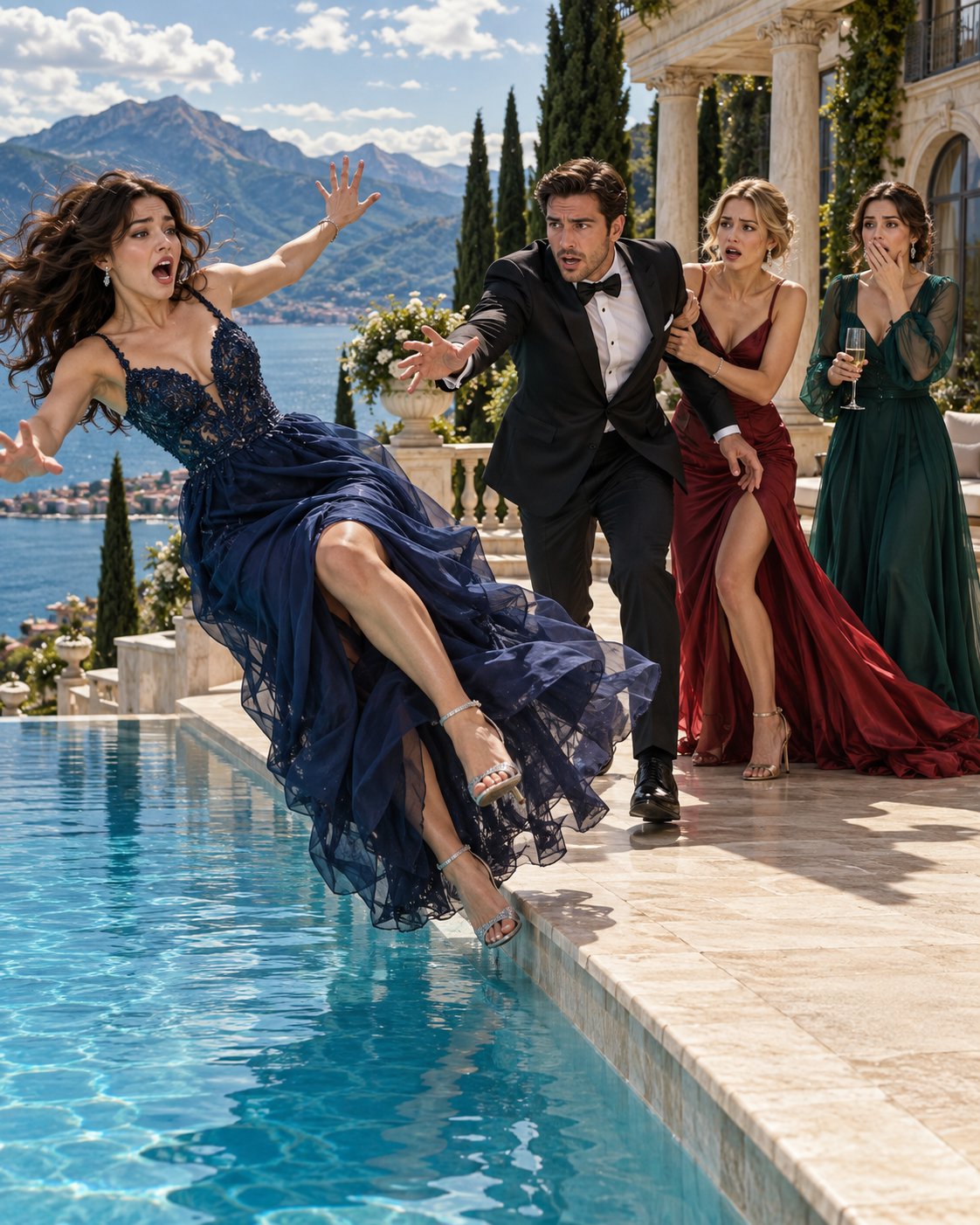
I was still dripping from the Thorne estate pool when Julian called me an EMBARRASSMENT in front of eight hundred guests
The rain kept tapping against the windows that night, soft and patient, while I sat at Gran Clara’s kitchen table with the little piece of paper between my fingers.
I had read the sentence so many times that the ink seemed to move.
“Never trust the first story you’re told.”
For eleven years, I had believed my grandmother’s greatest lesson was about building something no one could steal.
Now I wondered whether that had only been the part she wanted me to understand first.
I turned the copper cup upside down.
Nothing.
I ran my fingers along the dented rim, remembering how Gran Clara used to tap it against the wooden table whenever she wanted my attention.
Then I noticed a tiny seam beneath the blackened metal.
My heart began to pound.
I fetched a butter knife and carefully worked the edge loose.
A thin compartment opened.
Inside was a small brass key.
There was also another note.
This one had only an address.
It was the address of our first warehouse.
I almost laughed.
The place had been empty for years.
Julian had sold it after the company moved into its glass headquarters, claiming the old building was “sentimental clutter.”
Apparently, he had been wrong.
I called Arthur the next morning.
He listened without interrupting.
When I finished, he was silent for several seconds.
“Don’t go there alone,” he said.
“Why?”
“Because your grandmother wasn’t careless.”
Those words followed me all the way to the warehouse.
The building looked smaller than I remembered, its brick walls dark beneath the rain and weeds climbing around the loading dock.
Arthur arrived ten minutes after me.
Together, we unlocked the side door.
The smell hit me first.
Old oak.
Dust.
Whiskey.
Memory.
I remembered standing there at twenty-eight years old, stirring our first successful batch while Julian danced around the room, laughing because we had finally made something people wanted.
I had thought that was the beginning.
But behind a loose wooden panel near the original storage room, we found a steel box.
The brass key fit.
Inside were contracts, handwritten ledgers, bank statements, and photographs.
My name appeared everywhere.
So did Gran Clara’s.
And then I found something that made my stomach drop.
There was an agreement dated eight months before I had ever met Julian.
Arthur picked it up carefully.
“This is impossible.”
“What?”
He stared at the signature.
“Silas Thorne.”
I read the document twice.
Silas had approached Gran Clara years before Julian and I met.
He wanted to buy the recipe.
She refused.
Then he offered a partnership.
She refused that too.
Finally, according to the letter attached to the contract, he threatened to take the family recipe through litigation, claiming the formula had originated from an old distillery his ancestors once operated.
Gran Clara had fought him.
And she won.
But the documents revealed something else.
Silas had not stopped.
He had spent years trying to locate another heir who could be pressured into selling.
That heir was me.
I sat down on an overturned barrel.
“So Julian knew?”
Arthur shook his head.
“Not necessarily.”
That distinction mattered.
I had spent years believing Julian had deliberately targeted me.
But the evidence suggested something more complicated.
He might have been raised inside a family machine that had been turning long before he understood what it was designed to do.
I found another envelope.
My name was written across it in Gran Clara’s handwriting.
I opened it with trembling fingers.
“My darling girl,” it began.
“If you’re reading this, then the Thorne family has finally reached the part of your life I hoped you would never have to face.”
I stopped breathing.
Gran Clara had known.
She had known the Thorne name would eventually return.
She had known Silas would want the recipe.
And she had known Julian might become the bridge.
But then came the sentence that changed everything.
“I did not warn you because I wanted you to choose freely.”
I closed my eyes.
For years, I had wondered why she had never told me about the Thornes.
Now I understood.
She had not wanted fear to choose my husband for me.
She had wanted me to see him without the shadow of his family’s history.
The letter continued.
“Julian may not be his father.”
I read that sentence three times.
Arthur looked at me.
“What does that mean?”
“I don’t know.”
There was one final page.
It contained the name of a woman I had never heard before.
Eleanor Reed.
Underneath it was a date.
And beneath the date were five words.
“Ask her about Julian’s birth.”
The room seemed to tilt.
For years, Julian had been the golden son of the Thorne dynasty.
But Gran Clara had left me a trail suggesting his identity itself might be part of a secret.
Arthur wanted me to stop.
I couldn’t.
We spent the next three days searching public records and old newspapers.
Eleanor Reed had worked at a hospital in Charleston more than thirty years earlier.
She had disappeared from public life shortly afterward.
Eventually, Arthur found an address in Georgia.
I drove there alone.
An elderly woman answered the door.
The moment she saw the copper cup hanging around my neck, her face changed.
“You have Clara’s cup.”
I felt the blood leave my face.
“You knew my grandmother?”
Eleanor looked past me toward the road.
“She told me you might come one day.”
Inside her small house, every wall was covered with photographs.
None were of Julian.
They were of a young woman with dark hair.
Eleanor.
And beside her was Silas Thorne.
My voice barely worked.
“Who was she?”
Eleanor touched one photograph.
“My sister.”
Then she looked directly at me.
“And she was Julian’s mother.”
I stared at her.
“Cynthia isn’t his mother?”
“No.”
The word landed like a stone.
Eleanor told me the story slowly.
Her sister had fallen in love with Silas when they were young.
She became pregnant.
Silas’s family rejected her.
When the baby was born, the Thornes took him.
They told Eleanor the child would have a better life with them.
Then they erased her.
Cynthia married Silas years later and raised Julian as her own.
I could barely hear anything after that.
The cruelest woman at the mansion had spent decades treating Julian like a possession because she believed his existence was part of the bargain she had made with Silas.
But why had Gran Clara been involved?
Eleanor answered that too.
“Your grandmother knew my sister.”
She reached into a drawer and pulled out another envelope.
“She helped us once.”
Inside was a photograph of Gran Clara holding a newborn baby.
The baby was Julian.
On the back, Gran Clara had written a date.
The same date Eleanor had given birth.
I stared at the picture until tears blurred it.
For the first time, I understood why Gran Clara had written, “Julian may not be his father.”
She had meant something else.
He might not be his father’s son in the way the world believed.
But the secret was even deeper.
Eleanor handed me a second photograph.
It showed Silas holding the infant.
On the back were six words.
“Silas promised Clara he would protect him.”
My stomach tightened.
“Protect him from what?”
Eleanor’s eyes filled with sadness.
“From the family.”
I returned home carrying copies of every document.
Julian was no longer simply the man who had betrayed me.
He was a man who had been raised inside a lie.
That did not excuse what he had done.
But it changed the shape of my anger.
I called him.
He answered on the fourth ring.
“Why are you calling me?”
“I need to ask you something.”
“After everything?”
“Yes.”
He was silent.
Then he said, “Come to the old warehouse.”
I froze.
“The first one?”
“Yes.”
I arrived before sunset.
Julian was standing beneath the rusted sign, hands in his coat pockets.
He looked older than I remembered.
Not physically.
Somehow, spiritually.
I handed him the photograph.
He stared at it.
His face collapsed.
“Where did you get this?”
“Gran Clara.”
He sat on the loading dock.
For several minutes, he said nothing.
Then he whispered, “I knew.”
My heart stopped.
“You knew?”
“Not everything.”
He looked at me.
“I found a letter when I was seventeen.”
“What did it say?”
“That Cynthia wasn’t my biological mother.”
I waited.
“I asked Silas about it.”
“What did he tell you?”
“That blood didn’t matter.”
Julian laughed bitterly.
“He told me the only reason I had a life was because he gave me his name.”
I realized then that Julian had spent his entire life trying to earn something he had never truly possessed.
Approval.
Belonging.
Power.
Maybe that was why my success had frightened him.
If I could build something without a famous name, then his name stopped being proof of his worth.
But understanding someone does not erase the damage they caused.
“You still pushed me into that pool,” I said.
His eyes dropped.
“I know.”
“You humiliated me.”
“I know.”
“You tried to take the company I built.”
“I know.”
“Why?”
His voice broke.
“Because I thought if I lost the company, I would disappear.”
I looked at the man sitting across from me.
For years, I had wanted him to suffer.
Now I simply wanted him to understand.
“You were never the company, Julian.”
He looked up.
“You were supposed to be the person inside it.”
Neither of us spoke for a long time.
Then he asked, “Do you hate me?”
I thought about the mansion.
The pool.
The laughter.
The white jacket.
The way my body had hit the water.
I thought about the nights I had worked until dawn.
I thought about Gran Clara.
“No.”
His eyes filled.
“I don’t hate you.”
I stood.
“But I will never belong to you again.”
That was the moment something finally ended.
Not our marriage.
That had ended months before.
It was the version of me that believed forgiveness required returning to the person who hurt you.
I walked away.
Behind me, Julian remained sitting beneath the old warehouse sign.
I never saw him there again.
Years passed.
Clara Oak grew, but I refused to turn it into another empire built around one person.
The vocational school became my favorite part of the business.
We taught distilling, agriculture, accounting, contract law, marketing, and the simple discipline of keeping promises.
Some students came from families who had lost everything.
Others came from neighborhoods where nobody expected them to own anything.
I gave them the lesson Gran Clara had given me.
“Build something real.”
One afternoon, a nineteen-year-old student named Marcus stayed behind after class.
He was holding the same dented copper cup I had once carried as a child.
“Ms. Clara,” he said, “why did you name everything after your grandmother?”
I smiled.
“Because she taught me that a legacy isn’t what you inherit.”
I looked around the distillery.
“It’s what you leave stronger than you found it.”
That night, after everyone left, I walked into the aging office behind the school.
On my desk sat an envelope.
There was no stamp.
No return address.
Only my name.
I opened it.
Inside was a single photograph.
It showed Gran Clara standing beside Silas Thorne thirty-five years earlier.
Between them was a young woman I recognized immediately.
Eleanor.
But there was someone else in the photograph.
A little girl stood beside Gran Clara.
A little girl who looked exactly like me.
I turned the photograph over.
On the back, written in Gran Clara’s unmistakable handwriting, were nine words.
“Now you are old enough to know who your mother was.”
I stopped breathing.
All my life, I had believed the story of my childhood was complete.
Gran Clara had raised me.
My parents had died when I was young.
That was all I had ever been told.
But beneath the photograph was one final sheet of paper.
There was an address.
And beside it, a name I had never heard before.
I sat alone in the dark while the distillery machinery hummed downstairs.
For the first time since I had escaped the Thorne mansion, I felt that familiar sensation return.
Not fear.
Not grief.
Something more dangerous.
The knowledge that the truth was still ahead of me.
I folded the letter carefully and placed it beside Gran Clara’s copper cup.
Outside, dawn was beginning to break over the fields.
I had spent years believing I had finally escaped the secrets that shaped my life.
Now I understood something Gran Clara had known all along.
Sometimes the hardest legacy to inherit isn’t money.
It is the truth.
And somewhere beyond those fields was a woman who might finally be able to tell me why my grandmother had spent her entire life protecting me from my own beginning.
I picked up the photograph.
Then I locked the door behind me and started the car.
This time, I wasn’t running from the past.
I was going to meet it.