I was standing beside my scarred A-10 on the Midwest flight line when Colonel Sterling publicly called me the “weather girl”
Part 2
The first thing the storm took from me was visibility.
The second was altitude.
The third was every illusion I had ever had about control.
The Warthog dropped nearly two thousand feet in seconds.
Rain hammered the canopy so hard it sounded like gravel.
Ice formed across the edges of the windshield.
The aircraft shook violently.
I could barely see the instruments through the spray.
Then Nathan came over the radio.
“Weather One, we’ve lost the second engine.”
My hands tightened around the controls.
“Cross, what’s your altitude?”
“Four thousand.”
The voice beside him crackled.
“Three thousand eight hundred.”
“Hydraulics?”
“Partial.”
“Fuel?”
A pause.
“Bad.”
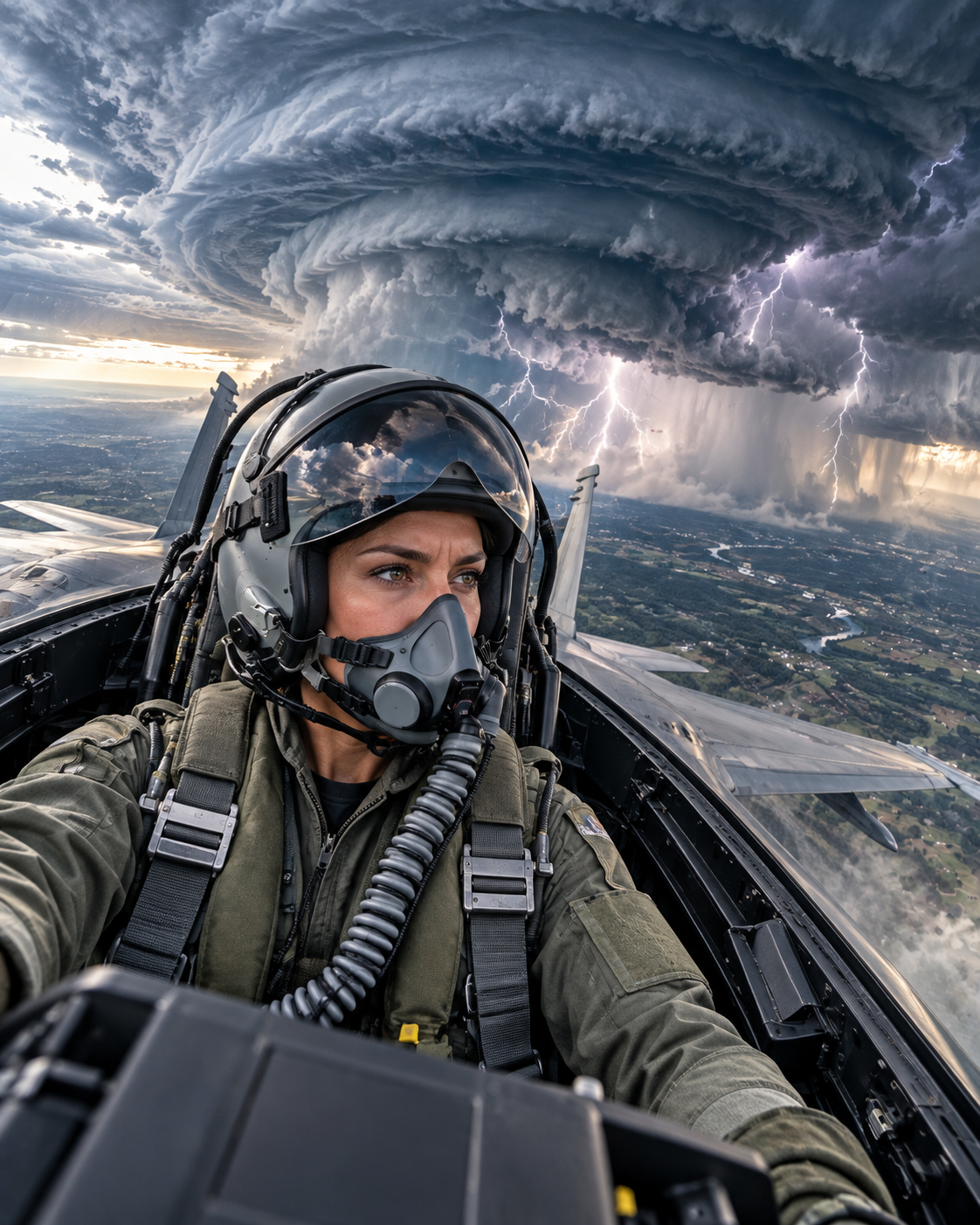
I looked at the storm structure.
The core was collapsing inward.
That meant the air around them was accelerating downward.
A microburst.
If I was right, the C-17 was about to be slammed toward the ground.
I transmitted.
“Nathan, stop trying to climb.”
“What?”
“Push the nose down.”
There was silence.
“Say again.”
“Push the nose down.”
“You want me to dive?”
“I want you to survive.”
“We’re already descending.”
“Then descend on purpose.”
I could hear the disbelief in his breathing.
The standard recovery procedure was obvious.
Pull up.
Fight the descent.
Try to regain altitude.
But the atmosphere was stronger than the aircraft.
The harder Nathan fought it, the more speed he would lose.
And the more speed he lost, the more violently the storm would own him.
I watched the vertical wind data.
The downdraft was increasing.
“Cross, listen to me.”
“I’m listening.”
“You cannot outclimb this air.”
A violent burst of static tore through the radio.
I shouted louder.
“Push the nose down.”
Nathan answered.
“Understood.”
The C-17 disappeared beneath the cloud deck.
I followed.
The ground appeared for half a second.
Kansas.
Flat.
Brown.
Terrifyingly close.
Then the cloud swallowed it again.
“Two thousand feet,” Nathan said.
I saw the transport through the storm.
Its silhouette appeared and vanished.
One engine was trailing smoke.
Ice covered the wings.
The aircraft was falling almost vertically.
I pushed the Warthog lower.
“Keep descending,” I told him.
“My God,” Julian whispered.
“Keep going.”
The C-17 dropped.
Three hundred feet.
Two hundred.
The ground rushed upward.
Then the microburst hit.
It was like an invisible hand had slammed both aircraft downward.
My stomach rose into my throat.
The Warthog dropped again.
The altimeter unwound so quickly it looked broken.
“Five hundred feet,” I shouted.
Nathan’s voice was strained.
“We’re at maximum descent.”
“Good.”
“Good?”
“Yes.”
I looked at the outflow boundary.
A narrow horizontal layer of violent wind was racing away from the storm.
If we could reach it, we could convert the downward energy into forward speed.
It was insane.
It was also our only chance.
“Cross, nose down another two degrees.”
Julian shouted something I could not hear.
Nathan answered calmly.
“Doing it.”
The C-17 dove.
So did I.
The earth expanded across my windshield.
For one terrifying moment, I believed I had sent forty-two people to their deaths.
Then the airspeed came alive.
The transport began accelerating.
The wings stopped shuddering.
The ice began peeling away.
“Now,” I said.
“Pull.”
Nathan pulled.
I pulled with him.
Both aircraft tore upward.
The C-17 missed the ground by hundreds of feet.
Not thousands.
Hundreds.
We punched through the bottom of the storm.
Sunlight exploded across the canopy.
I had forgotten what blue looked like.
For several seconds, nobody spoke.
Then Nathan said, “Weather One.”
I swallowed.
“Go ahead.”
“You just saved us.”
I looked at the damaged aircraft.
“No.”
I watched smoke stream behind it.
“We saved each other.”
Then the fuel warning appeared.
The celebration lasted less than ten seconds.
The C-17 was leaking fuel.
Its hydraulics were failing.
The damaged engine was barely producing power.
Base was too far away.
I checked the nearest usable runway.
There was an old Cold War strip about twenty miles west.
It had been abandoned years ago.
Cracked pavement.
Broken lighting.
No proper rescue crews.
No maintenance personnel.
But it was a runway.
“Cross, I have an alternate.”
“Is it good?”
“No.”
He laughed once.
It was the first normal sound I had heard all day.
“Then it’s probably perfect.”
I guided him toward the old strip.
The storm was still behind us.
The aircraft was getting heavier by the second.
Fuel was disappearing.
Hydraulic pressure was collapsing.
Nathan had forty-two lives behind him.
I had one battered A-10 beneath me.
Nobody spoke unnecessarily.
The runway appeared ahead.
At first, I thought I was looking at a shadow.
Then I realized it was a crater.
A massive depression had swallowed nearly the entire left lane.
The right side remained.
Barely.
“Cross, you see the runway?”
“Affirmative.”
“Left side is gone.”
“I see it.”
“You have forty feet of usable pavement on the right.”
Silence.
“That’s not a runway,” Julian said.
“No,” I answered.
“It’s a needle.”
The C-17 lined up.
I flew beside it.
The right landing gear looked unstable.
“Nathan,” I said, “keep the aircraft straight.”
“I’m trying.”
“No.”
I looked at the runway.
“You’re going to do more than try.”
The aircraft descended.
The wheels touched.
For one beautiful second, everything worked.
Then the right landing gear snapped.
The C-17 slammed sideways.
Sparks erupted beneath the wing.
Fire flashed along the pavement.
The aircraft skidded.
I shouted into the radio.
“Stay with it!”
Nathan fought the controls.
The transport spun slightly.
Then stopped.
Silence.
I circled overhead.
I saw the doors open.
One person emerged.
Then another.
Then dozens.
Forty-two people stumbled onto the cracked runway.
Alive.
Every single one.
I landed several minutes later.
When I shut down the Warthog, my hands were shaking so badly I could barely remove them from the controls.
Miller’s voice came through.
“You did it.”
I looked at the ice-pitted canopy.
“No.”
I stared at the people gathering around the damaged C-17.
“They did.”
But the story was not finished.
Because when I returned to base, I discovered that the storm had not been the only thing I had been fighting.
Part 3
The base was silent when I taxied in.
No jokes came over the radio.
No sarcastic comments.
No laughter.
Only the low rumble of engines and the distant sound of emergency vehicles.
I shut down the Warthog.
For a few seconds, I stayed inside.
My gloves were wet with sweat.
My flight suit was soaked.
My arms hurt from fighting the controls.
I looked at the cracked instruments.
The iron beast had taken ice, hail, wind, and punishment that should have grounded it permanently.
Then I opened the canopy.
Cold air rushed in.
I climbed down.
Nobody spoke.
Miller was the first person I saw.
He stood beside the aircraft, eyes red, helmet tucked beneath one arm.
He looked at the scars across the Warthog.
Then at me.
“She’s ugly now.”
I smiled weakly.
“She was ugly before.”
“No.”
He shook his head.
“Now she looks like she has a story.”
Behind him, people were gathering.
Pilots.
Mechanics.
Aircrew.
Security personnel.
Then Colonel Sterling stepped forward.
Major Vance stood beside him.
The same men who had laughed that morning.
Sterling stopped in front of me.
For the first time since I had known him, he looked uncertain.
“Captain,” he said.
I waited.
He looked toward the distant C-17.
“All forty-two are alive.”
“Yes, sir.”
His jaw tightened.
“You disobeyed a direct order.”
“Yes, sir.”
“You entered a severe weather cell.”
“Yes, sir.”
“You violated the exercise safety boundary.”
“Yes, sir.”
He stared at me.
“Would you do it again?”
I thought about the children in that alley years ago.
The backpacks.
The frightened faces.
The tiny hands gripping one another.
Then I thought about forty-two airmen climbing from a burning transport.
“Yes, sir.”
His expression changed.
Not anger.
Something quieter.
Something heavier.
He turned toward the assembled pilots.
“Attention.”
The entire flight line straightened.
Then Sterling saluted me.
For a moment, I could not move.
Major Vance raised his hand next.
Then the others.
One by one, every pilot who had laughed at the weather girl stood at attention.
And saluted.
I looked at Vance.
He held my eyes.
“I was wrong,” he said.
Those three words meant more than any medal could have.
I nodded.
Then Sterling handed me a folder.
I opened it.
The first page was an old incident report.
My old incident report.
The one from the mission years earlier.
Except this copy contained an attachment I had never seen.
A classified intelligence review.
The original target identification had been wrong.
The weapons depot had been empty.
The alley had contained a school evacuation center.
My refusal had prevented a mass casualty event.
The report had been buried.
I looked up.
“Why was this hidden?”
Sterling did not answer immediately.
Finally, he said, “Because admitting you were right would have meant admitting we were wrong.”
I closed the folder.
“That is not an answer.”
“No,” he said.
“It isn’t.”
For years, I had believed my career had been destroyed because I had made a mistake.
I had carried that shame into every cockpit.
Every briefing.
Every room where someone called me reckless.
But the truth was worse.
I had not been punished for being wrong.
I had been punished for being right when the wrong people needed me to be wrong.
I looked back at the Warthog.
Its armor was scarred.
Its canopy was white with dried ice.
Its nose was battered.
It looked exhausted.
So did I.
Nathan Cross arrived before sunset.
His flight suit was still stained with hydraulic fluid.
Julian was beside him.
Nathan walked toward me and stopped.
“I don’t know how to thank you.”
“You don’t have to.”
He shook his head.
“You don’t understand.”
He looked back at the C-17.
“There were forty-two people on that aircraft.”
“I know.”
“No.”
His voice cracked.
“You don’t.”
He swallowed.
“I had already started thinking about how to tell their families.”
I felt something inside me break open.
I remembered the children again.
That was why I had never regretted the first decision.
Not because I was fearless.
Because sometimes you see people who have no idea how close death is, and you realize you are the only person in the world who can move the line.
Nathan extended his hand.
I took it.
Then he pulled me into a brief embrace.
There were no cameras.
No medals.
No speeches.
Just two pilots standing beside damaged aircraft while the sun disappeared over the Midwest.
Later that night, I walked alone across the flight line.
The storm had moved east.
The sky was clear again.
Too clear.
I looked up at the stars and thought about how easily the world could fool us.
A blue sky could hide a catastrophe.
A decorated officer could hide a lie.
A disgraced pilot could hide the truth.
And sometimes the person everyone laughs at is the only person who has been paying attention.
I stopped beside the Warthog and placed my hand against its cold metal skin.
Miller appeared behind me.
“You staying?”
“For a while.”
He nodded.
“Good.”
I looked toward the horizon.
“Master Sergeant?”
“Yeah?”
“Why did you believe me?”
He was quiet for several seconds.
Then he said, “Because the first time everyone told you that you were wrong, people lived because you didn’t listen.”
I smiled.
He walked away.
I stayed beside the aircraft.
For years, they had called me the weather girl as if the name were an insult.
That night, I finally understood it differently.
Weather does not care about rank.
It does not care about medals.
It does not care who is sitting at the head of the briefing table.
It only asks whether you are paying attention.
And neither does truth.
Sometimes truth arrives as a warning nobody wants to hear.
Sometimes it sounds like an alarm everyone wants to silence.
Sometimes it looks like a battered old aircraft flying into a storm while everyone else runs from it.
I had spent years believing courage meant being willing to die.
I was wrong.
Courage was seeing forty-two lives falling through the darkness and deciding they were worth disobeying for.
It was seeing children in an alley and refusing to turn them into collateral damage.
It was standing alone while powerful people laughed.
And it was coming home afterward without needing them to call you a hero.
The next morning, the briefing room was different.
Nobody called me the weather girl.
Nobody laughed when I spoke.
They listened.
I placed a new atmospheric map on the screen.
The room became silent.
Then I said the words I had wanted to say for years.
“Trust the warning before you trust the person giving you permission to ignore it.”
Nobody moved.
Outside, sunlight touched the scarred wings of my iron beast.
For the first time, I did not feel like a disgraced pilot who had been given one last useless assignment.
I felt like exactly what I had always been.
A pilot.
A witness.
A warning.
And, when the sky turned black and forty-two people needed someone willing to fly into hell, I was exactly where I was supposed to be.