I was standing beneath the museum lights with a coat-check ticket in my hand when my stepmother laughed
Part 2
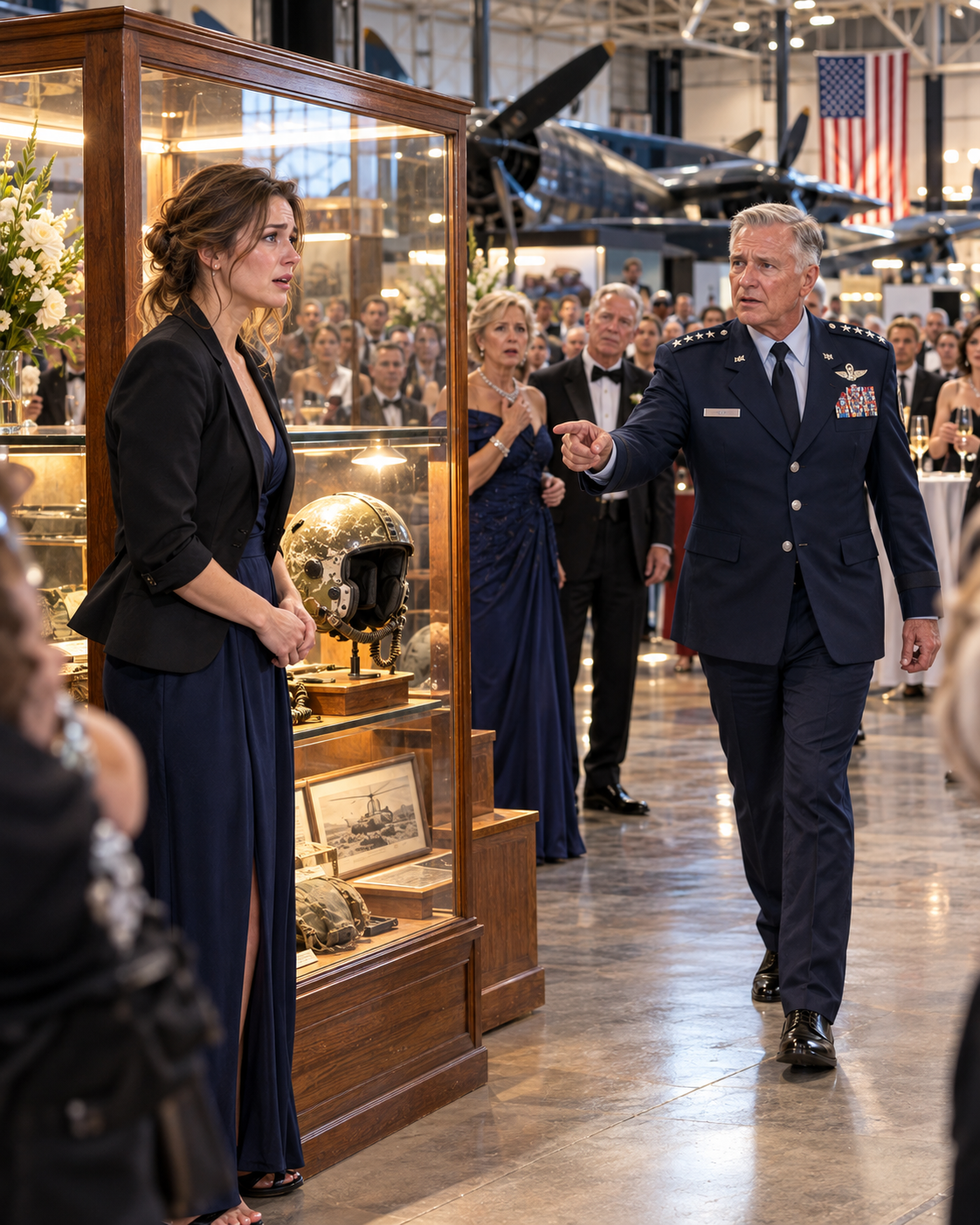
General Vance stood beneath the museum lights with one hand resting against the walnut case.
“That helmet belonged to the pilot who saved my life.”
Nobody moved.
The silence was so complete that I could hear the faint hum of the museum’s ventilation system.
Constance stared at him.
“I don’t understand.”
Vance didn’t look at her.
“In 2014, I was a fighter pilot in Helmand Province.”
He pointed toward the enormous photograph behind the stage.
“That image was taken during the worst five minutes of my military career.”
A murmur passed through the crowd.
Vance continued.
“My aircraft went down outside a village after taking enemy fire.”
He paused.
“I had two broken legs.”
Someone gasped.
“I couldn’t move.”
I remembered that day.
Not as a story.
As fragments.
Dust.
Heat.
Blood.
Radio static.
The smell of aviation fuel.
A voice screaming coordinates.
My flight engineer, Marcus Cole, shouting over the intercom.
And the terrible knowledge that the people on the ground had found us.
Vance pointed at the photograph.
“Pedro 66 came in when nobody else could.”
His eyes finally met mine.
“Enemy fire was coming from three directions.”
I felt the old pressure return to my chest.
“I told them to abort.”
Vance gave a bitter smile.
“They refused.”
The crowd slowly turned toward me.
Constance looked as though someone had slapped her.
Vance continued.
“Daniel Mercer was the aircraft commander.”
Nobody spoke.
“He brought that helicopter into a kill zone to pick me up.”
The room became smaller.
The lights seemed brighter.
I could barely hear anything except my own heartbeat.
Vance looked at the helmet.
“One round went straight through the side of his helmet.”
A woman near the front covered her mouth.
“Another struck the aircraft.”
Vance shook his head.
“I remember Daniel leaning toward me and saying, ‘Sir, you’re going home.'”
I had forgotten saying those words.
Or maybe I had buried them.
Vance’s voice cracked slightly.
“His crew pulled me into that helicopter while rounds were still hitting the fuselage.”
He looked around the room.
“That dust cloud in the photograph is the moment Pedro 66 lifted off with me alive.”
Nobody applauded.
Nobody knew how.
The photograph suddenly looked different.
What had seemed like a dramatic aviation image was now a frozen second of terror.
A second where four people had decided that another man’s life mattered more than their own.
Vance stepped away from the case.
“The photograph was never supposed to be used as a decorative backdrop.”
He turned toward Constance.
“And certainly not without knowing what it represented.”
Constance’s lips parted.
“I found it online.”
Vance’s expression hardened.
“You found a rescue.”
Teresa Gaines stepped forward.
“Actually, General, that’s only the beginning.”
She held a folder against her chest.
I looked at Walter.
He wouldn’t meet my eyes.
Teresa opened the folder.
“Two years ago, Mr. Mercer contacted the museum.”
My father’s shoulders tightened.
“He asked whether we could restore a particular display case.”
I stared at Walter.
“You told me you were fixing furniture.”
He finally looked at me.
“I was.”
Teresa smiled sadly.
“He brought us the case himself.”
She pointed to the walnut wood.
“That case is from 1946.”
I looked closer.
I could see the subtle marks beneath the polish.
“Your father spent fourteen months restoring it.”
I shook my head.
“Fourteen months?”
“Every weekend,” Teresa said.
“He did most of the sanding himself.”
I looked at Walter again.
He had never mentioned any of this.
Teresa opened another document.
“He also asked us to preserve the entire Pedro 66 crew collection.”
My throat tightened.
“What collection?”
Teresa looked at Walter.
Then she looked at me.
“Your collection.”
The room seemed to tilt.
She explained that Walter had retrieved my discarded flight gear from the trash two years earlier.
My helmet.
My flight box.
Old patches.
A flight log.
Photographs.
A pair of gloves.
Even the broken headset I had carried through several deployments.
He had taken them home quietly.
He had cleaned them.
Catalogued them.
Preserved them.
And when the museum board began discussing naming the new gallery after Constance’s late family in exchange for a large donation, Walter had stopped them.
Constance turned toward him.
“You promised me that gallery.”
Walter’s voice was barely audible.
“I promised you nothing.”
Her face reddened.
“You said the board would approve it.”
“I said they would consider it.”
“You knew what I wanted.”
Walter finally looked at her.
“I knew what you wanted.”
Teresa raised another document.
“There is also a legal designation attached to the exhibit.”
Constance froze.
“The gallery is legally dedicated to the Pedro 66 crew.”
The room erupted into whispers.
“That means the name cannot be changed without the consent of the surviving crew members and the museum’s historical trust.”
Constance stared at Walter as though she had never seen him before.
“You did this behind my back.”
Walter’s voice remained calm.
“I did it because it was right.”
She laughed once, but there was no humor in it.
“After everything I built for you?”
Walter looked toward the display case.
“No.”
Then he looked at me.
“After everything I failed to build for him.”
I couldn’t speak.
That sentence hurt more than anything else that night.
Because it was the first time my father had ever admitted there had been something missing.
Not in the museum.
Between us.
Before anyone could say more, the hangar doors opened.
A man in a dark suit entered with a cane.
I recognized him immediately.
“Marcus?”
Retired Master Sergeant Marcus Cole looked older, heavier, slower.
But his eyes were exactly the same.
He saw me.
I saw him.
Neither of us moved for several seconds.
Then he smiled.
“Hey, Wren.”
I laughed through tears.
“Hey, Marcus.”
He crossed the room as quickly as his leg allowed.
We embraced.
Hard.
The kind of embrace that carries years inside it.
When Marcus pulled away, he looked at the case.
Then at the photograph.
Then at Vance.
“You finally told them?”
Vance nodded.
Marcus sighed.
“About time.”
Someone in the crowd began clapping.
Then another person joined.
Then another.
Within seconds, three hundred people were standing.
The applause hit me like a physical force.
I had spent years believing my father was ashamed of me.
Now I was standing in a hangar full of strangers who knew exactly what I had done.
I didn’t know where to look.
Marcus put a hand on my shoulder.
“Don’t hide now, Wren.”
I looked at my father.
Walter was crying.
Quietly.
Without trying to hide it.
Constance stood beside the stage, completely alone.
The photographs she had forbidden me from appearing in were now being taken everywhere.
But this time, nobody was asking her to pose.
The board members were speaking in hushed voices.
Teresa was answering questions.
Vance was telling stories.
Marcus was laughing about how badly I used to sing during long missions.
And for the first time in years, I wasn’t trying to make myself smaller.
I was simply standing there.
After the gala ended, Walter found me outside near the loading dock.
The Oklahoma night was cold.
The museum lights spilled across the pavement.
He stood beside me for nearly a minute without speaking.
Finally, he said, “I didn’t know how to tell you.”
I stared at him.
“Tell me what?”
“That I was proud of you.”
My jaw tightened.
“You could have just said it.”
“I know.”
“You could have come to the ceremonies.”
“I know.”
“You could have answered my calls.”
“I know.”
His voice broke.
“I know, Daniel.”
I looked away.
He swallowed hard.
“I thought if I built something worthy of you, maybe someday you’d understand what I couldn’t say.”
I closed my eyes.
“That’s not how sons work, Dad.”
“I know.”
He took a breath.
“I know that now.”
For a moment, neither of us spoke.
Then he reached into his coat and handed me an old brass key.
“What is this?”
“The workshop.”
I looked at him.
“Tomorrow.”
He nodded.
“I want to show you something.”
Part 3
The next evening, I followed Walter into the workshop behind his house.
It smelled like sawdust, cedar oil, and old metal.
For the first time in years, I noticed how much of him was in that room.
Tools hung in perfect rows.
Half-finished furniture sat beneath canvas covers.
On one wall were sketches of aircraft.
Not modern aircraft.
Old rescue helicopters.
Search-and-rescue planes.
Machines built to bring people home.
Walter walked to a workbench and lifted a wooden box.
My flight box.
I recognized every scratch.
He set it in front of me.
“I kept this hidden.”
I opened it.
Inside were the things I thought had disappeared forever.
My flight log.
My old patches.
A photograph of my crew.
My gloves.
A folded letter I had written home but never sent.
And beneath everything was the headset from Pedro 66.
I touched it with two fingers.
“You saved all this.”
Walter nodded.
“I couldn’t save the years I missed.”
His eyes filled again.
“So I saved what I could.”
I sat down.
For years, I had imagined my father’s silence as indifference.
Now I understood that silence could also be cowardice.
Fear.
Regret.
Love expressed badly.
None of that erased the hurt.
But for the first time, I could see the man beneath it.
“I needed you,” I said.
“I know.”
“I needed my dad.”
“I know.”
He sat across from me.
“I was afraid every time you deployed.”
I looked up.
“You never said that.”
“I couldn’t.”
“Why?”
He stared at the flight box.
“Because if I admitted how scared I was, I’d have to admit how much I loved you.”
I laughed softly, though tears were running down my face.
“That’s a terrible excuse.”
“It is.”
We sat there until the room grew dark.
Then Walter said something I had wanted to hear since I was twelve.
“I am proud of you, Daniel.”
No speech.
No audience.
No microphone.
Just the words.
Simple.
Late.
Real.
I nodded.
“Thank you.”
The next morning, I went upstairs.
I opened the door to my old bedroom.
The gift-wrapping shelves were still there.
The ribbons were still arranged by color.
The expensive paper was still stacked against the wall.
For a moment, I stood in the doorway and felt twelve years old again.
Then I started removing everything.
Not angrily.
Not dramatically.
Just steadily.
One shelf at a time.
A few hours later, the room looked almost empty.
Walter stood in the doorway.
“You want help?”
I smiled.
“Yeah.”
He picked up a box.
“What goes in here?”
“My mother’s things.”
He nodded.
“Then we’ll start there.”
We spent the afternoon bringing back the things Constance had erased.
My mother’s chair.
Her porcelain birds.
Old photographs.
My model airplanes.
A framed picture of me in my first uniform.
And on the desk, I placed a photograph of Pedro 66.
Not because I wanted the room to become a shrine.
But because I no longer wanted any part of my life hidden.
Constance left the museum board soon after the gala.
Her influence disappeared almost overnight.
The gallery opened six weeks later.
The sign above the entrance read simply:
PEDRO 66 RESCUE CREW MEMORIAL.
There was no family name.
No donor’s name.
No political dedication.
Just the names of the people who flew into the dust.
Marcus attended the opening.
General Vance stood beside him.
Teresa spoke first.
Then Walter.
He didn’t give a long speech.
He simply looked at me and said, “Some heroes spend their lives running toward danger.”
He paused.
“Some spend their lives trying to learn how to say thank you.”
The room became silent.
I looked down because I couldn’t trust my face.
Afterward, Vance handed me a small photograph.
It was the original image from Helmand.
The helicopter was almost invisible inside the dust cloud.
But now I could see what I had never noticed before.
A tiny figure beneath the aircraft.
A man being carried toward the helicopter.
A crew refusing to leave him behind.
I realized something then.
For years, I had thought the story of my life was about being abandoned.
It wasn’t.
It was about surviving what I thought abandonment meant.
My father had failed me.
That was true.
His silence had cost us years we could never recover.
But love had been there too, buried beneath sawdust, walnut shavings, old photographs, and fourteen months of patient work.
He hadn’t known how to speak it.
So he built it.
He sanded it.
He polished it.
He protected it from being thrown away.
And when the time finally came, he placed it beneath a lamp where nobody could ignore it.
Months later, I visited the museum alone.
The hangar was quiet.
Sunlight fell through the high windows.
I stood before the walnut case and looked at my helmet.
The bullet hole was still there.
So was the scar.
So was everything I had survived.
But the case no longer felt like a monument to the worst day of my life.
It felt like proof that something broken could be preserved without pretending it had never been broken.
I touched the glass.
Then I heard footsteps behind me.
Walter stood there.
He didn’t say anything.
Neither did I.
He simply put his hand on my shoulder.
This time, I didn’t pull away.
We stood together beneath the photograph of Pedro 66, two men finally facing the years between them.
And I understood something I wish I had learned much earlier.
Real devotion doesn’t always roar.
Sometimes it works quietly in the dark.
Sometimes it looks like a father sanding an old piece of walnut wood for fourteen months because he cannot find the courage to say, “I’m proud of you.”
Sometimes love is not the loudest person in the room.
Sometimes it is the thing someone secretly saves after everyone else has decided it is worthless.
And sometimes, after years of believing you were forgotten, you discover that someone was preserving your honor all along, waiting for the day the whole room would finally be forced to see you.