I was standing beneath the chandeliers of a military ballroom in Raleigh when my husband laughed at my uniform
Part 2
The next morning, Christopher made coffee for both of us.
He didn’t apologize.
He simply placed my cup on the counter and said, “I didn’t know.”
I looked at him.
“I know.”
He sat down.
“I thought I knew you.”
I took a sip of coffee.
“You knew the parts of me I could safely give you.”
He stared at his hands.
“Why didn’t you ever tell me about Phantom?”
“Because I wasn’t allowed to.”
“And because of the people who died?”
“Because of them too.”
He nodded slowly.
For the first time, he didn’t demand details.
He didn’t ask for names, locations, dates, or missions.
He just sat there.
That mattered more than he realized.
But healing did not begin that morning.
It began weeks later, when Christopher made his first mistake.
His sister, Melissa, came over for dinner.
At some point, she laughed and said, “Chris told me you’re basically retired military now.”
Christopher glanced at me.
He expected me to laugh.
I didn’t.
Melissa looked between us.
“What?”
I said, “He also used to tell people I was an office soldier who had never seen combat.”
Christopher closed his eyes.
“Emily…”
“No.”
My voice remained calm.
“I’m not doing that anymore.”
Melissa looked at her brother.
“Is that true?”
Christopher didn’t answer.
His silence answered for him.
That night, I stopped protecting him from the consequences of his own words.
I didn’t expose him.
I didn’t insult him.
I simply stopped cleaning up the messes he made.
His parents heard the truth too.
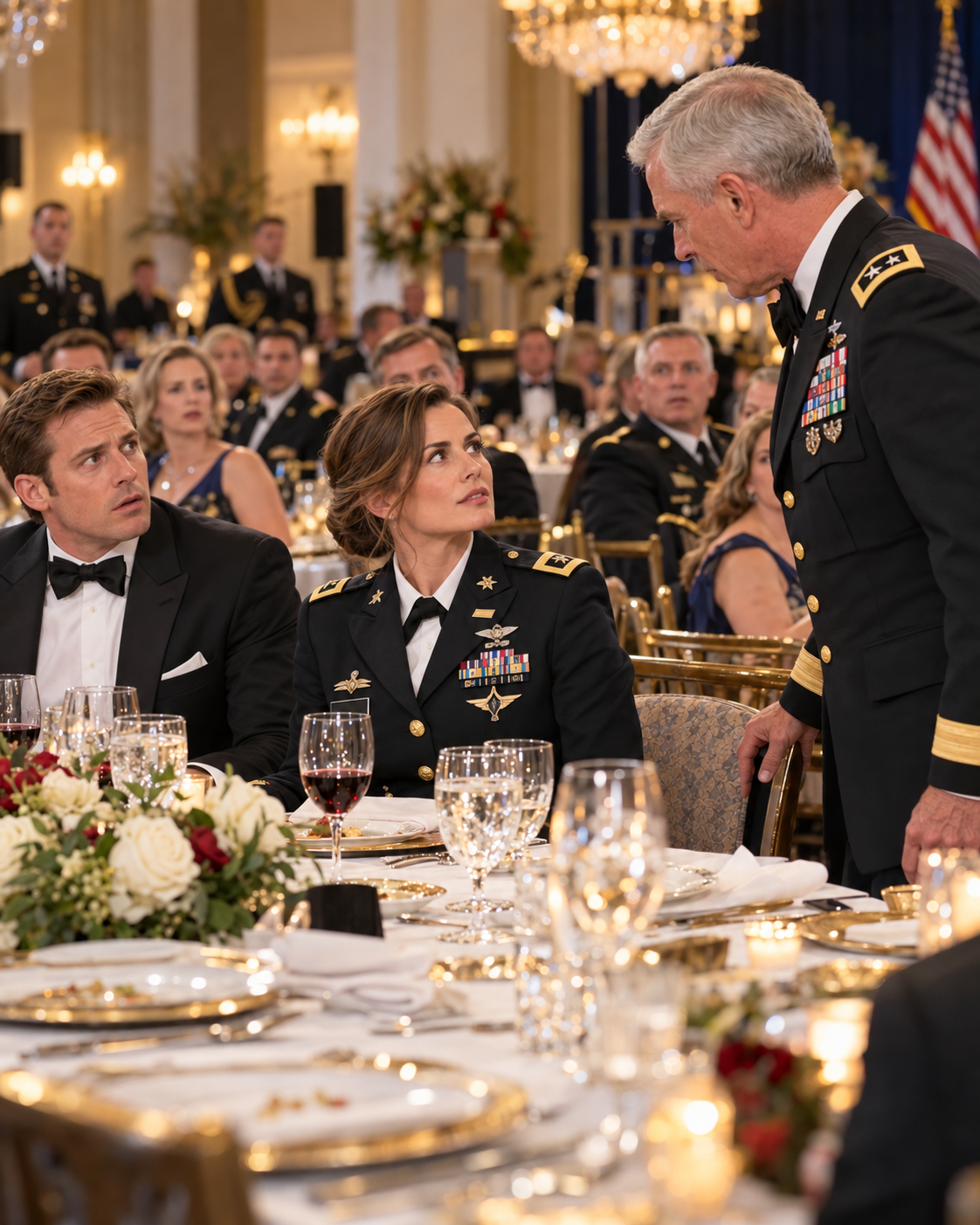
And when his father asked why Christopher had behaved that way, Christopher finally said what I had known for years.
“I was jealous.”
Nobody spoke.
He continued.
“I thought she was becoming someone I could never measure up to.”
His mother frowned.
“So you made fun of her?”
Christopher nodded.
“I thought if I made it sound small, I wouldn’t feel so small.”
I heard those words later.
Christopher told me himself.
He looked ashamed.
“I hated that people respected you for things I couldn’t even understand.”
I sat across from him.
“Do you know what I hated?”
He looked up.
“Coming home from the hardest days of my life and feeling like I had to make them smaller so you wouldn’t feel threatened.”
His eyes filled with tears.
“I know.”
“No.”
I shook my head.
“You know now.”
That distinction mattered.
The following months were quiet.
There were no grand speeches.
No dramatic promises.
Christopher simply changed his behavior one decision at a time.
He stopped calling my service “your little Army thing.”
He stopped making jokes about my medals.
When someone asked about my career, he didn’t answer for me.
When I said I couldn’t discuss something, he accepted it.
Sometimes he still looked frustrated.
But he learned that frustration was not permission to cross a boundary.
Then came the ceremony.
The Army had arranged a formal recognition event for several veterans and service families.
The same general from the dinner was there.
Christopher almost didn’t attend.
I told him he didn’t have to.
He looked at me and said, “I want to.”
During the ceremony, the general spoke about courage.
But he didn’t spend most of his speech talking about combat.
He talked about the people who carried the invisible weight afterward.
The spouses who waited.
The children who learned not to ask why.
The families who celebrated birthdays while someone was thousands of miles away.
Then he called my name.
I walked onto the stage.
The applause rose around me.
I heard Christopher clapping.
When I turned, I saw something different in his face.
There was no jealousy.
No embarrassment.
No need to compete.
Just pride.
The general pinned a small recognition onto my uniform.
Then he leaned toward the microphone.
“Some of the strongest soldiers I’ve ever known never wanted anyone to know what they did.”
He looked toward me.
“They simply did what had to be done.”
I felt my throat tighten.
For years, I had believed strength meant carrying everything alone.
That day, I understood something else.
Strength also meant allowing yourself to be seen without surrendering the parts of yourself that were not yours to reveal.
After the ceremony, Christopher waited for me outside.
He didn’t touch me immediately.
He simply said, “I’m proud of you.”
I smiled.
“Thank you.”
Then he added, “And I’m sorry.”
I looked at him.
He didn’t try to make the apology beautiful.
He didn’t explain it away.
He just let it stand.
That was the first time I believed him.
A few months later, another piece of the past surfaced.
Christopher had been dealing with an old business issue involving a contractor his company had used years earlier.
There had been questions about safety violations, fraudulent documentation, and potential federal consequences.
He had always assumed the matter had disappeared because the contractor had been investigated before the situation reached his company.
One evening, he found an old correspondence in a box of business records.
My name wasn’t on it.
It couldn’t be.
But there was a reference to an operational review that had redirected investigators toward the contractor instead of Christopher’s company.
Christopher brought the document to me.
“What is this?”
I read it.
My stomach tightened.
I remembered the case.
Years earlier, during my operational work, our team had uncovered information connected to a contractor operating in an area where American personnel were at risk.
The investigation had expanded.
Records had been cross-checked.
A chain of responsibility had been traced.
Christopher’s company had unknowingly been sitting much closer to the danger than he ever realized.
The investigation had ultimately cleared them.
I had never told him.
Not because I wanted credit.
Because I wasn’t permitted to.
He stared at me.
“You knew?”
“I knew enough.”
“You protected my company?”
I shook my head.
“I did my job.”
His eyes became wet.
“Even after everything I said about you?”
I looked at him.
“Your mistakes didn’t change my responsibility.”
He sat down slowly.
For several minutes, neither of us spoke.
Then he whispered, “You were protecting me while I was making you feel ashamed of what you did.”
I didn’t answer.
There was nothing left to say.
He covered his face with both hands.
“I don’t deserve you.”
I walked over and sat beside him.
“That isn’t the point.”
He looked at me.
“The point is whether you’re willing to become someone who does.”
He nodded.
And that became the work.
Not becoming perfect.
Becoming honest.
Part 3
Our marriage didn’t transform overnight.
There were still arguments.
There were still days when old habits returned.
Sometimes Christopher would hear praise directed at me and become quiet.
Sometimes I would catch myself preparing to defend my career before he had even said anything.
Healing had taught us that wounds could survive long after apologies.
So we learned patience.
He learned to ask instead of assume.
I learned that I didn’t have to soften every truth to make someone comfortable.
We learned how to sit in silence without turning it into punishment.
And slowly, the competition disappeared.
Christopher started asking about my work again.
Not for secrets.
Not for stories he could repeat.
Just because he wanted to understand the woman he had married.
I told him what I could.
He listened to what I couldn’t.
One evening, years after that dinner, we were sitting on our porch.
My old uniform was hanging inside the house.
The ribbons were still carefully arranged.
The Phantom insignia remained where it had always been.
Christopher looked through the window at it.
“I used to think those medals were the reason people respected you.”
I smiled.
“They aren’t.”
“What is?”
I thought about it.
“The things nobody sees.”
He nodded.
“The nights you didn’t talk about.”
“The people you remember.”
“The things you carried home.”
I looked at him.
“And the people who helped you carry them.”
He reached for my hand.
“I wish I’d understood that sooner.”
“So do I.”
He smiled sadly.
“But I’m glad I understand it now.”
I squeezed his hand.
There are stories from my service that I will never tell Christopher.
There are names I will never say aloud.
There are places I will never describe.
Not because I don’t trust him.
Because some promises are larger than marriage.
Some memories belong partly to the people who never came home.
And some silence is not secrecy.
It is respect.
Christopher finally understood that.
He also learned something else.
My strength had never been an insult to his.
My accomplishments had never taken anything away from him.
My uniform had never been a challenge.
He had simply mistaken my light for a judgment on his own darkness.
That was his battle to fight.
Not mine.
Years after that dinner, we attended another military ceremony together.
This time, Christopher stood beside me without shrinking.
When the general saw us, he smiled.
He shook Christopher’s hand.
Then he looked at me and gave me that same precise salute.
Christopher watched.
And when I returned it, he stood a little taller.
Not because he wanted to be like me.
Because he had finally stopped needing to be.
On the drive home, he reached across the console and took my hand.
“I know I can’t understand everything you’ve lived through.”
I looked at him.
“You don’t have to.”
“I just want to be someone who never makes you feel like you have to hide it.”
I smiled.
“That’s enough.”
The road stretched ahead beneath the headlights.
For a long time, neither of us spoke.
I thought about the ballroom.
The laughter.
The general standing at attention.
The photograph in the drawer.
The two empty spaces where two people should have been.
And I realized something I had never understood when I was younger.
Revenge would have been easy.
Humiliation would have been easy.
I could have destroyed Christopher that night with the truth.
Instead, I let the truth stand on its own.
And it changed him.
Not because I forced him to kneel.
Because I finally stopped kneeling for him.
That was the quiet victory.
I didn’t become louder.
I didn’t become crueler.
I simply became unwilling to make myself smaller.
Christopher eventually learned that loving someone strong does not mean standing in their shadow.
It means standing beside them without needing their light to dim.
And sometimes, the most powerful thing a person can do after being underestimated is not to prove everyone wrong.
It is to keep standing exactly where they are.
Tall.
Quiet.
Unashamed.
Some people will never know what you survived.
Some will never understand what you sacrificed.
And some may spend years trying to make your strength look ordinary because your greatness makes them uncomfortable.
Let them.
You do not need to explain every scar to deserve respect.
You do not need to reveal every battle to prove that you fought.
And you do not need to become smaller so someone else can feel tall.
Real strength does not scream for recognition.
It does not beg to be believed.
It simply stands there, steady and silent, until the people who love you finally learn how to see you.
And sometimes, the most beautiful ending is not being finally admired by everyone.
It is looking beside you and realizing that the person who once tried to diminish your light has finally learned to stand in it without fear.