I was standing beneath a banner celebrating Vance Manufacturing when Claire Vance shoved a glossy anniversary brochure against my grease-stained shirt and said
That night, I drove the restored roadster home instead of leaving it at the company lot, and for the first time, it felt like I was taking something back.
Maya was waiting on the porch with sawdust still clinging to the sleeves of her sweatshirt.
She looked at the car, then at me.
“Why is the Vance car here?”
“Because tonight, it’s ours.”
She frowned.
“You mean yours.”
I shut off the engine and sat there for a moment, listening to the ticking metal.
“You’re right,” I said. “It’s mine. And tomorrow, they’re going to hear the difference between something you give and something someone takes.”
She studied my face.
“Are you in trouble?”
“Maybe.”
“Are we broke?”
I laughed despite myself.
“No.”
“Then what are you worried about?”
I looked at the little wooden racer tucked under her arm.
“Losing the right to tell our own story.”
She didn’t answer.
She just climbed into the passenger seat.
At six the next morning, I found an email from Claire waiting on my phone.
I read it twice.
“Don’t bring the car to the factory yet. I need twenty minutes before the ceremony.”
Beneath that was a second message.
“I found something else.”
I stared at those four words until Maya came into the kitchen.
“Bad something?”
“I don’t know yet.”
She put toast on a plate.
“Then don’t decide what it means before you find out.”
I looked at her.
She shrugged.
“You always tell me that.”
She was right.
At eight-fifteen, I drove back toward Vance Manufacturing with Maya beside me and the roadster rumbling beneath us.
She had changed into the dress she was supposed to wear for her school racing competition.
The competition I had nearly missed because of an event I had never agreed to attend.
She noticed me looking at her.
“What?”
“Nothing.”
“You’ve been staring for ten minutes.”
“I was thinking about how fast you grew up.”
She rolled her eyes.
“That means you’re about to say something embarrassing.”
“I probably am.”
“Please don’t.”
I smiled.
“Deal.”
The factory grounds were already packed when we arrived.
Dozens of cars lined the parking lot.
Employees stood beside families.
A temporary stage had been built in front of the main manufacturing hall, complete with banners showing Arthur Vance smiling beside the same roadster I had driven in.
Except now the photograph had a caption.
“THE LEGACY LIVES ON.”
People turned as I pulled into the lot.
The whispers started before I had even opened the door.
One man pointed at the car.
Another lifted his phone.
A woman in a navy blazer hurried toward me.
She wasn’t Claire.
“Mr. Bennett?”
“Yes.”
“I’m from communications.”
“I figured.”
Her smile faltered.
“We’re so glad you made it.”
“I wasn’t invited.”
She blinked.
“You’re part of the program.”
“No.”
She looked confused.
“I restored the car.”
“Exactly.”
“No,” I said. “I was paid to restore the car.”
The woman’s expression tightened.
“Perhaps we should speak privately.”
Maya stepped out of the passenger seat.
The woman looked at her, then at the wooden racer in Maya’s hands.
“Is this—”
“My daughter’s.”
“What a lovely project.”
Maya smiled politely.
“Thanks.”
The woman looked at me again.
“We should really avoid any confusion before the ceremony.”
I closed the driver’s door.
“Then stop calling my invoice a donation.”
She went pale.
“Where did you hear that?”
I held up the brochure.
Her eyes dropped.
“Please don’t make a scene.”
“I don’t have to.”
I held the brochure between two fingers.
“You already did.”
Before she could answer, a voice came from behind us.
“He’s not making a scene.”
Claire was walking across the parking lot.
She wasn’t wearing the tailored charcoal suit I had first seen her in.
She wore dark trousers, a plain white shirt, and no company pin.
In one hand was a file.
In the other was a small cardboard box.
The communications woman stepped back.
“Claire, we’ve been looking for you.”
“I know.”
Her voice was calm.
That was when I knew she was furious.
She stopped beside me and looked at the roadster.
“You brought it.”
“You told me to.”
“I also told you not to come to the stage.”
“So why am I here?”
“Because I need witnesses.”
That answer caught me off guard.
She looked toward the factory doors.
“They’ve already started telling employees that there was a misunderstanding.”
She handed me the cardboard box.
Inside was a stack of original payment records.
“Your invoice.”
I looked through them.
Every page was signed.
Every payment was cleared.
Every hour accounted for.
“You found these?”
“No.”
She looked toward the building.
“They sent them to the accounting department by mistake.”
I felt a slow chill move through me.
“Who is they?”
Before she could answer, a man in a gray suit approached.
I recognized him from the brochure.
Martin Hale.
Vance Manufacturing’s chief financial officer.
He offered me a hand.
“Mr. Bennett, I’m sorry this has become confusing.”
I didn’t take it.
He lowered his hand.
“Claire tells me there’s an issue with the campaign language.”
“Campaign language?”
“Some promotional wording may have overstated the nature of the arrangement.”
“Overstated?”
I held up the brochure.
“You said I donated six weeks.”
He sighed.
“The intent was to highlight community partnership.”
“Then use the community’s money.”
His smile disappeared.
Claire stepped between us.
“Martin, where’s the authorization file?”
He looked at her.
“I don’t know.”
“Don’t lie to me.”
Silence.
Employees nearby had started watching.
Martin lowered his voice.
“Not here.”
“Here is exactly where.”
She opened the file in her hand.
“Because the grant application carries my electronic signature.”
Martin’s face changed.
Only slightly.
But I saw it.
So did Claire.
“That was an administrative process,” he said.
“You’ve never signed a grant request without seeing it.”
“I approved the general initiative.”
“Not this document.”
She turned a page.
“Nor this one.”
Then another.
“Nor this.”
She held up three sheets.
“These authorize labor credits, tax treatment, and the community workforce grant.”
Martin stared at them.
“Those were processed under the assumption that the restoration was donated.”
“I did not donate it,” I said.
“I know that now.”
“No,” Claire said. “You knew that six weeks ago.”
A few people nearby went quiet.
Martin looked around.
“Claire, this is not how we handle internal matters.”
She laughed once.
It wasn’t a happy sound.
“Internal matters?”
She held up the brochure.
“You put his daughter’s family story in a public campaign.”
Martin’s expression hardened.
“Your father built this company on this kind of community visibility.”
“My father also paid his bills.”
That landed.
Hard.
He looked at me.
Then at the roadster.
“Arthur would have wanted this car at the ceremony.”
I stepped closer.
“Then your mistake is thinking wanting something gives you ownership of it.”
Martin’s jaw tightened.
A microphone squealed from the stage.
Someone announced that the program would begin in ten minutes.
Martin glanced toward the stage.
“We can settle this after.”
Claire shook her head.
“No.”
She looked at me.
“Tell them.”
I frowned.
“Tell them what?”
“The truth.”
The stage lights clicked on.
Employees began moving toward the seating area.
The mayor arrived.
Board members gathered near the podium.
At the center of the stage was a giant photograph of Arthur beside the roadster.
And beneath it, in enormous letters:
HONORING A LEGACY OF SACRIFICE.
I felt something inside me go cold.
Claire saw it too.
She walked straight to the stage.
The crowd slowly quieted as she stepped behind the microphone.
“Good morning.”
Applause started.
She raised one hand.
It stopped.
“My father believed Vance Manufacturing was built by people who worked harder than anyone expected them to.”
She paused.
“He was right.”
Another pause.
“But over time, we confused sacrifice with obligation.”
Nobody moved.
Claire looked toward me.
“Six weeks ago, I hired a mechanic named Daniel Bennett to restore my father’s roadster.”
The crowd turned.
I heard someone whisper my name.
She continued.
“He gave us his skill.
He gave us his time.
He gave us invoices.
And Vance Manufacturing paid every one of them.”
A murmur moved through the audience.
Martin stood rigid near the stage steps.
Claire held up the brochure.
“This document says otherwise.”
She turned toward the audience.
“It says Daniel donated six weeks of labor.”
A woman near the front covered her mouth.
Claire’s voice became quieter.
“That statement is false.”
No music.
No applause.
Just silence.
She turned a page.
“This statement also says I authorized a grant application using donated labor.”
She looked directly at Martin.
“I did not.”
The crowd erupted in whispers.
A board member rose.
“Claire—”
She held up a hand.
“I am not finished.”
I had never seen her like that.
Not the woman who carefully measured every word.
Not the daughter trying to preserve her father’s memory.
This was someone who had finally decided memory did not have to mean obedience.
She turned toward me.
“Daniel, would you come up here?”
Every instinct told me not to.
Then I thought about the brochure.
About Maya’s name being used without being printed.
I stepped onto the stage.
She handed me the microphone.
I looked at the crowd.
At employees who had spent decades making this company run.
At people who probably knew exactly how often generosity became a word powerful people used when someone else was paying.
“I don’t know what you expected me to say,” I began.
A few people smiled nervously.
“I could tell you the roadster took six weeks because that’s true.”
“I could tell you I spent nights finding parts because that’s also true.”
“I could tell you my daughter watched me choose between dinner and another hour in the garage more than once.”
Maya looked down.
I swallowed.
“But none of that makes me a hero.”
I held up the brochure.
“And none of it makes me generous for doing work I was paid to do.”
Someone near the back shouted, “Exactly.”
The tension broke slightly.
I looked at the roadster below the stage.
“The car means something to Claire because it carries her memories.”
I looked at the employees.
“Your company means something to you for the same reason.”
Then I looked at the giant banner.
“But a legacy isn’t preserved by pretending the people who built it never needed to be paid.”
The crowd went completely still.
I lowered the microphone.
“My daughter has a competition this morning.”
A few heads turned toward Maya.
“I promised her I’d be there.”
Claire took the microphone back.
“And he should be.”
Martin stepped forward.
“Claire, we have a board presentation scheduled—”
She turned.
“Cancel it.”
“You can’t simply—”
“I am the chief executive.”
The room went silent again.
“I can.”
She reached into the cardboard box I had brought.
She pulled out the invoice.
“Effective today, every public statement regarding this restoration will be corrected.”
Martin shook his head.
“You’re overreacting.”
“No.”
She looked at him.
“I’m reacting exactly enough.”
Then she held up the grant authorization.
“This will also be sent to independent counsel.”
Martin’s face drained.
A board member stepped toward him.
“Martin, come with me.”
He didn’t move.
For the first time, he looked afraid.
Not because he had been embarrassed.
Because the numbers were real.
The signatures were real.
The records were real.
And someone had finally decided the story would have to match the documents.
Claire turned toward the audience.
“The apprenticeship campaign will continue.”
Martin looked back.
She added, “But it will not be funded by pretending someone’s labor was free.”
The applause that followed was hesitant at first.
Then stronger.
Not thunderous.
Not theatrical.
Just human.
People were looking at one another differently.
An older machinist near the front stood and said, “She’s right.”
Another worker nodded.
Then another.
I stepped down from the stage.
Maya was waiting at the bottom.
“You coming?”
“Yes.”
She held up her wooden racer.
“You better hurry.”
We drove away before the ceremony ended.
For twenty minutes neither of us spoke.
Then Maya said, “Did you win?”
I glanced at her.
“I don’t think that was the point.”
She smiled.
“Good.”
“What does that mean?”
“If you’d won, you’d probably tell me.”
I laughed.
“You know me too well.”
We reached the school just as the first race was being called.
Maya ran toward the gym.
I stood beside the roadster for a second.
Claire’s words kept echoing in my head.
A legacy isn’t preserved by pretending the people who built it never needed to be paid.
I thought about my father.
He had worked in factories his whole life.
He used to say the most dangerous sentence in any workplace was, “That’s just how we’ve always done it.”
I had always thought he meant machines.
That morning, I finally understood he meant people.
Maya’s race lasted six minutes.
Her little wooden car didn’t win.
It came in second.
She burst out of the gym furious for exactly thirty seconds.
Then she saw the other kid crying because his axle had snapped.
She gave him one of her spare wheels.
I watched her kneel beside him and show him how to fix it.
No cameras.
No speeches.
No brochure.
Just kindness with no audience.
When we got home that afternoon, Claire was sitting on the porch.
She stood as we approached.
“I thought you might come.”
Maya looked at me.
“Do I have to stay?”
“No.”
“Good.”
She grabbed her racer and disappeared inside.
Claire smiled.
“She really does not make things easy for you.”
“She’s talented.”
Claire held out an envelope.
I didn’t take it.
“What is that?”
“Your payment.”
“I already got paid.”
“Not all of it.”
She opened the envelope.
Inside was a second check.
“For what?”
“Everything they put into that campaign without your permission.”
I shook my head.
“I don’t want their money.”
“It’s not their money.”
She paused.
“It’s mine.”
I looked at her.
She continued.
“I used company funds when I shouldn’t have, and I signed off on a budget I didn’t fully understand.”
“Claire.”
“I spent so long thinking the problem was that I wasn’t enough like my father.”
She looked toward the roadster.
“Then I realized the real problem was that I had been measuring myself by his standards.”
She sat down on the porch.
“I can’t undo what happened.”
“No.”
“But I can decide what happens next.”
She told me the board had suspended Martin pending an outside investigation.
The grant would be reviewed.
The brochure would be reprinted.
The apprenticeship campaign would be rewritten.
And every independent contractor whose work had been described as “community donation” would receive a written correction.
“That’s a lot of change in one morning.”
“It is.”
“Your father would hate it.”
She laughed.
“I know.”
Then she looked at me.
“That’s how I know it’s mine.”
I sat beside her.
For a moment, neither of us spoke.
The roadster sat in the driveway, burgundy beneath the afternoon light.
Exactly as it was supposed to look.
Not new.
Not perfect.
Still carrying every scratch.
Every repair.
Every mark left by the hands that had kept it alive.
Claire touched the envelope again.
“There’s one more thing.”
I waited.
“I want to start a program for local tradespeople.”
“What kind?”
“Any kind.”
She looked toward the garage.
“Mechanics, electricians, welders, carpenters. People whose work gets treated like a favor until someone needs it.”
I smiled.
“What are you calling it?”
She shook her head.
“I thought about the Vance Legacy Fund.”
I groaned.
She laughed.
“Exactly.”
She reached for the brochure and tore the cover off.
“What about something simpler?”
She handed it to me.
On the blank back, she had written:
THE WORK HAS VALUE.
I looked at the words.
“That’s not a program name.”
“No.”
“It’s a rule.”
“Yes.”
I folded the paper and handed it back.
“Keep that.”
She looked surprised.
“Why?”
“Because people forget speeches.”
I nodded toward the garage.
“They remember rules.”
For the next few months, the story spread through town.
Not the version from the brochure.
The real one.
Vance Manufacturing issued corrections.
The independent investigation confirmed that donated labor had been used in grant calculations without proper authorization.
The company repaid certain funds and revised its community-partnership policies.
Martin resigned before the investigation was completed.
Claire never publicly discussed what happened to him after that.
She said the details belonged in the report, not in gossip.
That mattered to me.
Because accountability and humiliation were not the same thing.
One repaired something.
The other only broke another person.
Claire kept visiting the garage.
Sometimes for business.
Sometimes for coffee.
Sometimes because Maya had decided Claire needed another lesson in wooden engineering.
Six months later, Maya’s little racer sat in a glass case at Vance Manufacturing’s newly opened training center.
Not because it had won first place.
It hadn’t.
Because it represented what the new program was supposed to protect.
Curiosity.
Skill.
Patience.
And the right to be paid for your work while still choosing to give when you wanted to.
On opening day, Claire stood beside me as young apprentices walked through the shop floor.
She looked at the roadster parked outside.
“You know,” she said, “I used to think honoring my father meant keeping everything exactly the way he left it.”
“And now?”
She smiled.
“Now I think honoring the good in him means being brave enough to change the rest.”
I looked at Maya across the room.
She was teaching a sixteen-year-old apprentice how to balance a tiny wooden axle.
“What about the car?”
Claire glanced at it.
“You can keep it.”
I laughed.
“Excuse me?”
“My father left it to me.”
She smiled.
“And I finally learned that keeping something isn’t the same as owning the story around it.”
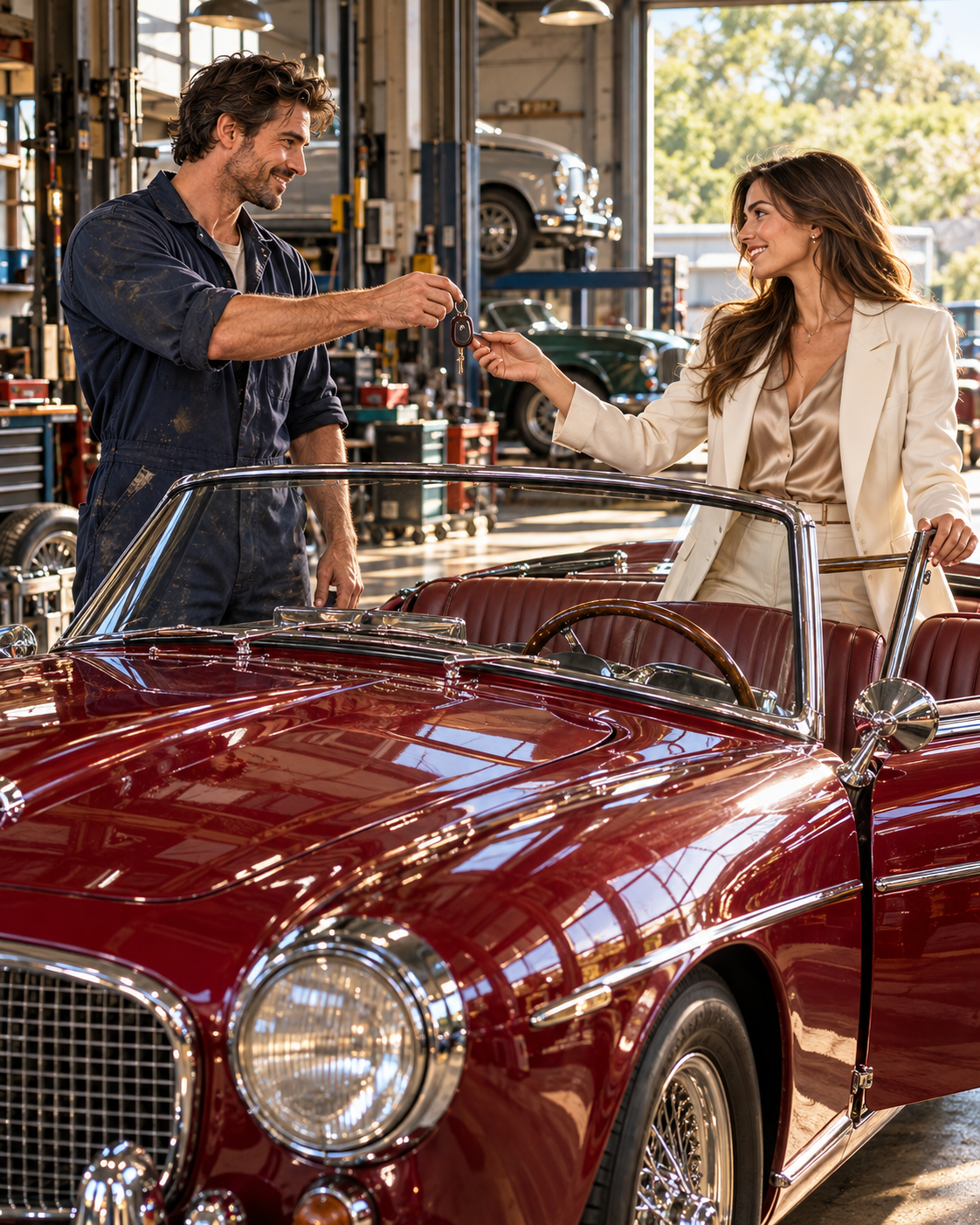
She placed the keys in my hand.
I stared at them.
“I can’t take this.”
“You can.”
“Claire—”
“I don’t want it sitting in a showroom.”
She looked toward Maya.
“I want it somewhere people work.”
So the roadster stayed at my garage.
It became the first thing visitors saw when they walked through the doors.
We didn’t polish away the scratches.
We didn’t replace the cracked leather completely.
We kept the repaired seat beside the original stitching.
A small brass plate hung beneath the steering wheel.
It didn’t mention Arthur.
It didn’t mention Claire.
It didn’t mention me.
It simply said:
“Nothing built by human hands is made valuable by pretending the work was free.”
Years later, Maya told me she remembered that morning at the factory more clearly than any race she had ever entered.
Not because of the speech.
Not because of the investigation.
Not because a powerful company had been forced to admit a mistake.
She remembered the moment I pulled into the school parking lot after leaving the stage.
She said I looked different.
“Like what?”
“Like you had finally stopped asking permission.”
I thought about that for a long time.
Because she was right.
For years, I had believed keeping my head down was the same as being humble.
I had mistaken silence for peace.
I had accepted gratitude in place of fair treatment because I thought refusing it would make me difficult.
But there is a difference between generosity and exploitation.
There is a difference between honoring someone and obeying their shadow.
And there is a difference between working hard and allowing someone else to rewrite the value of your work.
That roadster taught Claire that a legacy is not a museum piece.
It is a choice.
Every generation gets to decide which parts of the past deserve to survive.
Every person gets to decide where their limits are.
And sometimes the most important thing you can take back is not money.
It is the right to say:
“This is what happened.”
“This is what I gave.”
“And this is what I never agreed to give away.”
Maya grew up.
She became an engineer.
She still builds things with her hands.
Every now and then, she comes back to the garage, opens the hood of the old roadster, and tells me I’ve been adjusting the same carburetor for twenty years.
I tell her some things deserve to be maintained.
She tells me some things deserve to be replaced.
Then we argue the way fathers and daughters are supposed to.
Loudly.
Honestly.
With love underneath it.
And every time the roadster turns over, rough for a second before settling into that deep, steady hum, I remember the brochure that tried to turn six weeks of my life into a free gift.
I remember Claire standing at that microphone.
I remember Maya handing away her spare wheel to a kid who had lost a race.
And I remember the lesson neither the company nor the brochure could ever own:
Work is not less valuable because you love doing it.
Family is not a marketing story.
And kindness only remains kindness when it is freely given.
That is the legacy worth keeping.