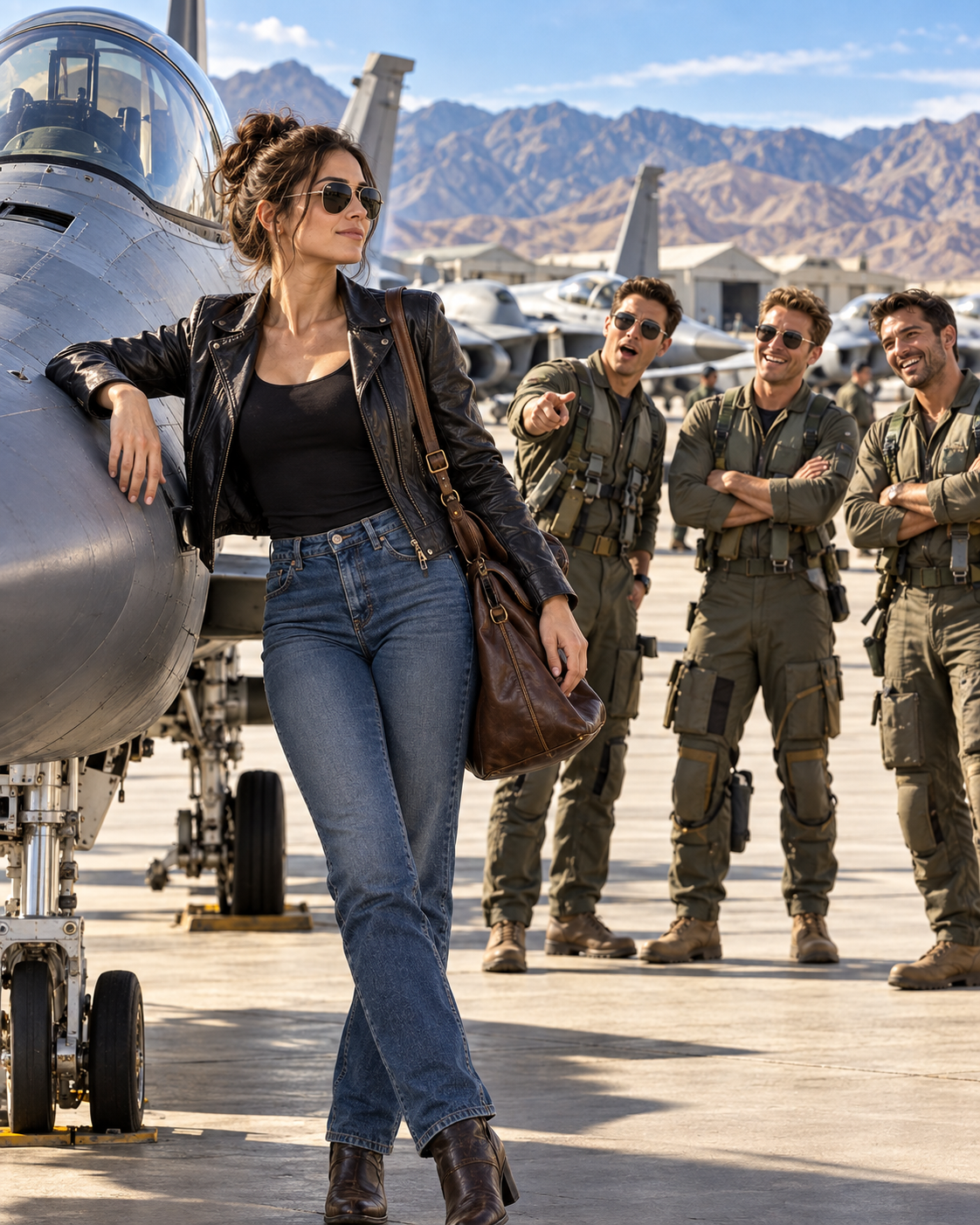
“I was publicly humiliated beside an F-16 on the sun-blasted ramp at Nellis Air Force Base when a young pilot called me a trespasser
Part 2
Before sunrise, the desert was black and silent beneath a sky crowded with stars.
I sat strapped into my Viper, listening to the familiar hum of systems coming alive around me.
The cockpit smelled of fuel, hydraulic fluid, and cold metal.
It smelled like every beginning I had ever survived.
Lucas’s voice crackled through the radio.
“Valkyrie, Apex.”
I smiled despite myself.
“Go ahead.”
“Still think there’s something wrong with my engine?”
“Yes.”
A pause.
“Understood.”
That answer surprised me.
Maybe he had spent the night thinking.
Maybe Colonel Sterling had convinced him.
Or maybe pride had simply become too heavy to carry into the air.
We launched at dawn.
Red Flag began exactly as planned.
Red air surged across the range while blue forces climbed into position, aircraft cutting through the pale morning light like silver blades.
From my cockpit, the Nevada desert looked peaceful.
It never looked peaceful from the ground.
The first engagements were clean.
Targets appeared and disappeared.
Missiles flashed across displays.
Pilots called threats.
Controllers issued corrections.
Then Lucas’s voice came through.
“Fox Two.”
“Good shot,” I answered.
For several minutes, everything worked.
Then I heard a sound that did not belong.
A sharp metallic bang.
Not thunder.
Not weapons fire.
Something inside his aircraft had broken.
“Apex, report.”
Nothing.
Then his breathing.
Fast.
Uneven.
“Valkyrie, I have an engine problem.”
“Confirm.”
“Engine’s gone.”
I looked at my instruments.
His descent rate was increasing.
“Restart procedure.”
“Trying.”
The next transmission was almost a whisper.
“I’ve got no hydraulic pressure.”
My chest tightened.
The warning I had given him on the ramp came rushing back.
The turbine.
The heat.
The rushed maintenance.
The possibility that nobody wanted to believe.
“Manual controls,” I ordered.
“Stick is locked.”
“Don’t eject.”
Silence.
Then Lucas said, “I’m over the civilian sector.”
I looked at the map.
He was right.
Below him were homes.
Roads.
Schools.
Thousands of people who had no idea a thirty-thousand-pound fighter was falling toward them.
“Lucas, listen to me.”
“I can’t control it.”
“Listen.”
His breathing became ragged.
“I have to eject.”
“No.”
“Major—”
“No, Lucas.”
I pushed my Viper into a steep dive.
Clouds swallowed my canopy.
The world became white.
I came through the bottom of the cloud layer almost inverted, my aircraft dropping toward his crippled jet.
There he was.
A Viper descending like a stone.
I rolled beneath him, then climbed until my canopy was almost level with his.
For one terrifying second, we flew side by side with nothing between us but a few feet of air.
Lucas looked down.
I knew he could see me.
“Do not eject,” I said.
His voice shook.
“I can’t fly this.”
“You can.”
“The controls are dead.”
“Then we’re going to make them move.”
I had flown with men who had been shot.
Men who had lost hydraulics.
Men who had lost engines.
Men who had lost pieces of themselves and still kept flying.
The body could panic.
The mind could remember.
And sometimes, a voice in the radio was enough to bridge the distance between them.
“Lucas, look at me.”
He turned his helmet toward me.
“You’re going to breathe.”
“I can’t.”
“You can.”
I slowed my descent until we were almost level.
“Now reach for the emergency power unit.”
“I can’t see it.”
“Right side.”
His breathing rattled in the microphone.
“Got it.”
“Fire it.”
He did.
The aircraft shuddered.
One system came alive.
Not enough.
But enough to give us a chance.
“Manual hydraulic override.”
“I don’t see it.”
“Below the panel.”
“I found it.”
“Pull.”
“It won’t move.”
“Use both hands.”
“I can’t.”
“Lucas, pull like your life depends on it.”
A strained grunt came over the radio.
Then a metallic crack.
The controls moved.
Barely.
But they moved.
“I have control!”
“You have some control.”
The runway was still miles away.
The desert rushed beneath him.
His airspeed dropped dangerously.
“Keep it above two hundred and ten knots.”
“Two-ten.”
“Don’t chase altitude.”
“I understand.”
“No, you don’t.”
I looked at the runway ahead.
“You don’t need to win.”
He was silent.
“You only need to land.”
Something changed in his breathing.
It became slower.
More deliberate.
He began to fly.
We descended together toward Nellis.
His aircraft had no engine.
No normal hydraulic pressure.
No margin for error.
But it still had wings.
Sometimes that was enough.
“Gear.”
“Won’t extend.”
“Emergency gear lines.”
Lucas hesitated.
“Now.”
He pulled the handle.
The gear dropped.
I could see the tires locking into place.
The runway was directly ahead.
“Keep the nose steady.”
“I’m trying.”
“Don’t try.”
I watched his airspeed.
“Do.”
The concrete rushed toward us.
“Flare at the threshold.”
“I’m too fast.”
“Then hold it.”
The Viper crossed the runway threshold.
Lucas pulled back.
His tires struck hard.
Smoke exploded beneath him.
The aircraft bounced once.
Then again.
I held my breath.
The jet settled.
It slid down the runway in a cloud of smoke and shredded rubber.
Lucas finally brought it to a stop.
For several seconds, neither of us spoke.
Then his voice came through.
“Valkyrie?”
“I’m here.”
“I thought I was dead.”
I looked at his aircraft.
“So did I.”
Emergency crews raced toward him.
I landed moments later.
When I climbed out, my legs felt heavier than they had in years.
Lucas was already being taken away by medics.
As I watched them close the ambulance doors, I realized something.
The arrogant lieutenant who had mocked me on the ramp was gone.
Whatever walked out of that aircraft alive would have to be someone different.
Part 3
I found Lucas in the medical bay that afternoon.
His face was pale.
There was dried sweat along his temples, and his hands trembled slightly beneath the blanket.
He looked at me when I entered.
For several seconds, neither of us spoke.
Finally he said, “You were right.”
I pulled a chair beside his bed.
“About the turbine?”
He nodded.
“The blade sheared exactly where you said it would.”
I looked down.
“How long had you been flying it?”
“Four hundred eighty-seven hours.”
I closed my eyes.
Thirteen hours short of five hundred.
The number hit harder than I expected.
Lucas swallowed.
“Why didn’t you let me eject?”
“Because you were over people.”
He looked away.
“I thought I was going to die.”
“So did I.”
He stared at me.
“You weren’t afraid?”
I laughed quietly.
“I was terrified.”
That seemed to surprise him.
“You didn’t sound terrified.”
“Fear is loud inside you.”
I leaned forward.
“You just don’t have to give it the microphone.”
His eyes dropped.
For the first time since I had met him, Lucas looked young.
Not weak.
Just young.
“I was an idiot,” he whispered.
“Yes.”
He looked at me.
I didn’t soften the answer.
“But you’re alive.”
He nodded.
“And now you have a choice.”
“What choice?”
“You can spend the rest of your career pretending yesterday never happened.”
I pointed toward the window.
“Or you can remember exactly what it felt like to be helpless at thirty thousand pounds.”
His jaw tightened.
“I don’t want to forget.”
“Good.”
I stood.
“Because tomorrow you’re going to help the maintenance crew tear your engine apart.”
His eyebrows rose.
“Me?”
“You.”
“Major, I’m a pilot.”
“So was I.”
I walked toward the door.
“Pilots who refuse to understand the machines carrying them eventually become passengers.”
Lucas stared at me.
Then he nodded.
“Yes, ma’am.”
I stopped.
“One more thing.”
He looked up.
“Never call yourself Apex because you think it makes you invincible.”
He almost smiled.
“What should I call myself?”
I opened the door.
“Call yourself lucky.”
The next morning, Lucas was on the maintenance floor before sunrise.
He worked beside the crew that had once seemed beneath his attention.
He learned where the blade had failed.
He learned why the sealant mattered.
He learned how a rushed inspection could become a grave.
And he never complained.
Weeks later, we stood together beside another Viper.
The desert wind moved across the ramp.
Lucas ran his hand over the fuselage.
Then he stopped.
“Major.”
I looked at him.
“Something wrong?”
He smiled.
“No.”
He shook his head.
“Just checking.”
I nodded.
“Good.”
We climbed into our aircraft together.
Before takeoff, Lucas’s voice came through the radio.
“Valkyrie.”
“Go ahead.”
“Thank you.”
I looked toward the horizon.
The sun was rising over the mountains, turning the desert gold.
“Don’t thank me yet.”
A pause.
“Why?”
“Because I’m still planning to beat you today.”
His laugh came through the radio.
It was different now.
There was humility in it.
And trust.
We launched into the morning sky.
Two Vipers climbed together, their shadows racing across the desert floor.
I had spent years believing the hardest part of being a combat pilot was surviving the enemy.
I was wrong.
The hardest part was surviving your own pride.
War taught me that skill could save a life.
Experience could prevent a mistake.
But humility was what allowed you to listen before the mistake happened.
Lucas had nearly died because he believed being a great pilot meant never being wrong.
He survived because, at the edge of death, he finally understood something every aviator eventually learns.
The aircraft does not care about your rank.
The sky does not care about your reputation.
And fear does not care how confident you sounded on the ground.
What matters is whether, when everything breaks, you are willing to listen to the person beside you.
Years later, Lucas would still tell people about the day an older woman in jeans embarrassed him on a flight line.
He would tell them about the turbine blade.
The dead controls.
The runway.
The smoke.
And the voice beside him in the clouds.
But whenever someone asked what he remembered most, his answer was always the same.
He remembered looking through his canopy and seeing my Viper flying beside him when he had already decided he was going to die.
He remembered that I could have ordered him to eject.
Instead, I stayed.
Because sometimes leadership is not standing above someone and telling them what to do.
Sometimes it is entering the fire with them and refusing to leave until they find their way out.
And every time I remember Lucas’s aircraft touching that runway in a cloud of smoke, I remember the truth I learned long before Red Flag ever existed.
A pilot’s greatest strength is not believing he cannot fall.
It is knowing that he can, and still having the courage to reach for the controls.