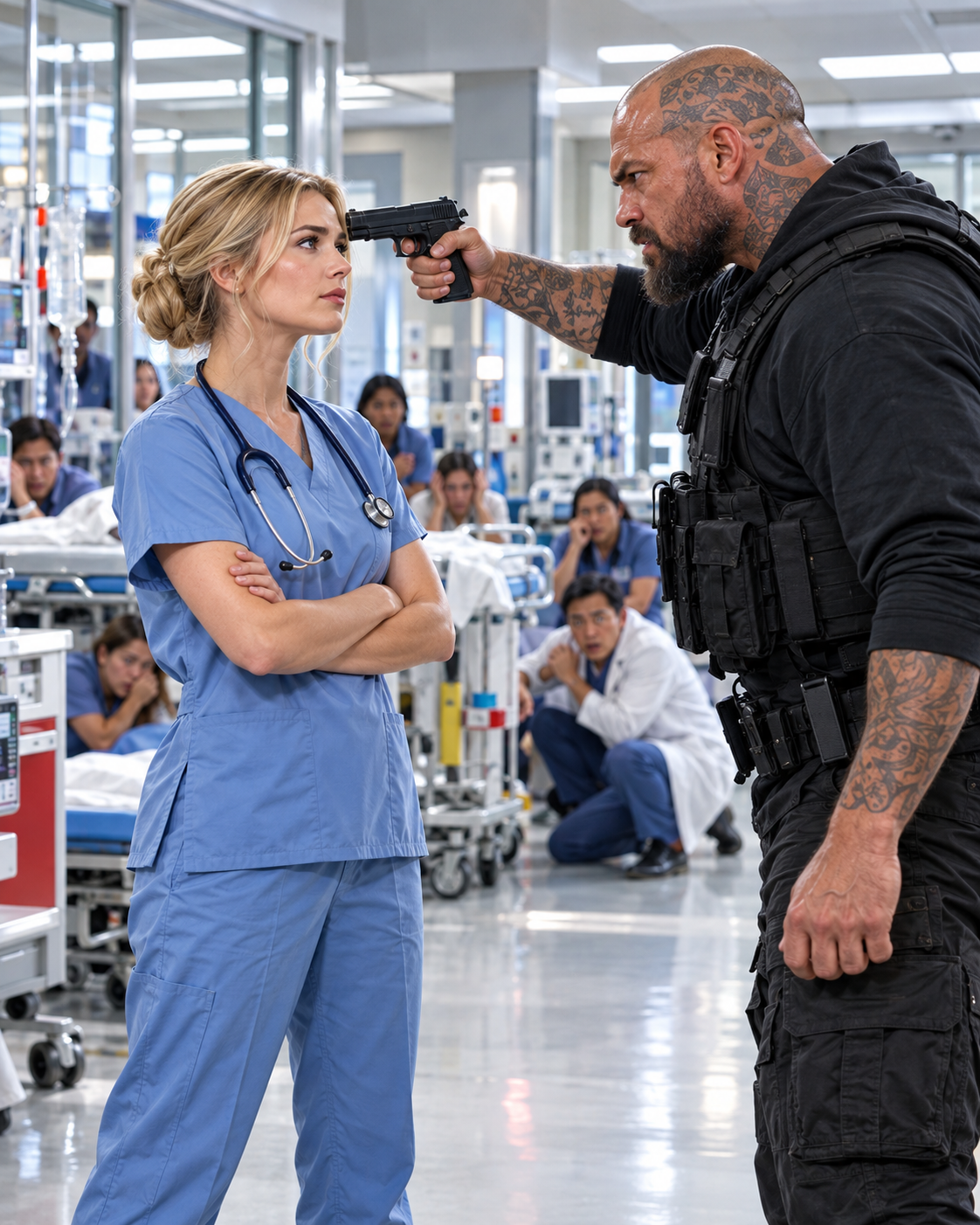
I was on the floor of Mercy West’s emergency room with a Glock pressed against my temple when Kyle laughed
Part 2
The police arrived in a wave of noise.
Boots thundered across broken glass.
Commands echoed through the emergency department.
“Police! Hands where we can see them!”
I raised both hands.
“I’m hospital staff.”
An officer approached cautiously.
“Are there more suspects?”
“Three.”
“Where?”
“Two in the west corridor.”
“And the third?”
I nodded toward the triage floor.
“Right there.”
The officer looked at me.
Then at the three men.
Then back at me.
“You did this?”
I didn’t answer immediately.
Elena stepped out from behind the desk.
“She saved me.”
The officer lowered his weapon slightly.
Another officer rushed toward the first two suspects.
Kyle was conscious.
Brody was conscious.
The third attacker was conscious too.
All three were furious.
But none of them could move.
The stolen weapons were secured by the police, and I stepped away from everything.
That was when my hands started shaking.
Not during the fight.
Not when Kyle had the gun against my head.
Not when Brody raised the shotgun.
After.
That was when my body remembered it was allowed to be afraid.
I walked into an empty treatment room.
I closed the door.
And I sat down.
For the first time that night, I cried.
Quietly.
Not because I thought I was going to die.
Because I had spent years convincing myself that part of me was dead already.
A police detective found me there about twenty minutes later.
Her name was Detective Lena Morales.
She didn’t come in like she was interrogating a suspect.
She knocked.
“May I?”
I wiped my face.
“Sure.”
She sat across from me.
“You want to tell me what happened?”
“I already told the officers.”
“I know.”
She studied me.
“That’s not what I mean.”
I looked down at my hands.
There was dried blood near my thumb.
Not mine.
“I used to be in the Army.”
She waited.
“How long?”
“Eight years.”
“Combat?”
I nodded.
“Three deployments.”
She glanced toward the door.
“Medic?”
“Yes.”
There was a pause.
Then she asked the question I had been avoiding for years.
“Why did you leave?”
I looked toward the window.
Outside, Portland was dark and wet.
Rain traced the glass in thin silver lines.
“Because I couldn’t remember how to sleep.”
She didn’t interrupt.
“I thought becoming a nurse would make me feel normal.”
“And did it?”
I almost smiled.
“No.”
The next morning, Mercy West looked like a different hospital.
Broken glass had been boarded over.
Police tape stretched across the emergency entrance.
Reporters gathered outside.
People wanted a story.
They wanted a hero.
They wanted someone they could put on television.
I wanted coffee.
Instead, I got called into the administrator’s office.
The hospital director, Robert Harlan, stood behind his desk.
He was a careful man.
Always polished.
Always composed.
He folded his hands.
“Maya, what happened last night was extraordinary.”
“I know.”
“We are grateful.”
“Thank you.”
He hesitated.
Then he said something I never expected.
“You understand that your military background was not disclosed when you were hired.”
I stared at him.
“My military background isn’t a criminal record.”
“No.”
“Then why does it matter?”
“It matters because the hospital has policies.”
I felt something tighten inside me.
“Robert, three armed men drove through our emergency room doors.”
“I understand.”
“I stopped two of them.”
“I understand.”
“And I protected one of our nurses from being shot.”
His expression changed.
“I understand.”
“Then what exactly are we discussing?”
He looked uncomfortable.
“The board is concerned about liability.”
I laughed once.
It wasn’t a happy sound.
“Liability?”
“Maya…”
“No.”
I stood.
“For years, I came here, worked twelve-hour shifts, took every weekend nobody wanted, stayed late when the ER was drowning, and treated everyone like they mattered.”
He said nothing.
“And now that I survived an armed attack, you’re worried about liability?”
His eyes dropped.
That was when I understood.
He wasn’t afraid of what I had done.
He was afraid of what people would think if they knew.
A quiet nurse had saved the hospital.
A woman nobody noticed had protected everyone.
And institutions don’t always know what to do with people who don’t fit the role assigned to them.
I left his office without another word.
The story spread anyway.
By noon, somebody had posted a blurry security image online.
By evening, millions of people had seen it.
The comments were brutal.
Some called me a liar.
Some called me a hero.
Some said no nurse could possibly do what I had done.
One person wrote, “She probably staged the whole thing.”
I stared at that sentence for a long time.
Then I closed my phone.
Because I knew something they didn’t.
The hardest part wasn’t fighting those men.
The hardest part was remembering why I had spent so many years pretending I couldn’t.
That night, I went home.
I opened the bottom drawer of my dresser.
Under old sweaters was a small wooden box.
Inside were my medals.
Photographs.
A faded Army identification card.
And a folded letter from a medic I had served with named Daniel.
Daniel had died during my third deployment.
His letter had arrived two weeks later.
I had never opened it.
I don’t know why.
Maybe some part of me knew that once I did, the past would become real again.
I unfolded it.
The handwriting was uneven.
The first line said, “Maya, if you’re reading this, you’re probably angry.”
I stopped breathing.
I kept reading.
He wrote about home.
About his mother.
About how he hoped I would leave the Army someday.
And then came the sentence that broke me.
“Don’t spend the rest of your life believing survival is something you should apologize for.”
I sat on the bedroom floor until dawn.
The next morning, I returned to Mercy West.
Not because I had forgiven the hospital.
Not because I wanted attention.
Because my patients were still there.
An elderly man named Mr. Callahan was waiting for his medication.
He looked at me.
“I saw you on television.”
I smiled.
“I was hoping you wouldn’t.”
He chuckled.
“You’re famous now.”
“No.”
I checked his IV.
“I’m still just Maya.”
He watched me for a moment.
Then he said quietly, “That’s what makes you dangerous.”
I laughed.
For the first time since the attack, it felt good.
But the story wasn’t finished.
Because three days later, Detective Morales came back.
And this time, she brought a folder.
Part 3
She closed the door behind her.
“I found something.”
I looked at the folder.
“About the robbers?”
“Yes.”
She sat down.
“The three men weren’t looking for narcotics.”
I frowned.
“Then what were they looking for?”
She opened the folder.
“Someone.”
The room seemed colder.
“Who?”
“One of your patients.”
My stomach tightened.
“Which one?”
She slid a photograph across the desk.
It showed an unconscious man from the trauma ward.
I recognized him immediately.
He had been admitted two nights before the attack after a motorcycle crash.
His name was Thomas Reed.
“Why would armed robbers come through an emergency room for him?”
“Because Thomas witnessed a robbery six weeks ago.”
I stared at the photograph.
“He was supposed to testify.”
Detective Morales nodded.
“The men weren’t random.”
The realization settled slowly.
The hospital attack had never been about drugs.
It had been an extraction.
They came to erase a witness.
And I had accidentally stood between them and their target.
“What happens to Thomas?”
“He goes into protective custody.”
I looked toward the hallway.
“Good.”
Morales closed the folder.
“There’s one more thing.”
I waited.
“Kyle told us something.”
“What?”
“He said you scared him.”
I almost smiled.
“Good.”
She didn’t smile back.
“He said the moment you looked at him after taking the gun, he knew you’d done this before.”
I looked down.
“Maybe he was right.”
Morales stood.
“Maya, people are going to want to make you into something.”
“A hero?”
“Maybe.”
She shook her head.
“Or a weapon.”
I understood.
I’d seen it before.
People love strength when it belongs to someone else.
They love heroes until heroes become inconvenient.
After she left, I walked back into the emergency department.
The boards still covered the shattered entrance.
Workers were replacing the glass.
The hospital smelled like disinfectant and wet pavement.
A new nurse was standing at the triage desk.
She looked nervous.
“Is it weird working here now?”
I considered the question.
“Yes.”
She nodded.
“Are you scared?”
I looked at the entrance.
Then at the patients.
Then at the nurses moving around me.
“Yes.”
Her eyebrows rose.
I smiled.
“Being brave doesn’t mean you’re not scared.”
She seemed to think about that.
Then she nodded.
That sentence stayed with me.
Because for years I had misunderstood my own survival.
I thought strength meant becoming harder.
Colder.
Less human.
Afghanistan had taught me how to move toward danger.
But Mercy West taught me something harder.
It taught me how to remain gentle after seeing what people could do to each other.
The hospital eventually repaired the emergency entrance.
The news cycle moved on.
Kyle and the others went to trial.
Thomas survived.
Elena stayed at Mercy West.
And I kept working nights.
People sometimes recognized me.
Most didn’t.
I preferred it that way.
One evening, months later, I was checking an elderly patient’s IV when she opened her eyes.
“You’re the nurse from the news.”
I smiled.
“Apparently.”
She squeezed my hand.
“I remember thinking nurses were supposed to be gentle.”
I looked at her.
“We are.”
She frowned.
“Even after what happened?”
I adjusted the blanket over her shoulders.
“Especially after what happened.”
She closed her eyes.
Outside, rain tapped softly against the glass.
For a moment, everything was still.
No sirens.
No shouting.
No gunfire.
Just the quiet rhythm of a hospital at night.
I thought about Daniel.
About the soldiers I couldn’t save.
About the people I had carried.
About the parts of myself I had buried because I thought surviving meant leaving them behind.
Then I realized something.
I hadn’t survived Afghanistan so I could become fearless.
I had survived so I could choose what kind of person I would be afterward.
Kyle saw a helpless nurse because that was all he knew how to see.
He saw the scrubs.
The soft voice.
The tired eyes.
He mistook compassion for weakness.
He never understood that compassion can exist beside courage.
That gentleness can have a spine.
That a person can spend years learning how to fight and still choose, every single day, to heal instead.
Before sunrise, I finished my rounds.
I checked every IV.
I replaced a blanket.
I reassured a frightened mother.
I wrote my notes.
Then I walked to the repaired emergency entrance.
For a moment, I placed my palm against the new glass.
It was smooth.
Unbroken.
Ordinary.
I could still remember the sound of it shattering.
But I could also hear something else now.
Life continuing.
A monitor beeping.
A nurse laughing down the hall.
A patient asking for water.
Someone being born three floors above me.
Someone being saved three floors below.
I stood there and finally understood what strength had always meant.
It wasn’t the ability to hurt someone who deserved it.
It wasn’t knowing how to take a weapon away.
It wasn’t being the strongest person in the room.
Strength was having every reason to become hard and choosing not to.
I turned away from the glass and walked back toward the nurses’ station.
The sun was beginning to rise over Portland.
For the first time in years, I didn’t feel like I was hiding from my past.
I felt like I had finally made peace with it.
I was still Staff Sergeant Maya Vance in the memories that followed me.
I was still the medic who had survived three deployments.
I was still the woman who had stood in a hospital corridor while armed men tried to turn fear into control.
But I was also Maya.
A nurse.
A daughter.
A friend.
A woman who had learned that surviving the darkness doesn’t mean you have to carry it forever.
And as I slipped my stethoscope around my neck and stepped into another ordinary morning, I realized the quietest people are not always the weakest people in the room.
Sometimes they are simply the ones who already know exactly what they are capable of—and have chosen, despite everything, to use that strength to save rather than destroy.