I was on my knees beside an eight-year-old boy in the darkened emergency bay when Dr. Kenneth Thorne shouted
The envelope felt heavier than paper should have felt.
I stood alone in the dim corridor outside the emergency department while the last families were being reunited, the smell of antiseptic and smoke still hanging in the air.
Commander Briggs watched me carefully.
“Open it when you’re ready,” he said.
I looked at the military seal.
“What’s inside?”
His jaw tightened.
“The reason six men nearly died four years ago.”
I had spent four years convincing myself that memory was enough.
The burning vehicle.
The mountain pass.
The gunfire cutting through snow.
Jason’s hand slipping from mine.
The sound of men screaming beneath twisted metal.
I had buried all of it under silence.
Now Briggs was asking me to dig it back up.
I broke the seal.
Inside was a photograph.
Six younger faces stood beside a transport vehicle, smiling beneath a pale foreign sky.
Jason was there.
So were the other five men I had dragged from the wreckage.
But one face made my stomach turn.
A civilian contractor stood behind them.
His name was circled in black ink.
Elliot Crane.
I knew that name.
Everyone at Glacier Point knew it.
Crane had become a major defense contractor after leaving the military, and his company supplied emergency equipment to hospitals throughout Alaska.
I looked at Briggs.
“Why is he here?”
“Because he wasn’t supposed to be there that night.”
I stared at the photograph.
Briggs lowered his voice.
“Your convoy route was classified, Rachel.”
“Then someone inside our own system leaked it.”
He nodded.
“And we never proved who.”
For a moment, the hospital disappeared.
I was back on that mountain.
Back inside the smoke.
Back beneath the screaming metal.
I remembered Jason shouting that he couldn’t see.
I remembered crawling through shattered glass while bullets struck the rocks around me.
I remembered finding the first man.
Then the second.
Then the third.
Six men.
One by one.
I had pulled them from that vehicle until my gloves were soaked through.
The last person had been Jason.
His legs were trapped.
The flames were climbing.
I had reached for him when an explosion threw me against the mountain wall.
A piece of metal tore across my forehead.
I should have blacked out.
Instead, I crawled back.
“Stay with me,” I had whispered.
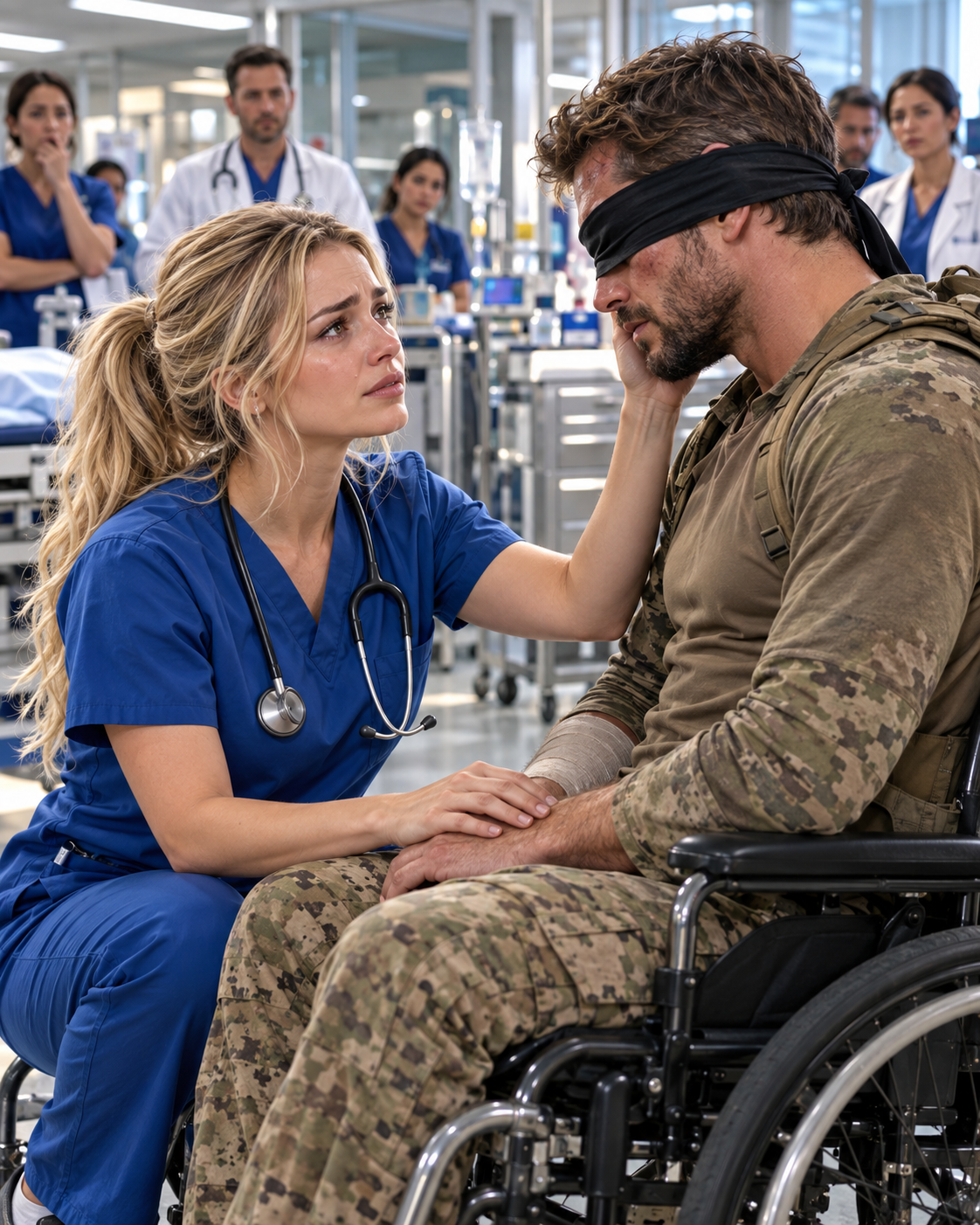
Jason had been shaking.
“I can’t see.”
“I know.”
“I’m going to die.”
“No.”
I had pressed my hand against his.
“Look at me, breathe with me.”
He had never been able to see my face.
But he remembered my voice.
And apparently, someone else remembered it too.
“Why didn’t you tell Jason who you were?” Briggs asked.
“Because I didn’t know he would remember.”
“You knew.”
I looked away.
“I knew the moment he heard my voice.”
“Then why hide?”
I thought of the hospital.
Of Brenda laughing when I dropped a tray.
Of Kenneth correcting every sentence I spoke.
Of people mistaking quietness for incompetence.
“Because after the war, I didn’t want to be Raven anymore.”
Briggs nodded slowly.
“Most people think survivors want applause.”
I gave him a tired smile.
“Sometimes survivors just want one morning where nobody needs them to be brave.”
He said nothing.
That sentence seemed to reach somewhere inside him.
Then his radio crackled.
“Commander, we have a problem.”
He answered immediately.
“What kind?”
“One of the injured bus passengers is missing.”
My heart tightened.
“Missing?”
“The family says their father was in the cafeteria during triage.”
I followed Briggs downstairs.
The cafeteria was almost empty now.
Chairs were overturned.
Blankets covered the floor.
Medical supplies sat in neat rows exactly where I had ordered them.
But near the rear exit, there was blood.
Not much.
Just three dark drops leading toward the service corridor.
Briggs crouched.
“These aren’t from the bus crash.”
I felt cold despite the warmth of the building.
“Someone left voluntarily.”
We followed the trail.
It ended beside an abandoned maintenance door.
On the floor was a hospital access card.
I recognized the photograph.
It belonged to one of the hospital administrators.
Briggs looked at me.
“Rachel.”
“I know.”
“You think someone inside helped Crane?”
“I think we need proof before we accuse anyone.”
That was the difference between fear and command.
Fear demanded an answer.
Command demanded the truth.
By sunrise, federal investigators had arrived.
Captain Monroe tried to keep the incident quiet, but I stopped him.
“No cover-up.”
He stared at me.
“We don’t know what happened.”
“Then we document everything.”
His expression changed.
A few hours earlier, he had seen me as a suspended nurse.
Now he saw something else.
“You’re right.”
The hospital began an internal security sweep.
Every access log was reviewed.
Every camera recording was recovered.
Every medication cabinet was checked.
Then we found something worse.
Someone had accessed Jason’s medical file three weeks before he arrived.
Not a nurse.
Not a doctor.
An administrator.
Elliot Crane’s company had requested information about his condition.
Briggs looked at the screen.
“Why would a contractor care about a blinded veteran?”
I knew the answer before he said it.
“Because Jason saw something.”
We found him resting in a quiet room later that afternoon.
I sat beside him.
“Jason, I need to ask you something.”
He smiled faintly.
“You’ve been avoiding me for years.”
I froze.
His smile disappeared.
“I knew it was you.”
My throat tightened.
“How?”
“Your voice.”
He touched his chest.
“People think blindness means darkness.”
He paused.
“It doesn’t.”
I sat silently.
“You remember the fire?”
“Every day.”
“What did you see before the explosion?”
Jason frowned.
“I couldn’t see much through the smoke.”
“Try.”
He closed his eyes.
“I remember the driver shouting that someone had changed our route.”
Briggs leaned closer.
“Who?”
Jason swallowed.
“I don’t know.”
Then his fingers tightened around the blanket.
“But I remember a voice.”
“What voice?”
“Someone on the radio.”
I felt the room become smaller.
“What did he say?”
Jason looked directly toward me.
“He said, ‘Raven won’t make it out.'”
Nobody spoke.
The words seemed to freeze the air.
I felt something inside me break open.
All these years, I had believed I was simply unlucky.
A bad route.
A terrible ambush.
A war story with no clean ending.
But someone had known my call-sign.
Someone had expected me to die.
And someone had survived long enough to make sure the truth stayed buried.
That evening, investigators discovered the missing passenger.
His real name wasn’t the one on his hospital registration.
He was a former contractor employed by Crane’s company.
He had been injured in the bus crash.
But he had not been a passenger.
He had boarded the bus deliberately.
He had been watching Jason.
When confronted, he ran.
Briggs’s team caught him outside the hospital.
He carried a small encrypted drive.
Inside were files dating back four years.
Names.
Routes.
Payments.
Hospital records.
Military schedules.
And one photograph of me.
Taken three months before the ambush.
I stared at it for a long time.
Someone had been watching me before I ever knew I was in danger.
Captain Monroe asked quietly, “What do you want to do?”
I looked at the photograph.
“I want the families of those six men to know the truth.”
“And after that?”
I thought about Jason.
About the boy with the peanut allergy.
About the forty people in the bus.
About the nurses who had cried when the lights went out.
“After that, I want to go home.”
Briggs smiled sadly.
“You don’t know how to do that.”
“No.”
I looked through the hospital window at the snow.
“But I’m learning.”
The investigation lasted months.
Elliot Crane was arrested.
The administrator who had leaked Jason’s records confessed.
The man who had changed our convoy route accepted a plea agreement.
The truth was uglier than any rumor.
Money had been exchanged.
Routes had been manipulated.
Lives had been treated like numbers on a spreadsheet.
And the six men who should have died were supposed to become statistics.
Instead, they became survivors.
Jason eventually left the hospital.
Before he did, he asked me to walk outside with him.
Snow fell quietly around us.
“You know what I remember most?” he asked.
“What?”
“Not the fire.”
He touched the scar above my eyebrow.
“Your hand.”
I looked at him.
“You held mine when you were terrified.”
“I wasn’t terrified.”
He laughed softly.
“You’re still a terrible liar.”
I smiled.
For the first time in years, I let myself laugh too.
“I thought you couldn’t see me.”
“I couldn’t.”
He turned his face toward the sound of my voice.
“But I knew exactly where you were.”
Those words stayed with me.
Months later, Glacier Point Naval Hospital changed.
Not because I became famous.
I never did.
Not because my story appeared in newspapers.
I refused interviews.
The hospital changed because everyone had learned what happens when people confuse silence with weakness.
The crisis-response program I requested became mandatory.
Doctors learned how to act when protocols collapsed.
Nurses practiced mass-casualty triage in darkness.
Volunteers learned how to recognize anaphylaxis.
Security teams learned evacuation routes.
And every employee was taught the same principle.
When the system fails, people must become the system.
Brenda completed her ethics training.
She eventually found me in an empty hallway.
“I owe you an apology,” she said.
I waited.
“I thought you were weak.”
“I know.”
“I was wrong.”
I looked at her.
She seemed smaller now.
Not physically.
Just human.
“Why did you hate me?”
She looked down.
“Because you reminded me of everything I was afraid I wasn’t.”
I had expected anger.
Instead, I felt sadness.
“Then I hope you stop punishing other people for that.”
She nodded.
“I will.”
Dr. Kenneth was harder.
He lost his leadership position but remained at the hospital under supervision.
Months later, he approached me after a training exercise.
“I’ve spent my career believing leadership meant having the answer.”
I said nothing.
He continued.
“You showed me leadership sometimes means being the first person willing to act when nobody else can.”
I looked at him.
“Then remember that next time someone is bleeding.”
He nodded.
“I will.”
Captain Monroe eventually asked me to become the hospital’s permanent crisis-response coordinator.
I refused the title.
“Why?”
“Because I don’t want people following me because of a call-sign.”
“Then what do you want?”
“People who know what to do when there is no one to follow.”
He smiled.
“That’s probably the most Raven thing you’ve ever said.”
I rolled my eyes.
“I’m Rachel.”
“I know.”
And for once, that was enough.
A year after the bus crash, the hospital held a quiet ceremony for the forty passengers who had survived.
No cameras.
No speeches about heroes.
Just families.
Doctors.
Nurses.
Firefighters.
And the little boy whose life I had saved.
He ran toward me carrying a handmade card.
On the front, he had drawn a woman in oversized blue scrubs.
Inside were five crooked words.
“Thank you for staying.”
I couldn’t speak.
His mother hugged me.
Then the boy looked up.
“Are you still scared?”
I smiled through tears.
“Sometimes.”
“Then how did you do it?”
I knelt beside him.
“Because someone once stayed for me.”
He thought about that.
Then he nodded as if he understood something much older than his eight years.
That night, after everyone left, I walked alone through the emergency department.
The lights were bright.
The generators were quiet.
The halls were empty.
For the first time, I could hear nothing but my own footsteps.
I stopped beside the chair where Jason had once sat.
My fingers touched the edge.
I remembered his hand.
His fear.
His voice.
And the words I had repeated without knowing they would come back to me years later.
Look at me.
Breathe with me.
I finally understood why those words had survived.
They weren’t instructions.
They were a promise.
A promise that someone would stay when the world became too dark to understand.
My phone rang.
It was Commander Briggs.
I answered.
“What’s wrong?”
Silence.
Then he said, “Nothing is wrong.”
I frowned.
“Then why are you calling?”
“I received another file.”
My stomach tightened.
“About Crane?”
“No.”
“Then what?”
He hesitated.
“About you.”
I closed my eyes.
“I thought that was over.”
“So did I.”
“What does it say?”
Another pause.
Then his voice became quieter.
“Your official military record says you were never assigned to that mountain convoy.”
I stopped breathing.
“What?”
“According to the records, you were already listed as missing three days before the ambush.”
The hallway suddenly felt colder.
“That’s impossible.”
“I know.”
“Who changed it?”
“We don’t know.”
I stared through the glass doors at the snow falling outside.
For four years, I had believed I survived the ambush.
But now there was a question I couldn’t escape.
If the military had already recorded me as missing before the convoy burned, then who had been wearing my name?
And why had someone wanted the world to believe Rachel Vance was already dead?
I looked down at the badge on my chest.
For eleven months, I had hidden behind it.
For four years, I had hidden behind a false story.
And now, somewhere in a classified archive, there was another version of me waiting to be found.
Briggs spoke again.
“Rachel, there’s one more thing.”
I whispered, “What?”
“We found a second Raven.”
The call went silent.
Outside, snow covered the hospital grounds until every footprint disappeared.
I stood there listening to my own breathing, realizing that the night I thought I had survived might not have been the beginning of my story.
It might have been the moment someone else’s story began.
And somewhere beyond the glass, beneath the endless Alaskan snow, I suddenly felt certain that whoever had written my name into that missing-person file had never stopped watching.