I was kneeling in frozen gravel beside my grandfather’s old airport gate when a line of black SUVs stopped behind my battered pickup
The SUV stopped beside the eastern hangar.
For a moment, nobody moved.
The engine remained running, its headlights cutting through the dusty windows like two pale blades.
Natalie stepped away from the window.
“There’s another way out.”
Arthur looked at her.
“I’m listening.”
She pointed toward the rear wall.
“The old service tunnel.”
I stared at her.
“How do you know about that?”
“My brother.”
Her voice was quiet.
“He’s been studying this airport longer than you realize.”
That sentence landed harder than the approaching footsteps outside.
I tightened my fingers around the brass key.
“Then we go.”
Arthur grabbed the metal tube and shoved it inside his coat.
Natalie took Lily’s hand.
I noticed the gesture immediately.
“You don’t have to do that.”
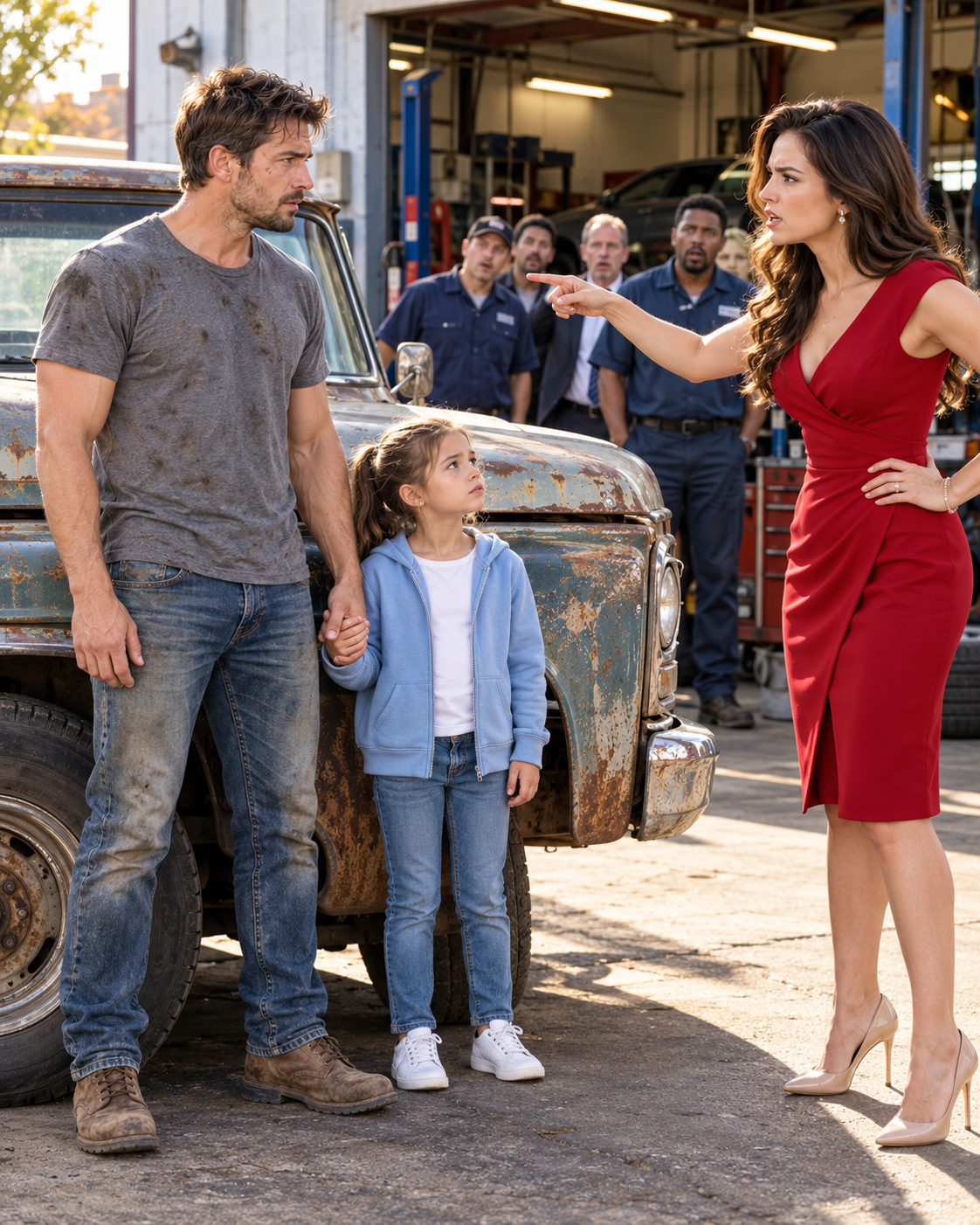
“I know.”
She looked at me.
“But I am.”
We moved behind the workbench and found a rusted steel panel almost completely hidden beneath years of dust.
The key fit the lock.
It turned with a heavy click.
The panel swung inward.
Cold air rushed through the opening.
Beyond it was a narrow concrete passage barely wide enough for one person.
Lily looked inside.
“Dad, where does that go?”
“Probably somewhere my grandfather didn’t want people finding.”
She smiled nervously.
“Then it must be important.”
We entered the tunnel just as the hangar door slammed open.
A man’s voice echoed through the building.
“Mr. Hale!”
I froze.
Julian.
He had come himself.
“Don’t answer,” Natalie whispered.
We moved deeper into the darkness.
Behind us, footsteps crossed the hangar floor.
Then Julian spoke again.
“You don’t understand what you’re holding.”
Arthur glanced at me.
“That means we’re holding something.”
The tunnel descended beneath the eastern hangar, then turned sharply toward the old maintenance buildings.
Water dripped from the ceiling.
Our shoes scraped against concrete.
Lily stayed between me and Natalie, holding both our hands.
After several minutes, we reached a steel door.
There was no lock.
Instead, someone had painted three numbers across it.
1971.
Arthur ran his fingers over the paint.
“Your grandfather left a trail.”
I looked at the key.
“Maybe the key isn’t for a door.”
I turned it over.
A tiny number was engraved into the metal.
214.
My heart stopped.
Flight 214.
The same flight that had just departed.
Arthur’s face changed.
“That’s not a coincidence.”
Natalie stared at the key.
“My brother knows about this flight.”
“How?”
“Because Flight 214 was the reason he came here last year.”
I looked at her.
“What are you talking about?”
She hesitated.
“Julian wasn’t interested in buying your airport.”
“Then what did he want?”
She swallowed.
“An old cargo manifest.”
The tunnel suddenly felt colder.
“What was on it?”
“Aircraft parts. Fuel equipment. Land records. And one item listed simply as—”
She stopped.
Arthur finished the sentence.
“Restricted transfer.”
Natalie nodded.
I pushed open the steel door.
We entered an underground room.
A single emergency bulb flickered overhead.
There were shelves everywhere.
Boxes.
Ledgers.
Reels of film.
Old photographs.
And hundreds of folders stamped with dates.
1970.
1971.
1972.
Arthur walked toward the nearest shelf like a man approaching a grave.
“This isn’t an airport archive.”
“No,” I said.
“It isn’t.”
Natalie opened a box.
Inside were property deeds.
Not ours.
Other families.
She opened another.
More deeds.
Another.
More.
Then she found a photograph.
Three men stood outside the airport administration building in 1971.
My grandfather was one of them.
Charles Mercer stood beside him.
The third man was a stranger.
Natalie turned the photograph over.
There was a name written on the back.
Richard Vance.
She went completely still.
“That’s my father.”
I looked at her.
“Your father knew my grandfather?”
She didn’t answer.
Arthur took the photograph from her.
“Your father was involved.”
“My father was involved in a lot of things.”
Her voice had hardened.
“But I didn’t know this.”
Arthur opened another folder.
Inside was a typed agreement.
He read the first paragraph, then the second.
His hand began to shake.
“What?”
He looked at me.
“The 1971 agreement wasn’t a reversionary agreement.”
“Then what was it?”
“A protection agreement.”
He turned the page.
“Your grandfather and several other landowners signed this to prevent a private company from acquiring the airport and surrounding properties.”
I stared at him.
“So Julian’s document is the opposite.”
“Exactly.”
Natalie picked up another folder.
“Who was the private company?”
Arthur looked at the name.
“Vance Aviation Holdings.”
Natalie closed her eyes.
“My father’s company.”
The room fell silent.
I could hear Lily breathing beside me.
“My grandfather fought your family?”
“My father did.”
Natalie looked at me.
“And apparently he lost.”
“No,” Arthur said.
“He didn’t.”
He pointed toward a stack of documents.
“Your grandfather won.”
I opened the top folder.
Inside were court filings showing that Vance Aviation Holdings had been denied the right to acquire the airport.
Then I saw something else.
A handwritten note.
My grandfather’s handwriting.
“Mercer agreed to testify.”
Arthur’s face went pale.
“Charles Mercer was the notary.”
I understood.
“He wasn’t the man who forged the agreement.”
“No,” Arthur said.
“He was the man who helped hide the real one.”
Natalie stared at the documents.
“Then why would Julian use his name?”
“Because Mercer is dead,” Arthur said.
“And because someone wants everyone to believe he was part of the fraud.”
A loud metallic bang echoed through the tunnel.
Lily jumped.
Julian’s voice came from somewhere behind us.
“You’re very close.”
Natalie stepped in front of Lily.
Julian appeared at the end of the corridor.
Two men stood behind him.
Neither carried a weapon.
They didn’t need one.
Julian smiled.
“You found the archive.”
I stepped forward.
“You forged the agreement.”
“No.”
He shook his head.
“I inherited the problem.”
“You knew it was fake.”
“I knew it was useful.”
Arthur raised the original protection agreement.
“Your document was created to trigger a reversion that doesn’t exist.”
Julian smiled.
“Legally, that depends on which document a court accepts.”
Natalie stared at him.
“You forged a fifty-year-old agreement to steal land.”
“Steal?”
He laughed softly.
“You really still believe this is about land?”
His eyes moved toward the shelves.
“This airport sits on the oldest private aviation corridor in the region. Whoever controls it controls access to six counties.”
I felt something tighten in my chest.
“You want the airport for development.”
“No.”
He pointed toward the documents.
“I want what your grandfather was protecting.”
Arthur’s expression changed.
“The corridor.”
Julian nodded.
“Exactly.”
I looked at Natalie.
She looked as shocked as I felt.
Julian continued.
“Your grandfather discovered that the federal government had quietly designated this corridor for emergency aviation operations. Medical flights. Disaster response. Military logistics.”
He smiled.
“It’s worth far more than a shopping complex.”
I looked at the runway above us.
For the first time, I understood why my grandfather had refused every offer to sell.
He hadn’t been protecting a family business.
He had been protecting something bigger.
Lily tugged at my sleeve.
“Dad.”
I looked down.
She was pointing at a small metal box beneath the table.
“What is that?”
Arthur crouched.
A label had been taped to it.
For Hale family eyes only.
My hands went cold.
I opened it.
Inside was a cassette recorder.
A single tape.
My grandfather’s name was written across it.
I pressed play.
Static filled the room.
Then his voice came through.
Older.
Tired.
But unmistakable.
“If you’re hearing this, someone has tried to use the 1971 agreement against you.”
I looked at Julian.
His smile disappeared.
My grandfather continued.
“Do not trust anyone who tells you the airport belongs only to our family.”
The tape crackled.
“The land is ours. The responsibility is not.”
Arthur closed his eyes.
My grandfather went on.
“I made an agreement with the county, the state, and the federal aviation office. The airport will remain privately owned, but its runway must remain available for emergency use.”
Julian took one step forward.
“Turn that off.”
I ignored him.
“There will come a time when someone offers you more money than this place could ever be worth.”
My grandfather paused.
“When that happens, remember what you’re really selling.”
The tape clicked.
Then his final words came through.
“You’re not selling dirt.
You’re selling the right of strangers to come home.”
The recording ended.
Nobody spoke.
Even Julian was silent.
Lily looked at me.
“Does that mean people need our airport?”
I knelt beside her.
“Yes.”
“Then we can’t sell it.”
I smiled.
“No.”
“We can’t.”
Julian suddenly moved.
He grabbed the cassette recorder.
Natalie stepped between us.
“Don’t.”
He shoved her aside.
I caught her before she hit the table.
Arthur shouted for the two men to stop.
They didn’t.
One grabbed the archive box.
The other reached for the documents.
Lily screamed.
And in that instant, something inside me snapped.
I lunged forward.
The man carrying the box stumbled.
The documents scattered across the floor.
Julian reached for the protection agreement.
I grabbed his wrist.
He looked at me with cold fury.
“You have no idea what you’re doing.”
“Yes,” I said.
“For the first time, I do.”
He pulled free.
Then the lights went out.
Total darkness swallowed the room.
A second later, alarms began screaming above us.
The airport emergency siren.
I heard engines.
Lots of them.
Natalie whispered, “What happened?”
Arthur answered.
“The emergency system.”
I understood.
My grandfather’s old system.
The one we’d maintained for decades.
The one connected to the airport’s emergency network.
Somewhere above us, runway lights flickered on.
Then another alarm sounded.
A voice came over the airport radio.
“Emergency medical aircraft requesting immediate landing clearance.”
Everyone froze.
Arthur looked at me.
“You need to go.”
I ran.
We raced through the tunnel and up the stairs.
The airport had transformed.
The old runway lights were blazing through the snow.
A medical helicopter circled overhead.
Behind it, another aircraft approached through the clouds.
Flight 214 had returned.
The radio crackled.
“Airport Hale, this is Flight 214. We have a critical medical emergency onboard.”
I grabbed the microphone.
“Hale Airport. You’re cleared to land.”
Julian appeared behind us.
“You can’t do this.”
I turned.
“This is exactly what this airport was built for.”
The aircraft descended.
The runway disappeared beneath a cloud of blowing snow.
For several seconds, we couldn’t see anything.
Then the landing lights emerged.
The aircraft touched down hard.
It rolled toward the terminal and stopped.
Medical personnel rushed forward.
The doors opened.
A stretcher appeared.
A woman was carried out.
Then a child.
Alive.
Breathing.
Safe.
Lily stood beside me.
She whispered,
“Dad.”
I put my arm around her.
“What?”
“Great-Grandpa really was right.”
I looked at the runway.
“Yes.”
Behind us, sirens approached.
County investigators entered the airport.
Arthur had already sent copies of the documents to the authorities.
Natalie’s own attorneys had transmitted the forged agreement to a federal fraud unit.
Julian tried to leave.
He made it ten steps.
Then two investigators stopped him.
For once, he had no answer.
Natalie watched her brother being escorted away.
She didn’t look victorious.
She looked exhausted.
“I should have known,” she whispered.
“You didn’t.”
“My father taught him everything.”
“He still chose what to do with it.”
She looked at me.
“You’re right.”
Weeks passed.
The investigation became bigger than any of us expected.
The archive revealed dozens of forged property agreements connected to Vance Aviation Holdings.
Families across the region had lost land because they believed documents that were never legally valid.
Some had spent decades fighting.
Others had simply given up.
The real 1971 agreement changed everything.
The county recognized the airport’s protected emergency status.
The federal aviation office confirmed the corridor.
The forged document was officially classified as fraudulent.
And my family kept the land.
But I didn’t keep it the way my grandfather had.
I opened the archive.
I invited every affected family to see the records.
Some cried.
Some shouted.
Some simply stood in silence.
Arthur helped establish a legal fund so families could challenge old property transfers.
Natalie sold the remaining assets of her father’s old aviation company and placed the proceeds into the fund.
She never asked me to forgive her family.
I respected her for that.
One spring morning, she came back to the airport.
No black SUVs.
No lawyers.
No folder.
Just Natalie, wearing a plain jacket and carrying two cups of coffee.
She handed one to me.
“Peace offering.”
I smiled.
“Your brother still sends me paperwork.”
“He always will.”
We laughed.
Then she looked toward the hangar.
“Do you ever regret not selling?”
I thought about the number in that first offer.
It had been enough to erase every debt.
Enough to buy a new house.
Enough to retire.
Enough to make life easier.
But I looked at Lily teaching a group of local children how to inspect an old aircraft.
I watched the runway.
I remembered the medical flight.
And I remembered my grandfather’s voice.
You’re not selling dirt.
You’re selling the right of strangers to come home.
“No,” I said.
“I don’t.”
Natalie nodded.
“I don’t think I would either.”
That afternoon, Lily came running toward us.
“Dad!”
“What?”
She held up a tiny wrench.
“Mr. Harris says the sensor is broken again.”
I laughed.
“Of course it is.”
She grinned.
“You’re going to fix it?”
I looked at the old airport.
At the patched fences.
The battered hangars.
The runway my family had protected for three generations.
Then I handed her the wrench.
“Together.”
She took my hand.
We walked toward the hangar.
Behind us, another aircraft appeared in the sky.
Its shadow moved across the runway and disappeared into the sunlight.
For fifty years, my grandfather had protected a piece of land.
I finally understood why.
Some things are valuable because they can make you rich.
Other things are valuable because they give people somewhere to land.
And sometimes, the greatest inheritance isn’t the property left in your name.
It’s the responsibility you choose to carry forward.
That was the lesson my grandfather had hidden beneath the hangar.
Not a secret about land.
Not a secret about money.
A secret about purpose.
And from that day on, whenever someone asked why I refused to sell the airport, I gave them the same answer.
“Because my family didn’t build this place just to own it.”
“We built it so someone, someday, would need it.”
And someday had finally come.