I was halfway through signing an emergency flight application when the commander stopped beside my desk
The next morning arrived before I was ready for it.
I stood outside Hangar Three at 05:20, staring at the aircraft waiting beneath the floodlights.
It was not the battered simulator I had spent years repairing.
This machine was real.
Every rivet, every hydraulic line, every warning system had consequences.
Captain Vance walked toward me carrying two helmets.
He handed me one.
“Still want to do this?”
I looked at the aircraft.
“Yes, sir.”
He studied my face.
“Being brave and being prepared are not the same thing.”
“I know.”
“Good.”
He handed me the helmet.
“Because once we’re up there, I won’t be grading your confidence.”
He paused.
“I’ll be grading your decisions.”
I nodded.
That was exactly what I wanted.
Inside the cockpit, everything felt both familiar and completely different.
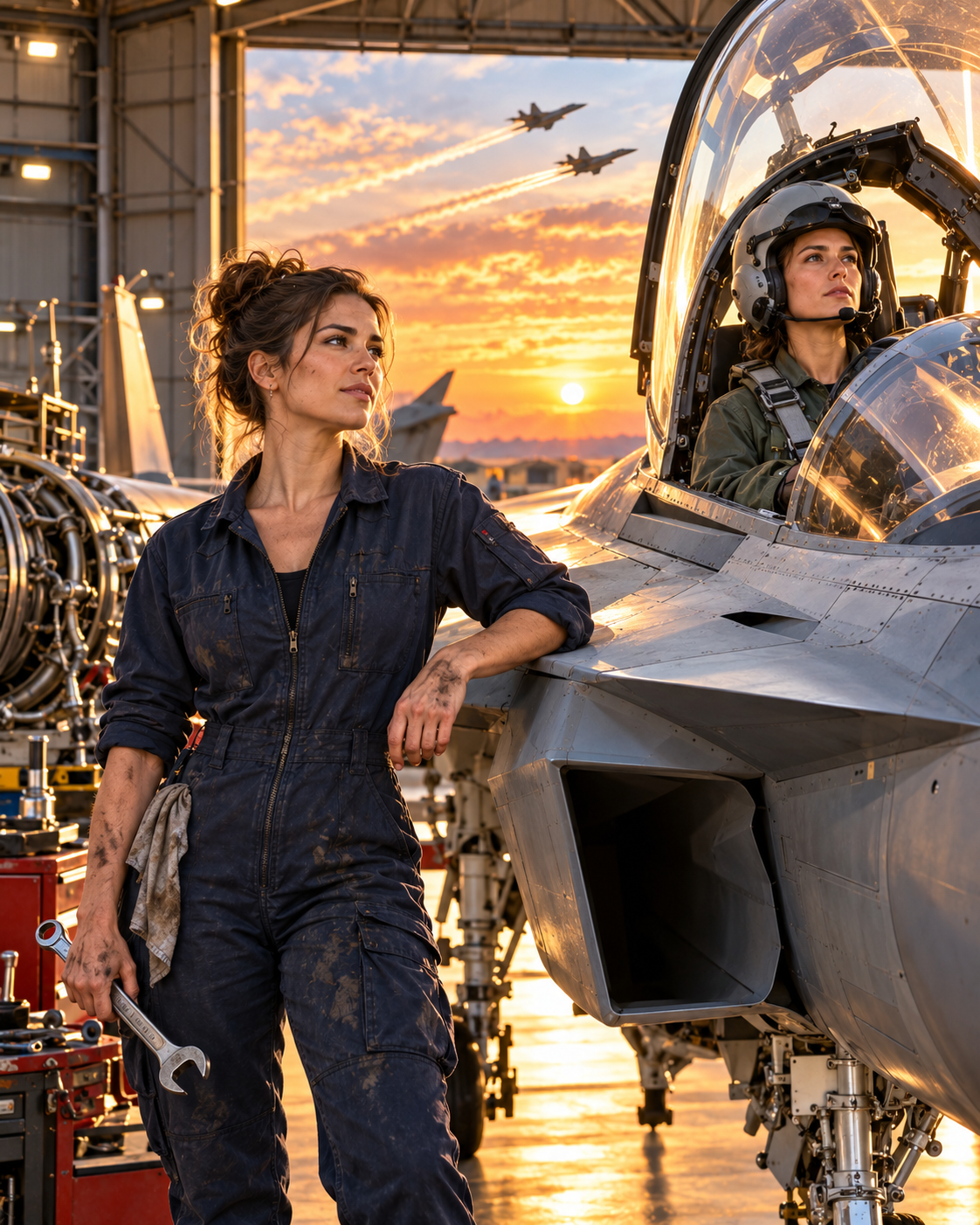
I had spent thousands of hours studying systems diagrams, memorizing procedures, and practicing emergency scenarios in the simulator.
But the moment the canopy closed, the aircraft became alive.
The engine started with a deep vibration that traveled through the seat and into my chest.
For the first time, I understood why pilots talked about aircraft as if they were living things.
The machine did not speak in words.
It spoke through pressure, sound, temperature, resistance, and motion.
I listened.
“Controls?”
Vance asked.
“Free.”
“Flight instruments?”
“Normal.”
“Navigation?”
“Normal.”
He looked at me.
“Ready?”
I tightened my grip.
“Ready.”
We taxied toward the runway.
I could see several people standing near the hangar.
Word had spread across the base.
Everyone wanted to see what happened when a maintenance technician tried to fly.
Some had come because they believed I would fail.
Others had come because they wanted to see whether I could prove them wrong.
I tried not to think about either group.
The runway stretched ahead.
Vance pushed the throttle forward.
The engine roared.
The aircraft accelerated.
For a few seconds, all I could hear was the engine and my own breathing.
Then the wheels left the ground.
My stomach dropped.
The earth fell away.
I was flying.
Not in a simulator.
Not in my imagination.
Not in the locked storage room beneath the training building.
I was actually in the sky.
Vance kept his eyes on the instruments.
“Your aircraft.”
I took control.
“My aircraft.”
The aircraft responded immediately.
A small movement of my hand produced a change in attitude.
The horizon shifted.
The pressure against the controls changed.
I corrected.
Vance said nothing.
We climbed through the morning clouds.
For several minutes, everything went smoothly.
Then Vance said, “Let’s see what you do under pressure.”
An alarm sounded.
I looked down.
Hydraulic pressure was falling.
My eyes moved automatically to the secondary indicators.
“Confirm the failure,” Vance said.
I checked the readings.
“Hydraulic pressure is dropping.”
“Your response?”
I began the emergency procedure.
Then I stopped.
Something felt wrong.
The pressure reading was falling, but the control response remained normal.
The temperature was stable.
There was no corresponding change in pump load.
I checked the mechanical indicator.
It was steady.
“Sir.”
“What?”
“I don’t believe we have a hydraulic failure.”
Vance turned his head slightly.
“Why?”
“The electronic sensor is showing a drop, but the mechanical system isn’t.”
“Your conclusion?”
“False sensor data.”
He nodded.
“Continue.”
I isolated the faulty circuit and the warning disappeared.
Vance said nothing.
Then he gave me a new heading.
We flew for another twenty minutes.
I began to relax.
That was when the aircraft shuddered.
It was subtle at first.
A vibration beneath my feet.
Then another.
I immediately recognized the pattern.
My hands tightened around the controls.
“Captain.”
“I feel it.”
The vibration increased.
The engine instruments remained within normal limits.
But the aircraft felt wrong.
“Reduce power,” Vance said.
I did.
The vibration changed.
Not disappeared.
Changed.
I looked at the engine readings.
Then at the fuel system.
Then at the electrical indicators.
Everything appeared normal.
“What’s your diagnosis?”
“I don’t know yet.”
“Good answer.”
He looked at me.
“Don’t guess when you don’t know.”
I listened again.
The vibration came in a repeating pattern.
Three seconds.
A pause.
Three seconds.
A pause.
I had heard it before.
Not in the air.
On the ground.
Six years earlier, while inspecting an aircraft that had been scheduled for a routine maintenance flight.
I remembered the report.
A minor vibration.
An intermittent electrical fluctuation.
Nothing serious, according to the pilot.
The aircraft had been cleared.
Two hours later, the grounding fault had spread through multiple systems.
I had argued for another inspection.
Nobody listened.
I remembered the feeling of standing beside that aircraft after it returned.
I remembered thinking that machines did not suddenly become dangerous.
They warned you first.
You simply had to notice.
“Sir.”
Vance waited.
“I think we have an electrical grounding problem.”
“What makes you think that?”
“The vibration is synchronized with the auxiliary electrical load.”
He looked at the panel.
“You’re certain?”
“No.”
He smiled slightly.
“Better.”
I switched the auxiliary system off.
The vibration disappeared.
Vance stared at the instruments.
Then he looked at me.
“Return to base.”
We turned toward the airfield.
The flight had become something else now.
This was no longer an evaluation.
It was an investigation.
As we approached the base, the radio crackled.
“Flight Two-One, this is control. We have a priority message. Confirm your status.”
Vance answered.
“Flight Two-One returning with a systems anomaly. No immediate emergency.”
There was a pause.
Then the controller spoke again.
“Understood.”
We continued toward the runway.
I looked at the electrical panel.
One indicator flickered.
Just once.
Then it went dark.
My heart tightened.
“Captain.”
“I saw it.”
“What if the fault isn’t in the auxiliary system?”
Vance looked at me.
“What are you thinking?”
I checked the systems diagram from memory.
“The auxiliary feed may only be exposing the problem.”
He said nothing.
I continued.
“If the grounding connection is failing upstream, switching off the auxiliary system only reduces the load. It doesn’t fix the fault.”
Vance’s expression changed.
“Then what happens when we land?”
“If the connection shifts again, we could lose more than the auxiliary systems.”
He immediately contacted control.
“Tower, Flight Two-One. Request emergency priority landing.”
The reply came instantly.
“Cleared priority.”
We entered the final approach.
The runway looked impossibly narrow.
I kept my breathing steady.
The aircraft descended.
Then every warning light on the panel illuminated at once.
The cockpit filled with red.
The instruments began flickering.
The radio cut out.
For one terrifying second, I could hear nothing but the engine.
Vance’s hand moved toward the controls.
I caught his wrist.
“Wait.”
He looked at me.
“What?”
“The engine is still stable.”
The instruments were failing, but the aircraft itself was not.
I looked through the windshield.
The runway was ahead.
“We can land.”
Vance released the controls.
“Your aircraft.”
“My aircraft.”
I ignored the electronic displays and focused on the mechanical instruments.
Speed.
Altitude.
Attitude.
Engine sound.
Visual reference.
The fundamentals.
Everything I had studied for six years suddenly became simple.
Fly the aircraft.
Do not chase the warning lights.
Do not let fear make decisions.
I aligned with the runway.
The aircraft touched down hard.
The wheels bounced once.
I corrected.
Then we landed.
The moment we slowed enough to exit the runway, emergency vehicles surrounded us.
The canopy opened.
Cool morning air rushed into the cockpit.
Vance climbed out first.
He turned toward me.
“You were right.”
I removed my helmet.
“About the grounding?”
“About something more important.”
He looked back at the aircraft.
“You listened to the machine.”
I didn’t know what to say.
Then Colonel Mercer arrived.
She climbed the stairs and looked directly at me.
“Are you hurt?”
“No, ma’am.”
“Vance?”
“I’m fine.”
Mercer looked at the aircraft.
“Maintenance found three electrical faults during the post-flight inspection.”
She paused.
“One of them could have become catastrophic.”
Nobody spoke.
Then she looked at me again.
“Come with me.”
We walked into the hangar.
The room was silent.
People who had laughed at me the day before were now watching without saying anything.
Mercer placed a report on the table.
“You identified a failure nobody else saw.”
I looked at the report.
“I only recognized a pattern.”
“That’s what expertise is.”
She closed the folder.
“But expertise isn’t enough to make someone a pilot.”
I nodded.
“I know.”
“Do you?”
Her voice was firm.
“You made good decisions today. But you also hesitated, questioned assumptions, and admitted when you didn’t know something. Those things kept you alive.”
She leaned against the table.
“If you want this, you will have to train properly.”
I looked at her.
“How long?”
“As long as it takes.”
That answer should have disappointed me.
Instead, it made me smile.
For the first time, nobody was offering me a shortcut.
They were offering me a path.
Three weeks later, I began formal flight training.
It was harder than I expected.
Much harder.
Knowing how an aircraft worked did not mean knowing how to fly one.
I struggled with approaches.
I overcorrected.
I reacted too quickly.
I learned that a pilot could understand every component in an aircraft and still make a terrible decision in the cockpit.
Captain Vance was relentless.
“Again.”
We repeated the maneuver.
“Again.”
I repeated it.
“Again.”
Some days I wanted to throw my helmet across the hangar.
But I remembered my father’s words.
The sky does not care who you are.
It cares whether you understand what you’re asking it to do.
So I kept learning.
Months passed.
Then came the night everything changed.
A storm moved across the region with almost no warning.
Visibility dropped.
Several aircraft were already airborne.
The control room became crowded with voices.
Weather reports changed every few minutes.
I was still a trainee, sitting in the operations room with Vance, when the emergency alarm sounded.
One of our aircraft had lost communication.
Then its navigation signal disappeared.
Everyone froze.
“Which aircraft?” Mercer asked.
The controller gave the call sign.
My blood ran cold.
It was the same aircraft type I had inspected dozens of times.
Vance looked at me.
“What’s wrong?”
I stared at the weather map.
“The storm isn’t the problem.”
“What is?”
I pointed to the route.
“That aircraft passed through the same pressure system where we had the grounding fault.”
Vance’s expression hardened.
“Could be coincidence.”
“Yes.”
I looked at the instruments on the control console.
“But if it’s not…”
Mercer stepped closer.
“Finish that sentence.”
I swallowed.
“If the aircraft has the same electrical problem, they may not know which instruments they can trust.”
The room went silent.
Mercer looked at the rescue coordinator.
“Can we establish radio contact?”
“No response.”
“Radar?”
“Intermittent.”
I stared at the storm.
Then I remembered something from my first flight.
The vibration.
The three-second pattern.
The way the auxiliary system changed it.
I suddenly understood.
“Can we send them a message?”
Mercer nodded.
“Tell them to reduce auxiliary electrical load and rely on mechanical references if they lose the primary displays.”
The controller transmitted the instruction.
For thirty seconds, nothing happened.
Then a weak voice came through the radio.
“Control, this is Two-One. We received.”
Everyone in the room exhaled.
The pilot continued.
“We’ve lost primary navigation and several displays.”
Vance looked at me.
The pilot’s voice crackled again.
“But we’ve got the aircraft.”
I closed my eyes for one second.
They were still alive.
But they were not out of danger.
The storm was getting worse.
Their destination was still forty minutes away.
Then the pilot reported another problem.
“Fuel indication is unstable.”
My eyes opened.
“Tell them not to trust the electronic fuel reading.”
Mercer looked at me.
“How do you know?”
“Because if the grounding fault is spreading, the fuel sensor could be affected too.”
She nodded.
The message went out.
The pilot acknowledged.
For the next twenty minutes, the entire base listened.
The aircraft flew mostly on mechanical references.
No shortcuts.
No perfect instruments.
Just judgment.
Finally, the radar signal returned.
The aircraft emerged from the storm.
Its landing was rough but safe.
When the crew stepped onto the runway, everyone at the base applauded.
The pilot removed his helmet and walked toward the command building.
He stopped when he saw me.
“You were the one who gave us the procedure?”
I nodded.
He held out his hand.
“Thank you.”
I shook it.
“You did the flying.”
He smiled.
“Maybe.”
Then he looked toward Vance.
“But someone taught us what to listen for.”
That night, I returned to the old simulator.
It was still in the same storage room.
The seat was worn.
The switches were mismatched.
The wiring was imperfect.
But I no longer needed to hide it.
I sat inside and switched on the main power.
The screens flickered to life.
For years, this room had been where I imagined becoming someone I wasn’t sure I could ever become.
Now I realized something.
I had never really been trying to become my father.
I had been trying to understand him.
He had lost the sky because of an accident.
I had spent years believing that meant the sky had been taken away from our family.
But that wasn’t true.
The sky had never belonged to him.
It had never belonged to me.
It belonged to nobody.
What mattered was what we learned from it.
The next morning, Colonel Mercer called me into her office.
There was a folder on her desk.
I recognized it immediately.
My pilot certification.
I stared at it.
“Is this…”
“Conditional operational certification.”
I looked at her.
“You passed.”
For several seconds, I couldn’t speak.
Then I smiled.
Mercer smiled back.
“There’s one more thing.”
She handed me another envelope.
I opened it.
Inside was a copy of my father’s old aviation certificate.
On the back was a handwritten note.
I recognized the handwriting immediately.
My father’s.
I read it twice.
It said:
“To Lucia. If you ever find your way into the sky, remember this: flying is not about proving that you belong there. It is about learning enough to bring everyone home.”
My eyes filled with tears.
I had never seen those words before.
“Where did you get this?”
Mercer pointed toward the door.
Captain Vance was standing outside.
“He found it with the rest of your father’s records.”
I looked at him.
“You knew?”
He shrugged.
“I knew your father.”
I stared at him.
“He flew with me.”
The room suddenly felt very quiet.
Vance continued.
“Your father was one of the best pilots I ever knew.”
I looked down at the note.
“Why didn’t you tell me?”
“Because if I had told you, you might have spent the whole evaluation trying to live up to his name.”
He paused.
“You needed to find your own reason to fly.”
I folded the note carefully.
He was right.
That was the part I had misunderstood for years.
I thought my father’s accident had left me with something unfinished.
But the unfinished thing was not his career.
It was my fear.
I had spent eleven years hiding behind machines because machines could not judge me.
Then I learned that machines did not need me to be fearless.
They needed me to pay attention.
People were the same.
Maybe that was what my father had really meant.
The sky did not care who I was.
Neither did the aircraft.
But the people inside them did.
And that meant I had a responsibility to them.
Months later, I stood on the runway before sunrise.
The sky was dark.
The runway lights glowed through the mist.
Birds were beginning to call beyond the perimeter fence.
The same sounds.
The same hour.
The same airbase.
But I was different.
Kevin walked up beside me carrying two coffees.
“You still come out here before everyone else?”
I took one.
“Old habit.”
He looked toward the aircraft.
“So, pilot.”
I smiled.
“Careful.”
He laughed.
“Sorry, Captain Gomez.”
I shook my head.
“I’m still a mechanic.”
“You fly aircraft.”
“I fix them too.”
He nodded.
“Fair enough.”
We stood quietly for a moment.
Then he asked, “Are you nervous?”
I looked at the horizon.
“Always.”
He seemed surprised.
“Really?”
“Being nervous reminds me to pay attention.”
The first aircraft started its engine.
The sound rolled across the runway.
I watched the cockpit lights come alive.
Then I heard the familiar hum.
For years, I had listened to aircraft from the ground.
I had listened for faults.
For changes.
For warnings.
Now I listened from the cockpit.
The same machine.
The same language.
A different perspective.
Before climbing aboard, I touched the folded note in my flight suit pocket.
I didn’t need to read it anymore.
I knew every word.
Bring everyone home.
That became the principle I carried into every flight after that.
Not proving myself.
Not impressing anyone.
Not becoming the person others expected me to be.
Just understanding the machine, respecting the sky, trusting my training, and remembering that every person in the aircraft had placed their life in someone else’s hands.
Years later, new technicians would sometimes ask me how I became a pilot.
They expected a dramatic answer.
They expected me to tell them about the emergency flight, the simulator, the evaluation, the day everyone laughed.
I would tell them all of it.
But I always ended with the same thing.
“You don’t become good at something by waiting for someone to give you permission to learn.”
Then I would point toward the aircraft.
“But learning isn’t the same as pretending you’re ready.”
I would tell them to study.
To practice.
To admit what they didn’t know.
To listen before acting.
And most importantly, to understand that courage was not the absence of fear.
Courage was being willing to take responsibility despite it.
Sometimes the person everyone overlooks is the person who has been paying attention all along.
Sometimes the quietest person in the room has spent years preparing for the moment when everyone else finally needs them.
But preparation only matters when it is joined with humility.
Because knowledge without humility becomes arrogance.
Confidence without discipline becomes danger.
And talent without responsibility can hurt the very people it was meant to help.
I learned that from an aircraft.
I learned it from my father.
And, eventually, I learned it from myself.
The sky never asked me to prove that I belonged.
It only asked me one question.
What are you going to do with the responsibility once you get there?
I finally had my answer.
I would listen.
I would learn.
And I would bring them home.