I was halfway through explaining why I refused to fly faster when Lieutenant Tyler Vance laughed across the briefing room
“Your call.”
I tightened my grip on the controls.
For the first time that night, I wondered whether going slow would be enough.
The answer came through my headset.
“Not if we stay here.”
Maya’s voice was calm, but I heard the tension beneath it.
I looked ahead.
The landing zone was a jagged patch of rock on the far side of the canyon, barely wide enough for the aircraft to settle. Muzzle flashes blinked around it like distant fireflies.
They were shooting at the ground, not at us.
Captain Thorne’s men were surrounded.
“We can’t approach the landing zone under that fire,” Maya said.
“I know.”
“Then what?”
I watched the flashes for three seconds.
Then I saw something else.
A line of smoke moved sideways through the rain.
Not wind.
Movement.
Someone was signaling from the ridge.
Three short bursts.
Pause.
Two bursts.
Pause.
Three.
I remembered the briefing.
Thorne’s unit had one smoke grenade left.
But the smoke wasn’t where the map marked the landing zone.
It was farther north.
Inside a narrow shelf beneath the ridge.
A place no pilot would choose.
A place with almost no room to turn.
“Captain Thorne,” I said over the radio, “identify your position.”
The answer came immediately.
“North shelf. We’re pinned against the rock wall. Main landing zone is compromised.”
I looked at Maya.
“How many?”
“Sixty men started this morning. We have fifty-seven accounted for.”
“Three missing?”
“Wounded. Sergeant says they’re still below us.”
I stared at the canyon.
The cables crossed the valley above the landing zone.
The shelf sat underneath them.
There was a route.
It was worse than the one we’d planned.
But it was possible.
“Thorne, can your people move?”
“Not without exposing them.”
“Then don’t move.”
I reached for the map clipped beside the console.
“Maya.”
She leaned closer.
“Tell me what I already know.”
“Four cables.”
“Five,” I said.
She frowned.
I pointed at the screen.
“The fifth is lower. It sags behind the others.”
“That’s the one that doesn’t show on the old survey.”
“Exactly.”
“You saw it?”
“Not yet.”
I slowed further.
The aircraft crept through the darkness.
The canyon narrowed until the rock walls felt close enough to touch.
I shifted the nose three degrees right.
Then another degree.
The first cable slid across my goggles.
The second was higher.
The third was hidden by rain.
“Four feet,” Maya whispered.
I held.
The aircraft trembled in a crosswind.
Then the hidden cable appeared.
It hung lower than the rest, almost at eye level from our position.
My stomach tightened.
Nine years disappeared.
Daniel.
The gorge.
The flash.
The empty sky.
The silence after.
I heard my own breathing inside the mask.
“Three feet,” Maya said.
I did not move.
“Two.”
The cable passed inches beneath the rotor arc.
Maya exhaled sharply.
We cleared it.
I let myself breathe again.
Then gunfire erupted ahead.
Tracer rounds stitched across the canyon.
“Incoming!”
I dropped the aircraft six feet.
Rounds passed above us and struck the wall.
I did not accelerate.
Maya looked at me.
“They’re walking fire toward the shelf.”
“I know.”
“We need to move.”
“I know.”
This time I pushed the controls forward.
Not fast.
Just enough.
The old aircraft answered with a low mechanical growl.
The shelf appeared.
A row of men crouched against the rock.
Their rifles were pointed outward.
Some were carrying wounded soldiers.
Others were firing toward the ridge.
Captain Thorne stepped into the smoke and waved both arms.
I brought the aircraft closer.
“Thirty seconds,” I told him.
“We need ten.”
“Then make it ten.”
The landing zone was too small for a normal approach.
There was no room for a clean descent.
So I didn’t make one.
I hovered sideways.
The left skid came within inches of the rock shelf.
Maya opened the side door.
Two soldiers jumped aboard.
Then four.
Then six.
Every second felt like an hour.
“Keep them coming!”
A burst of gunfire struck the aircraft.
Metal rang above my head.
Maya shouted.
“I’m hit!”
I looked at her.
She was still standing.
“Where?”
“Vest. I’m fine.”
Another burst slammed into the fuselage.
Warning lights flickered.
One of the engine gauges dropped.
“Hydraulic pressure!”
Maya grabbed the panel.
“Still holding!”
Captain Thorne was shouting from the ground.
“We’ve got more!”
I glanced at the instruments.
The aircraft was getting heavier.
Nine men.
Then twelve.
The wind was pushing us toward the canyon wall.
I corrected.
A tiny correction.
Too much would send us into the rock.
Too little would send us into the cables.
“Thirty-five aboard,” Maya said.
“Keep loading.”
“Ma’am, we’re over weight.”
“I know.”
A soldier appeared carrying another man over his shoulder.
He stumbled.
Captain Thorne caught him.
“That one goes first.”
I lowered the aircraft another foot.
The shelf disappeared beneath us.
I could no longer see the ground.
I was flying by instruments and Maya’s voice.
“Left two feet.”
I moved.
“Hold.”
I held.
“Right one.”
I moved.
A cable flashed overhead.
My heart slammed against my ribs.
“Clear.”
We kept loading.
Forty-eight.
Fifty-three.
Fifty-six.
Then Thorne climbed aboard.
He turned back toward the ridge.
“Wait.”
“Captain, get inside.”
“My men are still out there.”
“They’re all accounted for.”
“No.”
He pointed into the smoke.
“Three missing.”
The same three.
The wounded.
The ones trapped below.
“I’ll go,” he said.
“You’ll stay.”
He stared at me.
“They’re my men.”
“And right now, Captain, they’re also mine.”
He hesitated.
Then the sound came.
A deep metallic groan from above.
Maya looked up.
“One of the cables is moving.”
The storm had shifted.
The lowest power line was swinging.
Not much.
A few feet.
Enough to kill us.
“Thorne,” I said, “where are the three?”
“Below the shelf. Forty meters. Small ravine.”
I looked toward the black gap beyond the landing zone.
“I can get them.”
Maya turned toward me.
“You can’t take this aircraft deeper.”
“I don’t have to.”
I pointed to the soldiers.
“Unload everyone.”
Thorne stared at me.
“Unload?”
“Yes.”
“We’ve got wounded.”
“I know.”
“That will leave us exposed.”
“So will staying on this shelf when that cable comes down.”
He understood.
He jumped from the aircraft.
Then the others followed.
Within seconds, more than fifty soldiers were back on the rock.
I pulled the aircraft away.
The power cable swung overhead.
It dropped.
Not onto us.
Onto the shelf.
A shower of sparks lit the canyon.
The soldiers scattered.
The cable snapped against the rocks and went dark.
Nobody spoke.
Then Thorne shouted.
“Move!”
His men disappeared into the smoke.
I hovered outside the corridor.
Maya looked at the damaged engine gauge.
“We have maybe fifteen minutes.”
“That’s enough.”
“For what?”
“Three soldiers.”
We followed the ravine.
The canyon floor was barely visible beneath the rain.
I used the searchlight for one second.
Then turned it off.
Too bright.
Too obvious.
“Any movement?”
Maya leaned forward.
“There!”
A figure waved.
Then another.
The third was lying beside a boulder.
I brought the aircraft down as low as I dared.
There was no room to land.
I lowered the rescue cable.
Maya clipped herself in first.
“I’m going down.”
“No.”
She looked at me.
“You need both hands.”
“Exactly.”
She attached the line.
“Then don’t make me argue.”
She dropped into the rain.
I held position.
Rock walls on three sides.
Storm on the fourth.
Power cables above.
A damaged engine behind me.
And somewhere on the ridge, enemy shooters were searching for us.
Thirty seconds.
The line jerked.
Maya’s voice came through.
“First casualty secured.”
I raised him.
His body swung beneath the aircraft.
I steadied him.
Twenty seconds later, Maya called again.
“Second.”
The engine temperature climbed.
Fifteen minutes became ten.
I looked at the dark shelf where fifty-seven soldiers were waiting.
They were trusting me.
Maya was trusting me.
Three people were dangling below me.
And I suddenly understood why Tyler’s words had irritated me so much.
He thought speed was courage.
Sometimes it was.
But courage was not about moving fastest.
It was about knowing what could break.
“Third casualty secured.”
I raised them together.
The aircraft groaned.
The engine alarm began to scream.
“Ma’am!”
Maya’s voice sharpened.
“We have to go.”
I brought all three men inside.
Then I pulled away from the ravine.
The nearest cable swung across our path.
It was moving faster now.
I watched it.
Waited.
Waited.
Then the wind shifted.
The cable moved left.
I moved right.
For one perfect second, the corridor opened.
I accelerated.
Not because I was impatient.
Because the window had arrived.
We shot through.
The canyon opened behind us.
The mountains dropped away.
I climbed.
The aircraft shook violently.
Then the warning lights went dark.
For a moment, I thought we had lost the engine.
Maya grabbed the controls beside me.
But the engine was still running.
Barely.
“We’re losing power.”
“I know.”
“Can we make base?”
I looked at the storm ahead.
Then at the fuel gauge.
Then at the wounded soldiers lying across the cabin.
“No.”
Maya looked at me.
“Then where?”
I keyed the radio.
“All rescue aircraft, this is Raven One. We have fifty-nine personnel aboard including crew. Engine damage. Request emergency recovery.”
Static answered.
Then a voice.
Tyler.
“Raven One, this is Vance. I copy.”
I closed my eyes for half a second.
Of all the voices.
“Tyler.”
“I launched from base twenty minutes ago.”
“You shouldn’t have.”
A pause.
“Neither should you.”
I almost smiled.
“I need you to do something.”
“Anything.”
“Find me a road.”
“What?”
“We can’t land at base.”
He was silent for a moment.
Then I heard him say, “Give me three minutes.”
He flew ahead.
I followed at reduced speed.
Rain pounded the aircraft.
The engine temperature climbed again.
The men behind us were silent now.
Too silent.
Captain Thorne appeared beside my seat.
“You saved them.”
“Not yet.”
He looked back at his soldiers.
“You did.”
I shook my head.
“Keep them conscious.”
He understood.
He moved through the cabin.
One by one, he spoke to his men.
Names.
Birthplaces.
Families.
Anything that would keep them awake.
I flew.
Five minutes later, Tyler’s voice returned.
“Raven One, I found a clearing.”
“Coordinates.”
He sent them.
I entered them.
Then frowned.
“The clearing is surrounded by trees.”
“There’s a road through the middle.”
“Too narrow.”
“For you.”
I glanced at the engine.
Then at the road.
“Keep marking it.”
“I’m staying ahead of you.”
“Tyler.”
“Yes?”
“Don’t get clever.”
A laugh came through the radio.
“I’ve been waiting seventeen years for you to say that.”
I shook my head.
The road appeared.
Two pale tire tracks cutting through a forest.
A bridge crossed a river ahead.
The bridge was barely wider than the aircraft.
I circled once.
Then once more.
No power lines.
No obvious obstacles.
Just trees and rain.
I started the descent.
The aircraft touched the road.
The left skid landed first.
The right bounced.
The damaged engine coughed.
I pulled power.
The aircraft slid forward twenty meters before stopping.
Silence.
Then someone in the cabin started crying.
Another soldier laughed.
Then fifty-seven exhausted voices erupted at once.
Maya leaned back in her seat.
“We’re down.”
I looked at my hands.
They were shaking.
I hadn’t noticed.
Outside, Tyler’s aircraft circled once overhead.
Then he landed farther down the road.
He climbed out and ran toward us through the rain.
The first thing he did was look at the damaged aircraft.
The second was look at me.
He shook his head.
“You are absolutely insane.”
“I’ve been called worse.”
He smiled.
Then he noticed Maya’s bloodstained vest.
“Is everyone alive?”
Maya answered.
“Everyone.”
Tyler looked toward the soldiers.
Then back at me.
“How?”
I opened the cockpit door.
The rain hit my face.
“Slowly.”
He laughed.
Not the mocking laugh from the briefing room.
Something different.
Something quieter.
Respectful.
The rescue convoy arrived forty minutes later.
Medical teams moved through the aircraft.
The three wounded men from the ravine were transferred first.
Captain Thorne stayed beside them until the ambulances left.
Then he returned to me.
He removed his helmet.
“I don’t know how to thank you.”
“You don’t have to.”
“I do.”
I looked toward the mountain range disappearing into the storm.
“Then remember something.”
“What?”
“Everyone who got home tonight did so because nobody tried to be a hero.”
Thorne nodded slowly.
“Even you?”
“Especially me.”
He smiled.
Then he shook my hand.
When we returned to base just before dawn, the rain had weakened to a cold drizzle.
The briefing room was still lit.
Colonel Miller was waiting.
He looked at me.
Then at the ruined aircraft.
Then at the medical reports.
“How many casualties?”
“Three critical. All alive.”
He nodded.
“And the others?”
“All accounted for.”
Colonel Miller exhaled.
Then he looked at Tyler.
“How did she do?”
Tyler didn’t hesitate.
“She saved everyone.”
I raised an eyebrow.
He corrected himself.
“We got everyone out.”
Colonel Miller smiled.
“Better answer.”
He walked toward me.
“For the record, I don’t want another pilot flying that canyon tonight.”
“Neither do I.”
He looked at my flight suit.
The wire was still twisted around the zipper.
“You know,” he said, “they make new ones.”
“I’ve heard.”
“You could replace it.”
I looked down at the frayed cuffs.
“I might.”
Tyler stepped forward.
“Don’t.”
I looked at him.
He shrugged.
“Keep the relic.”
I laughed.
“So that’s still my name?”
He shook his head.
“No.”
“What then?”
He looked at the older pilots gathered near the door.
Then at the younger ones.
“Teacher.”
Nobody laughed.
Nobody corrected him.
Colonel Miller left the room.
Maya followed the medical team.
Tyler stayed.
He stood beside me in silence for several seconds.
Then he pointed at the damaged aircraft.
“How did you know when to speed up?”
I watched the maintenance crew surround it.
“You mean when to stop being cautious?”
“Yeah.”
I thought about Daniel.
About the canyon.
About the cable I had never seen until it was too late.
Then I answered.
“Because caution isn’t the opposite of courage.”
Tyler listened.
“Caution tells you what matters. Courage tells you when the moment has finally come.”
He nodded.
“And speed?”
“Speed is a tool.”
“Not the answer?”
“Never by itself.”
He looked toward the hangar doors.
“Think I can learn that?”
I smiled.
“You’re going to have to survive long enough to.”
He laughed.
Then he grew serious.
“Can I ask you something?”
“Sure.”
“Nine years ago… did you really stop flying fast because of what happened to Reyes?”
I looked at him.
“Yes.”
“Did you ever stop being afraid?”
“No.”
He seemed surprised.
I continued.
“I stopped pretending I had to.”
The sun was beginning to rise beyond the runway.
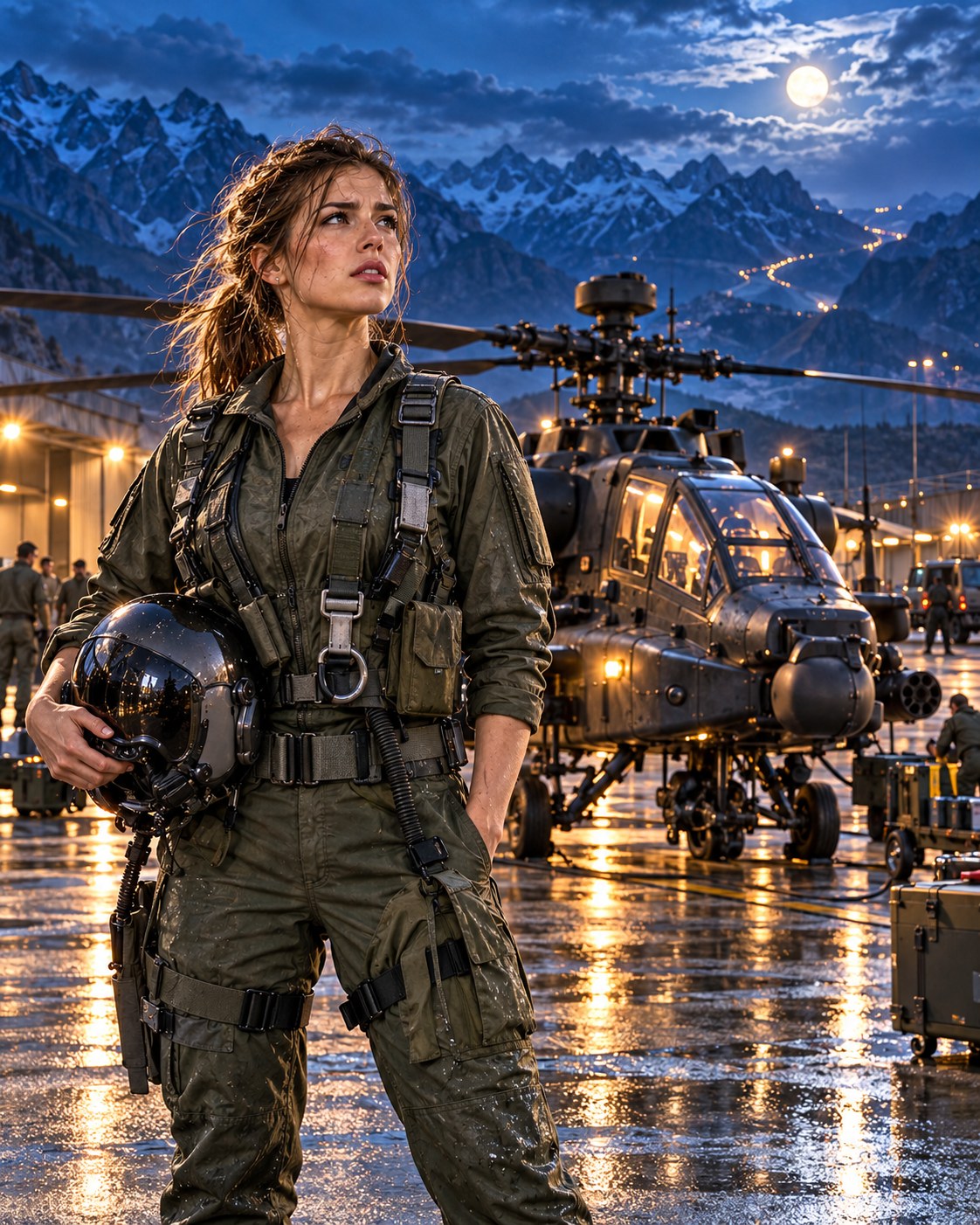
For seventeen years, I had worn the same olive-drab flight suit.
It had survived storms.
Emergencies.
Funerals.
Missions that never made the news.
It had survived the gorge.
It had survived me.
Maybe that was why I had kept it.
Not because I couldn’t afford a new one.
Because every scar in the fabric reminded me of something.
That machines could fail.
That weather could change.
That skilled people could make terrible mistakes.
That the bravest person in the room was sometimes the one willing to say no.
And that getting home was not about being fearless.
It was about respecting the things that could kill you and still finding the courage to move when the time came.
Later that morning, I finally replaced the zipper.
Maya watched from across the locker room.
“Traitor.”
I laughed.
“The wire finally broke.”
“So the relic is retiring?”
“No.”
I zipped the new closure.
“It just learned a new trick.”
She smiled.
By noon, the story had already spread through the squadron.
Some people said I had flown into a canyon no one else would touch.
Some said I had held an aircraft inches beneath live power cables during a storm.
Some said Tyler Vance had escorted me out like a wingman twice his age.
Most of them got the details wrong.
That didn’t matter.
The only detail that mattered was that sixty soldiers had gone into the mountains that night and sixty had come home.
Weeks later, a framed photograph appeared outside the briefing room.
It showed Captain Thorne’s unit standing together on the runway.
Some were bandaged.
Some were still on crutches.
All were smiling.
Underneath the photograph was a single sentence.
“Bring everyone home.”
I stopped in front of it every morning.
Sometimes Tyler would stand beside me.
Sometimes Maya.
Sometimes young pilots who had never heard the full story.
And whenever one of them asked why an old photograph of an old aircraft mattered, I gave them the same answer.
“Because talent gets you into difficult places.”
I pointed at the words.
“Judgment gets you out.”
Years later, people would still remember the mission.
They would remember the storm.
The cables.
The wounded soldiers.
The aircraft that barely made it through.
But I would remember something else.
A young pilot once called me a relic because I refused to confuse speed with strength.
And in the end, that was the lesson the canyon taught all of us.
The world will always reward the person who moves fastest.
It will praise confidence.
It will celebrate boldness.
It will make caution look old-fashioned.
But when the consequences are real, when lives depend on one decision, the bravest choice is not always to go faster.
Sometimes the bravest choice is to slow down.
Look again.
Admit what you do not know.
Wait for the right opening.
And when it finally comes, move with everything you’ve got.
Because courage is not the absence of fear.
Wisdom is not the absence of urgency.
And experience is not something that makes you obsolete.
Sometimes experience is the thing that keeps everyone else alive.
That night in the canyon, I did not prove that an old pilot could still fly.
I proved something more important.
That knowing when not to rush can be just as powerful as knowing when to act.
And that the people who make it home are more important than the people who get there first.
So let them call you a relic.
Let them laugh at the scars.
Let them wonder why you check twice when everyone else checks once.
If your caution comes from experience, and your courage comes from purpose, then wear both without apology.
There will always be another Tyler Vance.
There will always be another storm.
Another impossible valley.
Another moment when someone tells you that speed is the only way through.
When that moment comes, remember the canyon.
Remember the cables you cannot see.
And ask yourself not, “How fast can I go?”
Ask the question that matters more.
“How many people are trusting me to bring them home?”