I was halfway through a cup of terrible airplane coffee when a flight attendant rushed down the aisle, her face pale and her voice trembling.
For a long moment, I stood in the doorway of that aircraft, unable to answer the flight attendant.
My name.
It was such a simple question. Yet somehow, it felt more frightening than every emergency warning I’d faced during the flight.
“Daniel,” I finally said. “My name is Daniel Mercer.”
The flight attendant smiled through her tears.
“Mr. Mercer, you should know that everyone on this plane wants to thank you.”
I nodded, but before I could respond, a paramedic approached and asked me to step aside. They needed to examine me for possible exposure to the same contaminated cabin air that had incapacitated the captain and first officer.
I followed him down the emergency stairs.
The moment my shoes touched the runway, my knees nearly gave out.
I hadn’t noticed how exhausted I was until then.
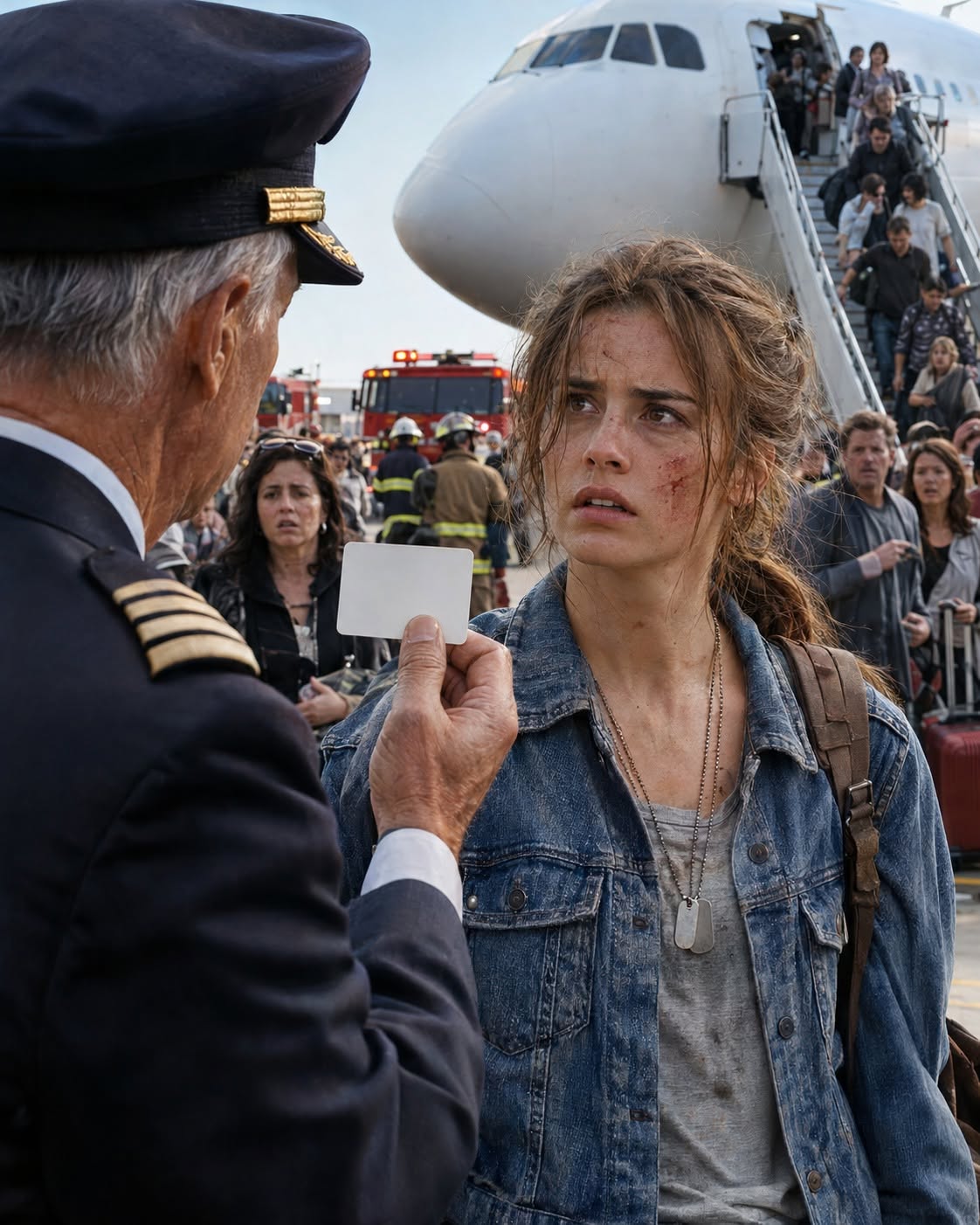
A few minutes later, I was sitting inside an ambulance while a medic checked my oxygen levels. Through the open doors, I could see passengers walking away from the aircraft, wrapped in emergency blankets. Some were crying. Others were calling their families.
And then I saw a little girl.
She couldn’t have been older than seven. She was holding a stuffed rabbit against her chest, and her mother was kneeling beside her.
The girl suddenly noticed me.
“Mommy, that’s the man who flew our plane.”
Her mother looked up.
She walked toward the ambulance, still holding her daughter’s hand.
“Sir, I don’t know how to thank you. My husband died three years ago. This was supposed to be my daughter’s first vacation with me since then. I thought I was going to lose her today.”
Her voice broke.
I looked at the little girl.
“What’s your name?”
“Emma.”
“Well, Emma, you did something very important today.”
“What?”
“You stayed brave when things got scary.”
She thought about that for a moment, then held up her stuffed rabbit.
“His name is Captain Buttons. He was brave too.”
I smiled.
For the first time that day, I laughed.
And for reasons I couldn’t explain, that small moment hurt more than the landing.
Because it reminded me of someone I had lost.
Someone whose name I had spent seven years trying not to say.
Her name was Sarah.
She was my daughter.
And she had been the reason I walked away from aviation.
Seven years earlier, I had been a senior captain for a major American airline. I had a beautiful house outside Denver, a loving wife, and a daughter who believed her father could do absolutely anything.
Sarah was nine when I first taught her how to recognize different aircraft.
She loved airplanes.
Whenever I returned from a trip, she would run to the front door and ask me which cities I had visited.
Sometimes, I brought her little souvenirs from airports. A miniature airplane from Chicago. A snow globe from Seattle. A postcard from London.
She kept every single one.
Then came the night that changed everything.
I was scheduled to fly a short domestic route from Denver to Phoenix. The weather was deteriorating, and dispatch had issued several warnings about thunderstorms along the route.
I had concerns about the flight.
I should have delayed our departure.
I knew that.
But there was pressure to maintain the schedule, and the conditions appeared manageable enough to proceed.
We departed.
About forty minutes into the flight, we encountered unexpected turbulence. It wasn’t unusual, but it was severe enough that I instructed the cabin crew to secure everything and remain seated.
Then an instrument malfunction complicated the situation.
The first officer and I worked through the abnormal procedures. We diverted toward an alternate airport and eventually landed safely.
Nobody was injured.
Nobody died.
But while I was dealing with the emergency, my wife had been trying to reach me.
Sarah had suffered a sudden medical crisis at home.
She was rushed to the hospital.
By the time I landed and switched on my phone, I had seventeen missed calls.
I called my wife immediately.
I still remember her first words.
“Daniel, where have you been?”
I didn’t answer.
I already knew.
Sarah had survived the initial crisis, but complications followed. She spent eleven days in intensive care.
I made it to the hospital, but I never made it back to the cockpit with the same confidence.
For months, I blamed myself.
I convinced myself that if I had been home, I might have recognized the warning signs sooner. If I hadn’t been flying, perhaps I could have helped her get medical attention earlier.
The doctors told me repeatedly that my absence had not caused what happened.
But grief doesn’t always listen to doctors.
Sarah eventually passed away.
She was ten years old.
After her funeral, I couldn’t bring myself to fly.
The sound of aircraft engines became unbearable. Every time I entered a cockpit, I remembered the hospital corridor and the phone call I had received.
My wife, Laura, tried to help me.
She suggested counseling. She encouraged me to take leave. She reminded me that Sarah had loved seeing me in uniform.
But I was drowning in guilt.
Eventually, our marriage collapsed under the weight of a loss neither of us knew how to carry.
Laura moved back to Ohio.
I resigned from the airline.
And I disappeared from the aviation world.
I never told anyone the full story.
Most people assumed I had retired early.
Only a handful knew what had really happened.
Seven years had passed.
And now, after saving 320 people, the past was standing in front of me again.
“Mr. Mercer?”
The paramedic’s voice brought me back.
“Your oxygen levels look stable. We’d still like you to go to the hospital for further evaluation.”
I nodded.
Then another man approached the ambulance.
He was wearing a dark suit and carrying a tablet.
“Captain Mercer?”
I looked up.
“I’m Michael Reeves. I’m with the airline’s emergency operations team.”
He glanced at the aircraft, then back at me.
“First, I want to thank you. What you did today was extraordinary.”
“Just make sure the passengers are taken care of.”
“We will. But there’s something else you need to know.”
His expression changed.
“We’ve been reviewing the aircraft’s preliminary maintenance data. The cabin-air system experienced an abnormal failure before the crew became incapacitated. Investigators are already looking into it.”
I frowned.
“What kind of failure?”
“We don’t know yet. But there are some unusual indications.”
He hesitated.
“There’s also something else. One of our passengers recorded part of your emergency landing. The video is already circulating online.”
I closed my eyes.
Of course it was.
Within an hour, my face was everywhere.
A retired airline captain saves 320 passengers after pilots collapse.
The headlines were dramatic. The comments were overwhelming.
Some people called me a hero.
Others wanted to know where I had been hiding.
Former colleagues began contacting me.
An aviation journalist requested an interview.
A retired instructor from my old airline sent a message that simply read:
I always knew you’d find your way back.
But one message stopped me cold.
It was from Laura.
Daniel, I saw what happened. Are you safe?
I stared at the screen for a long time.
Then I typed:
I’m okay.
I didn’t know what else to say.
She replied almost immediately.
I wish Sarah could have seen you today.
I put the phone down.
That night, I couldn’t sleep.
I kept replaying the landing in my mind. The warnings. The radio calls. The moment the wheels touched the runway.
But beneath all those memories was something else.
For the first time in seven years, I had spent an entire day thinking about flying without feeling like I was betraying my daughter.
That frightened me.
The following morning, I received a call from an unfamiliar number.
“Daniel Mercer?”
“Yes.”
“This is Captain Robert Hayes. I was your training captain when you first joined Western Pacific Airlines.”
I sat upright.
“Captain Hayes?”
“I’ve been following the news. Are you all right?”
“I’m fine.”
He chuckled softly.
“You always did have a talent for making complicated situations sound simple.”
I smiled faintly.
Then his voice became serious.
“Daniel, there’s something I want to discuss with you. Would you be willing to meet?”
We arranged to meet at a small restaurant near the hospital.
When I arrived, Robert was already waiting.
He was older than I remembered. His hair had turned almost completely white, and he walked with a slight limp.
But his eyes were the same.
He stood and shook my hand.
“I heard about Sarah,” he said quietly.
I looked down.
“I’m sorry I never called.”
“You didn’t owe me a call.”
We sat in silence for a moment.
Then Robert leaned forward.
“Daniel, I’ve been asked to help with the preliminary investigation into yesterday’s incident. I wanted to hear what you experienced before everyone starts filling your head with theories.”
I explained everything.
The unusual smell. The oxygen masks. The condition of the flight crew. The warnings I’d seen.
He listened carefully.
When I finished, he asked a question I hadn’t expected.
“Did you notice anything unusual about the cabin pressure before the pilots became incapacitated?”
I thought for a moment.
“Yes. There was a slight fluctuation, but it happened quickly.”
He nodded.
“That’s consistent with what we’re seeing in the initial records.”
He opened his tablet.
“The aircraft had undergone maintenance shortly before the flight. Investigators are examining whether a problem with the air-conditioning and pressurization system allowed contaminated air to enter the cockpit.”
“Could that explain why both pilots collapsed?”
“It’s one possibility. We need evidence before reaching a conclusion.”
He paused.
“There’s another thing. The airline has asked whether you would consider assisting with a formal technical review of the flight.”
I laughed without humor.
“I haven’t worked in aviation for seven years.”
“Your experience didn’t disappear.”
“I don’t know if I can do it again.”
Robert leaned back.
“Then don’t decide today.”
For the next several weeks, I helped investigators reconstruct what had happened aboard Flight 801.
I provided my observations, reviewed the flight data with the technical team, and answered questions about the decisions I had made.
The process was exhausting.
Some days, I found myself waking up at three in the morning, convinced I could still hear the warning tones from the cockpit.
Other days, I felt strangely peaceful.
I began to understand that the experience had reopened something inside me.
Not just fear.
Something I had buried beneath it.
Then, one afternoon, investigators discovered a detail that changed everything.
A maintenance technician had reported an intermittent problem with the aircraft’s air-conditioning system several days before the flight.
The issue had been documented, but the aircraft had subsequently been cleared for service after a routine inspection.
Further examination revealed a damaged component in the system.
Investigators suspected that the failure had contributed to contaminated air entering the flight deck.
The airline immediately grounded several aircraft for additional inspections.
There was no instant answer about individual responsibility. The investigation would take months, and the technical findings needed to be independently verified.
But one thing became clear.
Flight 801 had not simply suffered an unpredictable emergency.
There had been warning signs.
And somebody needed to make sure those warnings were never ignored again.
When I heard that, I felt an anger I hadn’t experienced in years.
Not because I had been forced to fly again.
But because 320 people had been placed in danger by a problem that might have been prevented.
I remembered the little girl with the stuffed rabbit.
I remembered the mother who had thought she would never see her daughter again.
And I realized something.
I had spent seven years believing my greatest failure was not being home when Sarah needed me.
But perhaps the real tragedy was allowing that guilt to convince me that I had nothing left to offer the world.
That evening, I called Laura.
She answered after the third ring.
“Daniel?”
“Hi.”
“Are you okay?”
“Yes. I just wanted to talk.”
There was a long silence.
Then I said something I had never been able to say properly.
“I still blame myself for what happened to Sarah.”
Laura began crying.
“So do I,” she whispered.
“I know the doctors said there was nothing we could have done. But I keep thinking about that night. I keep thinking I should have been there.”
“Daniel, listen to me.”
Her voice was trembling.
“Sarah never blamed you.”
I couldn’t speak.
“She used to tell me that her daddy helped people. She was proud of you. Even when you were away, she would point at airplanes and say, ‘That’s Daddy coming home.’”
I covered my face.
Laura continued.
“The last drawing she made before she got sick was of an airplane. She wrote your name underneath it. I still have it.”
I started crying.
Not the quiet tears I had learned to hide over the years.
I cried like a father who had finally allowed himself to miss his little girl.
“I’d like to see it,” I whispered.
“Then come home, Daniel.”
The following weekend, I flew to Ohio.
Not as a pilot.
Not as a hero.
Just as a man who finally understood that he couldn’t spend the rest of his life running away from the people and memories he had loved.
Laura met me at the airport.
We hugged for a long time.
Then she brought me to the house where Sarah had grown up.
Her bedroom was almost exactly as I remembered it.
The books were still on the shelf. Her favorite stuffed animals sat against the pillows. A collection of miniature airplanes lined the windowsill.
And on the desk was a framed drawing.
A blue airplane flying through white clouds.
Underneath it, in uneven handwriting, were the words:
MY DADDY BRINGS EVERYONE HOME.
I stood there for several minutes.
Then I sat on the edge of her bed and cried.
Laura sat beside me.
Neither of us tried to fix the moment.
We simply let it happen.
Before I left, she handed me a small envelope.
“I found this inside one of her books,” she said.
My name was written across the front.
The handwriting was unmistakable.
I opened it carefully.
Inside was a folded piece of paper.
Daddy,
When you fly, I hope you see the stars.
I think airplanes are lucky because they get to travel everywhere.
When you come home, I want you to tell me about all the places.
I love you.
Sarah.
I read it twice.
Then a third time.
And for the first time, I understood that my daughter had never wanted me to stop being a pilot.
She had simply wanted me to come home.
A month after the Flight 801 emergency, the airline invited me to a small ceremony honoring the crew and the passengers who had helped during the crisis.
I almost refused.
But Robert convinced me to attend.
The ceremony was held in a hotel ballroom near Los Angeles.
There were reporters, airline executives, emergency responders, and several passengers from the flight.
I stood near the back, hoping nobody would notice me.
Then I saw Emma.
She was sitting beside her mother, holding Captain Buttons.
When she spotted me, she jumped from her chair.
“Mr. Daniel!”
Her mother smiled.
“Emma has been telling everyone about you.”
The little girl ran over and handed me something.
It was a folded piece of paper.
“I made you a picture.”
I opened it.
There was a large airplane with 320 tiny stick figures inside.
At the front stood a man wearing a blue uniform.
Above him, Emma had drawn a bright yellow sun.
Underneath, she had written:
THANK YOU FOR BRINGING US HOME.
I had to look away.
During the ceremony, the airline’s chief executive approached the microphone.
He spoke about the emergency, the crew’s response, and the extraordinary actions taken by everyone involved.
Then he invited me to the stage.
The room erupted in applause.
I stood there, looking at hundreds of faces.
Some of them belonged to people I had helped.
Some belonged to people who had helped me.
For a moment, I didn’t know what to say.
Then I looked at Emma.
I looked at Laura, who had traveled to attend.
And I thought about Sarah.
I stepped toward the microphone.
“I’m grateful to be standing here,” I began. “But I want to make one thing clear. What happened aboard Flight 801 was not the work of one person.”
I paused.
“The flight attendants protected the passengers. The air traffic controller stayed with us. The emergency responders were ready on the runway. The passengers helped each other when they were frightened.”
I looked around the room.
“People sometimes think courage means never being afraid. That’s not true. I was afraid. Everyone in that aircraft was afraid.”
My voice cracked slightly.
“Courage is choosing to do what needs to be done even when fear gives you every reason to remain where you are.”
The room became silent.
“And there’s something else I’ve learned. Sometimes we carry guilt for so long that we mistake it for love. We believe that if we stop punishing ourselves, we’re somehow forgetting the people we’ve lost.”
I swallowed.
“I lost my daughter seven years ago. For a long time, I believed I had no right to be happy again. I believed I had to leave behind the life she had once been proud of.”
I looked down at Emma’s drawing.
“But yesterday, a little girl reminded me that saving lives is still something worth doing. And today, I want to believe that the people we lose would want us to keep living.”
Nobody moved.
Then the applause began.
It was louder than before.
But this time, I didn’t feel like I was being celebrated.
I felt like I was finally being understood.
After the ceremony, Robert approached me.
“I have an offer for you,” he said.
I raised an eyebrow.
“Let me guess. You want me back in the cockpit.”
He smiled.
“Not exactly.”
He explained that the airline was establishing a new safety and emergency-response training program. They wanted experienced pilots to help train flight crews, review emergency procedures, and improve communication between cockpit personnel and cabin staff.
The position would involve occasional simulator sessions, safety reviews, and mentoring younger pilots.
I would not have to return to commercial flying immediately.
I would not have to pretend the past hadn’t happened.
I could work at my own pace.
I thought about it for several days.
Then I accepted.
Not because I needed to prove anything.
Not because I wanted the headlines to remember my name.
I accepted because I had finally found a way to turn what I had experienced into something useful.
My first day back at the training center was difficult.
The familiar smell of the simulator room brought back memories I thought I had buried.
My hands trembled slightly when I entered the cockpit mock-up.
Robert noticed.
“You don’t have to do this today,” he said.
I shook my head.
“No. I want to.”
I sat in the captain’s seat.
For a few seconds, I simply looked at the instruments.
Then I placed my hands on the controls.
They felt familiar.
Not like a prison.
Like a responsibility I was finally ready to accept again.
Over the following months, I worked with dozens of young pilots and flight attendants.
I taught them how to communicate during emergencies, how to recognize the importance of seemingly minor warning signs, and how to make decisions under pressure.
But I also taught them something that wasn’t written in any manual.
I told them that passengers were not numbers on a manifest.
They were mothers, fathers, children, friends, and people with entire lives waiting for them on the ground.
I told them that every safety procedure mattered because someone was trusting them with the most precious thing they had.
Their life.
Eventually, I began flying again.
Not full-time.
Not immediately.
I started with supervised simulator evaluations and carefully selected training flights before returning to limited operational duties after completing the necessary medical, licensing, and company requirements.
I had no interest in chasing my old career.
I wanted to do the work well and come home with a clear mind.
And whenever I heard the engines start, I no longer thought only about the hospital corridor.
I also remembered 320 people walking safely across a runway.
I remembered a little girl and her stuffed rabbit.
I remembered my daughter’s drawing.
One year after Flight 801, I received an unexpected package.
There was no return address, only a handwritten note.
Inside was a photograph.
It showed Emma standing beside a miniature airplane, smiling with Captain Buttons tucked under one arm.
On the back, her mother had written:
Emma still talks about the man who flew her home. She says she wants to become a pilot someday. I thought you should know.
I placed the photograph on my desk.
Beside it, I put Sarah’s drawing.
Two little girls.
Two different moments in my life.
Both had reminded me why people mattered more than anything else.
A few weeks later, I was invited to speak at an aviation safety conference.
At the end of my presentation, a young pilot approached me.
He couldn’t have been more than twenty-five.
“Captain Mercer, can I ask you something?”
“Of course.”
He looked nervous.
“Have you ever regretted stepping away from aviation?”
I considered the question.
“Every day for a while.”
“Then how did you find the courage to return?”
I smiled.
“I stopped trying to return to the person I used to be.”
He frowned slightly.
I continued.
“You don’t have to erase your past to build a future. And you don’t have to be fearless to do something meaningful. You just have to understand why you’re doing it.”
He nodded slowly.
Then he asked the question I had once asked myself.
“What if you’ve made a mistake you can never forgive yourself for?”
I looked at him.
“Then start by making sure it doesn’t become the only thing that defines you.”
He thanked me and walked away.
I remained by the window for a while, watching aircraft take off in the distance.
The sky was clear.
A white jet climbed above the clouds, disappearing into the sunlight.
I thought about Sarah.
I still missed her every day.
That would never change.
But I no longer believed that happiness was a betrayal of her memory.
I no longer believed that leaving aviation had been the only way to honor her.
And I no longer believed that my life had ended on the day hers did.
Sometimes, the hardest landing isn’t the one that happens on a runway.
It’s the one that happens inside your heart, when you finally stop fighting the past and allow yourself to come home.
Flight 801 taught me that 320 lives can depend on one person deciding to stand up when everyone else is afraid.
But Sarah taught me something even more important.
You cannot control every storm.
You cannot change every decision.
And you cannot bring back everyone you lose.
But you can decide what you do with the life you still have.
Today, I still keep two pictures on my desk.
One is Emma with Captain Buttons.
The other is Sarah’s blue airplane.
Whenever a young pilot asks me why I chose this profession, I point to those pictures.
Then I tell them:
“Because somewhere, someone is waiting for the people on that plane to come home.”
And every time I walk toward a cockpit, I carry those words with me.
Not as a burden.
Not as a punishment.
But as a promise.
A promise to keep showing up.
A promise to keep learning.
And a promise to never mistake the pain of losing someone for a reason to stop loving the world.
I spent seven years believing I had lost my purpose.
Then, on one terrifying flight, I discovered that sometimes purpose doesn’t disappear.
Sometimes it waits quietly for us to find the courage to stand up again.