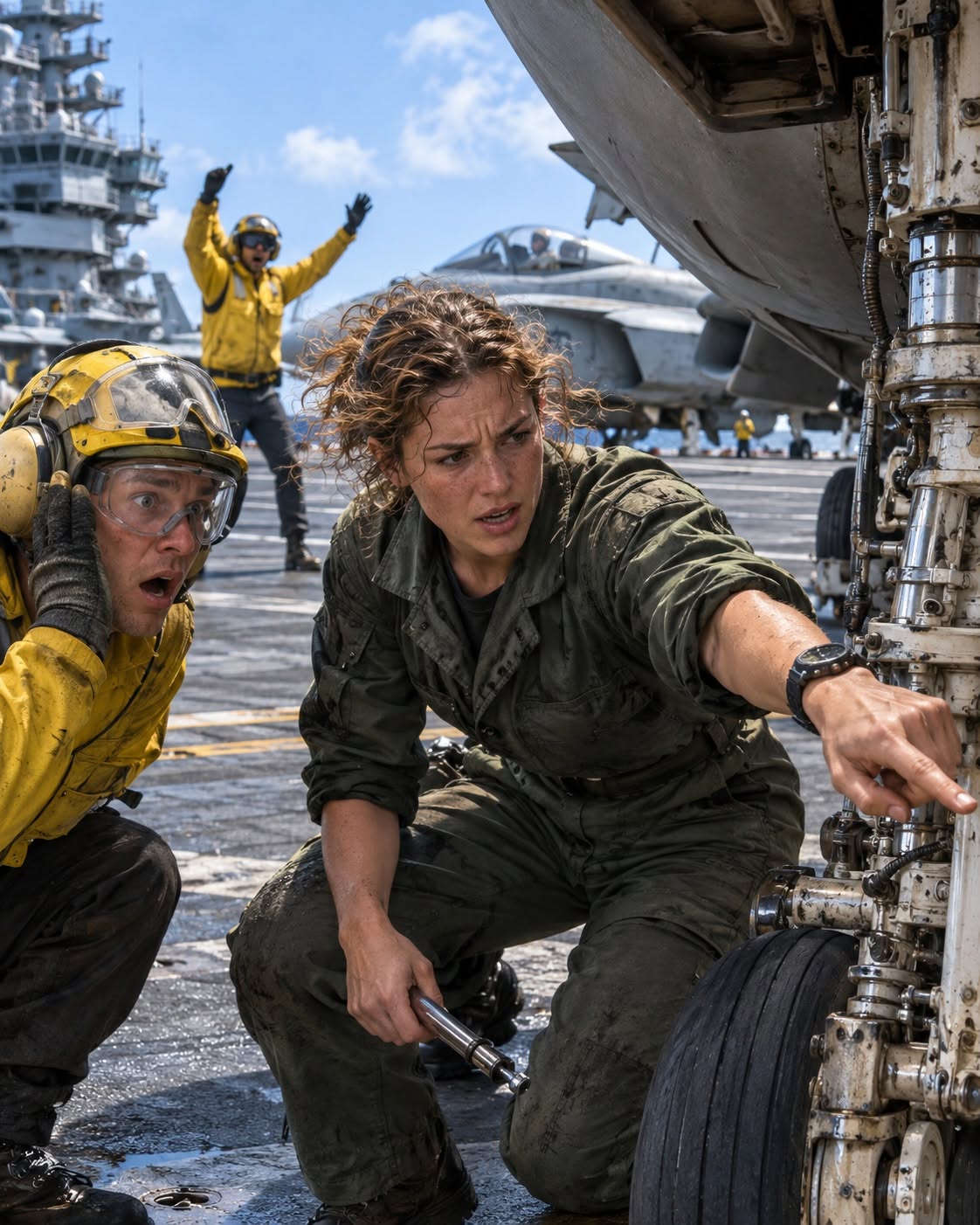
I was checking the landing gear of a fighter jet when I spotted something that made my stomach drop.
The supervisor turned the report toward me.
For a moment, I couldn’t understand what I was looking at. There were photographs of the hydraulic assembly, close-up images of the missing safety pin, and several pages of technical observations. But one sentence near the top of the report made my blood run cold.
“The object was not simply lodged in the assembly. Its position had interfered with a critical hydraulic component.”
I looked up at him.
“What does that mean?”
He took a slow breath.
“It means this aircraft may have experienced a serious hydraulic malfunction during flight if the obstruction had shifted under operating conditions.”
Nobody spoke.
The hangar suddenly felt much quieter than it had a few minutes earlier.
One of the engineers stepped forward and explained that the pin had been found in a particularly sensitive area. Although the aircraft’s hydraulic system had passed its previous routine checks, the foreign object created a risk that could not be ignored.
“If it had moved at the wrong moment,” he continued, “the consequences could have been severe.”
I stared at the photograph again.
A tiny piece of metal.
Something that could easily fit between two fingers.
Yet it had the potential to turn an ordinary training flight into an emergency.
The supervisor placed the report on the table.
“There’s something else,” he said.
I looked at him.
“The pin doesn’t appear to have come from the component where we found it.”
That was the moment everything changed.
Until then, I had assumed that a safety pin had somehow worked its way loose during maintenance. Perhaps someone had dropped it. Perhaps it had been overlooked during an earlier inspection.
But if it hadn’t come from that assembly, where had it come from?
And more importantly, how had it ended up inside the hydraulic system?
The maintenance officer asked the engineering team to investigate its origin. They compared the dimensions, markings, and physical characteristics of the recovered pin against the aircraft’s maintenance records.
Several minutes later, one of the technicians returned with a folder.
He looked uncomfortable.
“We’ve identified a possible match.”
The supervisor opened the folder.
The pin appeared to belong to a safety mechanism associated with a different section of the aircraft.
A section that had been inspected during maintenance the previous evening.
I felt my stomach tighten.
“Are you saying someone dropped it in there?” I asked.
The engineer shook his head.
“Not necessarily. We don’t know how it happened yet. But the records indicate that this aircraft underwent additional maintenance before today’s scheduled departure.”
The maintenance officer turned toward the supervisor.
“Who worked on it last night?”
The supervisor checked the paperwork.
Three names appeared on the maintenance record.
One belonged to a senior technician who had been working with the squadron for almost fifteen years.
Another belonged to a recently transferred mechanic.
The third name was mine.
I stared at the page.
“Wait. I didn’t work on that section last night.”
The supervisor studied me carefully.
“Your name is listed as the person who completed the final inspection.”
I shook my head.
“I completed the inspection this morning. I didn’t sign off on that maintenance operation.”
The maintenance officer frowned.
“Are you certain?”
“Absolutely.”
He closed the folder.
“Then we have another problem.”
I had spent years learning that aircraft maintenance was built on trust. Every inspection, every signature, and every recorded action represented a promise that the next person could safely continue their work.
A signature wasn’t just ink on a page.
It was someone’s life attached to a decision.
And now my name appeared beside work I hadn’t performed.
The supervisor immediately requested a review of the maintenance documentation. The aircraft remained grounded, and the investigation was expanded to include the previous night’s maintenance activities.
I was told not to make assumptions or confront anyone.
Just explain exactly what I knew.
That sounded simple enough.
But it became much harder when I saw the senior technician walk into the hangar.
His name was Daniel.
He had been one of the first people to train me when I joined the maintenance unit. He was the kind of mechanic who could recognize a developing problem simply by listening to an engine.
He had taught me never to rush an inspection, never to ignore an unusual sound, and never to sign something I hadn’t personally verified.
When he noticed the group gathered around the aircraft, he approached us.
“What’s going on?”
The maintenance officer handed him a copy of the report.
Daniel read it slowly.
His expression changed when he reached the photograph of the pin.
“Where did you find this?”
“Inside the hydraulic assembly,” I answered.
He looked directly at me.
“You found it?”
I nodded.
He lowered the report.
“Then you did exactly the right thing.”
For some reason, his response made me even more uneasy.
The supervisor asked him about the previous evening’s maintenance work.
Daniel explained that he had been assigned to inspect a nearby assembly, but another technician had completed the final checks.
“Did you leave any tools or components in the area?” the officer asked.
“No,” Daniel replied. “Everything was accounted for before the aircraft was released.”
“What about the safety pin?”
Daniel studied the photograph again.
“I recognize that type of pin. But I can’t tell you how it got there.”
The maintenance officer asked him to remain available while the investigation continued.
Daniel nodded without arguing.
Then, as everyone began leaving the table, he quietly approached me.
“Listen,” he said. “Don’t let anyone convince you that you made a mistake by grounding that aircraft.”
I looked at him.
“I wasn’t planning to.”
“Good. Because I’ve seen what happens when people become more concerned about schedules than safety.”
He walked away before I could ask what he meant.
By lunchtime, the atmosphere inside the hangar had completely changed.
The pilot who had been scheduled to fly that morning was informed that the aircraft would remain unavailable until the technical investigation was complete.
His name was Captain Michael Reeves.
He had been flying military aircraft for more than a decade and was known for being calm under pressure.
When he heard about the discovery, he requested a meeting with the maintenance officer.
I happened to be nearby when he arrived.
“Can someone explain what happened?” he asked.
The officer described the missing pin and the preliminary findings.
Michael listened without interrupting.
When the explanation was finished, he turned toward me.
“You’re the mechanic who spotted it?”
“Yes, sir.”
He extended his hand.
“I’m Michael. I want to thank you.”
I shook his hand.
“Just doing my job, sir.”
He gave a small smile.
“That’s what people always say. But sometimes doing your job means being the person who delays everyone else, even when nobody wants to hear it.”
His words stayed with me.
Then he asked something unexpected.
“Did the inspection reveal anything else unusual?”
I thought for a moment.
“Not directly. But I noticed something strange before finding the pin.”
“What was it?”
“The maintenance access area looked like it had been disturbed recently. I initially assumed it was from the previous inspection.”
Michael exchanged a glance with the maintenance officer.
“Did you document that?”
“I mentioned it in my notes.”
The officer immediately requested my inspection records.
We reviewed them together.
There, beneath my observations about the landing gear, was a short handwritten note:
Unusual disturbance near access area. Verify previous maintenance activity.
It was something I had almost forgotten.
But now it seemed important.
The investigation team requested access to the hangar’s maintenance records and available security footage.
At first, nothing unusual appeared.
Technicians had entered and left throughout the previous evening. Aircraft were moved between designated areas. Equipment was transported. Routine work continued.
Then one investigator noticed something.
At 9:42 p.m., a technician had returned to the aircraft after the maintenance team had officially completed its work.
The footage showed him carrying a small equipment case.
He remained near the landing gear area for several minutes before leaving.
The investigator paused the recording.
“Can anyone identify him?”
The supervisor leaned closer to the screen.
His face became serious.
It was a temporary contractor named Eric.
Eric had been working with the maintenance unit for only six weeks.
According to the records, he had been assisting with equipment inventory and support tasks.
He wasn’t authorized to complete independent maintenance work on that aircraft.
The officer requested that Eric be brought in for questioning.
When he arrived, he looked confused.
“Is something wrong?” he asked.
The supervisor showed him the photograph of the safety pin.
Eric stared at it for several seconds.
Then he looked down.
“Where did you find that?”
The room went silent.
The officer repeated the question.
Eric swallowed.
“I think I know what happened.”
He explained that during the previous evening’s work, he had been helping move maintenance equipment. At some point, a small container of safety components had been knocked over near the aircraft.
He had collected most of the items.
But he couldn’t remember whether every piece had been accounted for.
“Why didn’t you report it?” the maintenance officer asked.
Eric looked ashamed.
“I thought I had picked everything up.”
“Did you enter the maintenance area afterward?”
He nodded.
“I went back to check something. I noticed one of the access covers wasn’t secured the way I expected, but I thought the maintenance crew would handle it.”
The supervisor’s expression hardened.
“You thought someone else would handle it?”
Eric looked down again.
“I didn’t want to cause trouble. I was afraid I’d lose the contract.”
For several seconds, nobody said anything.
Then the investigator asked the question that mattered most.
“Did you put the pin inside the hydraulic assembly?”
Eric immediately shook his head.
“No. I never touched that assembly. I don’t even have authorization to work on it.”
The investigation continued.
The technical team confirmed that the pin was consistent with the type of component used in the nearby maintenance area, but its exact path into the hydraulic assembly had not yet been established.
The security footage provided another important detail.
The access area had been opened during an authorized maintenance operation earlier that evening.
The contractor’s return happened afterward.
That meant the pin could have entered the area through an accidental sequence of events, but investigators still needed to establish precisely what had happened.
Nobody was willing to declare the matter solved.
And I began to understand why.
In aircraft maintenance, finding an object is only the beginning. You must establish where it came from, how it arrived, what it contacted, and whether any hidden damage remains.
The technical team continued its examination.
Hours passed.
The grounded aircraft remained inside the hangar, surrounded by engineers and maintenance specialists.
At around 4:30 p.m., I was called into the supervisor’s office.
He sat behind his desk with several documents in front of him.
“Take a seat.”
I did.
He looked at me for a moment.
“There’s something we need to discuss about your inspection record.”
My stomach tightened.
“Yes, sir?”
“Your signature appears on the previous night’s maintenance release.”
I shook my head.
“I told you, I didn’t sign that.”
He turned the document around.
There was my name.
But the signature looked slightly different from mine.
I leaned closer.
The handwriting was similar, but something was wrong with the final letter.
“That’s not my signature.”
The supervisor nodded.
“We’re checking the electronic record as well. It appears the entry was made using a shared maintenance terminal.”
I felt a chill move through me.
Someone had entered my name into the record.
Someone had made it appear that I had completed an inspection I had never performed.
“Do you know who did it?” I asked.
“Not yet. We have to establish the facts before drawing conclusions.”
I understood.
But I couldn’t stop thinking about it.
If I hadn’t discovered that pin, the aircraft might have been released with a maintenance record carrying my name.
And if something had happened afterward, I could have been blamed for an inspection I never conducted.
The supervisor noticed my expression.
“I want you to understand something,” he said. “You are not being investigated for finding the problem. Your actions are part of the evidence that helped us identify it.”
I nodded.
“Thank you, sir.”
He leaned back.
“One more thing. The technical team has completed another stage of the examination. They found evidence that the foreign object had contacted a nearby hydraulic component. We need to keep the aircraft grounded until the approved engineering assessment is complete.”
I felt my hands tighten.
“Was there damage?”
“There’s evidence of contact. The engineers are determining whether the component can be returned to service or must be replaced. We won’t speculate before they finish.”
That evening, I went home exhausted.
I kept thinking about the aircraft.
I imagined the pilot climbing into the cockpit, expecting an ordinary flight, unaware that a small piece of metal might be waiting inside a system he depended on.
I also thought about Eric.
He had made a mistake, perhaps through carelessness and fear. But the falsified inspection record suggested that something more serious had happened.
I barely slept.
The following morning, I returned to the hangar earlier than usual.
Daniel was already there.
He was standing beside the aircraft, looking at the grounded landing gear.
“Couldn’t sleep either?” he asked.
I gave a tired smile.
“Not much.”
He nodded toward the maintenance office.
“They’ve been reviewing everything overnight.”
“Did they find anything?”
He hesitated.
“Something, apparently. But I don’t know the details.”
We stood quietly for a moment.
Then Daniel spoke again.
“You know, when I first started working on aircraft, my instructor told me something I’ll never forget.”
“What was it?”
“He said a good mechanic doesn’t just look for what is wrong. A great mechanic is willing to question what everyone else assumes is right.”
I looked at him.
“That’s exactly what happened yesterday.”
“Yes,” he said. “And that’s why you need to keep trusting your training.”
Before I could respond, the maintenance officer called us into the briefing room.
The investigation team had received additional findings.
The officer stood at the front of the room with a technical report in his hand.
“We’ve established that the pin was not part of the hydraulic assembly,” he began. “It was introduced into the area during an earlier maintenance period. The precise sequence is still under review, but we have confirmed that it came from equipment used during the previous evening’s work.”
He turned to the next page.
“More importantly, the object had contacted a component whose condition could not be accepted without further engineering evaluation. The system’s earlier checks did not identify the foreign object.”
He paused.
“Had the aircraft been released, we cannot guarantee that the hydraulic system would have continued operating as intended under all flight conditions.”
The room became silent.
Then he showed us another document.
It concerned the maintenance release.
The electronic audit trail had revealed that my name was entered after the maintenance work had been completed.
But the terminal log showed that the entry had been made under another employee’s account.
That employee was a maintenance coordinator who had been responsible for organizing the previous night’s paperwork.
He was called into the room.
At first, he denied knowing anything about the altered record.
But when the investigation team presented the electronic timestamps and access records, his expression changed.
Eventually, he admitted that he had entered the inspection under my name.
His explanation was difficult to hear.
He claimed that the previous night’s work had fallen behind schedule. Several inspection records were incomplete, and he had been under pressure to prepare the aircraft for the next morning’s departure.
Instead of delaying the release and requesting the required verification, he had entered the missing information using a name already associated with the aircraft’s maintenance team.
He insisted that he believed the work had been completed correctly.
But that didn’t change what he had done.
He had created a false maintenance record.
And he had placed the responsibility on someone who had never performed the inspection.
The supervisor looked around the room.
“Let this be clear. No schedule, no deadline, and no administrative pressure gives anyone permission to falsify a safety record.”
The coordinator was removed from maintenance duties pending a formal investigation.
Eric’s actions were also reviewed separately. He had failed to report the missing inventory item and had returned to an area without a clear work requirement. His lack of experience and fear of losing his contract had contributed to the situation, but he was still accountable for his decisions.
The investigation was not about finding one person to blame.
It was about understanding every failure that had allowed the situation to develop.
That afternoon, the engineering team delivered its final assessment.
The hydraulic assembly required further corrective maintenance, and a component that had been exposed to the foreign object was declared unsuitable for continued service.
The aircraft would remain grounded until the approved corrective work, inspections, and documentation were completed.
I watched the engineers gather their equipment.
For the first time since discovering the pin, I felt that the immediate danger had been contained.
But something else was bothering me.
I had always believed that safety depended on people following procedures.
Now I understood that procedures could only work if people were honest about what they had actually done.
A checklist could contain every required step.
A maintenance record could look perfectly complete.
An aircraft could appear ready for departure.
Yet none of those things meant anything if someone was willing to put a signature where their own hands had never been.
Three days later, Captain Reeves returned to the hangar.
The aircraft was still grounded, but the replacement component had arrived and the approved maintenance work was progressing.
He found me near the inspection area.
“How’s our aircraft doing?” he asked.
“Better, sir. The engineers are finishing the corrective work.”
He smiled.
“Good. I’ve been thinking about what happened.”
I looked at him.
“About the pin?”
“About the decision you made.”
I shrugged.
“I didn’t really have a choice.”
He shook his head.
“That’s what makes it important. There were probably a dozen reasons to ignore something that small. The flight was scheduled. The crew was ready. Everyone expected the aircraft to leave.”
He paused.
“But you didn’t ignore it.”
I didn’t know what to say.
He continued.
“People sometimes think courage is doing something extraordinary under pressure. But in my experience, some of the bravest decisions are ordinary ones. A person notices something wrong, speaks up, and refuses to pretend everything is fine.”
He thanked me again before walking away.
A week later, the aircraft completed its corrective maintenance and the required technical evaluations. The maintenance team reviewed the documentation, verified the work, and authorized the aircraft for return to service through the proper process.
I watched it being moved toward the flight line.
The pilot climbed into the cockpit.
The engines eventually came to life, and the aircraft prepared for its scheduled departure.
I stood with Daniel near the hangar entrance.
“Feels strange seeing it ready again, doesn’t it?” he asked.
I nodded.
“Just a week ago, everyone thought it was ready.”
Daniel gave a quiet laugh.
“That’s why we inspect them.”
The aircraft taxied away.
For a moment, I watched it disappear into the distance.
Then Daniel placed a hand on my shoulder.
“Come on. We’ve got another inspection waiting.”
I smiled.
And we went back to work.
But the story didn’t end there.
Several weeks later, the maintenance unit introduced a new internal review of foreign-object reporting and maintenance documentation. The system was updated to make individual verification more accountable, and staff received additional training on reporting discrepancies without fear of retaliation.
The incident also became part of a safety briefing for the entire maintenance crew.
I was asked to speak about what I had found.
Standing in front of dozens of mechanics, engineers, and supervisors, I felt unexpectedly nervous.
I had never considered myself someone who needed to give speeches.
I preferred working quietly, checking components, and making sure everything was where it belonged.
But I knew this mattered.
I placed a photograph of the recovered pin on the screen.
It looked almost ridiculous.
A tiny metal object against a large mechanical assembly.
I began by explaining how I had discovered it, what I had noticed, and why I had refused to allow the aircraft to proceed.
Then I told them about the falsified maintenance record.
I explained how a single administrative shortcut had created a second danger, one that could have hidden the truth and placed responsibility on the wrong person.
When I finished, I looked around the room.
“I want everyone to remember something,” I said. “The aircraft doesn’t know how busy we are. It doesn’t know that a pilot is waiting, that a schedule is falling behind, or that someone is worried about getting into trouble. It only responds to the condition it’s in.”
Nobody moved.
“If something doesn’t look right, we have to speak up. Even if we’re the only person in the room who thinks there’s a problem. Especially then.”
An older mechanic raised his hand.
“What if you’re wrong?”
I thought about the question.
“Then we investigate and establish the facts. But being wrong after reporting a genuine concern is far better than being right only after something terrible happens.”
A few people nodded.
I looked at the photograph one last time.
“That pin was small. The responsibility wasn’t.”
The room remained quiet for a moment before the supervisor thanked everyone and ended the briefing.
As people began leaving, a young mechanic approached me.
He couldn’t have been older than twenty-five.
“I’ve only been here a few months,” he said. “Sometimes I notice things that don’t seem right, but I don’t always know whether I should question someone more experienced.”
I smiled.
“Experience matters. But it doesn’t make anyone incapable of making mistakes.”
He nodded.
“So I should still speak up?”
“Always. Do it respectfully, explain what you’ve noticed, and let the proper people investigate. Never hide something because you’re afraid of how someone might react.”
He thanked me and walked away.
I watched him leave and thought about how easily the entire incident could have been different.
If I had assumed someone else had already checked the area, I might have missed the pin.
If I had worried about delaying the flight, I might have stayed silent.
If the maintenance officer had dismissed my concern, the aircraft might have been released.
If the falsified record had never been examined, an unsafe culture could have continued unnoticed.
And if the pilot had taken off that morning, we might never have known how close we had come to a serious accident.
Months passed.
The investigation was eventually completed, and the personnel involved faced the appropriate consequences. The unit also made changes to its reporting procedures, equipment accountability, and maintenance oversight.
Daniel continued training younger mechanics.
Captain Reeves continued flying.
Eric was no longer assigned to aircraft maintenance duties, and the organization reviewed how contractors were trained and supervised.
As for me, I returned to my normal routine.
I still checked landing gear assemblies.
I still examined hydraulic components.
I still completed the same long lists of inspections that most people would never notice.
But one thing had changed.
Whenever I approached an aircraft, I no longer thought of a checklist as a series of boxes to complete.
I thought of it as a series of promises.
A promise that the person responsible for each task had actually performed it.
A promise that a concern would never be hidden just to keep a schedule.
A promise that the people climbing into the cockpit could trust the people working beneath the aircraft.
One evening, long after the incident, I was finishing another pre-flight inspection when I noticed a junior mechanic standing nearby.
He was looking at a small component with a puzzled expression.
“Something wrong?” I asked.
He hesitated.
“I’m not sure. This doesn’t look quite right.”
I walked over.
“Show me.”
He pointed to the area he was examining and explained what had caught his attention.
We checked it together and discovered a discrepancy that needed to be reviewed by the maintenance supervisor.
It wasn’t a dramatic discovery.
There was no emergency.
No pilot waiting anxiously.
No entire aircraft being grounded.
Just another small detail that deserved attention.
I thanked him for speaking up and made sure the issue was properly reported.
As he walked away, I remembered the first time I had spotted that missing safety pin.
I remembered the cold feeling in my stomach, the silence in the hangar, and the moment I realized that a routine inspection had become something much bigger.
Then I looked at the aircraft in front of me.
It was enormous, powerful, and built to operate under conditions most people could barely imagine.
Yet its safety still depended on ordinary people noticing ordinary things.
That was the lesson I carried with me.
The world often celebrates pilots for their courage, engineers for their intelligence, and commanders for their leadership.
But behind every safe flight are countless people whose names passengers and pilots may never know.
People who check one more connection.
People who question one unusual mark.
People who refuse to sign a document they haven’t verified.
People who are willing to stop everything when something doesn’t feel right.
And sometimes, those people save lives without ever realizing how close the danger came.
I never kept the safety pin as a souvenir. It belonged in the investigation records, where it could serve as evidence and a reminder of what had happened.
But I kept something more important.
A small handwritten note in my maintenance notebook.
It contained just one sentence:
“Never let the size of a problem determine the seriousness of your response.”
Because that morning, it hadn’t been a malfunctioning engine, a cracked landing gear, or a major hydraulic failure that stopped an aircraft from taking off.
It had been one tiny metal pin.
And one mechanic who decided that ignoring it was not an option.
I had once believed that my job was simply to make sure aircraft were ready to fly.
Now I understood something much more important.
My job was to make sure they were safe enough to bring everyone home.