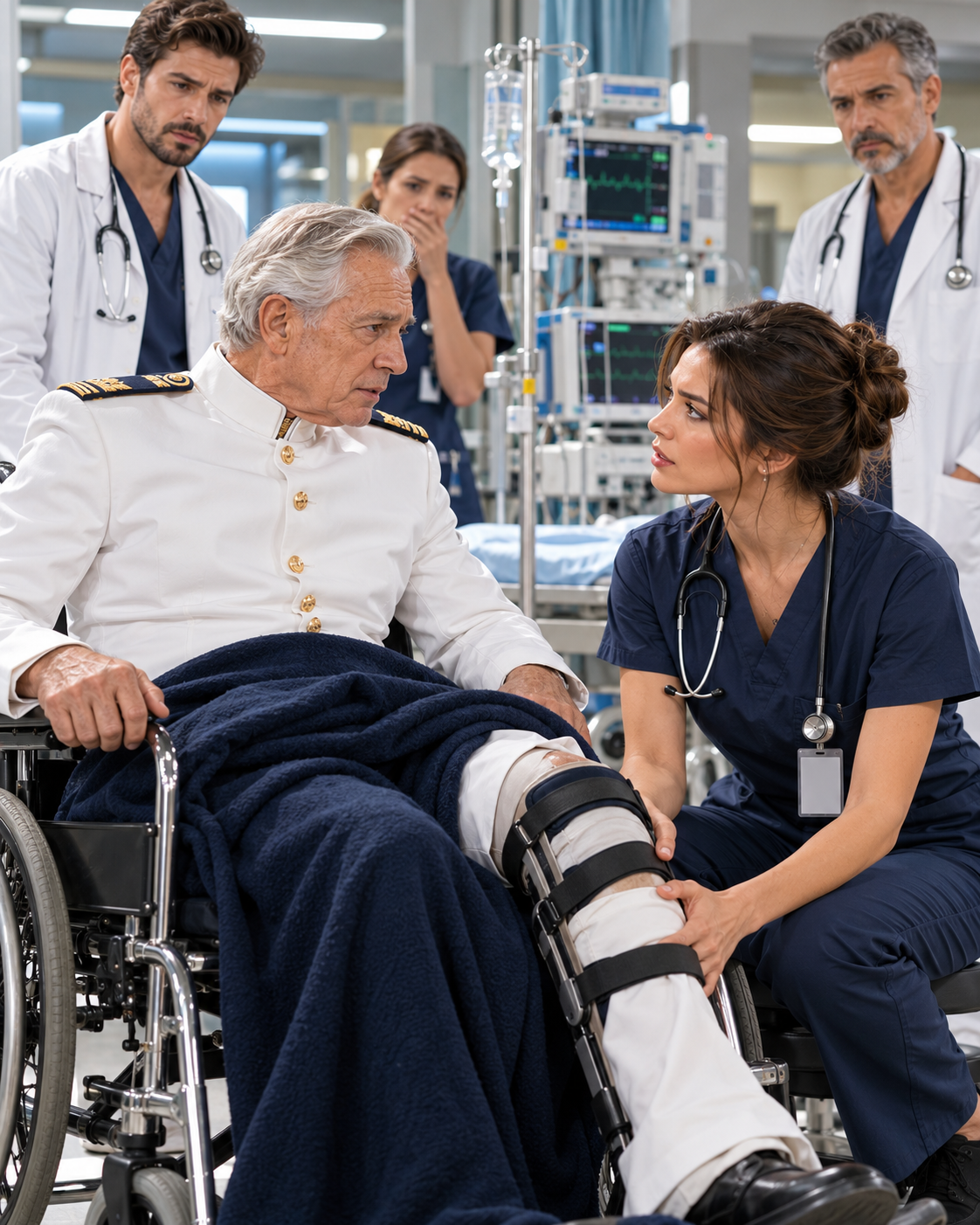
I was being wheeled through the emergency entrance of Bayside General when Dr. Finch looked at my useless legs
Part 2
The emergency scan changed everything.
Not immediately.
Not cleanly.
But enough.
The new images showed something the old reports had never mentioned.
My spinal cord was severely damaged.
But it was not completely destroyed.
A region of compressed tissue still carried faint electrical activity.
The bridge was there.
Dormant.
Scarred.
Waiting.
Dr. Finch stood in front of the scan for a long time.
Finally, he said, “That shouldn’t be possible.”
Brenna folded her arms.
“It is.”
He looked at me.
Then at the scan.
Then back at me.
“I owe you an apology.”
I had spent twenty years hearing certainty from men in white coats.
That was the first time one of them had admitted he might have been wrong.
But the story was bigger than me.
Brenna disappeared into an office for almost an hour.
When she returned, she carried a battered case.
Inside were old military documents, photographs, handwritten medical notes, and a list of names.
Thirty-nine names.
She placed the list on the table.
“Thirty-nine patients,” she said.
“All abandoned?”
She nodded.
“When Starlight was shut down, the program was buried.”
“What happened to them?”
“Some died.”
Her voice cracked.
“Some disappeared into the civilian system.”
“And the rest?”
“They were told their injuries were permanent.”
I stared at the list.
For twenty years, I had believed my tragedy was isolated.
It wasn’t.
There were thirty-eight other people carrying the same lie.
One name caught my eye.
Lucas Vance.
Brenna knew him.
She had recently located him living in a small town in Ohio.
He had been told for years that the numbness in his legs was irreversible.
With permission, they activated his dormant circuit.
He felt heat in his feet.
He cried so hard he couldn’t speak.
Then there was Perry Vance.
He had never been found in time.
His widow later wrote to Brenna.
She did not ask for money.
She did not ask for an apology.
She wrote only one sentence that Brenna showed me.
“Thank you for finally coming back for him.”
I read it three times.
Then I turned away.
Because I knew exactly what she meant.
Someone had come back for us.
And someone else had decided we weren’t worth coming back for.
The person who wanted the truth buried was Colonel Donald Vance, the former director of Project Starlight.
He was retired now, but his influence had survived him.
When he learned Brenna had activated my implant, the threats began.
First came phone calls.
Then legal notices.
Then a warning that Bayside General could lose federal contracts if the hospital continued unauthorized treatment.
Finch finally stood beside Brenna.
“We’re not transferring him.”
The hospital administration panicked.
Brenna refused to back down.
And then my old colleague, Brigadier General Garrett Vance, entered the fight.
Garrett had served with me years earlier.
He arrived at the hospital in a dark coat, carrying a folder under one arm.
He placed it on the administrator’s desk.
“You can threaten the nurse,” he said.
“You can threaten the hospital.”
He paused.
“But if you threaten these veterans again, you’ll have to do it publicly.”
Inside the folder were congressional contacts, military records, medical documentation, and enough evidence to force an investigation.
The door that had been closed for twenty years finally began to crack open.
But getting my circuit awake was only the beginning.
My muscles had forgotten what standing meant.
My bones had forgotten the weight of my body.
My brain had forgotten the language of movement.
Dr. Evelyn Thorne became my physical therapist.
She was relentless.
“Again.”
“I can’t.”
“Again.”
“My legs are shaking.”
“They’re supposed to.”
“I hate you.”
She smiled.
“Good. Again.”
The first month was humiliation.
My knees collapsed.
My feet twisted.
My arms shook from holding parallel bars.
I sweated through shirts and cried when nobody was watching.
Sometimes I screamed.
Sometimes I begged them to stop.
Once, after a particularly brutal session, I told Clara, “This was a mistake.”
She sat beside me.
“No.”
“I can’t do this.”
“You already did the impossible.”
“What?”
“You let us hope again.”
I hated her for saying it.
Because she was right.
Hope hurt.
Every morning, my body reminded me why I had stopped believing.
But every evening, something had changed.
A toe moved.
A calf tightened.
A foot responded to pressure.
Tiny victories.
Invisible victories.
The kind nobody applauds.
Then one morning, Evelyn placed her hands on my shoulders.
“Stand.”
I gripped the bars.
My legs trembled violently.
I pushed.
My knees buckled.
I fell.
Pain exploded through my hip.
Evelyn did not rush to comfort me.
She waited.
“Again.”
I stared at her.
“You really don’t know how to say anything else, do you?”
“No.”
I tried again.
This time, I stayed upright for three seconds.
Three seconds.
That was all.
But when I looked at Clara through the glass, she had both hands over her mouth.
Julian was crying openly.
I turned away before they could see my face.
Because I was crying too.
Months passed.
The investigation widened.
Other veterans were found.
Other circuits were discovered.
Some were too damaged.
Some had been removed.
Some patients had died years earlier.
But enough remained.
Enough to prove that Starlight had not been a failure.
It had been abandoned.
That distinction mattered.
Because failure is sometimes tragic.
Abandonment is a choice.
And choices have consequences.
By the sixth month, I could take steps with a walker.
By the eighth, I could cross a room with a cane.
By the ninth, I could stand without holding anything for nearly a minute.
Evelyn called that “dangerously encouraging.”
I called it freedom.
Still, I had one final battle left.
Not against my legs.
Against the man I had become.
For twenty years, I had defined myself by what I could no longer do.
I was the admiral who could not stand.
The father who needed help.
The man who had learned to measure every room by wheelchair access.
I was afraid that walking would somehow force me to become the old version of myself again.
But the old me was gone.
The man who survived had been built from every loss.
One rainy afternoon, Brenna came into the rehabilitation room.
She held a garment bag.
“What is that?”
“Something you asked me to bring.”
Inside was my old Navy dress uniform.
It had been altered years earlier because I had never expected to wear it standing again.
I touched the fabric.
“I can’t wear that.”
“You can.”
“I haven’t worn it since the blast.”
“Then maybe it’s time.”
I looked at her.
“Why are you doing all this?”
She smiled faintly.
“Because twenty years ago, someone stopped looking for you.”
She zipped the garment bag closed.
“I decided I wouldn’t.”
The next morning, Bayside General prepared a small ceremony.
No press.
No cameras.
Just doctors, nurses, therapists, veterans, families, and the people who had refused to let thirty-nine forgotten names disappear.
I put on my uniform.
Clara adjusted my collar.
Julian fixed my sleeve.
My hands were shaking.
“So,” Julian whispered, “you ready?”
“No.”
He smiled.
“Good.”
We entered the room together.
Everyone stood.
I was still holding my cane.
Brenna stood near the front.
Evelyn stood beside her.
Dr. Finch was there too.
He looked older than he had nine months earlier.
Maybe guilt does that.
Maybe truth does.
I stopped in the center of the room.
For a moment, I felt the weight of twenty years pressing down on me.
Then I looked at my cane.
I set it on the floor.
And I let go.
Part 3
The room became completely silent.
I shifted my weight onto my left leg.
Then my right.
My knees trembled.
Every instinct told me to reach for something.
A chair.
A wall.
A hand.
Anything.
But I didn’t.
I took one step.
Then another.
The third step was the hardest.
Not because my legs were weak.
Because twenty years of fear were telling me I had no right to believe in the fourth.
I took it anyway.
Clara began to cry.
Julian covered his face.
Someone behind me whispered, “Oh my God.”
I kept walking.
Five steps.
Seven.
Ten.
I stopped in front of Brenna Caldwell.
The nurse who had been told to keep quiet.
The nurse who had been threatened.
The nurse who had opened a forgotten case and refused to close it.
She looked at me, tears filling her eyes.
“Admiral,” she whispered.
I straightened my back.
My legs shook beneath me.
But they held.
Then I raised my right hand.
Slowly.
Precisely.
The way I had done thousands of times before.
I rendered a crisp standing salute.
Brenna covered her mouth.
She shook her head.
“Please don’t.”
I kept my hand raised.
Because the salute was not for rank.
It was not for medals.
It was not even for the Navy.
It was for the person who had looked at a man everyone else had written off and decided that his story wasn’t finished.
When I finally lowered my hand, the room erupted.
Not with applause at first.
With sobbing.
People embraced.
Veterans who had spent decades hiding their pain stood beside families who had spent decades being told to move on.
Dr. Finch walked over to Brenna.
“I was wrong,” he said.
She nodded.
“I know.”
He gave a sad smile.
“I should have looked harder.”
“Yes.”
There was no cruelty in her answer.
That somehow made it more powerful.
In the months that followed, the investigation forced Project Starlight into the light.
The government acknowledged the program.
Hospitals reopened old records.
Veterans were contacted.
Medical teams were assembled.
Some patients received treatment.
Some received answers.
And some, like Perry, could only receive justice through the truth being told.
Brenna was offered positions she had never imagined.
A senior military medical appointment.
A federal advisory role.
A leadership position at a national neurological center.
She turned them all down.
When I asked why, she shrugged.
“I like the doors.”
“What doors?”
She pointed toward the hospital entrance.
“The ones people walk through when everyone else has already told them there’s no reason to hope.”
She stayed at Bayside General.
She became the person families asked for when a diagnosis sounded too final.
Sometimes she found something.
Sometimes she didn’t.
But she always looked.
That was her gift.
Not miracles.
Attention.
The courage to notice what everyone else had stopped seeing.
As for me, I learned how to walk differently.
Slowly.
Carefully.
Gratefully.
I still use a cane on difficult days.
I still wake sometimes with pain in my back.
I still remember the blast.
I remember the dust.
The heat.
The terrible silence afterward.
I remember the first doctor who told me I would never walk.
I remember believing him.
But I remember something else now.
The sound of Clara laughing when she saw me take my first unassisted steps.
The way Julian cried without trying to hide it.
The first time my feet felt rain.
And the first morning I walked through my own front door without anyone pushing me.
One year after my recovery began, I returned to Bayside General alone.
I stood outside beneath a gray morning sky.
The automatic doors opened.
Inside, Brenna was at the reception desk.
She saw me and smiled.
“You walking in here by yourself just to show off?”
I smiled back.
“Maybe.”
She laughed.
Then I looked past her at the hospital doors.
People were coming and going.
Families carrying bags.
Patients leaning on walkers.
Nurses rushing between rooms.
Some were afraid.
Some were angry.
Some were exhausted.
Some had already heard the word impossible.
I thought about the thirty-nine names.
Thirty-nine people who had once been told that their stories were over.
Thirty-nine lives caught between a secret program and a system that had forgotten them.
And I finally understood something I wish I had known twenty years earlier.
Sometimes the cruelest sentence in medicine is not “You cannot be healed.”
It is “There is nothing more to look for.”
Because once people believe that sentence, they stop searching.
Families stop asking.
Doctors stop questioning.
And the forgotten become invisible.
I looked at Brenna.
“You know what I think?”
“What?”
“I spent twenty years thinking my greatest battle was learning to live without my legs.”
She waited.
“It wasn’t.”
“What was it?”
“Learning to believe that being forgotten didn’t mean being finished.”
Her eyes filled with tears.
She nodded slowly.
Then the doors opened behind me.
A young man in a wheelchair was being pushed into the hospital by his mother.
The mother looked terrified.
The son looked defeated.
For one second, I saw myself.
Twenty years earlier.
Same fear.
Same silence.
Same look in the eyes.
Brenna noticed them too.
She stepped away from the desk.
She walked toward them.
And I watched her stop beside the wheelchair.
She crouched until she was eye level with the young man.
She said something I couldn’t hear.
The boy looked at her.
Then his mother looked at her.
And something changed in their faces.
Not certainty.
Not a miracle.
Just the smallest spark of possibility.
I stood there holding my cane.
Then I remembered the first thing Brenna had said to me that rainy night.
“I need you to listen carefully.”
So I did.
For the first time in twenty years, I understood what she had really meant.
Not that I was guaranteed to walk.
Not that every wound could be repaired.
Not that every ending could be reversed.
She meant that before we surrender a human being to the word impossible, we owe them the dignity of looking one more time.
I turned toward the doors.
The rain had stopped.
Sunlight was breaking through the clouds.
I left my cane beside the entrance.
Not because I would never need it again.
But because I finally understood that needing help and being defeated were never the same thing.
Behind me, Brenna opened another forgotten file.
Ahead of me, the sidewalk stretched into the morning.
And for the first time since the blast, I didn’t measure the distance by how far I could go.
I measured it by the fact that I was still moving.