I was arguing with my eight-year-old daughter about whether scrambled eggs counted as a real breakfast
The document was a copy of the insurance settlement paperwork Harriet’s grandmother had received before her death.
Harriet explained that Eleanor had been deeply attached to the Jaguar. Her husband had bought it decades earlier, and the two of them had spent years taking it on weekend drives. After his death, Eleanor kept the car even when she rarely drove it.
When the shed caught fire, she had been devastated. The insurance payout was supposed to help her recover some of what she had lost.
Instead, she had accepted the adjuster’s assessment that the Jaguar was effectively destroyed.
Harriet had trusted the report because Croft was an experienced professional. Neither she nor her grandmother had the technical knowledge to challenge his conclusions.
“I thought we were selling a wreck,” Harriet said. “Grandma died believing the car was gone for good. Now you’re telling me someone might have deliberately taken that from her.”
I explained that my evidence supported serious concerns about Croft’s report, but the regulatory investigation would have to establish what had actually happened. I wasn’t going to accuse him of a crime before the facts were fully examined.
Harriet nodded. Then she pushed the settlement paperwork toward me.
“I don’t know how to thank you for telling me the truth.”
“You don’t have to thank me,” I said. “Your family deserved to know what you had.”
The following morning, I arranged the $100,000 transfer to the Caldwell estate. I made sure the payment and its purpose were documented properly, and I retained copies of the inspection records and the original insurance report for the ongoing investigation.
Croft’s conduct was now in the hands of the regulators. I couldn’t promise Harriet that he would be disciplined or that her family would recover anything else. I could only make sure the evidence was available and that my own part in the transaction was transparent.
Before leaving, Harriet walked around the Jaguar one more time.
For the first time since she had arrived, she smiled.
“Grandma would have liked that you saved it,” she said.
After she drove away, I stood beside the roadster and thought about how easily things could have gone differently. I could have kept quiet, sold the car, and told myself that finding a bargain was simply good business.
Nobody would have forced me to call Harriet.
Nobody would have required me to give her family a dollar.
But I knew what it felt like to investigate a loss and discover that the paperwork told a different story from the evidence. I’d spent eleven years learning that the truth often depended on someone being willing to look a little closer.
That evening, Maisie came into the workshop while I was cleaning my tools.
“Dad, is that the really expensive car?”
“It’s the one we’ve been talking about.”
“Are you rich now?”
I laughed. “Not exactly.”
“Then why did you give some of the money away?”
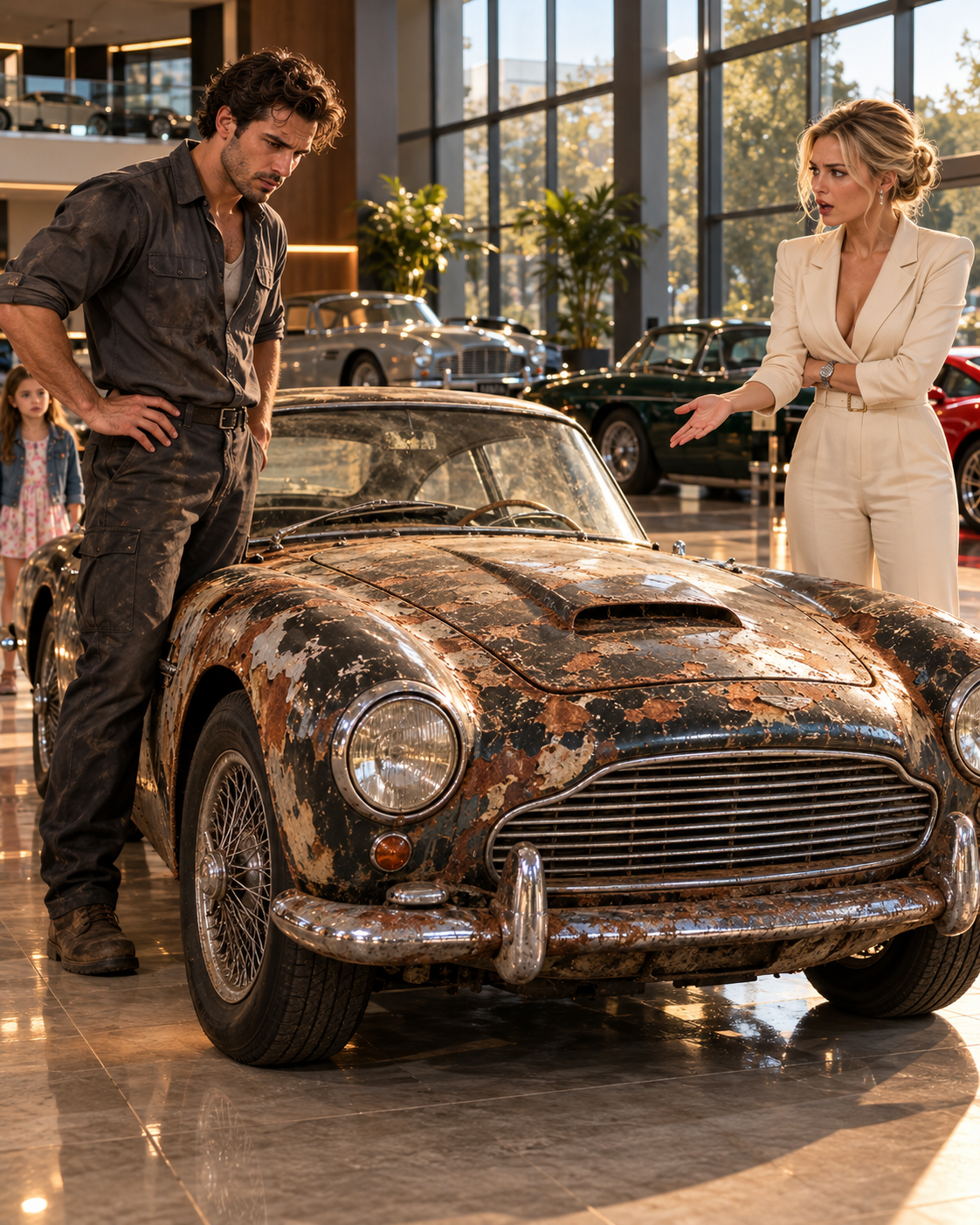
I thought about how to explain it to an eight-year-old without making the answer more complicated than it needed to be.
“Because finding something valuable doesn’t always mean all the money should belong to you.”
Maisie considered that for a moment, then picked up her backpack.
“So, can we still have scrambled eggs tomorrow?”
“Absolutely.”
She grinned and headed for the door.
The Jaguar would eventually find its way to a collector who had spent nine years looking for it. The investigation into the insurance report would take its course, and I would return to repairing cars in my two-bay shop.
But I knew I’d made the right decision.
Sometimes, the most valuable thing you recover isn’t the machine itself. It’s the chance to make things right when nobody would blame you for walking away.
The following Monday, I arrived at Tanner’s Workshop before sunrise, made a pot of coffee, and stood beside the Jaguar with my hands wrapped around a chipped ceramic mug.
For the first time since the wire transfer had arrived, I allowed myself to think about what the sale meant.
Four hundred thousand dollars.
Even after setting aside taxes, business expenses, and the money I had promised the Caldwell estate, the transaction would change my life. It could pay off the remaining loan on my shop, replace two aging pieces of equipment, and give me enough breathing room to spend more time with Maisie without worrying about whether a customer’s overdue invoice would cover next month’s bills.
But the money wasn’t what kept returning to my thoughts.
It was Harriet’s face when she had learned what her grandmother’s Jaguar was worth.
There had been shock, certainly, but underneath it was something more painful. For years, her family had believed the car was destroyed beyond repair. They had accepted the insurance assessment because they thought they had no reason to doubt it.
If I had never seen that Marketplace listing, they might never have discovered the truth.
And if I had been a different kind of man, they might never have discovered it either.
My phone rang at 6:42 a.m.
The caller was Bernard Filibert.
“Tanner, have you got a minute?”
“I’ve got coffee and a car that isn’t going anywhere for another hour.”
“Good. I’ve been thinking about the documentation we assembled.”
Bernard spoke slowly, as he always did when he wanted me to understand that something mattered.
“The Swiss collector has received the photographs, the provenance report, and the structural inspection. He’s pleased. But there’s another issue.”
I set down my mug.
“What kind of issue?”
“He wants to know whether you’re willing to cooperate if the regulator asks for a formal technical statement. He doesn’t want his purchase becoming tangled up in a dispute over the original insurance claim.”
“Of course I’ll cooperate.”
“I thought you would. There’s something else. He asked me to pass along his thanks. Apparently, he’s been looking for that exact chassis for nine years because it belonged to a car collection he admired when he was younger.”
That was the first time I understood why someone might pay so much for a damaged automobile.
To me, the Jaguar was an extraordinary piece of engineering, a rare machine worth saving. To the collector, it represented the recovery of something he had spent nearly a decade trying to find.
“Tell him the paperwork is in order,” I said. “And tell him I’ll answer any legitimate questions that come through the proper channels.”
Bernard chuckled.
“I’ll tell him. And Tanner?”
“Yes?”
“You did something decent. Don’t let the paperwork convince you it was anything less.”
We ended the call, and I went back to work.
By eight o’clock, the Jaguar had been moved into the secure section of the shop, where I could finish documenting its condition before the buyer’s transport company collected it. I photographed the chassis stamping, the engine block, the front frame tubes, and every area where the fire had left visible damage.
I also photographed the sections Croft had described as severely compromised.
The pictures told a remarkably consistent story.
The paint was burned. The bonnet was dented. Several electrical components had been damaged, and the interior would require substantial restoration.
But the structural damage Croft described simply wasn’t there.
At 10:15, I received an email from the Financial Services Regulatory Authority confirming that my submission had been received and assigned a reference number. The message requested that I preserve my original photographs, correspondence, inspection notes, and copies of the insurance report.
I printed the email and filed it.
Then I went back to work.
I had spent eleven years investigating fires. I knew better than to assume that a suspicious report automatically proved deliberate fraud. Mistakes happened. Measurements could be misinterpreted. Evidence could be incomplete.
But when a professional’s conclusions contradicted the physical evidence, and the recorded chassis number was wrong, the discrepancies deserved answers.
That afternoon, Harriet called.
“They contacted me,” she said.
“Who did?”
“The regulator. They asked whether I would be willing to provide the documents my grandmother received from the insurer.”
“Are you?”
“Yes. I’ve already sent copies.”
There was a pause.
“There’s something else, Tanner. I wanted to tell you before you heard it from anyone else.”
I leaned against the workbench.
“Go ahead.”
“My grandmother’s solicitor found a letter in her files. It was written several weeks after the fire.”
“What did it say?”
“She had written to the insurance company because she was worried about the assessment. She said the adjuster had rushed the inspection and wouldn’t let her speak to the independent mechanic she wanted to consult.”
I stopped moving.
“Did she receive a reply?”
“Yes. A short one. They told her the claim had been handled according to procedure and that the assessment was final.”
“Do you have copies?”
“I do.”
“Send them to the investigator handling your file. Keep the originals safe.”
“I will.”
Harriet exhaled.
“I keep thinking about how much my grandmother trusted people. She wasn’t foolish. She just believed that if someone had a professional title and a company behind them, they would do their job properly.”
I understood what she meant.
During my years with the Ontario Fire Marshal’s office, I had seen families lose homes, businesses, and irreplaceable possessions. Sometimes the losses were accidental. Sometimes they involved criminal acts. Occasionally, the hardest part of an investigation was explaining that the person someone trusted had not been honest.
“Your grandmother wasn’t wrong to expect people to do their jobs properly,” I told her. “The responsibility belongs to the person who fails that trust, not the person who extends it.”
Harriet was quiet for a moment.
“Thank you,” she said.
After the call, I stood in the workshop for a while, listening to the heater cycle on and off.
I thought about Eleanor Caldwell, a woman I had never met, who had written a letter because she believed something was wrong.
I wondered whether she had ever imagined that a stranger would one day find her car in an online listing, recognize what it really was, and uncover the discrepancy she had tried to report.
Probably not.
Life rarely gives us the satisfaction of seeing every loose end tied together. But sometimes it leaves enough evidence behind for someone else to finish what we started.
The next few weeks were less dramatic than the discovery of the Jaguar, but they were far more demanding.
The regulator requested a formal statement detailing how I had identified the vehicle, what I had observed during my inspection, and why Croft’s report appeared inconsistent with the physical evidence.
I supplied everything I had.
Bernard prepared an additional technical memorandum explaining the identifying marks and structural features of the car. He distinguished the damage caused by the fire from the conditions Croft had described in his assessment.
I also provided a timeline showing when the vehicle had been listed for sale, when I inspected it, when I purchased it, and when I first reviewed the insurance report.
I didn’t speculate about Croft’s motives. I didn’t call him a criminal in my statement. I wrote down what I could establish and identified the questions that remained unanswered.
That distinction had mattered throughout my investigative career, and it mattered now.
The regulator eventually informed me that the complaint had progressed to a more detailed review. They couldn’t discuss every aspect of the process with me, and I didn’t expect them to.
Meanwhile, the Swiss collector arranged transportation for the Jaguar.
Before the car left my shop, Bernard came down from the Laurentides one final time to inspect the documentation package. We checked the serial numbers again, verified the photographs, and reviewed the provenance records.
Everything matched.
The transport driver arrived on a rainy Thursday morning. He secured the Jaguar carefully inside an enclosed trailer, checked the straps twice, and handed me a receipt.
I watched the trailer disappear down the road.
For a moment, the workshop seemed strangely empty.
I had owned the car for less than a week before selling it. I hadn’t restored it, driven it, or even heard its engine run.
Yet I felt a peculiar attachment to it.
Perhaps because it reminded me of my former work. Perhaps because I had been the first person in a long time to look beyond its burned paint and damaged bonnet.
Or perhaps because, for once, I had been able to repair something without needing to replace a single part.
I locked the shop and went home.
Maisie was spending the evening with me, and I had promised her homemade pizza.
She was sitting at the kitchen table with a sheet of paper when I walked in.
“Dad, I need your help.”
“With what?”
“My school has a project about people who help the community.”
She slid the paper toward me.
At the top, in careful handwriting, she had written: MY DAD’S JOB.
I smiled.
“I thought you were doing a project about firefighters.”
“I changed it.”
“Why?”
“Because you used to investigate fires, and now you fix cars. I think both are interesting.”
I pulled out the chair beside her.
“All right. What do you need to know?”
She tapped her pencil against the page.
“Do you think fixing something is better than throwing it away?”
I considered the question.
“Sometimes. It depends on whether it can be fixed safely, whether the repair makes sense, and whether the person who owns it wants to save it.”
“What about people?”
That caught me off guard.
“People aren’t cars, Maisie.”
“I know.” She looked impatient. “But people make mistakes, right? Can they fix those?”
I leaned back in my chair.
“Sometimes they can. But fixing a mistake usually takes more than saying you’re sorry. You have to tell the truth, take responsibility, and do what you can to make things right.”
She wrote that down, sounding out the longer words as she went.
Then she looked up.
“Is that what you did with the Jaguar?”
“I tried to.”
“Because you gave the lady money?”
“Because her family deserved to know the truth. The money was one way to help make things right.”
Maisie nodded, apparently satisfied.
Then she returned to her project.
I went into the kitchen to start dinner, and for the first time in weeks, I wasn’t thinking about insurance reports, chassis numbers, or regulatory investigations.
I was thinking about how much a child could understand when you trusted her with an honest answer.
In December, Harriet invited Maisie and me to visit the Caldwell estate.
She explained that the family had decided to organize a small gathering to remember Eleanor. It wouldn’t be a formal event, just relatives, a few old friends, and some people who had helped manage her affairs.
“I know it’s a little unusual to invite you,” Harriet said over the phone. “But my grandmother loved that car. And you’ve become part of its story.”
I hesitated.
“I don’t want to intrude on a family gathering.”
“You wouldn’t be intruding. Besides, Maisie might enjoy seeing the house.”
I asked my daughter that evening.
“Do you want to visit the house where the Jaguar used to be kept?”
“Will there be dogs?”
“I don’t know.”
“Can we find out?”
That settled it.
We drove to Toronto on a cold Saturday morning. Maisie wore her favorite red scarf and carried a small notebook because she had decided she wanted to draw the house.
Harriet greeted us at the front door.
The estate looked different from the day I had first visited. The gardens were bare, and a thin layer of snow covered the lawn. The damaged shed had been cleared, though the family had decided to preserve part of its original structure as a reminder of Eleanor’s long history with the property.
Inside, Harriet showed us photographs of her grandmother standing beside the Jaguar in the 1970s.
In one picture, Eleanor was laughing in the driver’s seat while a young man leaned against the open door. In another, the car sat outside a country inn, its dark paint shining in the afternoon sun.
Maisie studied the photographs.
“She looks happy.”
“She was,” Harriet said. “Especially when she was driving that car.”
“Was it loud?”
Harriet laughed.
“Very.”
Maisie turned to me.
“We should have heard it.”
I smiled.
“Maybe we will someday.”
During the gathering, Harriet introduced us to her grandmother’s solicitor and several family members. They thanked me for the money, but I made it clear that the transfer had been my decision and that they owed me nothing in return.
One of Eleanor’s nephews approached me later.
“I hope you don’t mind me asking,” he said, “but why did you do it?”
I knew what he meant.
“You bought the car legally. You found the buyer. You could have kept every dollar.”
I looked across the room at Maisie, who was showing Harriet’s cousin how to draw a proper wheel.
“I spent years investigating fires,” I said. “I saw what happened when people lost things they could never replace. Sometimes the insurance company helped them recover. Sometimes it didn’t. And sometimes the paperwork became another problem they had to fight.”
He nodded.
“But you weren’t obligated to give anything back.”
“No. I wasn’t.”
“So why?”
I thought about the question before answering.
“Because I knew something the family didn’t. Once I knew the car was worth that much, I couldn’t pretend I was simply another buyer who’d found a bargain. The purchase was legal, but that didn’t mean keeping every dollar was the only fair thing to do.”
He held out his hand.
“Your daughter has a good example to follow.”
I shook his hand, though I wasn’t entirely sure I deserved the compliment.
On the drive home, Maisie fell asleep before we reached the highway.
At a red light, I glanced at her in the rearview mirror.
Her notebook rested on her lap. The drawing she had made of the Caldwell house was visible beneath her hand.
I wondered what she would remember about that day when she was older.
Maybe the big house.
Maybe the photographs.
Maybe the woman who had lost a car and discovered that a stranger had tried to make things right.
I hoped she would remember that doing the decent thing wasn’t always about making a grand sacrifice. Sometimes it meant giving up money you could have kept. Sometimes it meant admitting you were wrong. Sometimes it meant refusing to benefit from someone else’s misfortune simply because you had the opportunity.
Those were lessons I wanted her to learn before the world gave her a reason to forget them.
The investigation continued into the new year.
In February, I received a call from the regulator’s investigator asking me to clarify several points in my original statement.
The investigator explained that the discrepancy in the chassis number was significant, but that no single discrepancy proved deliberate wrongdoing. They were reviewing the original inspection records, the insurer’s internal communications, and the basis for Croft’s conclusions.
I answered every question as accurately as I could.
A few weeks later, Harriet called with an update.
The insurer had reopened its review of the original claim after receiving the new technical evidence and her grandmother’s correspondence. The family had been told that the earlier assessment was being examined alongside the regulator’s investigation.
It wasn’t a final finding, but it was progress.
“They’re finally taking it seriously,” Harriet said.
“That’s good.”
“I know nothing is guaranteed. My solicitor explained that. But at least someone is looking at the evidence.”
“That’s what should have happened the first time.”
She agreed.
Then she asked whether I would be willing to speak with the insurer’s independent technical reviewer if requested.
“Of course,” I said.
The request arrived the following month. I supplied the relevant photographs and participated in a technical discussion about the car’s condition when I purchased it. I made no claims beyond what I could support.
By late spring, the insurer acknowledged that the original report contained material inaccuracies and that its conclusions about the vehicle’s structural condition were not supported by the available evidence.
The company also informed Harriet that it was reviewing the consequences for the original claim.
I couldn’t tell her what the eventual settlement would be, and I didn’t want her to count on money that had not been offered. But the acknowledgment mattered.
For the first time, the family had an official response recognizing that the assessment had been wrong.
The regulator’s review remained separate, and I still had no definitive answer about Croft’s intentions.
I was careful not to confuse the two things.
An inaccurate report could have serious consequences regardless of whether it resulted from deliberate deception, reckless work, or some other failure. Establishing which explanation applied required evidence I didn’t possess.
My part was to provide what I knew.
The rest belonged to the investigators.
That summer, the Swiss collector sent Bernard a photograph of the Jaguar after its arrival in Europe.
The car was sitting inside a clean, brightly lit storage facility, its damaged bonnet still in place. A small identification card beside it displayed the chassis number: 875006.
Bernard forwarded the photograph to me.
His message contained only one sentence.
Some machines get a second chance.
I printed the picture and pinned it to the wall above my workbench.
It became a conversation starter for customers who visited the shop. When someone asked why I had kept a photograph of a burned car, I explained how I’d found it, how we’d verified its identity, and how it had eventually been sold.
I never described myself as a hero.
I had bought a car, examined it, recognized a discrepancy, and decided to share the truth with the people affected by it.
Those were ordinary actions, even if the consequences had been unusual.
Still, the story brought new business to Tanner’s Workshop.
A local classic-car club invited me to speak about evaluating fire-damaged vehicles. A restoration shop in Orillia referred several difficult projects to me. A collector asked me to inspect a vintage Aston Martin that had been damaged in a garage fire.
I accepted the work, but I also began turning down jobs that weren’t a good fit.
For the first time since my divorce, I had enough financial breathing room to think beyond the next invoice.
I paid off the remaining balance on the shop’s equipment loan. I replaced a failing lift and upgraded the ventilation system. I put money into an education account for Maisie.
Most importantly, I stopped working every Saturday she was with me.
Not every weekend was free. Customers still had deadlines, and emergencies happened. But I began treating time with my daughter as something worth protecting rather than something I would get to when the work was finished.
Sandra noticed.
One evening, while we were exchanging Maisie’s schoolbag in the parking lot outside her school, she asked how business was going.
“Better than expected,” I said.
“Is that because of the Jaguar?”
“Partly.”
She looked at me for a moment.
“I’m glad things are working out for you, Tanner.”
There was no bitterness in her voice. Our marriage had ended because we had gradually become people who were better at managing a household than sharing a life. Neither of us needed to turn that into a permanent argument.
“Thanks,” I said.
She adjusted the strap on Maisie’s backpack.
“She’s been talking about the car at school. Apparently, she’s told her teacher that her dad can tell when a car has been lied about.”
I laughed.
“That’s not exactly how I would describe it.”
“It’s how she describes it.”
I looked at Maisie, who was standing beside her mother with a gap-toothed smile.
“Well, I suppose I should be careful what I teach her.”
Sandra smiled.
“Don’t be too careful. She’s listening.”
Then she got into her car and drove away.
I watched them leave, feeling a kind of peace I hadn’t expected.
For years, I had thought of my life in terms of what had been lost: the marriage, the family home, the future I had once imagined.
But my life with Maisie was not a damaged version of the life I’d had before.
It was a different life, and it was becoming a good one.
Nearly a year after I bought the Jaguar, Harriet visited the shop again.
This time, she arrived without paperwork or a folded document in her handbag. She brought coffee and a box of pastries from a bakery near her office.
“I thought you might need a break,” she said.
“I always need a break. I just don’t always take one.”
“That sounds familiar.”
We sat in the small office at the back of the shop while the morning light came through the dusty window.
Harriet told me that the estate had finally completed most of its outstanding business. The family had received a revised response from the insurer, and their solicitor was still handling the remaining questions about the original claim.
She didn’t give me a figure, and I didn’t ask.
The important thing was that the family was no longer being told to accept an assessment that contradicted the evidence.
“Grandma would have been relieved,” Harriet said. “She spent weeks worrying that she had done something wrong by questioning the report.”
“She had every right to question it.”
“I know that now.”
She took a sip of coffee.
“There’s something I’ve been meaning to ask you.”
I waited.
“When you called me that Tuesday morning, did you already know how much money you were going to give us?”
“I knew I wanted to make restitution. I hadn’t worked through every detail yet.”
“Why didn’t you wait until everything was settled?”
I considered the question.
“Because the sale had already happened, and I had enough information to know that your family had been affected by a report that didn’t match the car’s actual condition. I didn’t want to treat the money as mine first and the truth as something I could deal with later.”
Harriet looked down at her cup.
“I think that’s what surprised me most. You didn’t make us ask.”
“No.”
“You called us.”
“Yes.”
She nodded slowly.
“My grandmother always said that character was what people did when nobody was watching. I used to think that sounded a little old-fashioned.”
“Maybe it is.”
“Maybe. But I understand it better now.”
We finished our coffee and walked through the workshop.
She stopped beside the empty bay where the Jaguar had stood.
“It’s strange,” she said. “I spent so much time thinking about that car as something we’d lost. Now, when I remember it, I think about what happened after we thought it was gone.”
I leaned against the workbench.
“What do you mean?”
“The fact that it was still there, even after the fire. The fact that you recognized it. The fact that the truth wasn’t completely buried.”
She looked around the shop.
“And the fact that someone who didn’t owe us anything decided we still mattered.”
I didn’t know what to say to that.
So I didn’t try to make the moment smaller by answering too quickly.
After a while, Harriet smiled and headed toward the door.
Before leaving, she turned back.
“I hope you know that what you did mattered.”
I watched her walk to her Volvo.
Then I returned to work.
Two years later, Maisie used the Jaguar story for a school presentation.
She was ten by then, old enough to understand that the car’s value wasn’t the same thing as the money in my bank account. She had also learned that investigations didn’t always produce immediate answers and that an accusation wasn’t the same as proof.
Her teacher had asked the class to choose an event that had taught them something important about responsibility.
Maisie chose the morning I had argued with her about scrambled eggs.
She remembered the phone call from Toronto, the pictures of the burned Jaguar, and the day Harriet visited our workshop.
She remembered asking why I had given the money away.
Most of all, she remembered my answer.
When the class finished, her teacher sent me a photograph of the presentation board.
Across the top, Maisie had written:
Sometimes fixing something starts with telling the truth.
Beneath the words, she had drawn a small car with a dented bonnet, a little two-bay garage, and three people standing beside it.
One was a man with dark hair and a coffee mug. One was a woman holding a folder. The third was a little girl with a red scarf.
The drawing wasn’t technically accurate. The Jaguar had been green, not blue, and my hair had more gray in it than Maisie had included.
But I kept the photograph.
I saved it on my phone and printed a copy for the office wall.
It sat beside Bernard’s picture of the Jaguar in Europe, a reminder that the car had continued its journey long after it left my shop.
I never learned every detail of what happened to Gerald Croft. The regulatory process was not mine to direct, and I wasn’t entitled to confidential information simply because I had submitted the original evidence. What mattered was that the inconsistencies had been documented, the insurer had reconsidered the claim, and the Caldwell family had been given a chance to pursue the questions that had been ignored before.
I also never regretted the $100,000.
It was a substantial amount of money. I would never pretend otherwise.
But it was money I could give without endangering my daughter’s future or the survival of my business. It helped correct an imbalance that had bothered me from the moment I understood what the Jaguar really was.
I didn’t give it because I expected gratitude.
I gave it because I knew the truth, and I wanted my actions to reflect that knowledge.
There were easier choices available.
I could have sold the car, deposited the proceeds, and congratulated myself on a remarkable business deal. I could have told myself that the estate had set the price and that the responsibility for the insurance report belonged to someone else.
Every one of those arguments would have sounded reasonable if I had wanted them to.
But reasonable excuses can still lead a person somewhere he doesn’t want to go.
I had spent years examining the aftermath of fires, searching for the details that explained why something had happened. I knew that damage could conceal evidence, that appearances could be misleading, and that the first report wasn’t always the final truth.
The Jaguar reminded me of something else.
Sometimes, the most important part of an investigation isn’t identifying what went wrong.
It’s deciding what to do once you know.
On an ordinary Wednesday morning, I had been a divorced father trying to convince his daughter that scrambled eggs counted as breakfast. I was a mechanic who liked old cars and a former investigator who still noticed details other people overlooked.
I hadn’t expected to become involved in a family’s loss, a disputed insurance assessment, or a rare automobile that someone across the Atlantic had spent nine years trying to find.
I certainly hadn’t expected a $750 purchase to become one of the most consequential decisions of my life.
But I was grateful it had.
Not because the money changed my circumstances, although it did.
Not because the story brought new customers to my shop, although it did that too.
I was grateful because it gave me an opportunity to choose the kind of man I wanted my daughter to see when she looked at me.
Someone who worked hard.
Someone who admitted what he knew and what he didn’t.
Someone who didn’t confuse a legal advantage with a moral obligation.
And someone who understood that doing the right thing didn’t require him to be perfect. It only required him to recognize the moment when a choice mattered and then make it honestly.
Every morning, I still unlock the doors of Tanner’s Workshop, turn on the lights, and look at the photograph pinned above my workbench.
The Jaguar is no longer there. It belongs to a collector who spent years searching for it, and perhaps one day it will return to the road, restored to something close to its original glory.
My shop is still small. My daughter is growing up. The work remains difficult, and there are days when I wonder whether I have made the right decision about a repair, a customer, or a business expense.
But when I need a reminder of what matters, I look at that photograph.
A burned car.
A family that deserved the truth.
A stranger who had the chance to walk away and chose not to.
And a little girl who learned that the value of something isn’t always measured by what it can earn you.
The most important things I’ve ever recovered were never made of steel or aluminum.
They were trust, time, and the knowledge that when the truth finally appeared in front of me, I had not turned away.