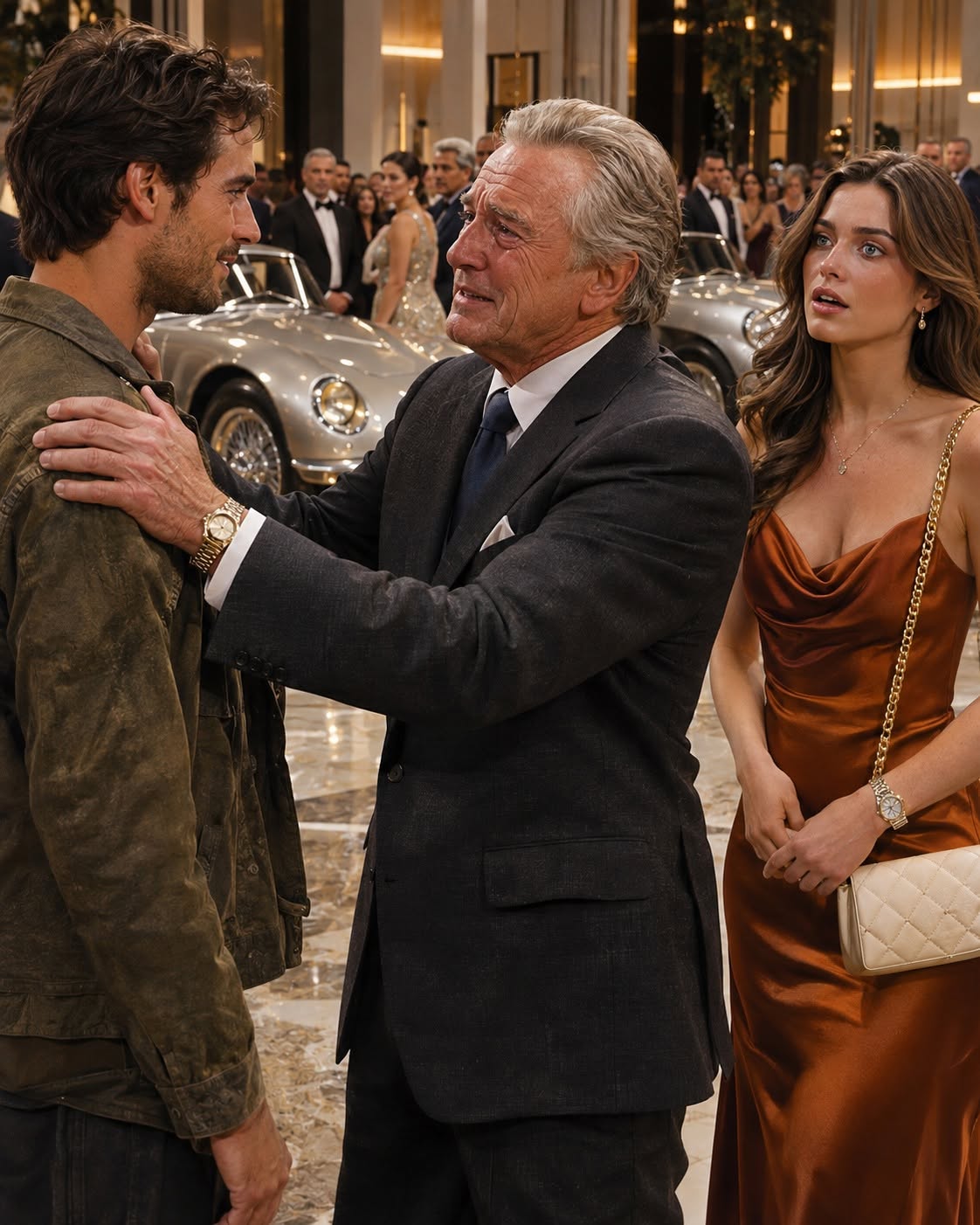
I walked into a luxury showroom wearing grease-stained pants, an old work jacket, and boots that had seen better days.
“Ten years ago,” the founder began, his voice trembling, “I was driving home from a business meeting when a terrible storm hit the mountains. The roads were covered in ice. I remember losing control of the car. One moment, I was driving. The next, I was upside down in a ditch, with broken glass everywhere and blood running down my face.”
Everyone in the small repair shop fell silent.
Amanda stood beside her father, her arms folded tightly across her chest. She had never heard him speak about that accident in such detail.
“My driver had been thrown from the vehicle,” he continued. “I couldn’t move my left leg. The doors were jammed, and the engine was smoking. I knew I didn’t have much time.”
He paused, swallowing hard.
“Then someone appeared outside the broken window. A man in an old work jacket. His hands were covered in grease, and he had a scar near his wrist.”
His eyes returned to mine.
“You broke the rear window with a metal bar. You pulled me out just before the vehicle caught fire. You carried me nearly half a mile through freezing rain until you found a place where emergency workers could reach us.”
Amanda slowly turned toward me.
Her father continued.
“When I regained consciousness in the hospital, I was told that my rescuer had disappeared. I sent people to every hospital in the area. I contacted the police, local businesses, and even newspapers. Nobody knew your name.”
I looked down at my hands.
“I remember that night,” I said quietly. “But I didn’t think it was worth making a big deal out of.”
The founder shook his head.
“You saved my life. How could that not matter?”
I gave him a tired smile.
“Anyone would have done the same.”
“No,” he replied firmly. “They wouldn’t.”
He reached into his jacket and pulled out a small photograph.
It showed a younger version of him standing beside a damaged black vehicle. A rescue worker was visible in the background, but the person holding the camera had captured only part of another man walking away.
I recognized the jacket immediately.
It was mine.
“I kept this photograph for ten years,” he said. “I was hoping one day I would find you.”
Amanda looked at the photograph, then at me.
For the first time since she had walked into my shop, she seemed unable to find the right words.
“Dad,” she whispered, “you mean this is the man who saved you?”
“Yes.”
“But he was at the showroom yesterday. I thought he was just a mechanic.”
Her father turned toward her.
“And that’s exactly the problem, Amanda.”
She lowered her eyes.
I wasn’t interested in making her feel worse. I had met plenty of people who judged others by their clothes, their cars, or the size of their bank accounts.
Still, something about the way she had laughed at me the previous evening had stayed in my mind.
“Your father doesn’t owe me anything,” I said. “I helped him because he needed help. That’s all.”
The founder looked at me for a long moment.
Then he asked a question that surprised everyone.
“Would you be willing to come with me today? There’s something else you need to know.”
I hesitated.
“My daughter has school this afternoon. I need to pick her up.”
He immediately nodded.
“Of course. We can work around your schedule.”
Amanda looked up.
“Your daughter?”
I nodded.
“She’s twelve. It’s just the two of us.”
For a brief moment, something softened in her expression.
Then her father said something that changed the entire conversation.
“Ten years ago, after the accident, I made a promise to the person who saved me. I promised that if I ever found him, I would give him a chance to share in the future I was fortunate enough to keep living.”
I shook my head.
“I don’t want money.”
“I expected you to say that.”
He reached into his briefcase and placed a thick folder on my workbench.
“Then perhaps you’ll accept something different.”
I opened it.
Inside were documents showing the ownership structure of a new charitable foundation. Its purpose was to provide emergency assistance, medical care, and financial support to families of injured workers and first responders.
The founder pointed to the final page.
“I want you to lead the foundation’s community program. Not because I owe you a favor, but because I need someone who understands what happens when ordinary people are left to face extraordinary circumstances.”
I stared at him.
“I’m a mechanic. I don’t know anything about running a foundation.”
“You know more about helping people than most executives I have met.”
I closed the folder.
“I’ll think about it.”
He smiled.
“That’s all I ask.”
But Amanda wasn’t smiling.
She had been quiet for several minutes, and I could tell something was bothering her.
Finally, she stepped closer.
“There’s something I need to tell you.”
Her father looked at her.
“Amanda, perhaps this isn’t the time.”
“No, Dad. It is.”
She took a deep breath.
“Yesterday wasn’t the first time I treated someone like that.”
I looked at her.
She continued.
“Last month, I had a delivery driver removed from another company event because his clothes didn’t meet the dress code. A few weeks before that, I refused to let a woman enter our executive lounge because I thought she was looking for free food.”
Her voice began to crack.
“I never even asked why they were there.”
Her father closed his eyes.
“Your grandfather built this company by working twelve-hour shifts in a factory,” he said. “He used to tell me that a person’s hands reveal more about their character than their clothes ever will. I think you’ve forgotten that.”
Amanda wiped her eyes.
“I know.”
For a moment, nobody spoke.
Then I said something she clearly hadn’t expected.
“An apology is a beginning, not a solution.”
She nodded.
“I understand.”
“Do you?”
She looked directly at me.
“I want to.”
I didn’t answer immediately.
Then I pointed toward the truck sitting on the lift.
“There’s an old man who owns that vehicle. He can’t afford the repairs, but he needs it to get to his dialysis appointments. I’ve been fixing it after hours because he doesn’t have anyone else.”
Amanda looked at the truck.
“Why are you telling me this?”
“Because if you really want to understand what matters, you can start by helping someone without expecting anyone to notice.”
She nodded slowly.
“I can do that.”
Her father glanced at me with an expression I couldn’t quite read.
For the first time, I wondered whether the encounter might become something bigger than an apology.
I didn’t know how much bigger it would become.
Three days later, a black car appeared outside my repair shop again.
This time, Amanda stepped out alone.
She was wearing jeans, a plain sweater, and comfortable shoes. There were no assistants, no expensive handbag, and no security guards.
She held a cardboard box in her arms.
“Good morning,” she said.
I wiped my hands on a rag.
“What brings you here?”
She placed the box on the counter.
“Tools. My father said you might need some new equipment. But before you refuse, I want you to know I paid for them myself.”
I opened the box.
There were several high-quality tools, including a torque wrench, a diagnostic scanner, and a set of professional sockets.
“They’re good tools,” I admitted.
She smiled nervously.
“I did some research.”
I looked at her.
“Did you come here just to deliver these?”
“No.”
She glanced toward the old truck.
“I wanted to see if that gentleman needed help.”
I studied her face.
“You could have sent someone.”
“I know. That’s why I came myself.”
That afternoon, Amanda helped me contact a local medical transportation organization. They agreed to provide the elderly man with free rides to his appointments while I finished repairing his truck.
When he arrived to collect it, Amanda was the one who handed him the keys.
He looked at her expensive watch, then at her simple clothes.
“Are you the owner’s daughter?” he asked.
She smiled.
“Something like that.”
He shook her hand.
“Thank you, young lady.”
She watched him drive away with tears in her eyes.
It was the first time I had seen her look genuinely happy without anyone applauding her.
Over the next few weeks, she returned several times.
At first, she mostly observed. Then she began volunteering at a community center. She met families struggling with medical bills, injured construction workers, and people who had lost their jobs after workplace accidents.
Their stories changed her.
One afternoon, she came into the shop carrying a folder.
“I think I’ve found something important,” she said.
I put down my wrench.
“What is it?”
She opened the folder and showed me a list of workers who had suffered serious injuries at factories owned by companies within her father’s holding group.
Some had received compensation. Others were still fighting for it.
Several cases had been delayed for years.
I frowned.
“Why are you showing me this?”
“Because I found something disturbing.”
She pointed to a series of documents.
“Some of these workers were denied assistance because their injuries were classified as pre-existing conditions. But the medical reports suggest otherwise.”
I studied the papers.
“Does your father know?”
“He knows there have been complaints, but he doesn’t know how serious it is.”
I looked at her.
“Then he needs to know.”
She nodded.
“I think someone has been hiding information from him.”
That evening, she presented her findings at a meeting with the company’s senior executives.
Her father sat at the head of the conference table.
At first, the room was quiet.
Then a man named Richard Cole, the company’s chief operating officer, interrupted her.
“These are isolated cases,” he said. “You cannot build an entire argument around a handful of complaints.”
Amanda didn’t back down.
“There are thirty-seven cases. That’s not a handful.”
Richard leaned back.
“Perhaps you should spend more time learning how this company operates before questioning decisions made by people with decades of experience.”
Amanda’s face flushed.
I was sitting near the end of the table, invited as a community adviser.
I recognized the look on her face.
It was the same look people wore when they realized they had entered a room where nobody wanted to hear the truth.
Her father spoke.
“Richard, let her finish.”
Amanda continued.
She explained that injured workers had been pressured to sign settlements without independent legal advice. Some had lost access to company health benefits while waiting for their claims to be reviewed.
Then she revealed something even more serious.
One worker, a forty-six-year-old maintenance technician named Daniel Brooks, had died after returning to work too early following a spinal injury.
His family had received almost nothing.
The room fell silent.
Richard’s expression changed.
“That’s an unfortunate tragedy,” he said. “But it has nothing to do with this meeting.”
I leaned forward.
“Actually, it has everything to do with it.”
Richard turned toward me.
“And who exactly are you to comment on company policy?”
Before I could answer, Amanda stood up.
“He is the man who saved my father’s life. He has spent his entire life repairing things that people like us depend on. And unlike some people in this room, he understands what happens when a worker is treated as disposable.”
Richard gave a dismissive laugh.
Her father placed both hands on the table.
“That’s enough.”
He turned to the legal department.
“I want an independent investigation. Every injury claim, every denied benefit, every settlement made over the past five years. No exceptions.”
Richard’s face tightened.
“Sir, that could expose the company to enormous liability.”
The founder looked directly at him.
“Then perhaps we should have thought about that before people got hurt.”
The meeting ended abruptly.
As everyone left, Richard passed me in the hallway.
He stopped.
“You should be careful,” he said quietly. “You have no idea how complicated the business world can be.”
I met his eyes.
“I know enough to recognize when someone is trying to scare me.”
He walked away without another word.
Two days later, the founder called an emergency board meeting.
The independent investigation had uncovered serious misconduct.
Several managers had altered accident reports. Insurance payments had been delayed intentionally. A regional director had received bonuses based partly on reducing compensation costs.
And Richard Cole had approved a policy that encouraged departments to classify workplace injuries as employee-related whenever possible.
The company had saved millions.
But workers and their families had paid the price.
Richard denied everything.
He claimed Amanda had misunderstood the records and that I had influenced her against the company.
Then he made a final accusation.
He suggested that the founder was becoming emotionally unstable because of his gratitude toward the man who had saved him ten years earlier.
The room erupted in whispers.
I stood up.
“Mr. Cole, I didn’t come here to take anyone’s position or damage anyone’s reputation. I came because I was asked to help. But if you’re going to question my intentions, then I suggest you look at the people whose lives were affected by your decisions.”
I placed a photograph on the table.
It showed Daniel Brooks standing beside his young daughter.
Amanda had obtained it from his family.
On the back was a handwritten message.
Daddy says the company will take care of us if he gets hurt.
The founder stared at the photograph.
For a long moment, he said nothing.
Then he turned toward Richard.
“Is this what our company has become?”
Richard looked away.
The founder called for an immediate suspension of every executive implicated in the investigation.
Richard was escorted out of the building before the meeting ended.
But the most difficult part was still ahead.
The founder announced that the company would establish a compensation fund for affected workers and their families. Every denied claim would be reviewed by an independent panel.
Amanda volunteered to oversee the reform process.
She also requested something unexpected.
“I don’t want a promotion,” she told her father. “I want to spend six months working with the people affected by these decisions. I need to understand what our policies have actually done to their lives.”
Her father looked at her for a long time.
Then he nodded.
“That’s the first decision you’ve made in a long time that makes me proud.”
I watched her walk out of the room.
She had changed.
But I knew that changing one’s attitude was easier than changing an entire system.
And the hardest test was waiting just around the corner.
A week later, my twelve-year-old daughter, Lily, came home from school crying.
I was working under a car when she entered the garage.
“Dad?”
I immediately stood up.
“What happened?”
She tried to smile, but tears were running down her cheeks.
“Some kids made fun of my shoes.”
I looked down.
Her sneakers were old. The soles were worn, and one side had begun to separate.
“What did they say?”
“They said I looked poor. They asked why I couldn’t afford proper shoes.”
My chest tightened.
I knelt in front of her.
“Listen to me. There’s nothing wrong with having old shoes. There’s nothing wrong with working hard for what you have. You should never feel ashamed of either.”
She wiped her face.
“But I wanted to look like everyone else.”
I hugged her.
“I know, sweetheart.”
That night, after she went to bed, I sat alone in the kitchen.
I had never wanted her to grow up surrounded by luxury. But I also didn’t want her to feel that she had to apologize for our circumstances.
The following afternoon, Amanda arrived at the shop.
She noticed Lily sitting at the desk doing homework.
“Hi, Lily,” she said warmly.
Lily looked up.
“Hello.”
Amanda smiled.
“I brought something for you.”
She placed a small envelope on the desk.
Inside was a gift card to a local bookstore and a handwritten note.
For the girl who has a wonderful father. Keep being brave, keep asking questions, and never let anyone convince you that your worth is measured by what you wear.
Lily read it twice.
“Thank you.”
Amanda shook her head.
“You don’t have to thank me. I wanted you to have it.”
Then she looked at me.
“I heard about what happened at school.”
I frowned.
“Who told you?”
“Your daughter mentioned it while we were talking.”
I nodded.
“She’s learning that not everyone understands what really matters.”
Amanda sat down beside Lily.
“Can I tell you something?”
Lily nodded.
“When I was your age, I had everything. Nice clothes, expensive vacations, and a big house. But I was always trying to impress people. I thought being important meant having things other people wanted.”
She paused.
“I’m still learning that I was wrong.”
Lily smiled.
“Maybe we can both learn together.”
Amanda laughed softly.
“I’d like that.”
A month later, the foundation officially opened.
It wasn’t launched in a luxury ballroom or with a celebrity guest list.
Instead, the founder chose an old community hall near the industrial district.
There were no red carpets, no champagne fountains, and no expensive decorations.
Just workers, families, volunteers, and people who had spent years believing nobody in power cared about them.
The founder stood at a simple wooden podium.
He introduced me as the person who had inspired the foundation.
I immediately shook my head.
“Please don’t make this about me.”
But he continued.
“Ten years ago, a stranger saved my life. I spent a decade looking for him because I believed I owed him something. When I finally found him, I discovered that he had spent those same ten years quietly helping people who could never repay him.”
He looked toward the audience.
“That made me realize something. We have spent too much time celebrating wealth and too little time recognizing the people who make our lives possible.”
Then he announced the foundation’s first initiative.
It would provide emergency financial assistance to injured workers, support for families facing medical hardship, and scholarships for children whose parents had been injured or killed while working.
The room filled with applause.
I stood at the back, feeling uncomfortable with all the attention.
Then I noticed Amanda.
She was standing beside Daniel Brooks’s widow, holding her hand.
The woman was crying.
Amanda was crying too.
After the ceremony, Daniel’s widow approached me.
“My husband used to tell our daughter that good people still existed,” she said. “I want her to know he was right.”
I didn’t know what to say.
So I simply held her hand.
That evening, the founder invited us to dinner.
Lily came along.
For the first time, she entered the same luxury showroom where I had been humiliated.
The chandeliers still sparkled. The expensive cars still stood beneath the bright lights. Executives still wore tailored suits.
But something had changed.
At the entrance, there was a new sign.
Respect is not determined by appearance, position, or wealth. Every person deserves dignity.
Amanda stood beside it.
She saw us and smiled.
“Welcome,” she said.
Then she turned to a security guard.
“This is Lily and her father. They’re our guests.”
The guard nodded respectfully.
I looked at Amanda.
She understood what I was thinking.
“I know,” she said quietly. “I should have treated you that way the first time.”
I smiled.
“Now you have another chance to treat the next person better.”
She nodded.
Later that evening, the founder asked me to step outside with him.
We stood beneath the showroom’s entrance lights.
“I have one more thing to ask you,” he said.
I sighed.
“You keep asking me things.”
He laughed.
“I suppose I do.”
Then his expression became serious.
“I want to offer you a partnership. The company is creating a technical training program for young people who cannot afford college. I want your repair shop to become the first training center.”
I looked at him.
“You want to turn my little garage into a school?”
“I want to give young people the opportunity to learn a skill that can support them for the rest of their lives.”
I thought about Lily. I thought about the countless children growing up in families where money was always tight.
Then I thought about my own childhood.
My father had been a mechanic too. He taught me how to recognize a failing engine by listening carefully. He taught me that every broken machine deserved patience before judgment.
He had never been wealthy.
But he had given me something more valuable than money.
He had given me a way to stand on my own feet.
I looked at the founder.
“I’ll accept, but I have one condition.”
“Anything.”
“The students won’t be treated like cheap labor. They’ll be paid for their work, trained properly, and given a real opportunity to build a future.”
The founder smiled.
“Agreed.”
“And I want scholarships for girls too. There are plenty of young women who would make excellent mechanics if someone gave them the chance.”
He nodded.
“Consider it done.”
Three months later, the old repair shop looked completely different.
The original garage remained, but a new training area had been built beside it. There were workbenches, diagnostic equipment, safety stations, and classrooms.
A sign above the entrance read:
THE SECOND CHANCE GARAGE
Underneath were smaller words:
Skills build confidence. Opportunity builds futures.
On opening day, twelve students arrived.
Some had left school early. Others came from families struggling to pay their bills. One young woman named Emily had been told repeatedly that automotive work was not suitable for her.
She stood near the entrance, looking uncertain.
“Are you sure I can do this?” she asked.
I handed her a pair of safety glasses.
“You won’t know until you try.”
She smiled.
Then I noticed Amanda arriving with her father.
She wasn’t wearing an expensive outfit or surrounded by assistants.
She carried a box of notebooks and a stack of application forms.
Lily ran toward her.
“Amanda! We saved you a seat!”
Amanda laughed.
“I wouldn’t miss it.”
The founder stepped forward and addressed the students.
“Some of you may think you’re here because someone is giving you a favor. You’re not. You’re here because you deserve an opportunity. What you do with it will be up to you.”
The students applauded.
Then he turned toward me.
“Would you like to say a few words?”
I looked at the young faces in front of me.
I remembered the luxury showroom, the laughter, and the moment security had been ordered to remove me.
I also remembered the mountain road, the freezing rain, and the man trapped inside a burning vehicle.
Ten years had passed between those moments.
Yet the lesson was the same.
“I’m not going to tell you that life will be fair,” I began. “It won’t. Some people will judge you before they know your name. Some will assume your value based on your clothes, your job, or the money in your pocket.”
I paused.
“But don’t let their opinions decide who you become. Learn your craft. Keep your word. Help people when you can. And never become so successful that you forget the people who helped you get there.”
The room was silent.
Then Lily started clapping.
Everyone followed.
After the ceremony, Emily approached me.
“Sir, can I ask you something?”
“Of course.”
“Do you think I could own my own repair shop one day?”
I smiled.
“I think you could own three if you wanted to.”
She laughed.
“I’ll start with one.”
“That’s a good place to begin.”
Years passed.
The Second Chance Garage became one of the most respected technical training centers in the region. Hundreds of young people graduated with professional qualifications, and many opened their own businesses.
The foundation helped thousands of families.
Amanda eventually became its executive director, not because her father had appointed her, but because she had earned the trust of the people she served.
She continued working with injured employees and their families. She made sure the company published transparent safety reports and established an independent process for workers to report problems without fear of retaliation.
Richard Cole’s case was eventually referred to the authorities. Several managers faced legal consequences, and the company paid compensation to families whose claims had been mishandled.
The founder also made a difficult decision.
He stepped down from his executive position and appointed a new leadership team, with strict oversight from an independent board.
He wanted the company to become something better than what it had been.
As for me, I kept my original repair shop.
Even after the training center became successful, I still enjoyed getting my hands dirty.
I still wore old work jackets.
I still drove an ordinary truck.
And I still believed that the best part of my day was when someone arrived with a broken vehicle and left knowing they could get home safely.
One Saturday morning, nearly five years after that first encounter, I received an unexpected visitor.
Amanda stood at the garage entrance, holding a small framed photograph.
It was the old picture from the mountain accident.
The one her father had kept for ten years.
“I thought you should have this,” she said.
I looked at it.
The photograph showed me walking away from the wreckage, wearing the same old work jacket I had worn to the showroom.
I studied it for a moment.
“Your father kept this all these years?”
“He did. He said it reminded him that his life had been given back to him by someone who expected nothing in return.”
I smiled.
“Your father is a good man.”
Amanda nodded.
“He also asked me to tell you something.”
“What?”
She handed me a folded letter.
I opened it.
Inside, the founder had written a short message.
My friend, I spent ten years searching for the man who saved my life. I thought I was searching for a person. But what I really needed to find was the lesson he had taught me that night: a person’s worth is never measured by what they own, but by what they are willing to do for someone else. Thank you for reminding me how to live.
I folded the letter carefully.
Amanda watched me.
“Do you ever think about what happened that night at the showroom?”
“Sometimes.”
“Do you still hold it against me?”
I looked at her.
She wasn’t the same woman who had laughed at my clothes and ordered security to remove me.
But I didn’t want her to forget what had happened either.
“Forgiveness doesn’t mean pretending something never happened,” I said. “It means deciding that the mistake doesn’t have to control what happens next.”
She nodded.
“I hope I’ve made things right.”
“You’ve helped a lot of people. That’s a good start.”
She smiled.
Then she looked around the garage.
“Do you know what I remember most about that first day?”
“What?”
“You could have embarrassed me in front of everyone. You could have told the entire showroom who you were. You could have demanded that my father punish me.”
I shrugged.
“I had a truck to finish.”
She laughed through her tears.
“That’s exactly what I mean.”
Before she left, she noticed a photograph hanging above my workbench.
It showed my daughter, Lily, standing beside a group of students at their graduation ceremony.
“She looks happy,” Amanda said.
“She is. She’s studying engineering now.”
Amanda smiled.
“Your father would be proud,” she said.
I looked at her.
“My father passed away years ago.”
“I meant you.”
For a moment, I couldn’t speak.
Then I smiled.
“Thank you.”
Amanda walked toward her car.
Before getting in, she turned around.
“There’s something else. My father wants to invite you and Lily to dinner next Sunday.”
I laughed.
“Tell him I’ll come if he promises not to bring another expensive gift.”
She smiled.
“I’ll tell him.”
As she drove away, I returned to the engine waiting on my workbench.
The garage was noisy. Tools clattered. Students argued over diagnostic readings. Someone dropped a wrench and laughed.
It was an ordinary morning.
And I was grateful for every second of it.
That evening, Lily called me from university.
“Dad, I have some exciting news.”
“What happened?”
“I got selected for an engineering internship.”
I smiled.
“I knew you could do it.”
“There’s something else. They asked me to give a short speech at the scholarship ceremony.”
“That’s wonderful.”
She hesitated.
“I want to talk about you.”
I looked at the photograph of my father hanging above the workbench.
“Why me?”
“Because when people ask me what success looks like, I don’t think about expensive cars or big offices. I think about the man who taught me that you can have grease on your hands and still have a heart full of gold.”
I swallowed hard.
“Lily, you don’t have to make me sound special.”
“I’m not making anything up, Dad.”
We talked for another twenty minutes before saying goodnight.
After hanging up, I sat quietly in the garage.
I thought about how strange life could be.
One evening, I had been treated as if I didn’t belong in a room because of the clothes I wore.
Years later, that same room had helped inspire a foundation that changed thousands of lives.
But the most important thing hadn’t been the apology, the money, the business partnership, or even the recognition.
It was what happened afterward.
A man who had once believed wealth made him important learned to measure success differently.
A woman who had judged people by their appearance learned to listen before making assumptions.
And a mechanic who never wanted to be celebrated discovered that the smallest acts of kindness could create opportunities far beyond anything he had imagined.
The following Sunday, I attended dinner with the founder and Amanda.
Before the meal, the founder raised his glass.
“To the man who saved my life.”
I shook my head.
“Please don’t.”
He smiled.
“Then let’s drink to something else.”
He looked around the table.
“To the people who remind us that we are all human, regardless of where we come from.”
Everyone raised their glasses.
I looked at Amanda.
She smiled back.
And for the first time, I knew she understood.
The man in the old work jacket had never needed a luxury car, an expensive watch, or a place at an exclusive event to prove his worth.
He had already earned something much more valuable.
Respect.
Not the kind that comes from fear, money, or authority.
The kind that grows quietly through the way we treat people when we have nothing to gain.
Because life has a strange way of bringing us face-to-face with the people we once overlooked.
The person you dismiss today may be the person who saves you tomorrow.
The person you think has nothing to offer may possess the one thing your money cannot buy.
And the person standing in front of you, wearing worn-out boots and stained clothes, may have a story far greater than anything you could imagine.
So the next time you meet someone whose appearance doesn’t match your expectations, remember this:
Never judge a person’s worth by the clothes they wear or the work they do. Some of the greatest people in this world spend their lives quietly making life better for everyone else.
And sometimes, the most important lesson you will ever learn comes from the person you almost asked to leave.