I stood in my greasy repair shop in Cleveland while a billionaire tech CEO laughed at the idea that a single father
I read the message again, then carried the phone to the front window and checked the street.
A black SUV sat across from the garage, its engine running beneath the rain-darkened hood. The windshield reflected the gray afternoon sky, making it impossible to see the driver.
I watched it for nearly a minute.
When a delivery truck pulled up behind it, the SUV eased away from the curb and disappeared around the corner.
I returned to my workbench and locked the front door.
For fifteen years, I had made a living fixing things people with more money than patience had decided were worthless. Broken engines, seized transmissions, antique clocks, industrial equipment that had outlived its manufacturers. Most problems came down to understanding what had failed and why.
This one had started to feel different.
I called Professor Martin Hale again.
“Someone just threatened me,” I told him.
“Did you tell Victoria about the inscription?”
“No.”
“Then someone else knows you’re examining the machine.”
“Who?”
“I don’t know, Daniel. But I spent thirty years studying mechanical instruments, and I recognize that engraving style. It isn’t part of the original construction.”
I looked through the microscope at the tiny characters.
“Someone added it later.”
“Exactly. And if my suspicion is correct, you need to be very careful about what you do next.”
“What suspicion?”
Martin hesitated.
“Bring the machine to my university laboratory. Don’t touch the central chamber until we can examine it together.”
I glanced at the broken silver bird.
“With respect, Professor, I don’t think moving it is a good idea.”
“Why not?”
“Because whoever sent that message knows where it is.”
I ended the call with no more certainty than I had started with.
That evening, Lily sat cross-legged on the apartment floor, arranging plastic animals into rows while I made grilled cheese sandwiches on our little stove.
“Is the pretty bird going to sing?” she asked.
“I hope so.”
“Why don’t you just fix it?”
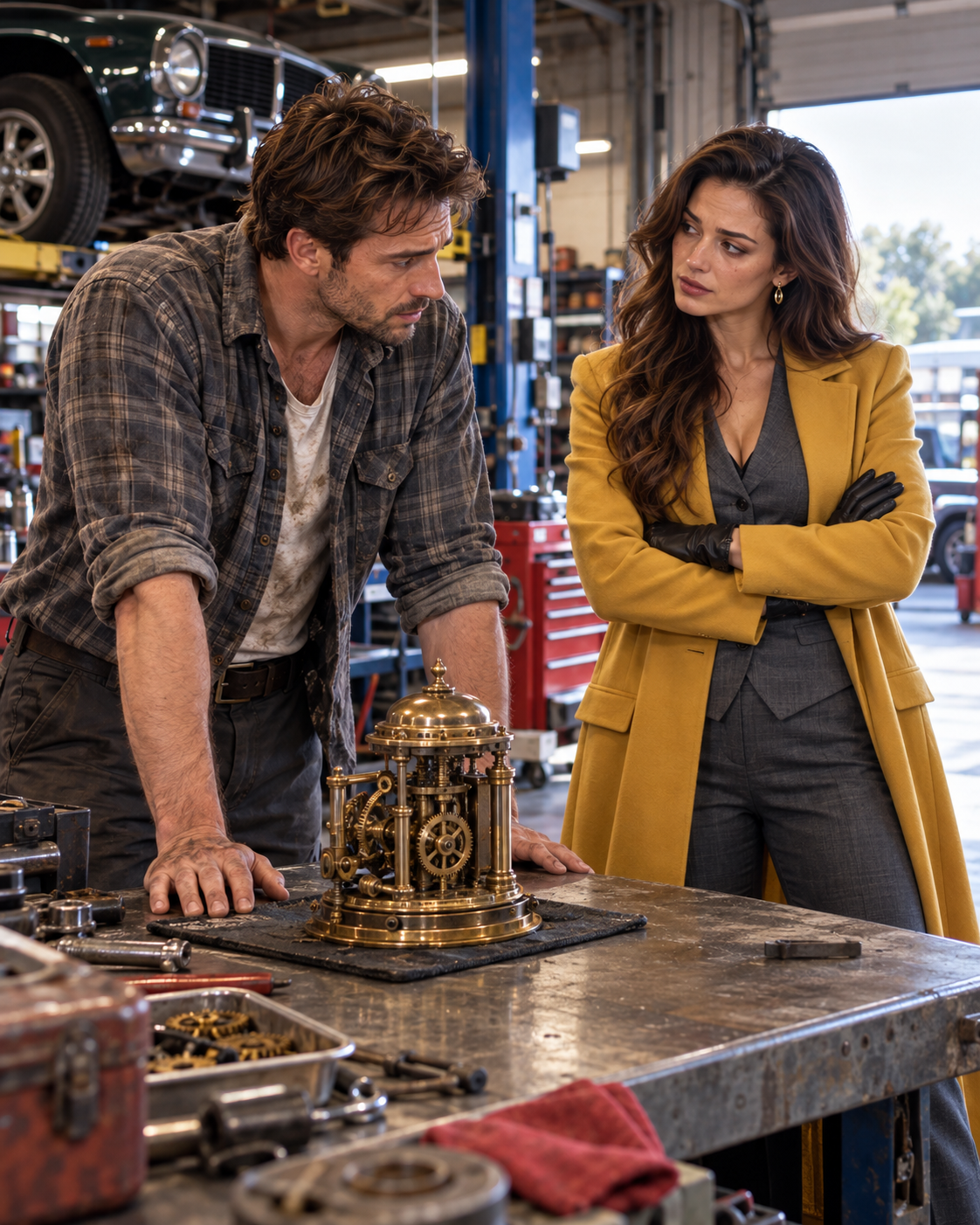
I turned the sandwich over.
“Because sometimes you have to understand why something broke before you can make it work again.”
She considered that.
“Like when my music box stopped?”
“Exactly like that.”
She smiled and returned to her animals.
My late wife, Rachel, used to say Lily asked the kind of questions adults spent their entire lives trying to avoid. Rachel had been a nurse, practical and patient, with a laugh that could turn a terrible day into something survivable.
She died three years earlier after a sudden brain aneurysm.
Since then, the shop had become more than my livelihood. It was the place where I could work with my hands when grief made sitting still unbearable, and the place where Lily could sit nearby with homework while I tried to keep our small world from falling apart.
I wasn’t interested in becoming wealthy.
I wanted to keep the lights on, pay the bills, and be there when my daughter woke from a nightmare.
That was enough.
At least, it had been before Victoria Sterling arrived with her impossible machine.
The following morning, I found an envelope tucked beneath the garage door.
Inside was a photograph of the automaton before it had been damaged.
It showed the brass tree on a velvet-covered table, its petals fully opened around the silver bird. The bird’s wings were extended, and a tiny spring-driven mechanism was visible beneath its tail.
Someone had written a date on the back: October 14, 1989.
Below it was a second line.
Ask Victoria what happened to her father.
I sat down on the overturned bucket beside my workbench.
Victoria’s father, Edward Sterling, had founded Sterling Dynamics. I remembered reading that he had died in a private aircraft accident when Victoria was a teenager. The company had nearly collapsed afterward, only to recover under her leadership years later.
I turned the photograph over again.
The date was thirty-seven years old.
The automaton was supposed to be more than two centuries old.
Why had someone photographed it in 1989?
And why had they wanted me to connect it to Edward Sterling?
I placed the photograph in a drawer and returned to the machine.
I wasn’t going to let an anonymous message dictate my work.
But I wasn’t going to ignore it, either.
For the next four nights, I worked until my eyes burned.
The damaged gears required custom replacements, each one cut from thin brass stock and finished by hand. I straightened the central arbor under magnification, testing its alignment repeatedly with a dial indicator. The escapement wheel was beyond repair, so I made a replacement using the surviving fragments as a template.
The work was slow enough to make a man question his life choices.
I loved every minute of it.
At the end of the fourth night, I finally removed the central chamber’s outer plate.
Beneath it lay a small cylinder wrapped in a strip of faded paper.
I lifted it with tweezers.
The paper had been folded many times, but the writing remained legible.
It was a list of dates, measurements, and abbreviated notes in French. Some entries referred to the bird’s song. Others described changes to the mechanism that made no sense for a decorative automaton.
Then I found a line written in English.
The song must remain unchanged. The original recording is not to be transferred.
I read it three times.
A mechanical bird from the eighteenth century couldn’t contain a recording in the modern sense. Its song would have been produced by air forced through tiny whistles, controlled by a rotating cylinder and a system of valves.
Unless the note referred to something else.
I examined the paper under ultraviolet light. The edges fluoresced faintly, revealing a watermark that wasn’t visible to the naked eye.
The paper wasn’t eighteenth-century at all.
It had been manufactured in the 1980s.
Someone had opened this machine decades after its supposed creation and placed a message inside.
The phone rang.
Victoria’s name appeared on the screen.
I answered.
“Have you made any progress?” she asked.
“Some.”
“Can it be repaired?”
“Possibly.”
“That’s encouraging.”
“Victoria, I need to ask you something. Did your father ever own this automaton?”
The silence on the other end lasted just long enough.
“Why would you ask that?”
“Because I found a photograph dated 1989, and a note inside the mechanism that appears to have been added around the same time.”
“Where did you get the photograph?”
“I found it outside my shop.”
Her voice sharpened.
“Daniel, listen to me carefully. Don’t discuss the machine with anyone else.”
“Someone has already threatened me.”
Another silence.
“What did they say?”
“That I should stop restoring it.”
I heard a door close on her end.
“Did they identify themselves?”
“No.”
“Don’t respond to any more messages. I’ll send someone to collect the automaton.”
“No.”
The word came out before I had time to consider it.
“Excuse me?”
“You hired me to examine it. I’m not handing it to an unknown employee because somebody is nervous.”
“Daniel, you don’t understand what you’re dealing with.”
“Then explain it to me.”
“I can’t do that over the phone.”
“Then come here and tell me in person.”
She exhaled slowly.
“I’ll be there tomorrow.”
When she arrived the next afternoon, she came alone.
She looked less polished than before. Her hair was loose, her suit jacket hung over one arm, and faint shadows sat beneath her eyes.
I showed her the photograph.
The moment she saw it, the color drained from her face.
“Where did you find this?”
“Under my garage door.”
She sat down without asking permission.
For several seconds, she simply stared at the image.
“My father had it in his study,” she said.
“Then you know the machine.”
“I know the story I was told about it.”
“Which was?”
She rubbed her forehead.
“My father collected antique instruments. He said this one belonged to an ancestor who had been a watchmaker in France. It was supposed to be the finest example of its kind.”
“Did it work?”
“Not when I saw it. I was twelve. I remember the brass petals were open, and the bird was lying on its side. My father told me it had been damaged during transport.”
“Transport from where?”
“He never said.”
I placed the paper beside the photograph.
“Someone put this inside the mechanism in the 1980s. It refers to an original recording that must not be transferred.”
Victoria read the note.
Her fingers tightened around the edge of the workbench.
“I’ve never seen this.”
“Did your father have any connection to audio technology?”
“Not publicly. Sterling Dynamics was a precision engineering company then. We made components for medical devices and industrial equipment.”
“And privately?”
She looked at me.
“My father was developing something he called the Resonance Project. I was a child. I didn’t understand what it was, and after he died, the project disappeared.”
“Disappeared how?”
“His office was cleared. His research was sealed by the board. My mother wouldn’t discuss it.”
“Why?”
Victoria stood and walked to the window.
“Because she believed my father had been betrayed by the people he trusted.”
I thought about the anonymous message.
“Did she name anyone?”
“No.”
“Did she believe the aircraft accident was an accident?”
Victoria turned back toward me.
“The official report said it was.”
“That’s not what I asked.”
For the first time since I’d met her, she looked like someone who had spent years carrying a question she was afraid to ask aloud.
“No,” she said. “She didn’t.”
The rain began again, tapping against the glass.
I pulled the photograph closer.
“Victoria, I think this machine was deliberately damaged. Some of the cuts are too precise to be accidental, and the note suggests somebody wanted the original mechanism preserved.”
She looked at the silver bird.
“Can you fix it?”
“I can try.”
“Then do it.”
“Why is this so important to you?”
Her gaze shifted to the tiny bird’s twisted wing.
“Because if there’s even a chance that my father left something behind, I need to know what it was.”
I studied her for a long moment.
She was still the billionaire who had walked into my shop and treated my work like a party trick. She had still made a wager at my expense.
But the fear in her face wasn’t manufactured.
“All right,” I said. “But from now on, no more secrets about the machine.”
She nodded.
Then she looked at the inscription again.
“V.S. Seventeen.”
“What does it mean?”
“I don’t know.”
“Your initials?”
“No. My father’s name was Edward Sterling.”
“Then what is V.S.?”
She stared at the letters.
“I wish I knew.”
I returned to the bench.
For the first time, we stood on the same side of the problem.
Neither of us knew who had damaged the automaton, why someone had threatened me, or what Edward Sterling had left behind.
But we were going to find out.
Over the next week, Victoria came to the garage every evening after work.
At first, she stood several feet from my bench, answering calls and checking messages while I worked. Gradually, she began putting her phone away. She asked questions about the gears, the escapement, and the air chamber that produced the bird’s song.
I explained what I could.
“The mechanism is like a tiny orchestra,” I told her one night. “Every part has a job. If one wheel is out of alignment, the whole performance fails.”
“And you can hear the difference?”
“Sometimes. A worn gear has a different rhythm from a damaged one.”
She watched me adjust the replacement escapement wheel.
“How did you learn to do this?”
“My grandfather repaired watches. I spent summers in his shop when I was a kid.”
“Why didn’t you become an engineer?”
I laughed softly.
“I did the practical version. I got married, had a kid, and bought a garage before I was old enough to realize how much it would cost me.”
“Do you regret it?”
I considered the question.
“Not the daughter part.”
Victoria smiled.
It was the first smile I’d seen from her that didn’t look like it belonged in a boardroom.
One evening, Lily came into the garage carrying a sheet of construction paper.
“Miss Victoria, I made you something.”
Victoria crouched beside her.
“What is it?”
“A bird. It doesn’t sing, but Daddy says you can fix almost anything if you have enough patience.”
Victoria studied the drawing. The bird was silver, with enormous blue eyes and wings that reached almost to the edges of the page.
“Your father says that?”
“Sometimes. Usually when he breaks something first.”
I laughed from the workbench.
Victoria pressed the drawing against her chest for a moment before folding it carefully and placing it inside her bag.
“Thank you, Lily.”
After Lily went back inside, Victoria remained beside the bench.
“She trusts you completely,” she said.
“She’s eight. She hasn’t learned not to yet.”
“Maybe that’s a good thing.”
I glanced at her.
She was looking at the door through which Lily had disappeared.
“Did you have children?” I asked.
“No.”
“Did you want them?”
She took a breath.
“I used to think I would. Then my company became the only thing I knew how to take care of.”
She said it without self-pity.
I understood that better than I wanted to.
The next day, my landlord called to remind me that the shop mortgage payment was overdue.
I had been short on cash since a customer refused to pay for a transmission rebuild, and two large repair jobs had been postponed. I had enough to cover the shop or the apartment, but not both.
I sat at my desk with the bills spread in front of me, trying to decide which one could wait another week.
Victoria came in while I was on the phone.
She noticed the papers but didn’t ask about them.
Instead, she placed a small box beside the automaton.
Inside were precision cutting tools worth more than my entire current inventory.
“I thought these might help,” she said.
“I can’t afford them.”
“They’re a loan.”
“I didn’t ask for a loan.”
“No. You didn’t.”
I pushed the box back toward her.
She didn’t move.
“Daniel, you are working on something that may help me understand what happened to my father. I want you to have the right equipment.”
“Then pay my invoice.”
“I will.”
“Not a gift. Not an investment. Just pay me for the work.”
She looked at me, then nodded.
“Fair enough.”
She took the box away.
An hour later, my bank notified me that an invoice from Sterling Dynamics had been paid in full.
No extra money.
No strings attached.
For the first time, I began to wonder whether the woman who had arrived in my garage was still the woman standing beside me.
I was careful not to confuse gratitude with affection.
I had made that mistake once in my younger years, and I knew how much a child could suffer when adults let their feelings turn into promises they weren’t ready to keep.
But I began looking forward to Victoria’s visits.
She brought coffee on cold evenings and listened while I talked through difficult mechanical problems. Sometimes she told me about the company. Sometimes she said nothing at all, sitting on a stool with Lily’s drawing beside her while I worked.
We were becoming comfortable in the silence.
That made the next discovery hurt more than it should have.
I found it while replacing the damaged spring beneath the bird’s central chamber.
The spring housing had a second plate attached to its underside. The screws were modern, not original, and the metal around them had been polished to conceal the tool marks.
I removed the plate.
Inside was a thin metal disk, no larger than a quarter, engraved with concentric grooves so fine they were almost invisible.
It resembled an audio record, though its surface was unlike anything I’d seen.
A tiny symbol had been stamped into its center.
A circle crossed by seventeen short lines.
I photographed it and sent the image to Martin Hale.
He called within five minutes.
“Daniel, where did you get that?”
“Inside the automaton.”
“Don’t play it.”
“I wasn’t planning to.”
“Good. Because I think you have found the heart of the Resonance Project.”
I leaned back in my chair.
“What is it?”
“I don’t know exactly. But in the late eighties, several research groups were experimenting with ways to preserve mechanical sound patterns at microscopic scale. Most of the work was abandoned because it was too fragile, too difficult to reproduce, or too expensive.”
“And Edward Sterling?”
“His company had the precision equipment to manufacture the components.”
I looked at the disk.
“Could it contain a recording?”
“Possibly. Or a pattern that can reproduce one. The grooves may control a series of valves or resonators. But I need to examine it.”
“Victoria is coming tonight.”
“Tell her what you’ve found. And Daniel?”
“Yes?”
“If the machine is connected to her father’s death, someone may have spent decades making sure it never works again.”
That evening, Victoria arrived later than usual.
She looked tired, and she kept checking her phone.
I showed her the disk.
She stared at it without speaking.
Then she reached into her bag and pulled out a photograph of a younger man standing beside Edward Sterling in a laboratory.
The man wore a white coat and held a small metal instrument.
On the back, someone had written a name.
Victor Shaw, 1989.
“Victor Shaw was my father’s chief research engineer,” Victoria said. “He disappeared three months after the accident.”
“Disappeared?”
“He resigned. Sold his house. Left the country, according to the company records.”
“And nobody looked for him?”
“My father had enemies. The board said he had been unstable, that he was making decisions without authorization. After he died, they claimed Shaw had stolen research materials.”
She looked from the photograph to the disk.
“V.S. Seventeen.”
“Victor Shaw?”
“I don’t know. But if he made this mark, he may have been the last person to handle the machine.”
I studied the photograph.
The man had a narrow face, dark hair, and an expression of deep concentration.
He looked nothing like a thief.
“Where is he now?”
“I don’t know.”
“Can you find out?”
Victoria took out her phone.
“I can try.”
She spent the next two hours making calls. Most went unanswered. One person claimed not to remember Shaw. Another said his records had been destroyed.
Then an older executive returned her call.
I heard only Victoria’s side of the conversation.
“Yes, I understand.”
A pause.
“No, I’m not asking about company secrets. I’m asking about a man who worked for my father.”
Another pause.
“Who authorized the destruction of his files?”
She stood so abruptly that her chair scraped across the concrete.
“You signed the order?”
The silence stretched.
Then she lowered her voice.
“Thank you for your time.”
She ended the call and stared at her phone.
“What happened?” I asked.
“The files were destroyed on my mother’s instructions.”
I frowned.
“Your mother?”
“Six weeks after my father’s death. She signed a document ordering the research archives sealed and the remaining project materials destroyed.”
“Why would she do that?”
Victoria looked at the photograph of Victor Shaw.
“She told me she was protecting the company.”
“From what?”
“I don’t know.”
She said it so quietly that I almost didn’t hear her.
For a long time, neither of us spoke.
Then Victoria looked at me.
“Can we make the bird sing?”
I glanced at the dismantled mechanism.
“I think we’re close.”
“How close?”
“One more day, maybe two. But I need to understand the disk before I put everything back together.”
She nodded.
“Then let’s find someone who can.”
Martin Hale agreed to examine the disk at his laboratory.
We transported it the following morning in a padded case, with the rest of the automaton secured separately. Victoria insisted on accompanying me, and for once I didn’t object.
Martin studied the disk beneath an electron microscope for nearly an hour.
Finally, he removed his glasses.
“It’s not a conventional recording,” he said. “It’s a control pattern. The grooves appear to correspond to specific frequencies, but they’re arranged in a sequence that would only make sense if the disk were rotated at a very precise speed.”
“Could it reproduce a voice?” Victoria asked.
“Possibly. But the pattern is more complex than a voice alone.”
He enlarged the image on his monitor.
“Look here. These grooves repeat at intervals, but the spacing changes slightly each time. That suggests the pattern was designed to respond to something external.”
“Like what?” I asked.
“Another frequency. Perhaps a resonant chamber, perhaps a second mechanism.”
Victoria leaned closer.
“My father called it the Resonance Project.”
Martin nodded slowly.
“Then I suspect this bird was never intended merely to sing.”
He turned toward me.
“Daniel, can you rebuild the original mechanism?”
“I can restore the drive train and the escapement. The chamber is more complicated.”
“Could you make it rotate at a controlled speed?”
“With the right spring tension and a clean governor, yes.”
Martin looked at Victoria.
“If this works, we may be able to reconstruct the experiment your father was conducting.”
She was quiet for several seconds.
“Then do it.”
Back at the garage, I worked through the night.
I fitted the replacement gears, adjusted the escapement, and rebuilt the governor from the surviving parts. The bent arbor took three attempts to align properly. I had to remake a tiny pinion after the first one slipped under load.
At dawn, the mechanism finally moved without binding.
I wound the spring a quarter turn and watched the governor settle into a steady rhythm.
The brass petals opened a fraction.
Then they stopped.
I adjusted the tension and tried again.
This time, the petals opened completely.
The silver bird rose from the center of the brass tree, its wings trembling slightly as the internal bellows began to move.
A thin, clear note rang through the garage.
Lily, who had fallen asleep on the couch beneath my old work jacket, sat upright.
“Daddy?”
I held my breath.
The bird turned its head.
Then it sang.
The melody was delicate and strange, unlike any mechanical bird I had ever heard. The notes rose and fell with almost human precision, each one separated by a pause that seemed deliberate rather than musical.
The final note lingered in the air.
Then the mechanism stopped.
No one spoke.
Victoria stood beside the workbench with both hands pressed against her mouth.
Tears slipped down her cheeks.
“My father used to hum that,” she whispered.
She reached toward the bird, then withdrew her hand before touching it.
“How do you know the melody?” I asked.
She shook her head.
“I don’t. I just remember him humming it when I was little.”
Lily came to stand beside her.
“Don’t cry, Miss Victoria. It worked.”
Victoria knelt and wrapped her arms around my daughter.
“I know, sweetheart.”
She held Lily for a moment longer than either of us expected.
Then she stood and wiped her face.
“Daniel, you did it.”
I looked at the machine.
“I repaired the mechanism. I haven’t figured out what the disk does.”
Victoria stared at the bird.
“Perhaps it was enough to hear it sing.”
Martin arrived an hour later with a portable frequency analyzer and a small device for measuring the disk’s rotation.
We fitted the disk into the central chamber and wound the spring again.
The bird sang its melody.
This time, Martin watched the readings on his screen.
At first, the pattern looked ordinary. Then the analyzer registered a series of faint frequencies beneath the audible notes.
“Stop,” he said.
I released the mechanism.
He checked the data, adjusted the instrument, and asked us to repeat the test.
The same frequencies appeared.
Martin sat down slowly.
“Those aren’t harmonics from the whistles.”
“What are they?” Victoria asked.
He turned the screen toward us.
“They’re a sequence of encoded signals. The bird is transmitting information through sound.”
Victoria stared at the screen.
“My father built a machine that sends messages?”
“Perhaps,” Martin said. “But the pattern isn’t random. It’s structured. If we can isolate the frequencies and decode their sequence, we may discover what it contains.”
“How long will that take?”
“Days. Maybe weeks.”
Victoria looked at me.
“Can you keep the mechanism running?”
“Yes.”
“Then we finish it.”
For the first time, her voice held no challenge, no wager, and no hint of superiority.
Only hope.
We spent the next three days working with Martin to map the signal.
The melody contained seventeen distinct frequency groups, each corresponding to a different position of the governor. The pattern repeated at regular intervals, but certain notes changed slightly every time the bird completed a cycle.
Martin believed those variations were intentional.
On the fourth day, he called us to the laboratory.
“I think I have something.”
He displayed a waveform on the monitor.
“When I separated the recurring signals from the musical sequence, I found a secondary pattern. It resembles an index, perhaps a key to a document or another recording.”
“Can you decode it?” I asked.
“Not completely. But there are repeated clusters that correspond to dates and initials.”
Victoria leaned forward.
“What initials?”
Martin enlarged the image.
“V.S.”
She gripped the edge of the table.
“Victor Shaw.”
“Possibly.”
The next cluster was a date.
October 14, 1989.
The same date written on the photograph.
Then came a series of numbers and a final sequence that Martin couldn’t interpret.
He saved the data to an encrypted drive and made two copies.
“Whatever this is,” he said, “someone took considerable care to preserve it.”
Victoria looked at the screen.
“My father knew he was in danger.”
We returned to the garage that evening.
I was cleaning my tools when Victoria approached me.
“There’s something I should tell you.”
I set down the rag.
“Go ahead.”
“The bet I made when I first came here was cruel.”
I waited.
“I thought I could turn the whole thing into a game. I wanted to see whether someone outside my world could do what my experts couldn’t. I told myself I was testing your ability, but I was really testing whether I could control the situation.”
She looked down at her hands.
“I’m sorry.”
It wasn’t a grand apology. There was no audience, no speech prepared by a public relations team.
That made it easier to believe.
“Why did you offer me anything I wanted?” I asked.
“Because I assumed you’d ask for money.”
“And when I didn’t?”
“I didn’t know what to do with that.”
I leaned against the bench.
“Money isn’t useless, Victoria. I could use plenty of it. But I don’t want to be treated like a curiosity.”
She nodded.
“I understand that now.”
“Do you?”
She met my eyes.
“I’m trying to.”
For a moment, I considered reaching for her hand.
Instead, I asked whether she had eaten dinner.
She laughed softly.
“No.”
“Neither have I.”
We closed the shop and walked to a diner two blocks away.
The place had cracked vinyl booths, a jukebox that hadn’t worked in years, and coffee that tasted like it had been sitting on the burner since breakfast.
Victoria looked around with quiet amusement.
“You bring all your clients here?”
“Only the ones who need to learn humility.”
She laughed, and I found myself smiling back.
We talked about ordinary things. Lily’s school, Victoria’s first job, my grandfather’s watch shop, and the strange ways grief changed the shape of a day.
She told me she had never been to a school play, never attended a parent-teacher conference, and rarely took a vacation that lasted longer than a weekend.
I told her that Lily had once insisted on wearing a firefighter costume to a funeral because she believed her mother’s spirit would appreciate the effort.
Victoria listened without trying to turn the conversation into something inspirational.
When she drove me home, she parked outside my apartment and left the engine running.
“I’d like to see you again,” she said.
“As a client?”
“No.”
I looked at her.
She swallowed.
“As a woman who wants to spend time with a man she admires.”
I didn’t answer immediately.
I had spent years believing that opening my life to someone new would somehow betray Rachel’s memory. But Rachel had never asked me to stop living. She had asked me to raise our daughter, to keep laughing, and to find reasons to stay in the world.
Victoria wasn’t Rachel.
She wasn’t supposed to be.
“I’d like that,” I said.
She smiled, and for the first time I saw the woman beneath the reputation.
Then my phone rang.
It was an unfamiliar number.
I answered.
A man’s voice spoke in a low whisper.
“Tell Victoria to stop looking into her father’s death.”
I stood straighter.
“Who is this?”
“You’ve repaired something that should have remained broken. You have no idea what you’ve exposed.”
The call ended.
I looked at Victoria.
She had heard enough to understand.
Neither of us slept much that night.
The next morning, she brought a security specialist from Sterling Dynamics to the garage. He checked the doors, the alarm, and the cameras before making a report.
I disliked having a stranger walk through my shop as if it were a crime scene.
But I disliked the idea of Lily being in danger even more.
The specialist found no signs of forced entry.
However, the camera footage showed the black SUV parked outside on three separate nights.
Each time, it left shortly after midnight.
The registration was obscured.
Victoria watched the footage with her jaw clenched.
“Someone at the company knows about this.”
“Or someone outside it,” I said.
She shook her head.
“The timing is too precise. They knew when we were working on the disk.”
“Who has access to the research files?”
“Very few people.”
“Then start there.”
She called her chief legal officer and requested a complete audit of the old project records.
The response came within an hour.
The archives had been accessed twice in the previous month.
Both access requests carried the authorization of Malcolm Reed, Sterling Dynamics’ chief operating officer.
Victoria stared at the report.
“Malcolm has been with the company for thirty years.”
“Did he work with your father?”
“Yes. He was his finance director.”
“Could he have known about the Resonance Project?”
“He would have known it existed. But he told me the research was abandoned after my father died.”
I thought of the inscription.
“Maybe it wasn’t abandoned.”
Victoria looked at me.
“I need to speak with him.”
“Not alone.”
She almost argued.
Then she nodded.
We arranged a meeting at Sterling Dynamics the following afternoon.
I wore my cleanest shirt, which still had a faint grease stain near the cuff. Victoria noticed it but said nothing.
The company’s headquarters occupied a glass tower overlooking the lake. Everything inside gleamed: polished stone floors, silent elevators, and reception desks that looked as though nobody had ever placed a coffee cup on them.
Malcolm Reed met us in a conference room on the twenty-third floor.
He was in his late sixties, silver-haired, and impeccably dressed. His handshake was firm, his smile practiced.
“Victoria. I was surprised to hear you wanted to discuss the old research archives.”
“I found something connected to my father’s Resonance Project.”
The smile faded slightly.
“What did you find?”
She placed a photograph of the automaton on the table.
Malcolm looked at it for several seconds.
“I haven’t seen that in decades.”
“Did you know my father kept it?”
“Of course. He was fascinated by mechanical instruments.”
“Did you know it contained a recording mechanism?”
His eyes moved briefly toward me.
“No.”
I placed the photograph from 1989 beside the first one.
“Then perhaps you can explain why the project records were accessed last month.”
Malcolm folded his hands.
“Old files are sometimes reviewed for historical purposes. That doesn’t imply wrongdoing.”
“Who requested the review?”
“I would need to check.”
“The system says you did.”
His expression hardened.
“Then the system is correct.”
Victoria leaned forward.
“Why?”
Malcolm glanced at the glass wall.
“Your father was a brilliant engineer, but he became obsessed with the project. He believed the device could preserve and reproduce signals with extraordinary accuracy. He wanted to use it in medical diagnostics, industrial control, and several other applications.”
“And you opposed him?”
“I opposed the money he was spending without proper oversight.”
“That isn’t what I asked.”
Malcolm sighed.
“Your father was preparing to reveal a series of irregularities in the company’s accounts. He believed some research funds had been diverted without authorization.”
Victoria went very still.
“By whom?”
“I never saw the complete report.”
“Did you know Victor Shaw?”
“Of course.”
“What happened to him?”
“He left the company.”
“Why?”
Malcolm looked directly at her.
“Because your father accused him of stealing the research.”
Victoria’s face tightened.
“Did he?”
“I don’t know.”
“Then why did you tell the board he had?”
“I reported what I had been told.”
“By my father?”
Malcolm hesitated.
“No.”
The silence was immediate and absolute.
Victoria’s voice dropped.
“Who told you?”
Malcolm looked at me, then back at her.
“Your mother.”
Victoria slowly sat back in her chair.
“My mother said Victor Shaw betrayed my father?”
“She said he had removed confidential materials from the laboratory. She believed he was responsible for the accident.”
“Why didn’t you tell me this before?”
“Because your mother asked me not to. She wanted to protect you.”
“Protect me from what?”
Malcolm looked exhausted for the first time.
“From the possibility that your father had been murdered.”
The words seemed to empty the room of air.
Victoria didn’t speak.
I could hear the ventilation system humming above us.
Finally, she asked, “Do you still believe Victor Shaw caused the accident?”
Malcolm shook his head.
“I no longer know what to believe.”
He stood and walked to the window.
“Victoria, there are people who built their careers on your father’s death. Some of them are still here. If the Resonance Project contains evidence of what happened, they will do whatever they can to keep it hidden.”
“Who?”
He turned back toward us.
“I can’t answer that without evidence.”
“Then help us find it.”
Malcolm looked at her for a long moment.
“I’ll give you the access records. But you must understand something. Your father didn’t just build a machine. He discovered a way to preserve evidence that other people wanted destroyed.”
We left the building with more questions than answers.
In the elevator, Victoria stared at the floor numbers.
“My mother lied to me.”
“Maybe she believed she was protecting you.”
“That’s what everyone says when they want to make a lie sound noble.”
I didn’t argue.
When we reached the lobby, she stopped beside the glass doors.
“I need to see her.”
Her mother, Eleanor Sterling, lived in a large house in Shaker Heights, surrounded by gardens that looked immaculate even in late autumn.
She welcomed us into a sitting room filled with antique furniture and family photographs.
When Victoria placed the photograph of the automaton on the table, Eleanor’s expression changed.
“Where did you find that?”
“In a mechanic’s shop,” Victoria said. “Where I took it to be repaired.”
Eleanor looked at me.
“You’re the man who made the wager with my daughter?”
I answered before Victoria could.
“She made the wager with me.”
Eleanor’s mouth tightened.
“Of course she did.”
Victoria placed the metal disk on the table.
“Tell me what happened to my father.”
Eleanor looked at the disk for a long time.
Then she sat down.
“I knew this day might come.”
Victoria’s voice shook.
“Did you know Victor Shaw?”
“Yes.”
“Did he steal my father’s research?”
“No.”
The answer came without hesitation.
Victoria stared at her mother.
“Then why did you say he did?”
Eleanor clasped her hands.
“Because I believed the truth would destroy what remained of your father’s life.”
“He’s dead, Mother.”
“I know.”
“Then tell me the truth.”
Eleanor closed her eyes.
“Your father discovered that someone had been diverting money from the Resonance Project for years. The records suggested the money was being used to fund unauthorized research at a private facility.”
“Who was responsible?”
“I never knew for certain. Your father suspected Malcolm, but he had no proof. Victor believed the records had been altered.”
“Then why blame Victor?”
“Because someone needed to take responsibility. The board was threatening to shut down the company, and I was afraid that if the scandal became public, you would lose everything your father had built.”
Victoria rose from her chair.
“So you let everyone believe an innocent man had stolen the research.”
“I was trying to save the company.”
“You were trying to save yourself.”
Eleanor flinched.
For a moment, I thought Victoria would leave.
Instead, she sat down again.
“What happened the night my father died?”
Eleanor stared at the disk.
“He told me he had found a way to preserve the original evidence inside the automaton. He said the machine could reproduce a sequence of signals that would prove where the money had gone and who had altered the records.”
“Did he tell you who was responsible?”
“No. He said he needed one more night to finish the recording.”
Victoria’s face had gone pale.
“Was he planning to fly somewhere?”
“He told me he had a meeting. I begged him not to go.”
Eleanor’s voice broke.
“He kissed your forehead while you were asleep. Then he left.”
Victoria pressed her fingers against her mouth.
“I remember that night. I remember waking up and asking where he was.”
Eleanor nodded.
“I told you he would be home in the morning.”
“But he never came home.”
“No.”
The room was silent except for the clock on the mantel.
I watched Victoria struggle to keep herself composed.
“Why did you destroy the research files?”
“Because I was afraid someone would come after you. I thought if the project disappeared, the people involved would have no reason to hurt you.”
“Instead, you protected them.”
Eleanor lowered her head.
“Yes.”
It was the first honest answer she had given.
Victoria stood.
“Do you know where Victor Shaw went?”
Eleanor looked up.
“He sent me a letter years ago. I never answered it.”
“Where is it?”
“In my study.”
She returned with a yellowed envelope.
The letter contained a post office box in a small town in Vermont and a brief message.
The machine is safe. Edward’s work is not lost. When the bird sings again, let the truth be heard.
Victoria read the words silently.
Then she handed the letter to me.
The handwriting matched the inscription on the strip of paper inside the automaton.
Victor Shaw had left the message.
And he had expected the machine to sing again.
We drove back to the garage without speaking much.
That evening, I placed the letter beside the automaton and studied the tiny silver bird.
The original song had been preserved.
The disk contained the encoded signals.
The inscription pointed to Victor Shaw.
And someone had spent decades ensuring that the mechanism remained broken.
For the first time, the pieces seemed to fit.
But we still needed Victor.
Victoria contacted a private investigator, who located an old forwarding address in Vermont. The post office box no longer existed, but a local librarian remembered a retired engineer named Victor Shaw who had lived nearby until five years earlier.
He had moved into assisted living after a stroke.
We drove north two days later.
The facility sat on a quiet road surrounded by bare trees and snow-covered fields. Victor was waiting in a small room overlooking the garden.
He was older than the photograph had suggested, his hair almost completely white, his right hand resting awkwardly in his lap.
When Victoria introduced herself, he closed his eyes.
“I wondered when you’d come.”
She sat opposite him.
“Did you know my father?”
“I worked with him for twelve years.”
“Did you betray him?”
Victor opened his eyes.
“No.”
The answer was quiet but firm.
“Then why did my mother say you stole his research?”
“Because your father needed someone to protect the original evidence, and I was the only person he trusted.”
Victoria stared at him.
“What evidence?”
Victor glanced toward me.
“The automaton. Your father discovered that the project records were being altered. The machine contained a sequence of signals that could be used to reconstruct the original data. He hid it in the bird because he knew the laboratory could be searched.”
“Who altered the records?”
Victor shook his head.
“I never saw the final evidence. Edward was going to meet someone who could verify it.”
“Who?”
“Malcolm Reed had arranged the meeting.”
Victoria’s face tightened.
“Malcolm?”
“I don’t know whether he was involved in the theft or whether he was trying to help your father. That was what Edward intended to find out.”
“What happened that night?”
Victor looked down at his hands.
“I was supposed to meet him at the airfield. He called me before he left and told me the meeting had changed. He said someone had warned him that the police would be waiting.”
“Why didn’t you go after him?”
“I tried. By the time I reached the airfield, his plane had already taken off.”
Victor swallowed.
“The next morning, I learned he had crashed.”
Victoria’s eyes filled with tears.
“And you disappeared.”
“I was told to leave the country if I wanted my family to remain safe. I thought Edward’s evidence had been destroyed. I was wrong.”
“Who threatened you?”
Victor looked at the window.
“I never learned the name. The voice on the telephone belonged to someone who knew my wife and children. I had no choice.”
He turned back to Victoria.
“Your father told me the machine would only be useful if someone restored it properly. He said it needed a person who cared more about the mechanism than the money.”
I thought of my grandfather’s watch shop.
Of the hours spent rebuilding gears that had no commercial value.
Of Lily’s purple dragon.
Victor studied my face.
“Edward said the right person would understand that a machine isn’t valuable because it’s expensive. It’s valuable because of what it carries.”
Victoria covered her mouth.
“My father knew this day would come?”
“He hoped for it.”
“Then what do we do now?”
Victor leaned forward slowly.
“Play the complete sequence. Not just the song. Every cycle. Your father encoded the evidence across the entire mechanism.”
We returned to Cleveland with Victor’s notes and a copy of his old research journal.
Martin helped us interpret the remaining signals. The bird’s song contained a sequence of numbers corresponding to entries in the original Resonance Project ledger.
When we matched the sequence to the financial records Malcolm had provided, a pattern emerged.
For years, funds had been transferred from the project into a network of shell companies. The transfers had been authorized by a private board committee, then concealed through falsified invoices.
The money eventually reached a research facility owned by a company that had ceased to exist in 1991.
The facility’s director had been Malcolm Reed.
But the records showed something else.
Edward Sterling had discovered the diversion and prepared to report it. On the night of his death, he had scheduled a meeting with a federal investigator.
The investigator had never arrived.
His appointment had been canceled using a message sent from the Sterling Dynamics office.
The message carried Eleanor Sterling’s authorization.
Victoria stared at the document.
“My mother canceled the meeting.”
Martin shook his head.
“Or someone used her credentials.”
The room fell silent.
We needed to know which.
Victoria called her mother.
Eleanor arrived at the garage an hour later, carrying a small leather case.
She looked at the evidence spread across the workbench.
“I remember the night Edward died,” she said. “I remember signing papers. I was exhausted, and Malcolm told me the meeting had been postponed.”
“Did you cancel it?” Victoria asked.
Eleanor shook her head.
“No. He told me the investigator had requested a different date. I signed a document acknowledging the change.”
“Do you still have it?”
Eleanor opened the case.
Inside were old letters, bank records, and a copy of the document.
Martin examined it.
“The signature appears genuine. But the authorization code was entered before the document was signed.”
Victoria frowned.
“What does that mean?”
“Someone prepared the cancellation in advance. Your mother may have signed the acknowledgment without knowing what it authorized.”
Eleanor began to cry.
“I should have checked.”
Victoria sat beside her.
For several seconds, neither spoke.
Then Victoria reached for her mother’s hand.
“You should have told me what you knew.”
“I was afraid.”
“So was I.”
Eleanor looked at her daughter.
“I thought I could protect you by keeping the truth buried.”
Victoria squeezed her hand once, then let go.
“We can’t undo what happened. But we can stop protecting the people who did it.”
She turned to Martin.
“Can the evidence be authenticated?”
“Yes. The original data, the financial records, and the old correspondence support one another. We’ll need independent experts and investigators.”
“Then we’ll get them.”
For the first time, Victoria wasn’t trying to control the story.
She was ready to let the truth speak for itself.
The next week brought a new kind of pressure.
Sterling Dynamics’ board announced an emergency meeting. Malcolm Reed accused Victoria of using company resources to pursue a personal vendetta. Anonymous sources began leaking stories that she had become emotionally unstable and was making reckless decisions based on unverified evidence.
A reporter appeared outside my shop.
Then another.
One asked whether I had manipulated Victoria into giving me money.
Another wanted to know whether our relationship was part of a scheme to gain control of Sterling Dynamics.
I refused to answer.
Victoria called that evening.
“I’m sorry,” she said.
“For what?”
“For bringing this into your life.”
“You didn’t bring it into my life. The machine did.”
She was quiet.
“I can have security arrange another place for you and Lily to stay.”
“No.”
“Daniel, someone is following you.”
“I know.”
“Then please let me help.”
I looked at Lily, who was sitting at the kitchen table doing math homework.
“I need to know that my daughter is safe. But I won’t let anyone turn my life into something I don’t recognize.”
“I would never ask you to.”
“I know. That’s why I’m telling you.”
We agreed to have the garage monitored and to keep Lily away from the shop until the investigation was complete.
It wasn’t the life I wanted.
But it was the one I had to protect.
Two days later, Malcolm Reed requested a private meeting with Victoria.
She asked me to accompany her.
We met in a small conference room at the company’s headquarters. Malcolm arrived without his usual smile.
“I know you’ve found the financial records,” he said.
Victoria placed the encoded sequence on the table.
“We’ve found more than that.”
Malcolm looked at the printout.
For several seconds, he said nothing.
Then he sat down.
“I did divert money from the project,” he said.
Victoria’s face went rigid.
“Why?”
“Because I believed Edward was wasting the company’s future on a machine that would never have commercial value. I thought I could redirect the funds toward research that would save the company.”
“You falsified records.”
“Yes.”
“You blamed Victor Shaw.”
“I believed he had the evidence.”
“And my father’s death?”
Malcolm’s face changed.
“I did not kill your father.”
“Then who canceled his meeting with the investigator?”
“I don’t know.”
“Who warned him that the police would be waiting?”
“I don’t know.”
“Who sent the messages threatening Daniel?”
Malcolm looked at me.
“I didn’t.”
Victoria leaned forward.
“Then tell me what you do know.”
Malcolm rubbed his eyes.
“Your father discovered the transfers and confronted me. I told him I could correct the records and repay the money. He refused. He said he would report everything.”
“What happened next?”
“He said he had arranged a meeting with an investigator. I tried to persuade him to wait. He wouldn’t listen.”
“Did you know about the flight?”
“No.”
“Did you know the meeting had been canceled?”
Malcolm hesitated.
“I learned about it the following morning.”
“From whom?”
He looked away.
“Your mother.”
Victoria sat back.
“You’ve had thirty-seven years to tell the truth.”
“I know.”
“Why now?”
Malcolm’s eyes were wet.
“Because I’m tired of being afraid.”
It wasn’t enough to absolve him.
But it was enough to give the investigators another path to follow.
The evidence was turned over to federal authorities, who reopened the investigation into Edward Sterling’s death and the financial fraud surrounding the Resonance Project.
Malcolm resigned from the company and agreed to cooperate.
The original flight records were recovered from an archive that had been overlooked for decades. They showed that the plane’s maintenance schedule had been altered shortly before takeoff.
A mechanic who had worked at the airfield was found and interviewed.
He remembered a man in a dark coat asking to inspect the aircraft that afternoon.
He also remembered that the man had presented identification bearing the name of a company executive.
The records were incomplete, and no one could prove exactly what had happened during the final hours before the crash. But the new evidence was sufficient to establish that Edward’s death had not been investigated properly.
For the first time, the case was being examined without the company’s influence.
The process would take months, perhaps years.
Victoria didn’t pretend otherwise.
She had the opportunity to sell the company, accept a position on an international technology board, or use her fortune to build a private research foundation.
Instead, she chose to stay in Cleveland and oversee the investigation while restructuring Sterling Dynamics.
She also kept visiting my shop.
Not every evening. Not when she had hearings or meetings that couldn’t be postponed. But often enough that Lily began asking whether Miss Victoria would come for dinner on Sundays.
I was careful with my feelings.
Victoria was careful with hers.
We didn’t make promises we couldn’t keep.
One evening, after the last customer had collected his truck, she stood beside the workbench while I cleaned the tools.
“I have an offer for you,” she said.
I looked up.
“That sounds dangerous.”
She smiled.
“I’m serious.”
She handed me a folder.
Inside was a proposal for a new restoration division within Sterling Dynamics. The company would provide a fully equipped workshop, a research budget, and a salary that would have paid off my mortgage in less than a year.
I read the figures twice.
“That’s a lot of money.”
“You earned it.”
“I repaired a bird.”
“You recovered my father’s work, helped uncover fraud, and restored a mechanism that experts around the world had given up on.”
“Those are different things.”
“They’re connected.”
I closed the folder.
“What would I have to do?”
“Lead a team of restoration engineers. Work on precision mechanisms, historical instruments, and advanced prototypes. You’d have access to equipment you could never afford here.”
I looked around the garage.
The old compressor rattled in the corner. A radio played softly near the office. Lily’s drawings covered the wall beside the calendar.
“I appreciate it,” I said.
“But?”
“But this is my shop.”
Victoria’s expression tightened.
“You could keep it as a hobby.”
I shook my head.
“It’s not a hobby. It’s my work.”
“You wouldn’t have to worry about bills anymore.”
“I’d still have to worry about being somewhere I don’t belong.”
She looked away.
For a moment, I thought she might be angry.
Instead, she sat down on the stool beside my bench.
“I thought I was offering you a way out.”
“I know.”
“Out of the mortgage, the late payments, the long nights. Out of having to choose which bill gets paid first.”
I looked at the folder.
“Those things are hard. I’m not pretending they aren’t.”
“Then why refuse?”
I took a breath.
“Because I don’t want to wake up ten years from now and realize I built a life that looks impressive to everyone except me.”
She stared at the floor.
“I spent years doing exactly that.”
“Then you understand.”
She nodded slowly.
“I think I do.”
I slid the folder back toward her.
“I’ll keep repairing things. I’ll keep raising Lily. And if you want to see me, you can come here. You don’t need to buy me a different life.”
Victoria looked at me for a long moment.
Then she laughed softly, though there were tears in her eyes.
“You really are impossible.”
“That’s what the experts said about the bird.”
She smiled.
This time, there was no armor left to hide behind.
She reached across the workbench and took my hand.
“I don’t want to buy your life, Daniel. I want to be part of it.”
I held her hand.
“Then start by coming to dinner on Sunday.”
She looked toward the apartment door.
“What are we having?”
“Whatever Lily decides.”
Victoria laughed.
“Then I’d better bring dessert.”
The months that followed were not easy.
The investigation moved slowly. The company underwent audits, executives resigned, and old documents surfaced in places no one had thought to search.
Malcolm’s cooperation helped establish the financial fraud, but the circumstances surrounding Edward’s death remained more complicated. The investigators found evidence of tampering with maintenance records and a series of calls made from a company office shortly before the flight.
They could not establish beyond doubt who had caused the crash.
Victor Shaw provided a sworn statement about the threats he had received, and Eleanor gave investigators the letters she had kept for decades.
The truth was finally being examined in public, where it could no longer be quietly sealed away.
Victoria testified before the board and the investigators.
She did not defend the company blindly.
She admitted that its leadership had failed to protect the truth, and she accepted responsibility for correcting what could still be corrected.
When reporters asked whether the scandal would damage Sterling Dynamics, she said the company had already been damaged by what it had hidden.
I watched the interview from the garage office.
She looked tired, but she spoke plainly.
That mattered more to me than any headline.
The automaton remained in my shop.
After the investigation team completed its examination, they returned it to Victoria, who asked me to keep it until the restoration was fully documented.
I built a small protective case for it and mounted the mechanism on a wooden base made from oak salvaged from my grandfather’s old workbench.
The silver bird stood at the center, its wings folded, waiting for the next winding.
Lily insisted that the case needed a plaque.
She wrote the words herself, slowly and carefully, with the tip of her tongue caught between her teeth.
For things worth fixing.
I attached it beneath the glass.
On the anniversary of the day Victoria first walked into my shop, she came by after work carrying a small paper bag.
Inside was a brass watch with a cracked crystal.
“My father gave this to me when I was twelve,” she said. “It stopped the year he died.”
I examined it.
The movement was worn, the mainspring was weak, and the hands had been bent slightly out of alignment.
“Do you want me to fix it?”
She nodded.
“If you can.”
I smiled.
“I’ll take a look.”
She watched me set the watch beneath the lamp.
“Do you ever think about what would have happened if I hadn’t brought the bird here?”
“Sometimes.”
“And?”
I glanced at the silver automaton.
“I think someone else would eventually have repaired it. Maybe. But I doubt they’d have listened to it the way we did.”
Victoria leaned against the bench.
“You know, I never actually paid you for the wager.”
“You paid my invoice.”
“I mean the other part.”
I looked at her.
She smiled.
“I promised you anything you wanted if you made it sing.”
“I remember.”
“So what do you want?”
I considered the question.
The mortgage was manageable now. The shop had more customers than I could comfortably fit into a week. Lily had grown more confident at school, and she no longer woke from nightmares as often as she once had.
I had a life that was still imperfect, still uncertain, but unmistakably mine.
I looked at Victoria.
“Come back tomorrow.”
She blinked.
“Tomorrow?”
“Tomorrow, and the day after that. Come when you can. Stay when you want. Let Lily teach you how to make pancakes without burning them.”
Victoria laughed.
“That’s your grand demand?”
“It’s a complicated machine. I don’t want to ask for too much at once.”
She reached over and brushed a fleck of brass dust from my sleeve.
“All right, Daniel.”
Then she kissed me.
It was a quiet kiss, a little hesitant, and nothing like the dramatic scenes people imagined when they heard the word billionaire.
It was better than that.
It was real.
That Sunday, Victoria came for dinner.
Lily made pancakes shaped like stars, though most of them came out looking like misshapen clouds. Victoria burned the first batch, laughed at herself, and helped Lily make the next ones.
After dinner, we went to the shop.
The automaton stood beneath the lamp, its brass petals catching the warm light.
“Can we hear it?” Lily asked.
I wound the mechanism carefully.
The petals opened.
The silver bird rose.
Then the melody filled the garage, clear and delicate, the same sequence of notes that had once brought a billionaire to tears and opened a door into a past everyone had tried to bury.
Victoria stood beside me, holding Lily’s hand.
When the song ended, she didn’t ask about the company, the investigation, or the fortune she could have spent on a thousand better-equipped workshops.
She simply looked at the little bird and smiled.
I understood then that restoring the automaton had never been about proving that I was better than the experts, or earning a place in Victoria Sterling’s world.
It had been about listening closely enough to discover what was still there.
The next morning, I opened the garage before sunrise.
A delivery truck waited outside with a damaged engine, and three customers had already left messages about repairs. The compressor rattled when I switched it on, and the radio struggled to find a station through the static.
Lily came running down the apartment stairs with her backpack bouncing against her shoulders.
“Don’t forget my science fair, Daddy!”
“I wouldn’t dare.”
Victoria stood in the doorway holding two coffees.
She had a meeting downtown in an hour, but she had come anyway.
She kissed Lily on the forehead, handed me my coffee, and watched as I lifted the hood of the waiting truck.
“You know,” she said, “I think your grandfather would have liked this place.”
I looked around the garage, at the worn workbench, the scattered tools, the drawings on the wall, and the silver bird resting quietly in its glass case.
“Yeah,” I said. “I think he would have.”
Victoria slipped her hand into mine for a moment before heading toward the door.
“I’ll see you tonight?”
“Tonight.”
She left, and I returned to the engine.
There would always be broken things waiting for me. Some would be expensive, some ordinary, and some would carry histories no one could fully understand.
I couldn’t save every machine, and I couldn’t undo every loss.
But I could keep showing up, one repair at a time, with my daughter’s laughter drifting down from the apartment and the little silver bird waiting patiently on the shelf.
For the first time in years, I no longer felt that I was merely keeping my life from falling apart.
I was building it, right there in the place where I belonged.