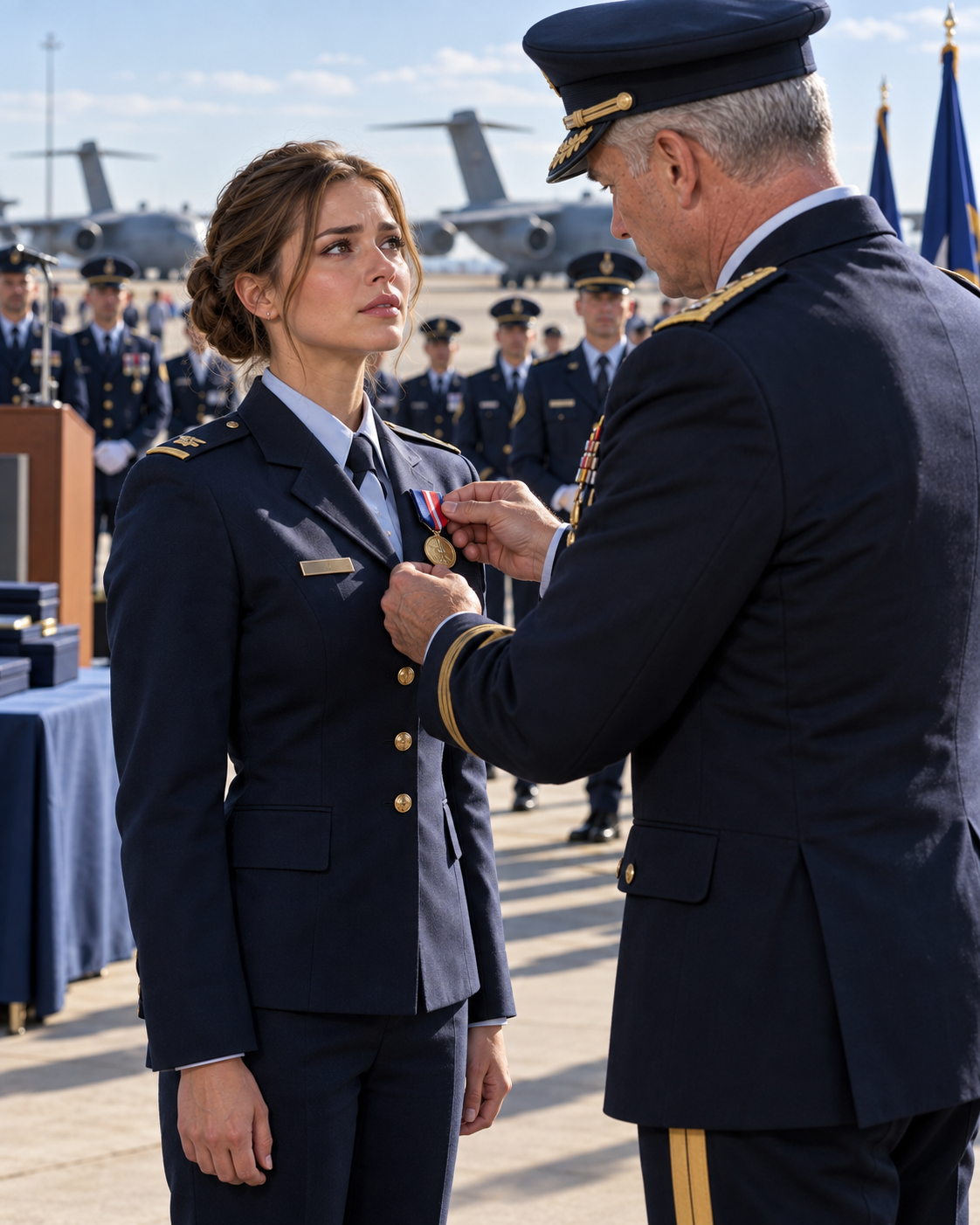
I stood beneath the floodlights at Joint Base Andrews while a general pinned a meaningless medal to my chest
Part 2
General Vance found me three days later in maintenance bay four at Dover Air Force Base.
I was underneath a C-17 with hydraulic fluid running down my gloves when I heard footsteps stop beside me.
“Captain.”
I slid out from beneath the aircraft.
He was standing there alone.
No aides.
No photographers.
No ceremony.
Just the general and the truth he had been hunting.
“You shouldn’t be here,” I said.
“I know.”
He looked at my hands.
“Still doing the work nobody notices.”
I wiped the grease from my palm.
“It’s what I’m good at.”
“No,” he said.
“It’s what they made you do.”
I stared at him.
He held a folder.
“I pulled your personnel records.”
My stomach tightened.
“They’re clean,” he continued.
“Too clean.”
He opened the folder.
“Seven years of transport duty, almost no combat history, no disciplinary actions, no gaps.”
He looked at me.
“Except the aircraft maintenance records tell a different story.”
I said nothing.
“I found a C-17 transfer order that places you at a base you were never assigned to.”
His voice became quieter.
“Then I found the F-15E.”
My breath caught.
He placed a photograph on the workbench.
It showed the burned aircraft sitting inside a hangar.
The serial number had been blacked out.
But I knew every scar on that fuselage.
“I thought it was destroyed,” I whispered.
“It was.”
He looked at me.
“Officially.”
For a moment, neither of us spoke.
Then he asked the question I had feared for seven years.
“Why didn’t you come to me?”
I laughed bitterly.
“Because they told me what would happen if I did.”
“Who?”
I looked at him.
“You know who.”
His jaw tightened.
“Sterling.”
I nodded.
“He knew you were investigating the missing funds.”
Vance’s face changed.
“What did he know?”
“Everything.”
I reached beneath my shirt.
The titanium case came free from the chain around my neck.
I placed it on the workbench.
The sound it made was almost nothing.
But to me, it sounded like a prison door unlocking.
Vance stared at it.
“What is that?”
“The reason I’m still alive.”
He didn’t touch it.
“Open it.”
I shook my head.
“You open it, and there is no going back.”
He looked me directly in the eyes.
“Captain, there was no going back seven years ago.”
So I opened it.
Inside was the drive.
Small.
Black.
Ordinary.
The kind of object nobody would notice on a desk.
Vance picked it up carefully.
“What’s on it?”
“The mission.”
He looked at me.
“All of it?”
“Everything they missed.”
We took it to a secure intelligence room.
Colonel Marcus Reed from the Defense Intelligence Agency was waiting for us.
He was the kind of man who spoke softly because he never needed to prove he had authority.
He examined the drive.
“Where did you get this?”
“I flew the mission,” I said.
He looked at Vance.
Vance nodded.
Reed connected the drive.
The screen remained black for several seconds.
Then the first file appeared.
October 14, 2019.
Operation designation: classified.
Aircraft: classified.
Pilot: classified.
The next line had been corrupted.
Reed recovered it.
CALLSIGN: PHANTOM.
Nobody spoke.
Then the transmission played.
Sterling’s voice filled the room.
“Stand down all aerial support.”
Reed froze.
Vance’s face went pale.
The recording continued.
“Repeat, no aircraft are to enter the corridor.”
Then came my voice.
“Convoy is under attack.”
Silence.
Then Sterling again.
“Maintain position.”
Vance stood perfectly still.
I watched the screen.
Seven years of nightmares were suddenly no longer nightmares.
They were evidence.
Reed began pulling timestamps.
Authentication codes.
Encrypted routing data.
Command authorization.
Then the financial files appeared.
Payments.
Shell companies.
Defense contractors.
Transfers routed through offshore accounts.
The convoy attack wasn’t random.
It was designed to end Vance’s investigation before he could expose the theft.
And I had survived it.
Reed leaned back slowly.
“This isn’t misconduct.”
“No,” I said.
“It’s treason.”
Vance looked at me.
“Why didn’t you destroy this?”
I almost smiled.
“Because I needed to remember that I wasn’t crazy.”
That sentence broke something in him.
He looked down.
For the first time, the general seemed less like a general and more like the man I had seen standing beside that burning convoy.
“I’m sorry,” he said.
I looked away.
“Don’t apologize.”
“I should have found you.”
“You were fighting the same machine.”
“I should have looked harder.”
I finally met his eyes.
“Then look now.”
He did.
The investigation moved quietly at first.
Then it moved like a storm.
Federal agents began reviewing Sterling’s communications.
Financial crimes investigators traced the money.
The Inspector General reopened files that had been sealed.
Every road led back to the same man.
Patrick Sterling.
The deputy secretary who had once been untouchable.
The man who had buried a pilot to protect himself.
But Sterling knew something was wrong.
He called me that night.
My phone rang once.
Unknown number.
I answered.
“You should have stayed invisible.”
I didn’t speak.
“You had seven years of peace.”
“No,” I said.
“I had seven years of silence.”
His breathing changed.
“You’re making a mistake.”
“No.”
I looked through the hangar window at the aircraft outside.
“I already made my mistake.”
“What mistake?”
“Coming home alive.”
There was silence.
Then he whispered, “You have no idea what you’re challenging.”
I hung up.
The next morning, General Vance walked into the Pentagon with armed federal agents.
I wasn’t there.
I didn’t need to be.
For once, I stayed exactly where I belonged.
Out of sight.
The doors to Sterling’s office opened.
Sterling stood behind his desk.
He looked at the agents.
Then at Vance.
“You don’t have authority to do this.”
Vance placed a document on the desk.
“We do.”
Sterling read it.
His face changed.
“This is classified.”
Vance’s voice was calm.
“So was the truth.”
Sterling looked toward the door.
“You’ll destroy the department.”
Vance shook his head.
“No.”
He looked directly at him.
“You did that yourself.”
The agents moved forward.
Sterling tried to reach for his phone.
One of them stopped him.
He was charged under the Espionage Act and multiple federal statutes tied to conspiracy, obstruction, and financial corruption.
The story became public only after the evidence was secure.
Even then, much of it remained classified.
There were hearings.
Resignations.
Investigations.
Careers ended quietly.
Sterling disappeared from television screens and eventually entered prison.
But my name remained absent.
That was the price of keeping the operation buried.
The government did not restore my records.
They did not publicly acknowledge Phantom.
They did not explain why a transport captain had once flown an impossible combat mission in an aircraft that officially never existed.
I should have been angry.
Maybe I was.
But anger changes shape after seven years.
Sometimes it becomes exhaustion.
Sometimes it becomes peace.
And sometimes it becomes the courage to finally ask what comes next.
Three weeks after Sterling’s conviction, General Vance called me.
“Pack your bags.”
“Where?”
“Nellis.”
I laughed.
“Why?”
“You’ll see.”
Part 3
The Nevada desert was already hot when I arrived at Nellis Air Force Base.
The runway shimmered beneath the morning sun.
A row of aircraft sat beyond the hangars.
Then I saw it.
Matte black.
Angular.
Silent.
A radar-absorbent F-35A Lightning II stood alone near the end of the ramp.
I stopped walking.
Vance stood beside it.
He didn’t say anything.
He didn’t need to.
I looked beneath the canopy.
There it was.
Fresh paint.
White letters.
PHANTOM.
For several seconds, I couldn’t move.
“Is this mine?” I finally asked.
Vance nodded.
“Only if you want it.”
I looked at the aircraft.
Seven years ago, I had flown because men were about to die.
Now someone was offering me the sky without asking me to disappear first.
“What about my record?”
Vance shook his head.
“Still classified.”
“My medals?”
“Classified.”
“My combat hours?”
“Classified.”
I smiled faintly.
“So nothing changed.”
He looked at me.
“Everything changed.”
I didn’t understand.
Then he stepped closer.
“Before that night, you thought your worth depended on whether the Air Force remembered you.”
He glanced at the F-35.
“Now you know it doesn’t.”
I looked down at my hands.
They were older.
Scarred.
Still carrying faint traces of hydraulic grease that never seemed to wash away.
“I lost seven years.”
“I know.”
“I lost my career.”
“I know.”
“I lost the person I was.”
Vance was quiet.
Then he said, “Maybe you didn’t lose her.”
I looked at him.
“Maybe she survived.”
The wind moved across the runway.
For the first time in years, I felt no fear in it.
I walked toward the aircraft.
Every step felt strangely familiar.
At the ladder, I stopped.
I touched the fuselage.
Cold metal beneath my palm.
Not the battered Strike Eagle.
Not the machine that had nearly killed me.
Something new.
Something waiting.
Vance stood behind me.
“Captain.”
I turned.
He raised his hand.
Not a casual salute.
Not a ceremonial gesture.
A slow, deliberate salute from one soldier to another.
I stared at him.
Then I returned it.
No cameras were there.
No medals.
No applause.
No politicians.
Only the desert.
Only the aircraft.
Only two people who remembered what the official records had forgotten.
I climbed into the cockpit.
The canopy lowered.
The world became quieter.
My hands settled around the controls.
For seven years, I had been told that the safest version of me was the invisible one.
The obedient one.
The silent one.
The woman who carried cargo and signed paperwork and pretended not to remember the mountains.
But the truth had never disappeared.
It had simply waited.
I started the engine.
The aircraft came alive beneath me.
For one moment, I closed my eyes.
I remembered the burning convoy.
The missile.
The smoke.
The Vulcan cannon.
The man standing in the ravine.
The voice ordering me to stay away.
And the small, impossible decision I had made.
I had chosen not to leave people behind.
That choice had cost me seven years.
But it had also given me something no classified file could ever take.
The knowledge that when the moment came, I had done what I believed was right.
I opened my eyes.
The runway stretched ahead.
I pushed the throttle forward.
The F-35 accelerated.
The desert blurred.
The nose lifted.
And then I was airborne.
No ghost.
No fabricated captain.
No erased pilot.
Just Natalie Vance.
I climbed through the blue until the runway disappeared beneath the clouds.
Below me, General Vance watched until I became a speck against the sky.
He knew what the world would never know.
There would be no ceremony for this flight.
No newspaper headline.
No medal pinned to my chest.
No official record that could explain how a forgotten pilot had returned from the dead.
But I had stopped needing proof.
Because sometimes justice does not arrive with cameras.
Sometimes it arrives quietly, years late, carrying the name they tried to erase.
And sometimes the greatest victory is not making the people who hurt you regret what they did.
Sometimes it is simply becoming yourself again.
As the aircraft climbed higher, I looked at the endless sky ahead of me.
For seven years, I had been afraid that silence meant they had won.
I finally understood the truth.
Silence is only defeat when you let someone else define what it means.
They had erased my name.
They had buried my mission.
They had taken my medals.
They had stolen seven years of my life.
But they had never taken the one thing that mattered.
The choice I made when everyone else chose to look away.
I had been Phantom.
I had been Captain Vance.
I had been a forgotten name in a classified file.
But now, for the first time in seven years, I was simply myself.
And as the F-35 disappeared into the morning sky, I realized something I wish someone had told me before that terrible night.
You can bury the truth.
You can threaten the people who carry it.
You can erase their names from every record you control.
But if even one person remembers what really happened, the truth is not dead.
It is waiting.
And one day, when the sky finally clears, it will come home.