I stood beneath the crystal lights of the Chicago Grand Pavilion while a $3 million Bugatti sat dead behind me
Part 2
The Bugatti kept running.
That sound should have made me happy.
Instead, I felt strangely empty.
For years, I had imagined the moment someone finally admitted I had been right.
I thought it would feel like victory.
It didn’t.
It felt like standing in the ruins of a house I had once loved.
Fiona kept turning pages.
The original filing contained everything.
My diagrams.
My calculations.
My notes.
Even the handwritten corrections I remembered making at two in the morning while Mara slept beside me.
There were dates.
Digital timestamps.
Drafts.
Emails.
The evidence wasn’t dramatic.
It was worse than dramatic.
It was undeniable.
Evelyn looked at Julian.
“Did you know this existed?”
Julian’s face had gone pale.
“I don’t know what you’re implying.”
Klaus gave a quiet laugh.
“That is not an answer.”
Julian looked at me.
For the first time in three years, I saw no arrogance in his eyes.
Only fear.
I should have enjoyed it.
I didn’t.
I thought about Mara.
She used to tell me that revenge was expensive because it kept charging interest long after the person who hurt you had forgotten the debt.
I had never understood what she meant.
I did then.
Evelyn asked security to close the doors.
Nobody left.
The engineers gathered around the original filing while Fiona began comparing the technical data with the company’s archived records.
Klaus requested an immediate provenance audit.
Julian was told to surrender his presentation materials.
The partnership signing was postponed.
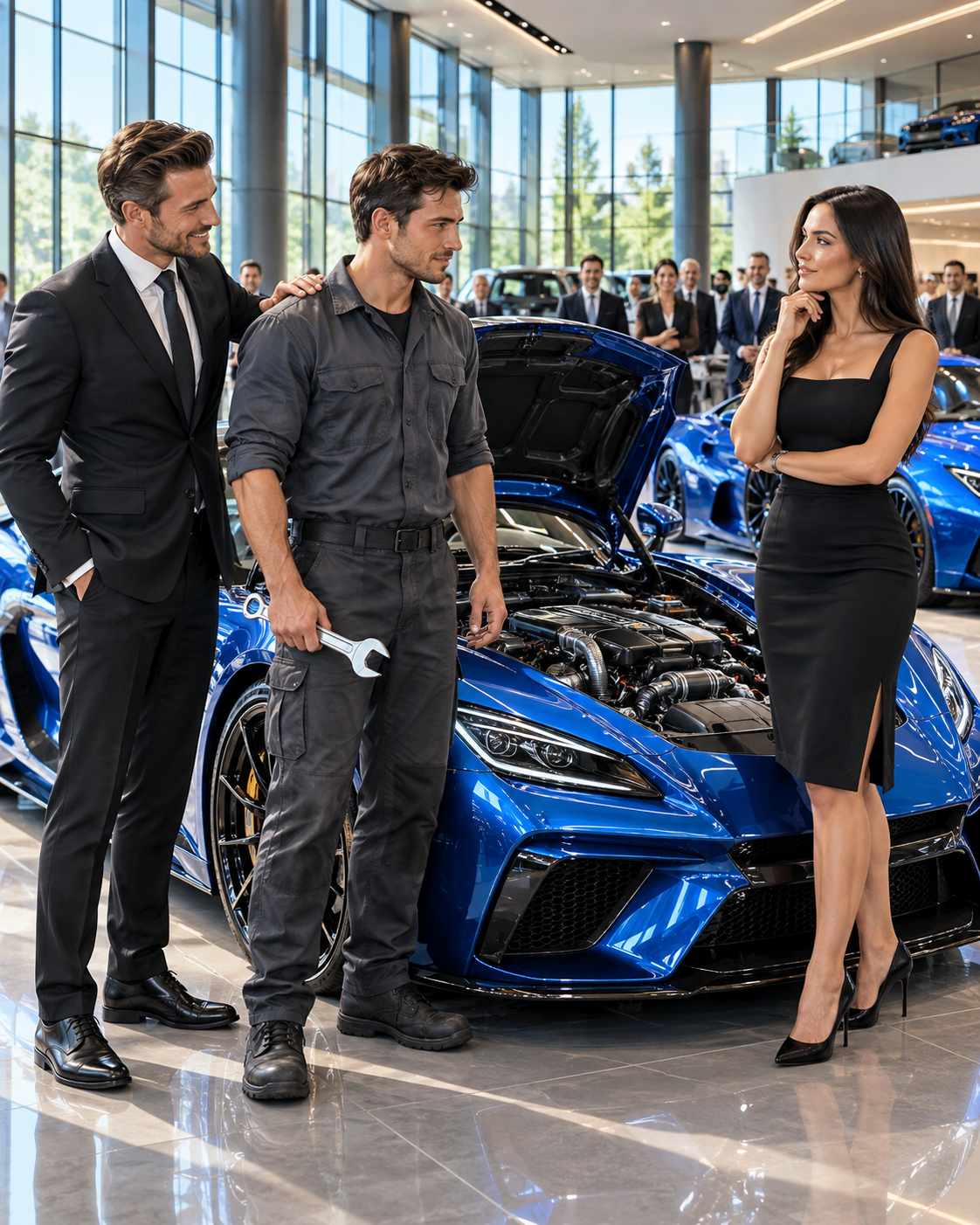
The room that had been built for celebration became an investigation site.
And somehow, I was standing in the middle of it wearing a faded gray work shirt with a five-year-old girl holding a toy car beside me.
A few minutes later, Evelyn found me near the catering corridor.
She closed the door behind her.
For the first time, there were no executives around us.
No engineers.
No investors.
Just two people standing beneath fluorescent lights while waiters carried untouched food past us.
“You should have been given credit years ago,” she said.
“Yes.”
“I can fix this.”
“You can correct the record.”
“I can do more than that.”
She reached into her briefcase.
There was an offer inside.
A large one.
More money than I had ever seen in a single document.
Restitution.
Back pay.
A consulting arrangement.
A signing bonus.
Enough money to erase years of financial fear.
I stared at it.
Then I folded the paper back toward her.
“I don’t want the money.”
Her expression tightened.
“Caleb, this is substantial.”
“I know.”
“You understand what you’re refusing?”
“Yes.”
“Then what do you want?”
I looked through the glass door at Chloe.
She was sitting on a chair, swinging her legs and holding Lightning in her lap.
“I want my name back.”
Evelyn said nothing.
“I don’t want a private apology,” I continued.
“I don’t want money that makes this disappear.”
I looked directly at her.
“I want the company to officially restore my authorship.”
She nodded slowly.
“And after that?”
“Then we can talk.”
She studied me for several seconds.
“You really mean that.”
“I do.”
She glanced toward the hallway.
“Most people would take the money.”
“Most people didn’t spend three years watching someone else build a career out of their work.”
Her face softened.
“I’m sorry.”
That was the first time anyone inside that company had said it without adding a defense afterward.
I nodded.
“Make the record honest.”
Then I left.
On Sunday morning, I made scrambled eggs.
Chloe sat on the kitchen counter wearing pajamas covered in tiny stars.
She watched me cook with the serious expression of a restaurant critic.
“Are you going to get a new job?”
“Maybe.”
“With the blue car?”
“Maybe.”
“Are there lots of cars?”
“More than you can count.”
She smiled.
Then she became quiet.
“Will you still pick me up from preschool?”
I turned off the stove.
I dried my hands.
Then I walked over and knelt in front of her.
“Every afternoon.”
“Even if you’re important?”
I smiled.
“Especially then.”
She studied my face.
“Mom would like that.”
My chest tightened.
“Yeah,” I whispered.
“She would.”
Chloe hugged me.
I held her longer than usual.
Outside, Sunday traffic moved through the neighborhood.
People went to brunch.
Dogs barked.
Children rode bicycles.
The world continued as if nothing had happened.
But something had changed.
For the first time in years, I wasn’t asking whether I deserved a place at the table.
I was waiting to see whether the truth would finally be allowed to sit there too.
On Monday morning, Fiona called me.
Her voice sounded tired but satisfied.
“It’s done.”
I sat at the kitchen table.
“What is?”
“The official record.”
I stopped breathing for a second.
“Your name has been restored to the 2021 filing.”
I closed my eyes.
“And Julian?”
A pause.
“He resigned.”
I looked down at the old filing sitting beside my coffee.
My name was there.
Caleb Thorne.
Not Mercer.
Not stolen.
Not buried beneath someone else’s signature.
Mine.
Fiona added, “There’s one more thing.”
“What?”
“Evelyn wants to see you.”
I smiled faintly.
“Where?”
“Top floor.”
The Cross Automotive headquarters had thirty-eight floors.
I had never been above the twelfth.
The elevator doors opened on the top floor Monday morning.
Glass walls surrounded the executive office.
Beyond them, Chicago stretched beneath a pale autumn sky.
Evelyn stood beside the window.
She didn’t offer me a seat immediately.
She handed me a folder.
Inside was a formal employment contract.
Chief Engineering Director.
A leadership position.
A team.
Research authority.
And a salary that made my old invoices look almost absurd.
I read every page.
Evelyn waited.
Finally, I looked up.
“I have one condition.”
“I assumed you would.”
“I start Tuesday.”
She raised an eyebrow.
“Not Monday?”
“I pick up my daughter Monday afternoon.”
A smile touched her face.
“Then Tuesday.”
I signed.
She signed.
Neither of us shook hands immediately.
Then she extended hers.
I took it.
“This time,” she said, “your name goes on everything.”
I nodded.
“Good.”
When I walked out, I carried the restored filing against my chest.
It was only paper.
Thin.
Ordinary.
Easy to tear.
But to me, it weighed more than the building.
I drove straight to Chloe’s preschool.
The afternoon light had begun turning gold when I parked.
Children were gathered near the windows.
Then I saw her.
Chloe pressed both hands against the glass.
The moment she saw me, her face lit up.
She ran outside.
I crouched and caught her.
“Dad!”
“Hey, Lightning.”
She pulled back.
“Did you get the job?”
“I did.”
“With the blue cars?”
“Yes.”
She looked suspicious.
“Are they really blue?”
I laughed.
“They are.”
“Like mine?”
I looked at the tiny toy car sticking out of her backpack.
“Exactly like yours.”
She grinned.
“Then yours is the best.”
I smiled.
“Why?”
“Because Mom gave it to me.”
And just like that, the world became quiet again.
Not the frightening silence from the pavilion.
A different silence.
The kind that comes after you finally understand what matters.
Part 3
That evening, Chloe and I drove home through Chicago traffic.
She sat in the back seat singing a song she had invented about Lightning being faster than every car in America.
I listened.
I didn’t correct her.
Some victories belong to facts.
Others belong to children.
When we reached home, I put the restored filing on the kitchen table.
Chloe climbed onto a chair and looked at it.
“What’s that?”
“It’s something important.”
“Is it your job?”
“Not exactly.”
“Then what is it?”
I thought about Julian.
About the engineers.
About the four hours of failure.
About the moment the engine came alive.
About my wife’s voice from years ago telling me that truth had a strange way of surviving people who tried to bury it.
“It’s proof,” I said.
“Proof of what?”
I looked at my daughter’s face.
“That something can belong to you even when somebody else tries to take it.”
She considered that.
“Like my car?”
I smiled.
“Exactly like your car.”
She reached for the toy.
“Nobody can take Lightning.”
I laughed softly.
“I hope not.”
She hugged it against her chest.
Then she asked the question I had been afraid of.
“Are you happy now?”
I sat beside her.
The honest answer was complicated.
I was happy to have my career back.
Happy to have my name restored.
Happy that the truth had finally been acknowledged.
But grief does not disappear because justice arrives.
Mara was still gone.
There was still an empty chair at our dinner table.
There were still mornings when I reached for a second coffee before remembering I only needed one.
There were still nights when Chloe whispered, “I miss Mom,” and I had to find the strength to say, “Me too.”
So I answered carefully.
“I think I’m getting there.”
Chloe nodded as if that made perfect sense.
Then she leaned against me.
“That’s okay.”
I kissed the top of her head.
“Yeah.”
“It takes time.”
I smiled.
“Who told you that?”
“Mom.”
My throat tightened.
I held her close.
The next morning, I returned to Cross Automotive.
This time, I didn’t enter through the side door.
I walked through the main entrance.
My employee badge carried my name.
Caleb Thorne.
Engineering Director.
People who had ignored me three days earlier now stood when I passed.
Some apologized.
Some looked embarrassed.
Some tried to explain.
I accepted the apologies that sounded sincere.
I ignored the ones that sounded rehearsed.
Fiona met me near the engineering floor.
She was holding two coffees.
“One is yours,” she said.
“How did you know?”
“You look like someone who needs coffee.”
I took it.
“Fair.”
She smiled.
“You know, when you fixed that Bugatti, everyone thought you were showing off.”
“I wasn’t.”
“I know.”
She looked toward the engineering bay.
“They’re already waiting for you.”
I looked through the glass.
Machines filled the room.
Engines.
Fuel systems.
Prototype components.
Thousands of hours of work waiting for someone to ask the right question.
For the first time in years, I felt something I thought I had lost forever.
Not pride.
Not revenge.
Purpose.
I walked inside.
And I began again.
Months later, the story of the Bugatti still circulated through the company.
People remembered the dead engine.
They remembered Julian’s panic.
They remembered Fiona finding the filing.
They remembered the moment the sixteen-cylinder engine roared back to life.
But that wasn’t the part I remembered most.
I remembered Chloe saying, “That’s the same color as my car.”
A five-year-old child had noticed something everyone else had overlooked.
Not because she understood engineering.
Because she was simply looking.
Sometimes that is what truth needs.
Someone willing to look without being told what to see.
I never became obsessed with proving Julian wrong.
I didn’t need to.
His name disappeared from the project.
Mine remained.
That was enough.
I also never forgot the lesson hidden inside that old filing.
A stolen idea can travel farther than its creator.
It can become a career.
A reputation.
A fortune.
It can sit beneath bright lights while the person who created it struggles to pay a bill.
But stolen truth has one weakness.
It remembers its original shape.
And eventually, someone will recognize it.
For me, that someone was Fiona.
For the Bugatti, it was me.
For Chloe, it was simply a blue toy car.
On the Friday of my first week, I picked her up from preschool.
She ran into my arms exactly as she had on Monday.
No executives.
No cameras.
No engineers.
No applause.
Just my daughter.
We walked to the car together.
She held my hand.
Lightning rested in her other hand.
“Dad?”
“Yeah?”
“Are you going to make the fastest car ever?”
I smiled.
“Maybe.”
“Can you make it blue?”
I looked down at her.
“Of course.”
“Then I want to ride in it.”
“You can.”
She smiled.
Then she looked toward the setting sun.
“Mom would come too.”
I stopped walking for half a second.
The old pain moved through me.
But this time, it didn’t knock me down.
I squeezed Chloe’s hand.
“She would.”
We kept walking.
Behind us, the city lights began to glow.
Ahead of us was a life I hadn’t planned.
A new job.
A new chapter.
A child growing up without her mother.
A father learning how to carry both grief and hope without letting either one destroy him.
And in my coat pocket was the restored filing bearing my name.
I touched it once before opening the car door.
It reminded me that some things can be stolen.
Some things can be buried.
Some things can even be forgotten for years.
But truth is strange.
It does not always fight back immediately.
Sometimes it waits.
Quietly.
Patiently.
Until the right person notices the flaw no one else could see.
Until one small voice points at something everyone else ignored.
Until an old piece of paper is opened beneath the right light.
And when that moment finally comes, what was stolen does not need to become something new.
It only needs to be brought back to life.
I looked at Chloe through the rearview mirror.
She was holding her tiny blue car against the window, smiling at the reflection of the evening sky.
I started the engine.
For the first time in a long time, the sound did not remind me of what I had lost.
It reminded me of what was still alive.
And as we drove home, I understood something I would carry for the rest of my life: people can steal your work, your title, your reputation, even years of your life, but they cannot permanently steal the truth of who you are, because sooner or later, someone who truly understands the work will hear the engine beneath the silence and bring it roaring back to life.