I raised my hand for the sixth rusted tractor at the Cedar Falls farm auction while Abigail Sterling laughed from the front row
The tractor rolled through the barn door and stopped beneath the gray morning sky.
Nobody spoke.
Rain ticked against the metal roof behind us, but the sound suddenly seemed very far away.
One of the inspectors slowly lowered the folder in his hands.
“Did you just operate that machine remotely?”
“No.”
He looked at me.
“I didn’t operate it at all.”
The tractor turned its front wheels three degrees to the left, corrected itself, and continued down the gravel lane.
Clara stared after it.
Lucas stared at me.
And then Warren Caldwell stepped out of the black SUV.
He wasn’t alone.
Two men in dark jackets followed him, one carrying a tablet and the other carrying a long black case.
Warren stopped about thirty feet from the barn.
For the first time since I’d met him, he didn’t look amused.
“Turn it off,” he said.
I didn’t answer.
He took another step.
“Turn it off.”
One of the inspectors looked at me.
“Mr. Harland, is there a safety override?”
“There is.”
“Then use it.”
I reached into my coat and pulled out the small control unit I’d carried for three years.
My thumb rested on the red switch.
I could stop the tractor.
I could prove that the system worked.
I could also hand Warren the exact information he’d been trying to buy from me.
I looked at Lucas.
He understood the question before I asked it.
“Don’t,” he said.
I turned toward him.
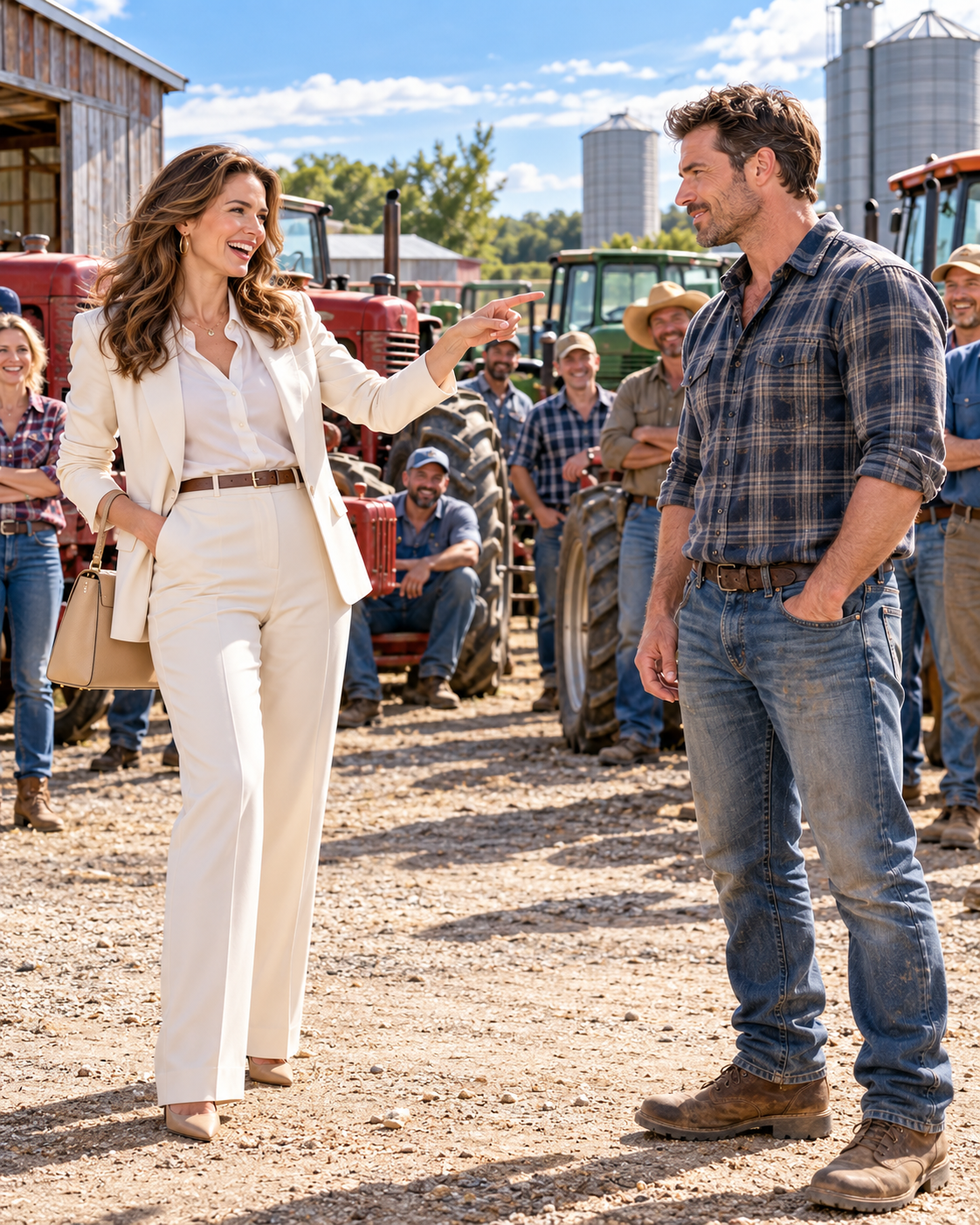
“Don’t stop it just because he’s telling you to.”
Something inside my chest tightened.
His mother had said almost the same thing years ago when I first showed her the original prototype.
Back then, it had been a little box on a kitchen table, three wires, one broken sensor, and an idea so ridiculous that I had been embarrassed to explain it.
She had looked at the mess and asked me one question.
“Would it help people?”
I’d said yes.
She had smiled.
“Then don’t let being laughed at make the decision for you.”
I lowered my thumb.
The tractor continued down the lane.
The county inspector closed his folder.
“Mr. Harland, I need to understand what I’m looking at.”
“You will.”
Warren laughed once.
It was short and cold.
“This is exactly what I warned you about.”
The inspector turned toward him.
“You warned him about what?”
Warren ignored the question.
He walked toward me and lowered his voice.
“You’re going to regret making this public.”
“I didn’t make anything public.”
He glanced at Clara.
“She did.”
Clara stepped forward.
“Actually, Mr. Caldwell, I haven’t published anything.”
Warren’s jaw tightened.
“Not yet.”
She nodded.
“That’s right.”
I looked at her.
“Why are you here?”
“Because I found something else.”
She pulled a photograph from her notebook.
It was an old black-and-white image of the Harlo Creek valley.
In the center sat a much larger farm than the one my father had owned.
At the bottom of the picture was a date.
October 1987.
I knew that date.
It was the year before my wife and I got married.
Clara pointed to the far edge of the photograph.
“See that drainage channel?”
I nodded.
“It was built before most of the road system.”
She flipped to another photograph.
“The county says this land was always agricultural.”
“It was.”
“Then why was the original drainage system engineered like an industrial irrigation network?”
I stared at the photograph.
She had found the old maps.
The ones I’d spent years trying to locate.
Before I could answer, one of the inspectors spoke.
“Mr. Harland, can we see your complete property survey?”
“Yes.”
“All of it.”
I went back into the barn and brought out a weathered blue tube containing the original plans.
I spread them across the workbench.
The inspector leaned over them.
Clara did too.
Warren remained by the door.
His men stayed behind him.
I pointed to the grid.
“My wife found these plans in an abandoned county archive four years before she died.”
Clara looked up.
“Your wife found them?”
“She was a civil engineer.”
Lucas blinked.
“You never told me that.”
“She didn’t want you to grow up thinking the farm was the only thing that mattered.”
I swallowed.
“So she worked on water systems instead.”
I traced the old lines with my finger.
“This land has one of the best natural drainage patterns in the county. What it doesn’t have is enough labor to use it efficiently.”
The inspector studied me.
“And that’s what the autonomous equipment is for.”
“Partly.”
I lifted another sheet.
“This is the real problem.”
The map showed a series of buried lines running beneath several parcels.
“These are old utility corridors.”
The inspector frowned.
“Those aren’t listed in the current county database.”
“I know.”
Clara’s eyes narrowed.
“Why?”
“Because somebody removed them.”
Silence settled over the barn again.
Warren finally spoke.
“You have no proof of that.”
I looked at him.
“I do.”
I reached beneath the workbench and pulled out a rusted metal box.
Lucas stepped closer.
“What is it?”
“My wife’s field recorder.”
I opened the box.
Inside were notebooks, handwritten calculations, photographs, and three small memory cards sealed in plastic.
My fingers shook as I picked up the first notebook.
“I found these after she died.”
Clara looked at me.
“Why didn’t you release them?”
“Because I didn’t know who had altered the county records.”
“And now?”
I looked toward Warren.
“Now I know who had something to gain.”
Warren’s expression changed.
Not much.
Just enough.
He turned to the inspectors.
“This is speculation.”
The older inspector shook his head.
“It’s becoming a documentation issue.”
Warren stepped closer.
“You’re misunderstanding the larger picture.”
“Then explain it,” the inspector said.
Warren looked at the six tractors.
“This project isn’t about farming.”
I nodded.
“No.”
His face hardened.
“It’s about automation.”
“Yes.”
“And once this technology works, you’ve created a system capable of controlling thousands of acres without human labor.”
“Yes.”
“Do you understand what that does to local agriculture?”
I almost smiled.
“That depends on what you think agriculture is for.”
Warren looked genuinely angry now.
“It’s supposed to create jobs.”
“No.”
The word came from Lucas.
Everyone turned toward him.
He stepped beside me.
“Farming is supposed to produce food.”
Warren stared at him.
Lucas continued.
“Jobs matter. People matter. But if a farm wastes water, fuel, seed, and time just to preserve the way things were done fifty years ago, that’s not tradition.”
He glanced at the tractor outside.
“That’s fear.”
Nobody spoke for several seconds.
Then one of Warren’s men moved.
He reached into the black case.
I saw the metal flash.
“Back away from that.”
He froze.
The inspector stepped between us.
“What is in the case?”
“Surveying equipment.”
Clara looked at me.
I didn’t believe him.
Neither did she.
Then the tractor outside suddenly stopped.
Every screen on my controller went black.
My stomach dropped.
“No.”
I grabbed the tablet.
The network wasn’t responding.
Someone had cut the signal.
The second tractor in the row shuddered.
Then the third.
A warning light flashed red.
Lucas looked at me.
“What’s happening?”
“Somebody just injected a shutdown command.”
Warren smiled.
It was the first real smile he’d shown since arriving.
“Maybe your miracle machine isn’t as reliable as you thought.”
I looked at the men behind him.
“Who connected to my network?”
The man with the tablet said nothing.
I pulled the controller apart.
The signal hadn’t merely been interrupted.
Someone had entered through the diagnostic port.
A port only a handful of people knew existed.
A port I had never documented publicly.
Clara whispered, “Someone inside your project.”
“No.”
I looked at Warren.
“Someone who had access before I knew I was being watched.”
Warren shrugged.
“That’s a serious accusation.”
The inspector reached for his radio.
“I need county law enforcement here.”
Warren’s face changed immediately.
“You don’t need to escalate this.”
“I think we do.”
Then thunder rolled across the fields.
The power flickered.
Every sensor in the barn came alive for half a second.
And on my central monitor appeared a message.
ROUTE FAILURE.
FIELD SEVEN.
WATER RISING.
I stared at the words.
“That’s impossible.”
“What?” Lucas asked.
“Field Seven is dry.”
Clara moved beside me.
“Then why is it reporting rising water?”
Because somebody had changed the environmental data.
That was the answer.
Someone wasn’t trying to prove my system failed.
They were trying to make it fail dangerously.
I ran to the pickup.
Lucas followed.
“Where are you going?”
“Field Seven.”
“You can’t drive through that rain.”
“Then don’t follow me.”
He opened the passenger door.
“Too late.”
Clara climbed into the back.
I looked at her.
“You’re a journalist.”
“I’m also apparently the only person here who brought a flashlight.”
She held it up.
I started the engine.
Behind us, the county inspectors remained in the barn while Warren shouted into his phone.
The gravel road disappeared beneath sheets of rain.
At the bend, we saw the first sign something was wrong.
A field gate stood open.
It had been locked that morning.
I stopped.
Lucas grabbed the flashlight.
“Someone came through here.”
We got out.
Mud swallowed our boots.
Ahead, one of the tractors was sitting sideways in the ditch.
Its engine was still running.
Steam rose from the hood.
I ran toward it.
“That’s Unit Three.”
The machine had followed a false route and driven straight into a drainage trench.
The trench was filling fast.
Lucas pointed.
“Dad!”
A small red indicator blinked beneath the rear chassis.
“That’s not yours.”
I crouched beside it.
Someone had attached a secondary transmitter to the tractor.
A cheap one.
Commercial hardware.
Not part of my system.
Clara photographed it.
“Can you trace it?”
“Maybe.”
I tore the transmitter loose.
At that exact moment, a second tractor came over the hill.
It wasn’t supposed to be there.
I stood.
“How did it get out?”
The machine moved directly toward us.
Lucas grabbed my arm.
“Dad!”
I looked at the route display.
The tractor wasn’t following a navigation path.
It was following the emergency obstacle response.
Someone had deliberately flooded the sensor feed.
It thought we were blocking a safe route.
There was no time to reach the control box.
I ran into its path.
“Move!” Lucas shouted.
The tractor accelerated.
Three seconds.
Two.
One.
I threw myself sideways.
The tractor blasted past and tore through the wooden fence.
Lucas ran toward me.
“Are you insane?”
I got up.
“Probably.”
He pointed at the machine.
“Then stop acting like it.”
For a second, I saw his mother in his face.
Same eyes.
Same stubbornness.
Same refusal to let fear become an excuse.
I took a breath.
“You’re right.”
Then I held out the controller.
“Your turn.”
His eyes widened.
“What?”
“You know the system.”
“I watched you build it.”
“You watched me build it. Now use it.”
He took the controller.
I showed him the manual override sequence.
The rain hammered against us.
The tractor was already approaching another embankment.
Lucas entered the command.
Nothing happened.
He tried again.
The screen flashed.
CONNECTION DENIED.
He looked at me.
“What now?”
“Don’t fight the machine.”
“Then what am I supposed to do?”
“Change the environment.”
He looked at the map.
Then it clicked.
He zoomed out.
Instead of commanding the tractor directly, he changed the route the system considered safe.
He opened an old irrigation gate.
Water rushed into the lower field.
The sensor network recalculated.
The tractor slowed.
Turned.
And stopped.
Lucas stared at the screen.
I stared at him.
He smiled.
“Mom taught you that?”
“No.”
I shook my head.
“You did.”
We returned to the barn forty minutes later.
The sheriff had arrived.
So had two deputies.
Warren’s men were being questioned separately.
One of them finally admitted the transmitter had been installed on the tractor.
Warren denied ordering anything.
He said he had come only because he was concerned about the county’s safety.
Clara looked at him.
“That’s an interesting concern for a man trying to buy the central acreage.”
He didn’t answer.
The sheriff asked for my records.
I handed him the field recorder.
Then Clara handed over copies of the utility reports she had found.
The inspectors compared them against the county files.
Something didn’t match.
Then something else didn’t match.
By noon, they found seventeen altered documents.
Old easements.
Drainage maps.
Electrical usage logs.
Property classifications.
Every single alteration made my land look less valuable or less useful than it really was.
And every alteration benefited one company.
Caldwell Industrial Development.
Warren’s company.
The sheriff looked at me.
“How long have you suspected this?”
“Since the day he offered me $1.2 million for land worth more than twice that.”
Warren scoffed.
“You have no idea what those properties are worth.”
“I do now.”
Clara closed her notebook.
“I think the bigger story isn’t the tractors.”
I looked at her.
“What is it?”
She held up my wife’s notebook.
“The records show your wife discovered the drainage network before she died.”
I felt the room go still.
Clara continued.
“She also documented that the county was preparing to condemn several parcels for a proposed industrial corridor.”
Lucas stared at the pages.
“Why?”
“So the county could acquire the land cheaply.”
He looked at Warren.
“And your company would develop it.”
Warren finally lost his composure.
“That’s absurd.”
The sheriff turned toward him.
“We’ll let the documents decide that.”
By sunset, Warren had been taken downtown for questioning.
The inspectors stayed until every machine was powered down.
No violations were found.
The system wasn’t perfect.
There were still problems.
There would always be problems.
But it was real.
Three days later, Clara published her article.
She changed the headline.
Not “The Farm That Doesn’t Need Farmers.”
The new headline read:
“THE FARM THAT REFUSED TO DISAPPEAR.”
The article spread far beyond Harlo Creek.
People came from other counties.
Engineers came from universities.
Farmers came from towns I’d never heard of.
Some wanted to invest.
Some wanted to buy the technology.
Some simply wanted to see whether the machines were real.
I turned most of them away.
Not because I didn’t want the project to grow.
Because I finally understood what growth could destroy.
The system wasn’t supposed to eliminate people.
It was supposed to eliminate waste.
It could plant straighter.
Water more precisely.
Monitor crops continuously.
Work at night.
Climb slopes a human operator shouldn’t have to risk.
But there were things the machines could never do.
They couldn’t understand why an old field mattered to someone.
They couldn’t sit at a kitchen table and listen to a grieving son.
They couldn’t remember the sound of a woman’s laughter.
They couldn’t decide when technology should stop and people should begin.
That part still belonged to us.
Six months later, the first full harvest from the 1,800 acres came in.
For the first time in years, the farm made enough money to pay every employee a better wage and enough profit to fund the next stage of development.
We hired more people, not fewer.
Technicians.
Agronomists.
Mechanics.
Water specialists.
Young farmers who didn’t want to leave town just to find work.
Lucas left the supply store.
He became head of field operations.
The first morning he took the controls, he looked nervous.
“Ready?” I asked.
“No.”
I laughed.
“Good answer.”
He smiled.
Then he looked across the fields.
“Mom would have loved this.”
I stood beside him.
“She would have found something to improve.”
He laughed.
“Definitely.”
We watched the six old tractors move slowly into the sunrise.
They no longer looked like dead machines.
They looked like proof.
Proof that something everyone else had thrown away could still have a purpose.
Before the first season ended, I put one of the original rusted hoods in the barn office.
Not as decoration.
As a reminder.
People had laughed at those tractors because they only saw what they were.
Old.
Broken.
Worthless.
They never stopped to ask what they could become.
I had made the same mistake with myself after my wife died.
I thought I was broken because I wasn’t the man I’d been before.
I thought Lucas needed a father who had all the answers.
I thought starting over meant becoming the person I used to be.
It didn’t.
Starting over meant accepting that some parts of your life were gone forever and building something meaningful with what remained.
One evening, nearly a year after the auction, I found Silas Fletcher sitting alone in the same old auction barn.
He was closing his ledger.
He looked up when I walked in.
“Come to buy another tractor?”
“Maybe.”
He laughed.
“Those first six still running?”
“Every one.”
He shook his head.
“I knew you were onto something.”
I stared at him.
“You did?”
“The day you bought the sixth one.”
“Then why did you let me pay fourteen-two?”
He smiled.
“Because a man who knows exactly what he’s buying doesn’t need a discount.”
I laughed.
Then I noticed the old ledger on the table.
He turned it around.
Beside my name, next to the auction record for the sixth tractor, he had written a single word.
WAIT.
I looked at him.
“What did that mean?”
Silas shrugged.
“It meant I thought the rest of the room would eventually catch up.”
Outside, the sun disappeared behind the fields.
I walked back toward my pickup.
Lucas was waiting by the gate.
“Where were you?”
“Remembering something.”
“Important?”
“Very.”
He looked at me.
“What?”
I glanced at the farm.
“People are always going to tell you what something is worth.”
Lucas smiled.
“Then how do you know?”
I looked across the land.
“Sometimes you don’t.”
I put my hand on his shoulder.
“Sometimes you just have to know what it’s for.”
He nodded.
Behind us, the tractors continued moving across the darkening field, their lights cutting narrow paths through the evening mist.
Once, I had believed the machines were the future.
I was wrong.
The machines were only tools.
The real future was the choice to keep building after loss.
To keep learning after failure.
To keep your hands on the wheel even when everyone around you is laughing.
And most of all, to remember that being underestimated can be painful, but it can also be freedom.
Because when people decide you are foolish, they stop watching closely.
And sometimes, while they are laughing, you are already building the thing that changes everything.