I laughed when I saw her aircraft sitting on the runway. By the end of that morning, she had turned my state-of-the-art fighter into a helpless target without firing a single shot.
I wondered whether I would have the humility to keep learning once I returned to a world where everyone expected me to be the expert.
I got my answer sooner than I expected.
Three weeks after the exercise ended, I was back at my home base, surrounded by familiar faces, familiar routines, and the same sophisticated aircraft I’d once believed made me nearly unbeatable.
The first thing I noticed was how quickly everyone wanted to hear about the exercise.
“How bad did you make the old lady feel?” one of my fellow pilots joked as I walked into the briefing room.
I smiled, but I didn’t join in.
“She made me work for every second I spent in the air,” I replied.
They laughed.
Someone asked whether her aircraft had even been equipped with a functioning radar.
I told them it didn’t matter.
That earned me a few strange looks.
I knew what they were thinking. I’d gone away as one of the squadron’s most confident pilots and returned sounding like I’d discovered some ancient secret about aviation.
I didn’t blame them.
Three weeks earlier, I would have reacted the same way.
But I had no idea how soon those lessons would be tested.
It happened on a Tuesday morning.
Our squadron had been assigned a demanding readiness exercise involving several aircraft, simulated threats, and rapidly changing mission conditions. It was supposed to be routine, the kind of training we’d completed dozens of times.
I was assigned as the lead pilot for a four-aircraft formation.
The briefing covered the objectives, communication procedures, weather conditions, and the expected threat environment. Everything appeared straightforward.
My wingmen trusted me.
The controllers trusted my judgment.
And, if I was being honest, I trusted myself more than anyone.
As we prepared to launch, I noticed a young pilot standing near the hangar doors, studying the aircraft with a nervous expression.
His name was Lieutenant Daniel Carter.
He had joined the squadron only a few months earlier and was still struggling to find his place among the more experienced pilots.
He approached me while I was checking my equipment.
“Sir, can I ask you something?”
“Go ahead.”
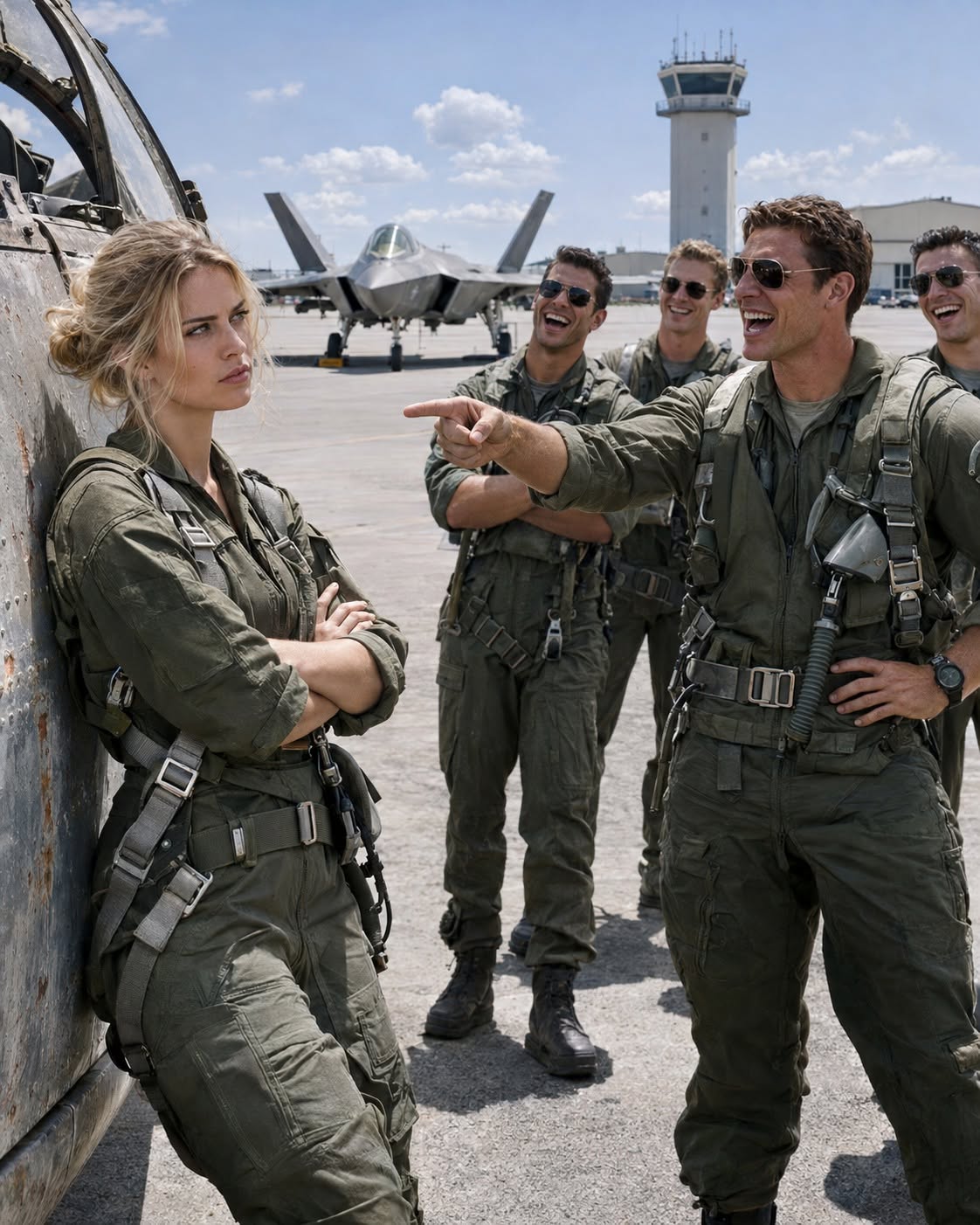
“During the exercise in the Southwest, is it true that an older training aircraft got behind your fighter without your radar detecting it?”
I stopped adjusting my flight gear.
“Who told you that?”
“I heard it from one of the instructors.”
I looked at him for a moment.
“Yes. It happened.”
He hesitated.
“What did you do wrong?”
It was an honest question, and I appreciated that.
“I assumed the information on my display was the entire picture.”
He nodded slowly.
I could tell he was trying to understand.
“Remember something, Carter,” I said. “Technology can tell you what its sensors detect. It can’t automatically tell you what you’re failing to notice.”
He thanked me and walked away.
I watched him go, thinking about Rebecca’s first question.
When was the last time you actually looked outside your cockpit?
Then the warning light came on.
We were cleared for takeoff.
Within minutes, our formation was airborne and moving toward the designated training area.
The first phase went exactly as planned. Communications were clear, positioning was stable, and our systems were reporting normal conditions.
Then the weather began changing.
A bank of clouds developed farther north than forecast, and the controller announced that the exercise scenario had been modified.
We were instructed to reposition and respond to a developing simulated threat.
I checked my displays.
Three friendly aircraft appeared where I expected them to be.
The fourth contact was slightly farther away.
Something about the picture bothered me.
I couldn’t immediately explain why.
The system showed a stable track, but the contact’s movement didn’t quite match what I expected from the reported conditions.
I looked outside.
The horizon was becoming hazy. Sunlight reflected off the thin cloud layer, making it difficult to distinguish distant objects.
I checked the display again.
The contact had changed direction.
“Flight, maintain awareness of your surroundings,” I announced over the radio.
One of my wingmen acknowledged.
A moment later, Daniel’s voice came through.
“Lead, I have something unusual at my ten o’clock.”
“What do you see?”
“Not sure yet. Possible aircraft movement near the cloud edge.”
I checked my instruments.
Nothing unusual appeared.
“Can you confirm?”
“Negative. I saw movement, but I lost visual contact.”
I felt the familiar temptation to dismiss his observation.
The system was giving me a clean picture. There was no reason to abandon it because a young pilot thought he’d noticed something.
Then Rebecca’s voice seemed to return from somewhere in my memory.
Your instruments are tools. They’re not your eyes, and they’re certainly not your brain.
I took another look.
This time, I noticed a faint shape moving against the background.
It wasn’t where the display suggested it should be.
I immediately informed the controller and requested clarification.
The response came back several seconds later.
“Lead, we have an unexpected contact in your operating area. Stand by.”
Unexpected contact.
Those two words changed the atmosphere inside my cockpit.
The exercise was suddenly no longer following the script.
The controller instructed our formation to hold its assigned safety boundaries while the situation was evaluated.
I acknowledged and began communicating with my wingmen.
Then the radio went quiet.
Not completely.
There was still background communication, but Daniel’s aircraft wasn’t responding.
“Two, report status.”
Nothing.
“Two, this is Lead. Confirm your position.”
A few seconds passed.
Then I heard a faint transmission.
“Lead, I’ve got an instrument warning. My display is giving me conflicting information.”
I looked at the formation picture.
Daniel’s reported position didn’t match his indicated position.
I immediately felt a knot tighten in my stomach.
I remembered the first time Rebecca had made me realize that a perfect-looking display could be dangerously incomplete.
“Daniel, don’t make any sudden changes based on that indication. Confirm your actual situation using your backup instruments and visual references. Maintain the published safety procedures.”
“Understood.”
I contacted the controller and reported the discrepancy.
The response was immediate.
“All aircraft, exercise suspended. Repeat, exercise suspended. Follow the safety instructions from control.”
I acknowledged.
The training scenario was over.
But the situation wasn’t.
Within minutes, the controllers identified the problem as a technical issue affecting part of the simulated tracking environment. The discrepancy had created an inconsistent picture of aircraft positions.
Daniel’s aircraft was safe, but his primary display was providing misleading information.
He followed the backup procedures, maintained communication when possible, and returned under controller supervision.
When we landed, the technical team began examining the problem.
I found Daniel sitting beside his aircraft, still wearing his flight gear.
His face was pale.
“Sir, I thought I was losing control of the situation.”
I sat beside him.
“You did the right thing by reporting what you saw.”
“But the display kept telling me something different.”
“That’s why we have procedures, training, and more than one way to understand what’s happening.”
He looked down at his hands.
“I almost ignored what I was seeing.”
I knew exactly how that felt.
“Almost isn’t the same as actually doing it,” I told him. “You recognized something wasn’t right, and you spoke up. That’s important.”
The following afternoon, the squadron commander called me into his office.
The technical investigation had confirmed that a software synchronization fault had produced misleading position information during the exercise.
There had been no actual hostile aircraft, no attack, and no immediate danger. But the incident had exposed a weakness in how some pilots were interpreting information from their systems.
The commander placed a report on his desk.
“I’ve read your account,” he said. “There’s something I want to ask you.”
“Yes, sir?”
“Why did you question the display when the others didn’t?”
I considered the question.
“Because I had recently learned what happens when you trust it too much.”
He leaned back.
“Where did you learn that?”
“From Colonel Rebecca Hayes.”
He raised an eyebrow.
“The instructor with the older aircraft?”
“Yes, sir.”
He looked at the report again.
“Interesting. I was considering inviting her to participate in our next advanced training program.”
I wasn’t expecting that.
“That would be a good idea.”
He studied me for a moment.
“Then perhaps you should be the one to contact her.”
I left his office thinking about the woman who had once stood beside her battered aircraft while I laughed at it.
I wondered whether she’d remember me.
She did.
When I called her that evening, she answered with the same calm voice I remembered.
“Hayes.”
“Colonel, this is the pilot you embarrassed in the desert.”
There was a brief pause.
Then she laughed.
“I’ve embarrassed a lot of pilots. You’re going to have to be more specific.”
I smiled.
“The one who thought an expensive fighter made him invincible.”
“Ah. That one.”
I could almost picture her expression.
“What do you need?”
I explained the training incident, the technical malfunction, and the commander’s interest in bringing her to our base.
She listened without interrupting.
When I finished, she asked a question.
“Did anyone get hurt?”
“No, ma’am.”
“Good. Then perhaps you learned something without having to pay the worst possible price for it.”
I told her the squadron wanted her to help develop a new training program.
She was quiet for a moment.
“Are you asking me because you need someone to teach your pilots how to fly?”
“No.”
“Then why?”
“Because they need someone to teach them how to think.”
This time, she didn’t answer immediately.
“All right,” she finally said. “I’ll come.”
Two weeks later, Rebecca arrived at our base.
She came without ceremony, carrying a small travel bag and wearing a plain flight jacket. There was no entourage, no grand introduction, and certainly no interest in impressing anyone.
Some of the younger pilots recognized her name.
Others had heard the story about the desert exercise.
A few still seemed skeptical.
At the opening briefing, our commander introduced her and explained the purpose of the program.
Then Rebecca stepped forward.
She looked around the room.
“I understand most of you fly aircraft with very sophisticated systems,” she began.
A few pilots nodded.
“Good. You should use them. They exist for a reason.”
She paused.
“But I want you to remember something. The more information you have, the easier it becomes to confuse information with understanding.”
She walked to the whiteboard.
“Tell me what makes a good pilot.”
One officer raised his hand.
“Technical proficiency.”
Another said, “Situational awareness.”
Someone else mentioned decision-making under pressure.
Rebecca wrote each answer on the board.
Then she turned around.
“All correct. But there’s one thing missing.”
Nobody answered.
“Humility.”
A few pilots exchanged glances.
She continued.
“The ability to recognize when you don’t know enough. The willingness to question an assumption. And the courage to admit that someone with less impressive equipment might understand a situation better than you do.”
Her eyes briefly met mine.
I knew she remembered our first encounter.
The program lasted ten days.
Rebecca designed exercises that forced us to work through uncertainty, conflicting information, communication problems, and unexpected changes.
She didn’t try to make us distrust our technology.
In fact, she insisted that we understand our systems better than ever.
But she also wanted us to recognize their limitations.
During one classroom session, she presented two versions of the same scenario.
In the first, the display was accurate, but the pilot misunderstood what it meant.
In the second, the display contained incomplete information, but the pilot recognized the uncertainty and made a cautious decision.
“Which pilot performed better?” she asked.
The answers were divided.
Rebecca shook her head.
“You’re still looking for the person who made the most impressive decision. That’s not always the right question.”
She pointed to the second scenario.
“This pilot recognized that the situation was uncertain. He didn’t pretend to know what he couldn’t know. He communicated the problem and followed the appropriate procedures.”
She looked at the room.
“Sometimes the best decision isn’t the boldest one. Sometimes it’s the one that keeps everyone safe.”
That lesson stayed with me.
But the most important moment came on the final afternoon.
The squadron had arranged a large coordinated training scenario involving multiple aircraft, ground controllers, and simulated emergency conditions.
Rebecca would observe from the control room.
I was assigned to lead the formation.
Daniel was flying with us.
Before the briefing, I found Rebecca standing near the hangar, looking at the aircraft lined up outside.
“Are you nervous?” she asked without turning around.
“A little.”
“Good.”
I laughed.
“Good?”
“Confidence is useful. A little nervousness reminds you that what you’re doing deserves your attention.”
I leaned against the nearby railing.
“Colonel, can I ask you something?”
“Go ahead.”
“Why did you agree to come here?”
She looked at me.
“Because I remember being young.”
I waited.
“When I started flying, there were pilots who believed experience meant knowing everything. I promised myself I’d never become one of them.”
She looked toward the runway.
“Then, after enough years, I discovered something. Experience can make you better, but it can also make you comfortable. And comfort can become its own kind of blindness.”
I thought about that for a moment.
“Do you ever worry that the next generation won’t understand what you know?”
She smiled faintly.
“No. I worry that they’ll understand it better than I do.”
I frowned.
She continued.
“Every generation has something to teach the next one. If I spend my time complaining about their technology, I become exactly the kind of pilot I once disliked.”
I had never considered it that way.
She wasn’t defending old aircraft.
She wasn’t trying to prove that the past was better.
She was trying to make sure the future didn’t forget what the past had learned.
“Remember this,” she said. “Your job isn’t to become the pilot I was. It’s to become the pilot your generation needs.”
Then she handed me the briefing folder.
“Now go do your job.”
The exercise began shortly afterward.
Our formation took off under clear skies, with the training area already prepared for the scenario.
At first, everything proceeded normally.
The simulated mission developed as expected, and our communication remained steady.
Then the controller introduced a complicated problem.
A reported aircraft position conflicted with information from another source. The situation required us to reassess our understanding before proceeding.
I checked my instruments.
The initial information suggested one interpretation.
But something didn’t fit.
I remembered the previous incident.
I also remembered Rebecca’s lessons about uncertainty.
“Flight, hold the planned maneuver. I want confirmation from control before we continue.”
One of my wingmen questioned the delay.
“Lead, our display indicates the contact is moving away.”
“I understand. But we don’t have enough confirmation to make that assumption.”
The controller acknowledged our request.
A few moments later, additional information came through.
The original position report had been incorrect.
Had we continued without checking, we would have entered a restricted portion of the training area and disrupted another formation’s exercise.
It wasn’t a dramatic victory.
There was no simulated enemy lock, no spectacular maneuver, and no triumphant announcement.
Just a decision to stop, question, communicate, and wait for reliable information.
Yet when we landed, Rebecca was standing outside the control room.
She approached me.
“Why did you hold the formation?”
“Because the information didn’t agree.”
“Was your display wrong?”
“Not entirely. It was showing the information available to it. But the information itself was incomplete.”
She nodded.
“And what did you do?”
“I asked for confirmation before making a decision.”
For a moment, she said nothing.
Then she smiled.
“That’s what I wanted to see.”
I felt a strange sense of satisfaction.
Not because I had beaten her.
Not because I had proved myself to the squadron.
But because I finally understood what she had been trying to teach me from the beginning.
A pilot’s greatest strength wasn’t the ability to react quickly.
It was the ability to recognize when reacting quickly would be the wrong thing to do.
After the exercise, the squadron commander gathered everyone in the briefing room.
He announced that the training program would become a permanent part of our readiness curriculum.
Rebecca’s methods would be incorporated into future exercises, and experienced pilots would be paired with younger officers to exchange knowledge.
Then he invited her to say a few words.
She stood at the front of the room, looking slightly uncomfortable with the attention.
“I’ve been asked to explain what this program has accomplished,” she said.
She paused.
“I could tell you about improved performance, better communication, and stronger decision-making. Those things matter.”
She glanced toward the pilots seated in front of her.
“But I think the most important thing is that you have learned not to confuse confidence with certainty.”
She picked up a marker and wrote three words on the board.
LOOK.
QUESTION.
LEARN.
“Look at what’s happening. Question what you believe you understand. And keep learning, especially when you think you’ve already mastered something.”
She put the marker down.
“That’s all I have.”
Everyone applauded.
I noticed Daniel sitting in the second row.
He was listening carefully, just as I had listened during my first meeting with her.
After the briefing, Rebecca began packing her things.
I found her near the exit.
“Colonel, I wanted to thank you.”
She looked up.
“For what?”
“For changing the way I think.”
She shook her head.
“I didn’t change it. You did.”
“You gave me the opportunity.”
“Then don’t waste it.”
I smiled.
She extended her hand.
I shook it.
For a moment, neither of us said anything.
Then I asked the question that had been bothering me since the desert.
“Can I ask you something about that first engagement?”
“Of course.”
“Did you know exactly what I was going to do?”
She laughed.
“Not exactly.”
“But you seemed to anticipate every move.”
“That’s because you were making the same mistake many confident pilots make.”
“Which was?”
“You were so focused on proving your aircraft was superior that you stopped paying attention to the person flying against you.”
I nodded.
She continued.
“I didn’t need to know everything about your aircraft. I only needed to understand how you were likely to use it.”
I looked at her.
“So you weren’t really fighting the machine.”
“No,” she said. “I was studying the pilot.”
That answer stayed with me long after she left.
A few months later, I was assigned to help evaluate new pilots entering our advanced training program.
During one evaluation, a young officer made a mistake that reminded me painfully of my own first encounter with Rebecca.
He relied too heavily on a single display, overlooked an important visual observation, and became frustrated when the scenario didn’t unfold as expected.
After the exercise, he approached me.
“Sir, I don’t understand what went wrong. The system showed that I had everything under control.”
I looked at him.
“Then tell me something. When was the last time you actually looked outside your cockpit?”
He stared at me.
For a second, I almost laughed.
Then I remembered Rebecca standing beside the hangar, holding out a bottle of water.
I took a breath.
“Come with me. Let’s go through it again.”
We spent the next hour reviewing his decisions, not to embarrass him, but to help him understand where his assumptions had failed.
At the end, he asked whether I had ever made the same mistake.
I smiled.
“Once.”
“Was it bad?”
I looked toward the flight line.
“It was bad enough that I still remember the person who taught me not to make it again.”
Years passed.
Technology continued advancing.
Aircraft became more sophisticated, displays became clearer, and the amount of information available to pilots increased beyond anything I had imagined when I first began flying.
But the lessons Rebecca taught never became outdated.
If anything, they became more important.
I eventually became an instructor myself.
On the wall outside my office, I placed a photograph from that training exercise in the Southwest.
It showed Rebecca standing beside her aging aircraft, one hand resting on the fuselage, the desert stretching behind her.
The photograph wasn’t particularly impressive.
There were no dramatic skies or heroic poses.
Just an experienced pilot standing beside a machine that had served her for years.
Underneath it, I placed a small plaque.
“Technology gives you information. Experience teaches you what to do with it. Wisdom reminds you that you may still be wrong.”
Whenever a new pilot asked about the photograph, I told them the story.
I told them how I had laughed at her aircraft.
How she had beaten me without firing a shot.
How I had spent days learning that the battlefield was bigger than the picture on my display.
And how the most important lesson had nothing to do with winning an engagement.
It had to do with knowing the limits of your own knowledge.
I didn’t know whether Rebecca ever understood how much she had changed my life.
We stayed in touch occasionally, exchanging messages and updates about the pilots we’d trained.
Then, one winter morning, I received a letter from her.
It was handwritten.
There were only a few lines.
“Keep teaching them to think. Machines will keep getting smarter. Make sure the people using them do too. And remember, the day you stop learning is the day you become dangerous.”
I read it twice.
Then I placed it beside the photograph.
A few weeks later, I heard that Rebecca had officially retired from flying.
Her years in the cockpit had come to an end.
I sent her a message, thanking her once again for everything she had taught me.
Her response arrived the following morning.
“Don’t thank me. Pass it on.”
I sat quietly for a long time after reading those words.
I thought about the first day I’d met her.
The faded paint.
The old aircraft.
The confident young pilot who believed the most advanced machine automatically belonged to the better aviator.
I had entered that exercise believing I had nothing to learn from her.
I left understanding that the greatest advantage a pilot could possess wasn’t something installed in an aircraft.
It was the willingness to recognize a mistake, the discipline to question an assumption, and the humility to learn from someone whose experience was different from your own.
Today, whenever I walk past that photograph, I remember the woman who taught me one of the most valuable lessons of my career.
She never asked me to abandon technology.
She never told me that old machines were better than new ones.
She simply reminded me that no matter how advanced our tools become, someone still has to make the decisions.
And that person must remain curious, alert, and humble enough to admit when the picture doesn’t make sense.
I used to believe that the best pilot was the one who could see the most information.
Now I believe the best pilot is the one who knows how to understand it.
Because sometimes the most dangerous thing in a cockpit isn’t a malfunction, an opposing aircraft, or a sudden change in the weather.
Sometimes it’s the quiet conviction that you already know everything you need to know.
And sometimes, the person who can teach you the most is the one you almost dismissed before you ever took off.
Rebecca Hayes taught me that lesson with an old aircraft, a few days of training, and one question I have never forgotten.
When was the last time you actually looked outside your cockpit?
I still ask myself that question.
Not just when I’m flying.
But whenever I’m leading a team, making a difficult decision, or facing a problem that seems to have an obvious answer.
Because the world outside our displays is always bigger than the picture they show us.
And the moment we forget that, we stop seeing what matters.
That morning in the desert, I thought I was about to teach an old pilot what modern aviation could do.
Instead, she taught me something that no machine, no computer, and no amount of expensive equipment could ever replace.
The greatest technology in the cockpit was never the aircraft.
It was the mind of the person flying it.
And the greatest sign of a truly skilled pilot wasn’t that they never made mistakes.
It was that they remained humble enough to learn from them.
I never laughed at an old aircraft again.
More importantly, I never again assumed that the person flying it had nothing to teach me.