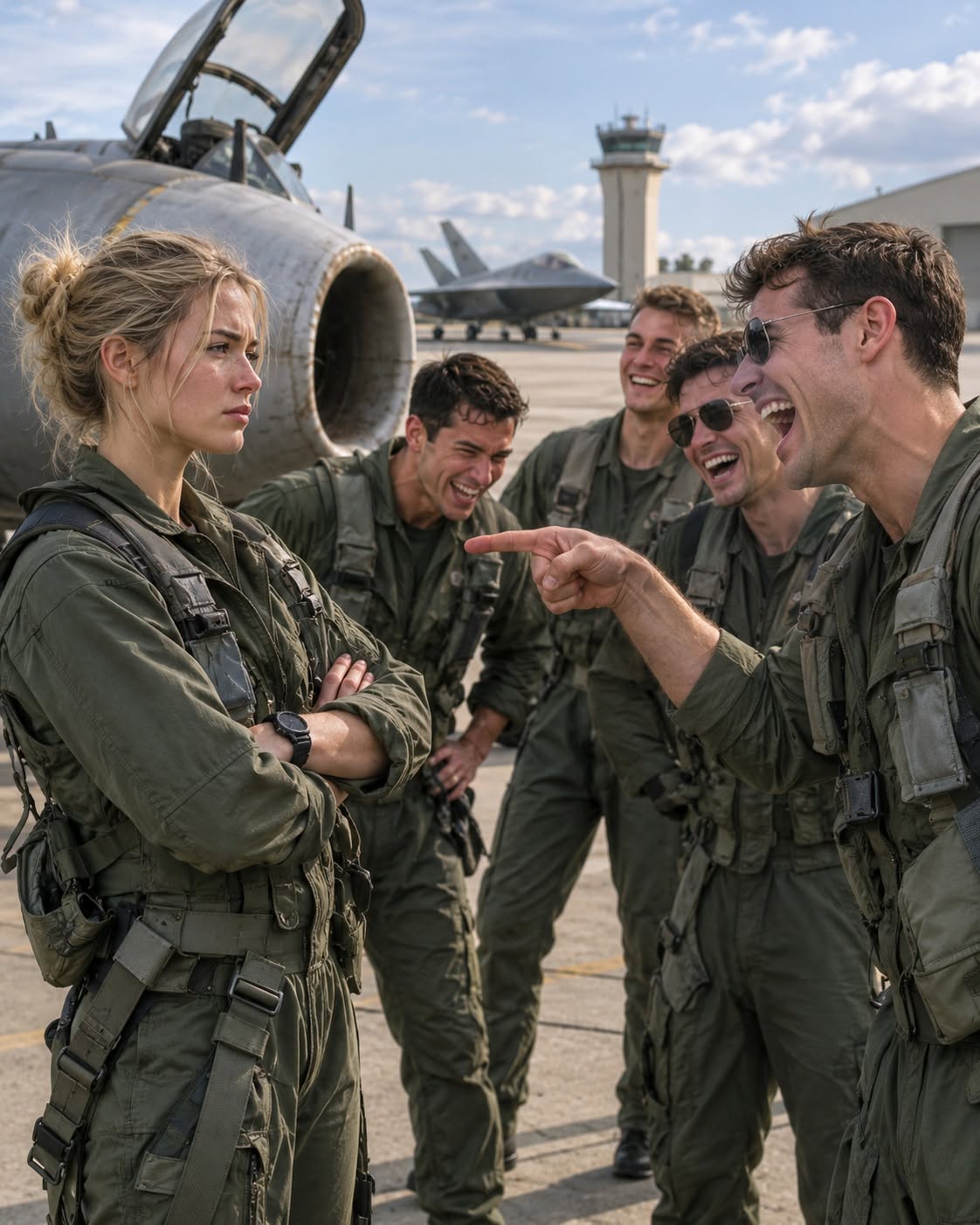
I laughed at Captain Vance’s thirty-year-old F-16 in front of the entire squadron. By the end of our exercise
The first page contained a photograph.
It showed two F-16s sitting side by side on a runway, their paint scorched and their canopies covered in dust. Behind them stood a group of pilots, most of them barely old enough to shave.
I recognized the aircraft in the foreground immediately.
Ghost.
But the second aircraft carried a name I had never heard before.
Raven.
At the bottom of the photograph was a date from twenty-two years earlier.
I turned the page.
A mission report appeared beneath a large red classification stamp. Several paragraphs had been blacked out, but one sentence remained visible.
“Captain Eleanor Vance was the only pilot to return after the entire flight was lost.”
I read it twice.
“What’s this?” I asked.
Vance didn’t answer immediately. She looked toward the hangar, where the afternoon sun reflected off the polished nose of my F-35.
“An exercise that was supposed to be simple,” she finally said. “And a lesson that took twenty-two years to understand.”
I looked down at the report again.
“Why wasn’t this in your official record?”
“Because the people who wrote the report didn’t want the truth becoming part of the record.”
Before I could ask another question, the base operations officer approached us.
“Commander, General Mercer wants both of you in the briefing room. Immediately.”
Vance’s expression changed.
Not fear.
Not surprise.
Something closer to resignation.
She folded her arms and looked at me.
“Looks like the past has finally caught up with us.”
I followed her toward headquarters, carrying the document that had just turned a routine training exercise into something much bigger.
And for the first time since taking command of Red Force, I wasn’t entirely sure I understood the situation.
The briefing room was already occupied when we arrived.
General Mercer stood at the head of the table, accompanied by three intelligence officers and the exercise director. A large digital display showed a map of the Nevada training range.
On the screen were several red circles.
Each marked a simulated aircraft loss from our exercise.
My squadron.
All of it.
“Sit down, Commander,” Mercer ordered.
I took a seat beside Vance.
The general tapped the screen.
“Today’s exercise was designed to evaluate our next-generation combat network. Specifically, its ability to maintain situational awareness when facing an adversary operating under degraded electronic conditions.”
I nodded.
That much was familiar.
“What wasn’t planned,” he continued, “was the complete collapse of Red Force’s tactical awareness.”
I shifted in my chair.
“General, Captain Vance exploited a combination of terrain and timing. It was an impressive performance, but I don’t believe it proves our systems are fundamentally flawed.”
Mercer looked at me.
“That’s exactly why you’re here.”
He changed the display.
A new image appeared.
It showed an aerial photograph of a mountainous region, with several small installations marked along the ridgelines.
“Three weeks ago, an intelligence team identified unusual electronic activity near a restricted training sector. Nothing dangerous, but enough to suggest someone had been testing methods of interfering with our battlefield network.”
One of the intelligence officers spoke.
“The activity was intermittent. Conventional monitoring equipment couldn’t establish a consistent source. We needed a controlled exercise to determine whether our systems could recognize the pattern.”
I glanced at Vance.
She was studying the photograph.
“You knew about this?” I asked.
“Not all of it,” she replied. “But I recognized the location.”
Mercer nodded.
“Captain Vance trained in this region during an experimental program twenty-two years ago. The program was called Silent Horizon.”
The name meant nothing to me.
The general continued.
“It involved a small group of experienced pilots who were tasked with developing tactics for operating against technologically superior adversaries. Their objective wasn’t to defeat advanced aircraft through superior equipment. It was to understand how human judgment, terrain awareness, deception, and discipline could expose weaknesses in an otherwise impressive system.”
I leaned back.
“So Ghost was part of that program?”
“Yes.”
Mercer paused.
“And so was Raven.”
Vance’s jaw tightened.
The intelligence officer brought up another photograph.
This one showed a younger Vance standing beside a different pilot.
He had dark hair, a broad smile, and the confident posture of someone who believed nothing could go wrong.
“Major Daniel Reeves,” the officer said. “Captain Vance’s flight partner.”
Vance looked away.
“Daniel was the best pilot I ever flew with,” she said quietly.
Mercer allowed a moment of silence before continuing.
“During a training mission, the team encountered unexpected interference in an area that had been declared safe. Their communication systems failed. Their navigation data became unreliable. Four aircraft disappeared from the exercise picture.”
“Crashes?” I asked.
“Not all of them. Two aircraft returned. One was recovered after an emergency landing. The fourth was never found.”
I looked at the photograph again.
“And Vance was the only one who returned?”
“She was the only one who completed the mission and brought back the information that revealed what had happened.”
I turned toward her.
“What about Reeves?”
Vance stared at the table.
“He was leading the formation. When our systems began giving us contradictory information, he trusted the instruments. I told him the terrain didn’t match what the displays were showing.”
She took a breath.
“He told me to stop questioning the equipment and follow the plan.”
“What happened?”
“His aircraft went down in a narrow valley. We lost contact seconds later.”
Nobody spoke.
Vance continued.
“I tried to reach him. I circled until I was nearly out of fuel. But I couldn’t get a reliable signal, and I couldn’t find a safe route back into the valley.”
Her voice remained steady, but her hands were tightly clasped.
“I returned with the information we needed. The official report said the incident was caused by pilot error and unexpected environmental conditions.”
“And you disagreed?”
“I knew there was more to it. The systems had been feeding us incorrect information. We had trusted the screens more than our own judgment.”
General Mercer closed the folder.
“Silent Horizon was suspended. The investigation was classified. The lessons were never fully incorporated into the training doctrine.”
I looked at the red circles on the display.
Then at the exercise results showing my squadron’s destruction.
I finally understood why Mercer had wanted Vance involved.
Today’s exercise hadn’t simply tested whether an old aircraft could defeat a new one.
It had tested whether the pilots flying those new aircraft had forgotten something essential.
But one question still bothered me.
“Why bring me into this now?”
Mercer looked directly at me.
“Because tomorrow’s exercise is going to be different.”
He changed the screen again.
A new heading appeared.
OPERATION IRON VEIL – PHASE TWO.
“Tomorrow, Blue Force will operate with simulated electronic disruption, unreliable navigation information, and restricted communication. Red Force will act as the opposing force. Your task is to identify and neutralize a mobile command element hidden somewhere in the training area.”
I frowned.
“That sounds like a much larger exercise.”
“It is.”
“How many aircraft?”
“Sixteen.”
I glanced at Vance.
“And what role does she have?”
Mercer answered before she could.
“She will lead Red Force.”
I sat up.
“General, with respect, I command the F-35 detachment. I have the largest formation and the most advanced aircraft available. Surely it makes more sense for me to lead the mission.”
Mercer didn’t blink.
“That was your position yesterday, Commander. How did it work out?”
The room went silent.
I felt my face grow warm.
Vance didn’t smile.
She simply looked at me and said, “You can lead the aircraft, Commander. But tomorrow, try leading the people.”
The meeting ended ten minutes later.
As we walked outside, I caught up with her.
“Captain.”
She stopped.
“I owe you an apology.”
She studied my face.
“For what?”
“For the comment about your aircraft. And for assuming the age of your equipment told me something about your ability.”
She considered that for a moment.
“Apology accepted.”
I nodded toward Ghost.
“Can I ask you something?”
“Go ahead.”
“Why do you still fly it?”
She looked at the faded fighter.
“Because people keep telling me what it can’t do. I like knowing exactly what it can.”
Then she walked away.
I stood there for several seconds.
For the first time, I wondered whether I had spent so much time learning to trust technology that I had forgotten how to trust myself.
The following morning, the entire squadron assembled in the operations hangar.
The atmosphere was different.
The pilots who had laughed at Vance’s aircraft the previous day were now studying her briefing notes. Some looked uncomfortable. Others seemed genuinely curious.
Ghost sat beneath the hangar lights.
Its faded paint looked almost silver.
My F-35 stood several spaces away, immaculate and modern, its exterior panels reflecting the overhead lights.
I had spent years believing that the difference between those two aircraft represented the difference between the past and the future.
Now I wasn’t so sure.
Vance stood in front of the formation.
“Before we begin, I want everyone to understand something,” she said. “Today’s objective isn’t to prove that old aircraft are better than new ones. It isn’t about making advanced technology look bad. Technology saves lives. It gives pilots information and capabilities that previous generations could only dream about.”
She paused.
“But technology is a tool. It doesn’t replace judgment.”
She pointed toward the map.
“Our simulated adversary has a mobile command vehicle somewhere inside this training region. It will move periodically. Our job is to protect it. Your job is to find it.”
I raised my hand.
“What are the rules of engagement?”
“Standard exercise restrictions. No actual weapons release, no unsafe maneuvering, and no unauthorized entry into restricted airspace. All simulated engagements will be adjudicated by the exercise controllers.”
“Understood.”
Vance nodded.
“One more thing. If your displays disagree with your observations, don’t automatically assume your observations are wrong.”
Several pilots exchanged glances.
I looked down at the map.
This time, I didn’t study it only as a collection of electronic symbols.
I tried to imagine the actual terrain beneath them.
The exercise began at 0900.
My F-35 lifted smoothly into the sky, and the familiar cockpit displays came alive around me.
Every aircraft in my formation appeared as a symbol on the tactical map. Their positions, headings, and status reports were visible within seconds.
I had never felt more connected to a battlefield.
For the first twenty minutes, everything went according to plan.
My squadron established a wide search pattern. Our sensors scanned the designated area while the supporting aircraft monitored the main access routes.
Then the first disruption appeared.
A navigation warning flashed across my display.
One of my wingmen reported an inconsistent position reading.
I checked the system.
“Probably environmental interference,” I said. “Maintain your assigned positions.”
A moment later, two additional aircraft reported similar problems.
I looked toward the mountains.
The terrain was difficult, with deep valleys and sharp ridges that broke up the otherwise open landscape.
I remembered Vance’s words.
Don’t automatically assume your observations are wrong.
“Flight Two, verify your position using independent references.”
“Copy.”
I checked the horizon and compared it with the terrain model.
Something wasn’t right.
The digital map showed our formation slightly east of our actual position.
Not enough to cause immediate danger, but enough to compromise our search pattern.
I corrected my course.
Then I noticed something else.
The simulated command vehicle had apparently moved farther north.
Its electronic signature appeared on the network for less than ten seconds before disappearing.
“All aircraft, hold your current assignments,” I ordered.
A new voice entered the radio.
“Red Force has eyes on the target.”
It was Vance.
I looked at the display.
No enemy aircraft were visible.
“Captain, I don’t see you.”
“That’s because you’re looking in the wrong place.”
The transmission ended.
I felt the familiar tension in my shoulders.
Then another message arrived.
RED FORCE SIMULATED ENGAGEMENT – BLUE TWO NEUTRALIZED.
One of my wingmen had been eliminated.
Seconds later, another warning appeared.
BLUE FOUR NEUTRALIZED.
I ordered my pilots to regroup.
But the network was beginning to fail.
Positions were inconsistent. Some aircraft disappeared from the shared display, while others appeared in places that didn’t match their reported headings.
I switched to a backup communication channel.
“All flights, report visually if possible. Do not rely exclusively on shared position data.”
For several seconds, there was no response.
Then a familiar voice came through.
“Commander, this is Vance. You’re doing better.”
I almost laughed.
“Is that your way of encouraging me?”
“No. It’s my way of telling you that you’re still alive.”
I scanned the surrounding airspace.
“Where are you?”
“Closer than you think.”
The radio went quiet.
I knew the exercise was designed to challenge us, but something about the latest disruption felt different.
The interference wasn’t random.
It was occurring in short, carefully timed intervals.
Someone was controlling the exercise environment in a way that was forcing us to make decisions with incomplete information.
I checked the mission briefing.
The mobile command vehicle was supposed to transmit a status signal every five minutes.
The last signal had come from the northern sector.
But the terrain around that location made the reported position questionable.
I zoomed out.
Then I saw it.
The command vehicle’s last three reported positions formed a nearly straight line.
Except the line didn’t follow the road network.
It crossed a mountain ridge.
I called the exercise controller.
“Confirm the last known location of the mobile command element.”
“Unable to verify, Commander. The signal is being degraded.”
“Was the vehicle ever physically present at those coordinates?”
There was a pause.
“Stand by.”
I looked at the terrain.
The locations were too perfect.
Someone had created a pattern that was meant to draw us toward a particular search area.
“All flights, do not pursue the last reported target position. Treat it as potentially deceptive.”
One of my pilots responded.
“Commander, we have a possible visual contact near the northern ridge.”
“Do not engage until we can confirm.”
I took a moment to study the landscape.
A narrow road disappeared between two rocky hills.
Beyond it was a dry riverbed.
And beside the riverbed, barely visible against the surrounding earth, was a long rectangular shape.
The actual command vehicle.
“Target located,” I said.
Before I could issue another instruction, Vance’s voice returned.
“Congratulations, Commander. Now tell me what you see.”
I stared at the display.
“I see the target.”
“That’s not what I asked.”
I looked again.
The vehicle was stationary.
There were no obvious support elements nearby.
But the road leading toward it was exposed.
If we approached directly, we would enter a predictable corridor.
“An ambush,” I said.
“Good.”
A second later, three simulated threat indicators appeared around my formation.
Vance had anticipated our approach.
I felt the old frustration rising.
“How are you always one step ahead?”
Her answer was quiet.
“Because you keep telling me what you’re going to do.”
I stared at the cockpit display.
Then I understood.
My squadron’s movements were coordinated, efficient, and visible.
We were relying on predictable procedures because our network had been built to make those procedures work.
Vance was forcing us to think beyond them.
I switched to the squadron channel.
“Everyone, stop trying to rebuild the original formation. We’re going to operate independently within the exercise restrictions. Communicate only what is necessary. Confirm important information through more than one source.”
A pilot responded.
“Commander, are you changing the entire plan?”
“Yes.”
“What’s the new plan?”
I looked toward the distant mountains.
“We’re going to stop chasing what the system says is happening and start understanding what’s actually happening.”
For the first time that morning, I heard confidence returning to the voices on the radio.
The next twenty minutes became the most demanding flying I had experienced in years.
We lost two more aircraft.
But this time, we also began identifying the patterns behind the simulated threats.
A false contact appeared near the eastern ridge.
We didn’t pursue it.
A navigation discrepancy appeared over the southern valley.
We verified it independently.
An aircraft disappeared from the network.
Instead of assuming it had been destroyed, we established contact through the backup channel.
Slowly, our formation became less predictable.
Then something unexpected happened.
The exercise controller announced that the mobile command vehicle had been compromised.
But not by me.
Not by my wingmen.
By an aircraft operating independently outside the main search pattern.
Ghost.
Vance had completed her objective while we were still trying to locate the target.
I looked toward the western mountains.
A small aircraft was visible against the distant sky.
For a moment, I couldn’t believe what I was seeing.
“Captain Vance, this is Blue Lead. How did you get there?”
“Same way you got here, Commander. By paying attention.”
Then the controller interrupted.
“Exercise pause. All aircraft, maintain safe separation and await instructions.”
I checked my fuel and began the return sequence.
But before we could land, another announcement came through.
“All units, be advised. An actual ground safety incident has been reported near the northern training boundary. Exercise operations are suspended. Follow range control instructions.”
The atmosphere changed instantly.
This wasn’t part of the simulation.
A few seconds later, range control transmitted the details.
A ground maintenance vehicle had broken down near an access road. Its crew had attempted to contact the exercise coordination team, but the communication relay in that sector was malfunctioning.
The vehicle was close to a restricted area, and ground personnel were trying to determine the safest way to reach it.
We were ordered to return unless specifically reassigned by range control.
I acknowledged the instruction.
As I turned toward the base, I noticed something on the ground.
A small white vehicle was parked beside a dirt road.
Two people were standing near it.
I couldn’t determine their condition from the air.
“Range control, Blue Lead. I have a possible visual on a ground vehicle near the northern boundary. Request confirmation.”
The controller responded.
“Stand by, Blue Lead. Do not approach the restricted area.”
I held my position at a safe distance.
Then another aircraft called in.
“Ghost has visual contact with the ground team.”
Vance’s voice followed.
“Confirmed. Two personnel, both visible and moving. No immediate indication of injury.”
Range control acknowledged.
“Copy. Ground rescue team is being dispatched.”
I watched the tiny figures beside the vehicle.
There was nothing heroic about the moment.
No dramatic maneuver.
No cinematic explosion.
Just two people waiting for help in the middle of an enormous training range.
But it reminded me why every aircraft, every sensor, and every exercise existed in the first place.
Not to win arguments.
Not to impress senior officers.
To bring people home.
We returned to base shortly afterward.
The exercise director gathered everyone in the main briefing room.
The final results appeared on the screen.
Red Force had completed its objective.
Blue Force had suffered several simulated losses, but had also identified the deceptive target pattern and prevented the exercise from escalating into an unsafe situation.
The results were more complicated than either side had expected.
General Mercer stood at the front.
“Today’s exercise demonstrated something important. Our next-generation systems are powerful. But they are not infallible. A network can improve awareness, but it can also create dependence. A sensor can provide information, but it cannot replace the judgment of the person interpreting it.”
He looked toward me.
“Commander, would you like to add anything?”
I stood.
For a moment, I considered giving the usual professional response.
Something about lessons learned, mission readiness, and future improvements.
Instead, I looked toward Vance.
“Yesterday, I made a joke about Captain Vance’s aircraft. I assumed that because it was older, it was less capable. I also assumed that because mine was newer, I was automatically better prepared.”
Nobody moved.
“I was wrong.”
I looked around the room.
“We have spent years learning to operate increasingly sophisticated aircraft. We’ve learned to interpret enormous amounts of information in fractions of a second. But somewhere along the way, some of us started confusing access to information with understanding.”
I paused.
“Captain Vance reminded me that the pilot is still responsible for the decision. The aircraft doesn’t make that responsibility disappear.”
Vance lowered her eyes slightly.
I continued.
“Today, I also learned that a squadron doesn’t become stronger simply because every aircraft shares the same picture. It becomes stronger when every pilot knows how to think, communicate, question assumptions, and support the people flying beside them.”
When I finished, the room remained silent for a moment.
Then General Mercer nodded.
“That’s a useful lesson, Commander.”
The formal debrief ended shortly afterward.
Most of the pilots left, but I stayed behind.
Vance was gathering her documents when I approached.
“I read the rest of your report,” I said.
She looked up.
“All of it?”
“Everything that wasn’t blacked out.”
She gave a faint smile.
“That’s not much.”
“Enough to understand why you kept flying.”
I hesitated.
“I also saw something in the final section. The investigation recommended that Silent Horizon’s findings be incorporated into future training. But the recommendation was rejected.”
“Yes.”
“Why?”
Vance placed the papers inside her folder.
“Because the findings were uncomfortable. They suggested that some of the most expensive systems in development could be defeated by human beings who understood their limitations.”
“That doesn’t sound like a reason to bury the research.”
“It wasn’t the only reason.”
She looked toward the windows.
“After Daniel died, the program became politically complicated. Some people wanted to blame the aircraft. Others wanted to blame the pilots. Nobody wanted to accept that the entire approach had been flawed.”
I understood then.
Her redacted record wasn’t simply a collection of classified missions.
It was a history of someone who had survived a tragedy and spent decades trying to make sure the same mistake didn’t happen again.
“Did you ever find out what happened to Daniel’s aircraft?” I asked.
Vance remained quiet for a long time.
“Three years ago, an investigation team located part of the wreckage. They recovered his flight recorder.”
I waited.
“It confirmed that his instruments had been giving him contradictory information. He had tried to correct his position, but the navigation system kept directing him toward the wrong route.”
“Was the report changed?”
“Eventually. His family received the revised findings.”
She closed the folder.
“But no report can give them back the years they lost believing he had simply made a mistake.”
I didn’t know what to say.
She looked at me.
“That’s why I keep talking about judgment. Not because old aircraft are special. Not because new aircraft are bad. Because the person in the cockpit deserves every possible chance to make the right decision.”
I nodded slowly.
For several seconds, neither of us spoke.
Then I asked the question I had been thinking about since the first exercise.
“Would you be willing to help me redesign our squadron’s training program?”
She raised an eyebrow.
“You’re asking me to teach your pilots?”
“I’m asking you to help us become better pilots.”
A small smile appeared.
“That sounds like a much better request.”
I extended my hand.
She shook it.
And just like that, something that had started as a humiliating exercise became the beginning of a partnership.
Over the next six months, the squadron changed.
Not overnight.
Not without resistance.
Some pilots complained that the new training requirements were unnecessary. Others believed that spending time learning terrain awareness and independent navigation was a step backward.
Vance didn’t argue with them.
She simply gave them opportunities to prove themselves.
She introduced exercises in which electronic information was deliberately incomplete. She encouraged pilots to explain their decisions rather than simply report the results. She taught them to recognize when confidence became overconfidence.
I changed, too.
I stopped measuring my performance solely by mission scores and technology advantages.
During briefings, I began asking different questions.
What information are we missing?
What assumptions are we making?
What happens if the system is wrong?
And perhaps most importantly, what would we do if we had to make this decision without the technology we normally depend on?
The results surprised even General Mercer.
Our pilots became more adaptable. Communication improved. Mission performance increased, not because we had acquired better aircraft, but because we had learned to use the aircraft we already had more intelligently.
The biggest change, however, happened on a quiet morning in late autumn.
I arrived at the hangar before sunrise and found Vance standing beside Ghost.
She was holding a small photograph.
It was the same photograph from the Silent Horizon report.
The two young pilots stood beside their F-16s.
Daniel Reeves and Eleanor Vance.
I approached carefully.
“Thinking about him?”
She nodded.
“Today would have been his birthday.”
I looked at the photograph.
“He looks happy.”
“He was. He used to say that the best pilots weren’t the ones who never made mistakes. They were the ones who recognized their mistakes before someone else paid for them.”
She smiled sadly.
“I didn’t understand what he meant back then.”
I looked at Ghost.
“Do you think he would have been proud of what you’ve done?”
She considered the question.
“I think he’d be more interested in whether the next generation learned something from it.”
I nodded.
Then I noticed a new marking on the aircraft.
Just below the cockpit, beneath the faded paint, someone had carefully added a small silver inscription.
FOR DANIEL.
I didn’t ask who had painted it.
Some things didn’t need an explanation.
A few weeks later, our squadron received notice that Ghost would be retired from active service.
Its airframe had reached the end of its approved operational life, and maintenance requirements had become increasingly difficult to justify.
The announcement was made during a routine maintenance briefing.
Vance listened without comment.
Afterward, I found her standing beside the aircraft.
“How do you feel?” I asked.
She ran one hand along the fuselage.
“Sad, I suppose. But not surprised.”
“You could request another assignment.”
“I already have one.”
I looked at her.
“Where?”
She smiled.
“Training command. General Mercer approved it this morning.”
I was genuinely pleased.
“You’re going to be teaching future pilots?”
“Someone has to make sure they don’t become too impressed with themselves.”
I laughed.
This time, she laughed with me.
The following Friday, Ghost made its final flight.
The entire squadron gathered along the flight line.
The old F-16 rolled toward the runway, its engine producing a familiar roar that seemed to vibrate through the hangar walls.
Vance was in the cockpit.
Before departure, she transmitted one final message over the squadron frequency.
“To everyone listening, remember this: the aircraft you fly is important. The equipment you carry is important. But neither one can decide what kind of pilot you become.”
She paused.
“Fly smart. Stay humble. Bring your people home.”
Then Ghost accelerated down the runway and lifted into the morning sky.
For several minutes, it circled the airfield.
The sunlight caught its faded wings, turning them gold.
I watched until it disappeared beyond the distant hills.
When I returned to my office that afternoon, I found a small envelope on my desk.
My name was written on the front.
Inside was a photograph of Ghost sitting on the runway.
On the back, Vance had written a short message.
“The future belongs to those who are willing to learn from the past. Don’t let the screens do all your thinking.”
I placed the photograph beside my desk.
Months passed.
Ghost was eventually transferred to a military aviation museum, where it would be preserved alongside other aircraft that had served their country.
I attended the ceremony.
Vance stood beside the aircraft in civilian clothes, looking at the old fighter one last time.
A young pilot approached her.
“Ma’am, is it true this aircraft once defeated an entire formation of F-35s?”
Vance smiled.
“That’s what the exercise report says.”
The young pilot looked impressed.
“So the old aircraft really was better?”
She shook her head.
“No. That’s not the lesson.”
She pointed toward the F-35 display across the hangar.
“That aircraft can do things Ghost never could. It has capabilities that make missions safer and give pilots advantages we once could only imagine.”
Then she tapped the F-16’s faded fuselage.
“But this aircraft taught me something that doesn’t become outdated.”
The young pilot waited.
“Never confuse the sophistication of your tools with the quality of your decisions.”
The young man nodded thoughtfully.
I stood a few feet away, listening.
Then Vance noticed me.
“Commander. Still checking your screens?”
I smiled.
“Only after checking everything else.”
She laughed.
It was the first time I had heard her laugh without restraint.
Later that evening, as I drove away from the museum, I thought about the first day I had seen Ghost.
I remembered my joke.
I remembered the laughter.
And I remembered how certain I had been that the newest technology automatically made me the better pilot.
I had spent millions of dollars learning to fly an extraordinary aircraft.
But it had taken one woman in a thirty-year-old fighter to teach me what no simulator, computer, or advanced sensor could fully explain.
Technology can give you an advantage.
Experience can help you recognize when that advantage is disappearing.
But humility is what allows you to learn before it’s too late.
I had once believed that the future belonged to whoever possessed the most advanced machine.
Now I understood something different.
The future belongs to those who know how to use their tools without becoming dependent on them, who respect experience without being trapped by tradition, and who never stop questioning what they think they know.
A few months later, I was assigned to lead a new generation of pilots.
During their first briefing, I placed two photographs on the table.
One showed my F-35.
The other showed Ghost.
I asked the room a simple question.
“Which aircraft would you rather fly into a difficult mission?”
Almost every hand went up for the F-35.
I smiled.
“Good. That’s probably the right answer.”
Then I turned the second photograph around.
On its back were Vance’s words.
“Don’t let the screens do all your thinking.”
I read them aloud.
“Remember this. The most dangerous pilot isn’t always the one with the newest aircraft. Sometimes it’s the one who understands the situation better than everyone else.”
The room became quiet.
I looked at the young faces in front of me.
“Your aircraft may be smarter than anything that came before it. But the moment you believe that makes you smarter than the person flying an older machine, you’ve already made your first mistake.”
I placed the photographs side by side.
“Respect the technology. Respect the experience. And never underestimate the person sitting in the cockpit beside you.”
That day, I finally understood why Captain Vance had never bothered defending Ghost.
She had never needed to.
Her skill had spoken for itself.
And the lesson she left behind would outlast every aircraft in that hangar.
Because machines grow old.
Systems become obsolete.
Technology gets replaced.
But the ability to think clearly under pressure, to remain humble in the face of experience, and to take responsibility for the lives entrusted to you will never go out of service.