I had flown F-16 fighter jets for years, but nothing prepared me for what I discovered during a routine pre-flight inspection at a military base in the Middle East.
PILOT’S LAST CALL – THE FINAL CHAPTER
The officer slowly turned toward us, his face pale. Then he opened his mouth to explain why he had done it.
“You’re too late,” he whispered. “You don’t understand what you’ve just walked into.”
The lead investigator kept his weapon trained on him.
“Hands where I can see them. Step away from the keyboard.”
The officer swallowed hard. His eyes moved from the investigator to me, then back to the computer screen.
“That aircraft wasn’t supposed to come back,” he said.
For a moment, nobody moved.
“What did you say?” I asked.
He looked directly at me.
“Your mission was never supposed to be reconnaissance. It was supposed to be your last flight.”
A cold feeling spread through my chest.
The investigator stepped closer.
“Start talking. Right now.”
The officer slowly lifted his hands from the keyboard.
“My name is Daniel Mercer. I’ve worked on this installation’s cybersecurity systems for eleven years. Three months ago, I discovered unauthorized access to classified flight records. Someone had been changing maintenance reports, altering mission schedules, and deleting communications between certain officers and a private defense contractor.”
“Who?” the investigator demanded.
Mercer hesitated.
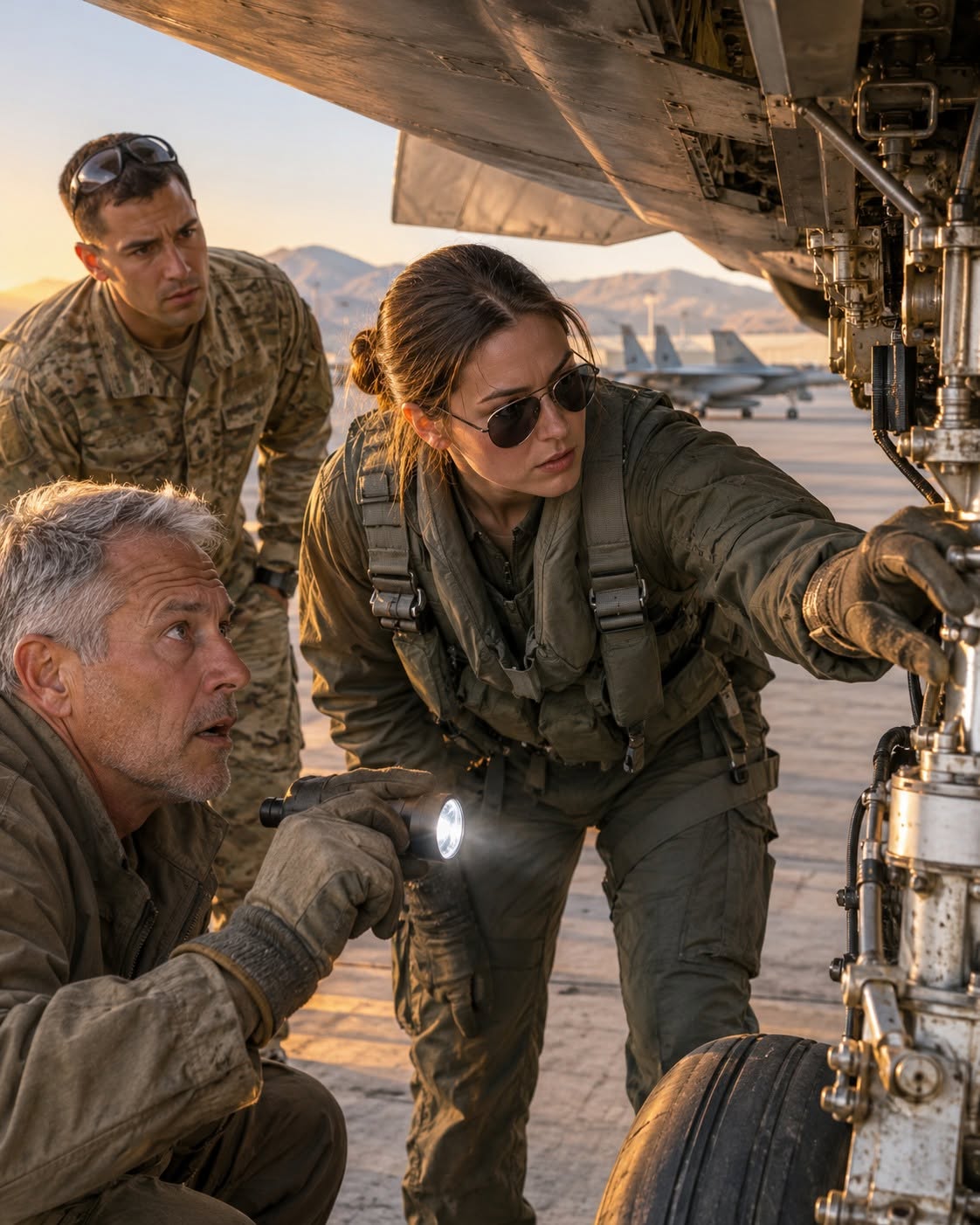
“Colonel Richard Vance.”
The name hit me harder than I expected.
Vance was the senior operations commander at the base. He had personally approved several of my missions. He was the kind of officer who remembered everyone’s name, shook hands with mechanics, and gave speeches about honor and duty.
He had even congratulated me after my last successful deployment.
I stared at Mercer.
“You’re telling me the colonel ordered someone to sabotage my aircraft?”
“Not exactly,” Mercer replied. “He ordered the operation. But the people carrying it out had their own reasons.”
The investigator glanced at the computer.
“What operation?”
Mercer nodded toward the screen.
“Look at the file marked NIGHTFALL.”
The investigator moved closer, careful not to touch the keyboard.
On the monitor was a series of encrypted documents. Several contained flight schedules, aircraft identification numbers, maintenance authorizations, and records of financial transfers.
One document had my name on it.
Beside it was a photograph of my aircraft.
Underneath the photograph were three words:
PILOT TERMINATION EVENT.
My mouth went dry.
“Why me?”
Mercer looked down.
“Because you were scheduled to fly over the northern corridor tomorrow morning. Your aircraft was supposed to lose control shortly after entering restricted airspace. The damage would be blamed on an enemy missile system.”
I felt my hands tighten into fists.
“But why would anyone want to start a war?”
“Because a defense contractor has been secretly transporting prohibited military technology across that border. The operation was making enormous amounts of money. Several senior people were involved. If the aircraft went down, the resulting confrontation would create an opportunity to launch a military response and destroy the evidence of those shipments.”
The investigator’s expression hardened.
“You’re saying they wanted a dead American pilot to create a false justification for military action?”
Mercer nodded.
“And they needed someone whose death would be impossible to dismiss as an accident.”
For several seconds, the only sound was the humming of the computer.
Then Mercer added something that made the situation even worse.
“They knew you would discover the missing shear pin.”
I stared at him.
“How could they possibly know that?”
“Because someone had reported your inspection habits. You always performed an additional walkaround, even when the maintenance team had already signed off on the aircraft. The plan was designed around that.”
“Then why leave the pin missing?”
Mercer looked toward the investigator.
“Because they wanted to know whether the contractor who discovered it would report the problem. If he did, they would eliminate him before he could speak to investigators.”
The image of the injured civilian contractor flashed through my mind.
“Is he alive?”
Mercer nodded.
“Yes. But they don’t know how much he remembers.”
Before anyone could ask another question, a sharp electronic tone sounded from the computer.
Mercer’s face changed.
“What now?” the investigator demanded.
“The wipe process just reached the external archive.”
“Can you stop it?”
“I can try, but the system is connected to another terminal outside this section. Someone is controlling it remotely.”
The investigator looked at me.
“Can you identify where?”
Mercer pointed to a small window on the screen.
“Building Twelve. Communications annex.”
The investigator immediately reached for his radio.
“Control, this is Agent Harris. We have a suspected insider attempting to destroy classified evidence. Send a team to Building Twelve. Secure the communications room. Nobody leaves.”
A burst of static answered him.
Then a familiar voice came through.
“Negative, Agent Harris. All security teams are currently responding to an emergency at the eastern perimeter.”
Harris frowned.
“Who is this?”
“Colonel Vance. I’m taking command of the situation.”
The investigator’s face went completely still.
“Colonel, I need you to remain in your office. We have reason to believe someone inside your command structure is involved in a criminal operation.”
There was a pause.
Then Vance replied calmly.
“Agent, you are making a serious mistake. Stand down and bring the pilot to my command office.”
Harris looked at Mercer.
Mercer shook his head violently.
“Don’t go near him.”
The radio crackled again.
“Agent Harris, that is a direct order.”
Harris switched off the radio.
“Well,” he muttered, “that answers one question.”
He turned to me.
“Colonel Vance knows we’re here. We need to move.”
I glanced at the computer.
“What about the evidence?”
Mercer pointed toward a small portable storage device beside the keyboard.
“I managed to create an emergency copy before the wipe began. It contains the financial transfers, the altered maintenance records, and the communications logs.”
Harris picked it up and secured it.
“Then we’re leaving.”
We had barely reached the end of the tunnel when the lights went out.
A second later, the emergency lights flickered on, bathing the passageway in red.
Somewhere behind us, a heavy metal door slammed shut.
Mercer stopped.
“That’s not supposed to happen.”
Harris raised his weapon.
“What?”
“The underground access doors are controlled by the base security network. Someone just locked down the entire tunnel system.”
A metallic impact echoed from behind us.
Then another.
Someone was coming.
“Move!” Harris shouted.
We hurried toward the nearest maintenance exit. The passage was narrow, and water from the malfunctioning suppression system had begun collecting along the floor.
Mercer stumbled.
I caught his arm before he fell.
“Keep moving!”
We reached a steel ladder leading to the service level. Harris climbed first, then pulled Mercer up. I was halfway through the hatch when a figure appeared at the far end of the tunnel.
“Stop!”
A security guard stood beneath the red emergency lights.
For one terrible second, I couldn’t tell whether he was there to help us or stop us.
Then he raised his weapon.
Harris pulled me back through the hatch just as a shot struck the metal frame.
“Get down!”
We dropped behind a concrete support column.
The guard advanced slowly.
“Put your weapons down!” he shouted. “Colonel Vance has ordered everyone in this section detained!”
Harris leaned toward me.
“That isn’t a normal security response.”
Mercer was trembling.
“He’s one of Vance’s people. I recognize him.”
Harris glanced at the investigator’s identification badge clipped to his vest.
“Stay behind me.”
He called out.
“Federal criminal investigation! Lower your weapon!”
The guard hesitated.
That hesitation was all the time we needed.
A second security team appeared from the opposite corridor, but instead of pointing their weapons at us, they ordered the first guard to stand down.
Their leader was a woman I recognized immediately.
Lieutenant Commander Elena Brooks.
She was the base’s deputy security officer and one of the few people I had trusted without hesitation.
“Are you all right?” she asked.
Harris lowered his weapon slightly.
“Who sent you?”
“Nobody. I heard the radio traffic and realized something wasn’t right.”
She looked at Mercer.
“Is that the cybersecurity officer?”
“Yes,” Harris answered. “And he’s going to help us expose a conspiracy.”
Brooks glanced at the approaching guard.
“Then we need to get out of this tunnel before the colonel sends more people.”
She led us through a secondary service corridor that opened into an equipment storage building.
For the first time since discovering the missing pin, I could breathe.
But the relief didn’t last.
My phone vibrated.
An unknown number.
I almost ignored it, but the message contained a photograph.
It showed the injured contractor lying in a hospital bed.
Underneath was a short sentence:
HE WON’T BE THE LAST PERSON TO GET HURT.
I showed it to Harris.
He studied the photograph carefully.
“Can you identify the hospital?”
I zoomed in.
There was a small blue sign reflected in the glass behind the bed. I recognized the logo of the medical facility attached to our base.
“He is still here.”
Harris immediately contacted the hospital security team.
“Nobody moves that patient without authorization. And nobody enters his room alone.”
Then another message arrived.
COME TO THE OLD CONTROL TOWER. ALONE. OR THE CONTRACTOR DIES.
Brooks read it over my shoulder.
“It’s a trap.”
“I know.”
“Then you’re not going.”
I looked at the photograph again.
The contractor had risked his life to report what he found. He had done the right thing when staying silent would have been easier.
I wasn’t going to abandon him.
But Harris grabbed my shoulder.
“Listen to me. That’s exactly what they want. You’re emotionally involved, and they know it.”
“I understand.”
“Do you? This isn’t a personal confrontation. We’re dealing with people who have access to military resources, classified information, and the ability to manipulate the base security system.”
He was right.
For the first time that morning, I understood that courage did not mean walking directly into danger.
It meant making the decision that gave everyone the best chance of surviving.
I handed him my phone.
“Then let’s make sure they don’t get what they want.”
We agreed to use the message as an opportunity to identify whoever was behind the operation. Harris contacted the investigative command outside the installation, while Brooks arranged a security perimeter around the hospital.
Mercer began reviewing the copied files.
For nearly twenty minutes, nothing happened.
Then he found something.
“Wait,” he said.
We gathered around his laptop.
“There’s another account connected to NIGHTFALL. It belongs to someone identified as PROJECT LIAISON.”
“Who?” Harris asked.
Mercer opened the account information.
The name appeared on the screen.
COMMANDER ELENA BROOKS.
I turned toward her.
She stared at the laptop, her expression unreadable.
Harris immediately raised his weapon.
“Hands where I can see them.”
Brooks didn’t move.
For a moment, I couldn’t believe what I was seeing.
The woman who had helped us escape the tunnels might have been part of the conspiracy all along.
“Elena?” I whispered.
She slowly raised both hands.
“Listen to me. That’s not what it looks like.”
Harris stepped closer.
“You’re going to explain everything.”
Brooks looked directly at me.
“Three months ago, I discovered that Vance was using an unauthorized security account to bypass the base’s access controls. I created a secondary account to monitor him.”
Mercer quickly examined the file.
“She’s telling the truth. This account was created to track suspicious activity. It wasn’t used to authorize anything.”
Harris lowered his weapon slightly but didn’t holster it.
“Why didn’t you report him?”
“Because I did. Twice. Both reports disappeared before reaching the regional command office.”
She looked exhausted.
“I knew someone was intercepting our communications. I couldn’t trust anyone on the installation, so I started collecting evidence independently.”
“Why help us now?” I asked.
“Because I heard the colonel order the security team to detain you. That was the moment I knew he was willing to destroy anyone who could expose him.”
Harris studied her for several seconds.
Then he nodded.
“You’re going to give us everything you’ve collected.”
Brooks opened a secure folder.
Inside were recordings, access logs, and a series of photographs showing Colonel Vance meeting with a civilian businessman outside the installation.
Mercer examined the images.
“That’s Marcus Hale.”
Harris recognized the name.
“CEO of Meridian Defense Logistics.”
I remembered seeing Hale at several official receptions. He was a wealthy contractor who supplied communications equipment and maintenance services to military installations across the region.
Mercer opened another file.
“There’s something else. The contractor who was injured wasn’t attacked randomly. He discovered a shipment record that connected Meridian to the altered maintenance reports.”
“What’s in the shipment?” I asked.
Mercer hesitated.
“Components from a restricted weapons guidance system. They were being transported through a supposedly civilian logistics network.”
The pieces were finally coming together.
Vance and Hale had built a private operation inside a military installation. They were moving restricted technology, manipulating records, and using the threat of an international incident to cover their activities.
My aircraft was simply the final piece of their plan.
Then Harris received a call.
He listened without speaking.
When the call ended, his expression had changed.
“What happened?” I asked.
“The contractor has regained consciousness.”
“Is he safe?”
“He’s alive. Hospital security has him under protection.”
I felt a wave of relief.
Then Harris continued.
“He also identified the person who struck him with the vehicle.”
“Who?”
Harris looked at the three of us.
“Colonel Vance’s personal driver.”
Brooks shook her head.
“That means Vance was directly involved.”
Harris nodded.
“And we’ve just received confirmation that an aircraft has been moved from the secondary hangar without authorization.”
My stomach tightened.
“What aircraft?”
He looked at me.
“An armed reconnaissance jet. Its flight clearance was approved using a stolen command authorization.”
“Is someone planning to take off?”
“Yes. And the destination is the northern corridor.”
I looked at Mercer.
“Why would they send another aircraft?”
He opened the copied mission files and searched through them.
Then he found a document with a scheduled departure time.
His face went pale.
“They’re trying to complete the original operation.”
Harris checked his watch.
“We need to stop that aircraft before it leaves the ground.”
We moved quickly toward the operations building.
The base was still in chaos. Emergency vehicles occupied the main roads, and personnel had been ordered to remain in designated areas.
As we approached the flight operations center, Brooks received a radio transmission.
“Security teams, report. Colonel Vance has ordered the immediate evacuation of the command building.”
She frowned.
“Why would he evacuate his own command center?”
Mercer answered before anyone else could.
“Because he knows the evidence is outside his control.”
We entered the operations center through a side entrance.
Several controllers were still at their stations. One of them looked up when he saw me.
“Captain, you shouldn’t be here.”
“Who’s authorized the aircraft on the secondary runway?”
The controller looked uncomfortable.
“Colonel Vance personally approved the departure.”
“Who is the pilot?”
He checked the screen.
Then he went silent.
I leaned over his shoulder.
The flight authorization listed a civilian test pilot working for Meridian Defense Logistics.
But the aircraft’s transponder information had been altered.
“That’s impossible,” I said.
Harris turned toward me.
“What?”
“That aircraft isn’t cleared for the northern corridor. It’s carrying restricted equipment, and its flight plan has been falsified.”
Mercer opened the encrypted file again.
“The mission isn’t just about moving weapons components. They’re planning to transmit a false emergency signal from the aircraft.”
Brooks looked at him.
“What kind of emergency?”
“An attack warning. It will make it appear that American forces have been targeted by an enemy system.”
The controller suddenly shouted.
“Aircraft moving!”
We all turned toward the main display.
The jet was taxiing toward the runway.
Harris grabbed the radio.
“Tower, this is federal investigative authority. Immediately deny departure clearance to the aircraft on runway two.”
The tower controller responded.
“Unable to comply. We have received direct authorization from base command.”
Harris’s jaw tightened.
“Who gave you that authorization?”
“Colonel Vance.”
I stepped toward the communications console.
“Put me through to the tower.”
The controller hesitated, then switched the channel.
“This is Captain Daniel Carter. The aircraft is not safe to fly. Repeat, the aircraft is not safe to fly. Do not authorize departure.”
A familiar voice answered.
It was Vance.
“Captain Carter, you are relieved of duty. Return to your quarters immediately.”
I stared at the speaker.
“Sir, there is evidence of criminal interference with aircraft maintenance and flight records. The aircraft must remain on the ground.”
“Your judgment has been compromised. You have no authority to interfere with this operation.”
I leaned closer to the microphone.
“Sir, I found a missing structural shear pin on my aircraft this morning. Someone deliberately cut the safety wire. A civilian contractor was attacked after reporting it. And your authorization was used to approve a mission that does not exist.”
Silence.
Then Vance spoke again.
“Captain, you have no idea what you’re interfering with.”
“I know enough to stop it.”
His voice became colder.
“Then you’ll have to live with the consequences.”
The transmission ended.
On the screen, the aircraft accelerated toward the runway.
Harris turned to the tower controller.
“Stop that aircraft!”
“We’ve lost communications with the pilot.”
Mercer looked at the flight data.
“He’s not responding because the aircraft’s communications are being routed through a separate encrypted system.”
Brooks picked up another radio.
“Ground security, block the runway immediately.”
A controller shouted that the aircraft was approaching takeoff speed.
For one terrible moment, it seemed there was nothing we could do.
Then the aircraft’s nose lifted.
It left the ground.
I felt a wave of helpless anger.
The jet climbed into the pale morning sky, carrying with it the evidence of a conspiracy that had already cost one man his safety and nearly cost me my life.
Harris contacted the regional military command.
“An unauthorized aircraft has departed the installation. We have a suspected criminal operation involving compromised flight authorizations. Request immediate intervention.”
The response came back almost immediately.
“Maintain visual tracking. Do not initiate any hostile action. Intercept authority is being coordinated.”
I watched the aircraft disappear beyond the far end of the airfield.
Then Mercer noticed something on the computer.
“Wait. It’s transmitting.”
A series of encrypted signals appeared on the screen.
He began analyzing them.
“That’s the false emergency message. They’re preparing to send it to a regional military monitoring network.”
“Can you stop it?” Harris asked.
“I can identify the transmission source, but I can’t shut it down from here.”
Brooks pointed toward the communications building.
“The signal is being relayed through the base’s satellite gateway.”
Mercer nodded.
“If we can isolate that gateway, we may be able to prevent the false warning from reaching its destination.”
Harris turned to the nearest security officer.
“Get a team to the communications building. Nobody enters or leaves without authorization.”
Then he looked at me.
“Captain, you’re coming with us.”
We ran across the courtyard.
The communications building stood at the far end of the installation, surrounded by fencing and a line of satellite equipment.
Inside, the emergency lights were flashing.
A civilian technician stood near the main control console.
When he saw us, he immediately reached for a panel.
Brooks shouted.
“Step away!”
He turned and ran toward the rear exit.
Two security officers intercepted him before he could reach the door.
Harris approached the console.
“Mercer, can you stop the transmission?”
Mercer examined the display.
“Give me a minute.”
The countdown on the screen showed less than four minutes remaining.
I watched the numbers decrease.
Three minutes.
Two minutes and thirty seconds.
Then Mercer stopped typing.
“I found it.”
“What?” Harris asked.
“The false warning has already been prepared. It’s waiting for a final authorization code.”
“Can you prevent it?”
Mercer nodded.
“But whoever is operating the aircraft has the authorization token. We need to invalidate it.”
“How?”
Mercer looked toward the captured technician.
“He knows.”
Harris walked over.
“Who authorized the transmission?”
The technician remained silent.
Harris placed the evidence folder on the table.
“We know about Vance. We know about Meridian. We know about the altered maintenance records. You can cooperate now, or you can explain to a federal court why you helped orchestrate an international military incident.”
The technician’s shoulders dropped.
“Vance gave us the authorization,” he whispered. “But Hale is the one controlling the operation.”
“Where is Hale?”
“At the old logistics terminal. He was supposed to leave the base after the aircraft transmitted the warning.”
Brooks looked at Harris.
“Then we still have time.”
The technician revealed the final authorization sequence. Mercer used it to invalidate the pending transmission, and the countdown disappeared from the monitor.
For the first time that morning, we had managed to stop one part of the plan before it could succeed.
But the aircraft was still airborne.
A few minutes later, the regional command center contacted Harris.
The jet had been intercepted by authorized military aircraft outside the restricted corridor. Its pilot had received instructions to divert to a designated airfield and land under supervision.
There would be no missile strike.
No false emergency.
No international confrontation.
I closed my eyes for a moment.
The immediate danger had passed.
But the man who had designed the operation was still free.
Harris gathered the security team.
“Let’s go find Marcus Hale.”
The old logistics terminal was almost deserted when we arrived.
Several vehicles stood near the loading area. One had its engine running.
A man in a dark business suit emerged from the building carrying a small case.
Marcus Hale.
He looked at us, then at the armed security personnel behind Harris.
For a second, his expression suggested he might attempt to run.
Instead, he smiled.
“Agent Harris. I assume there’s been some misunderstanding.”
Harris walked toward him.
“Put the case down.”
Hale glanced at me.
“Captain Carter. I’m sorry about your aircraft. I understand you’ve had a difficult morning.”
I stepped forward.
“You almost killed me.”
He gave a small shrug.
“Military aviation is dangerous. Equipment fails. Pilots make mistakes.”
“That wasn’t an equipment failure.”
His smile disappeared.
Harris opened the case.
Inside were several encrypted storage devices, financial records, and a passport.
Hale slowly raised his hands.
“Those documents are commercially sensitive.”
“You’re under arrest,” Harris replied.
Hale looked toward the road.
“You’re making a serious mistake. Do you know how many people depend on my company?”
“Probably fewer than depend on the truth.”
Harris ordered the officers to secure him.
As they placed handcuffs around his wrists, Hale turned toward me one last time.
“You think you’ve won something today, Captain?”
I didn’t answer.
He continued.
“People like Vance and me don’t build these operations alone. There are people above us. People who will replace us.”
Then he was escorted away.
The warning stayed with me.
Because I knew he might be right.
By noon, the entire installation had been placed under external military investigative authority.
Colonel Vance was arrested inside his office while attempting to destroy additional documents. The chief cybersecurity officer, Daniel Mercer, agreed to cooperate with investigators and provided access to the remaining digital evidence.
The civilian technician and several other personnel were detained.
The injured contractor survived surgery.
His name was Thomas Reed.
When I finally visited him in the medical facility, he was awake but visibly exhausted.
He looked at me and managed a weak smile.
“So,” he said, “I guess the plane didn’t fly.”
I pulled a chair beside his bed.
“No. You helped make sure of that.”
He shook his head.
“I just noticed something that didn’t look right.”
“That’s what saved my life.”
He looked toward the window.
“I was afraid to report it. I knew some of the people involved were important. I thought I’d lose my job.”
I leaned forward.
“You did the right thing, Thomas.”
He was quiet for a moment.
Then he asked the question I had been trying to avoid.
“Would you have found it if I hadn’t?”
I thought about the missing pin, the cut safety wire, and the routine maintenance report that had declared my aircraft perfectly safe.
“I don’t know,” I admitted.
That answer bothered me more than anything else.
Because it meant an ordinary civilian contractor had noticed a danger that an entire system of inspections, diagnostics, and command approvals had failed to catch.
The investigation continued for months.
What initially appeared to be a single act of sabotage eventually became one of the largest military corruption cases in the region.
Investigators uncovered fraudulent contracts, illegal technology transfers, falsified maintenance certifications, and a network of shell companies used to move money between private contractors and compromised officials.
The records from the NIGHTFALL operation revealed that my aircraft had not been the first target.
Two other aircraft had experienced unexplained maintenance irregularities during the previous six months. In both cases, alert mechanics had discovered the problems before the aircraft were cleared for flight.
The people responsible had been quietly reassigned.
Their reports had disappeared.
Their concerns had been dismissed as administrative errors.
And the conspiracy had continued.
The investigation also confirmed that the injured contractor had been deliberately struck after photographing a damaged component that connected Meridian’s shipments to the unauthorized weapons program.
The driver eventually confessed.
He admitted that he had been paid to frighten Reed into silence. When the contractor tried to escape, the driver lost control of the vehicle and struck him.
It was supposed to look like an accident.
Colonel Vance eventually pleaded guilty to conspiracy, corruption, and multiple charges related to the attempted sabotage. Marcus Hale and several associates faced lengthy federal sentences.
But the case did not end with their arrests.
The military launched an independent review of aircraft maintenance oversight and base cybersecurity procedures. Every aircraft connected to the compromised maintenance records was grounded and inspected.
Several senior officers lost their positions.
New procedures were introduced to ensure that maintenance concerns could be reported directly to independent safety authorities without interference from local command.
Most importantly, the people who had spoken up were protected.
Thomas Reed recovered slowly and eventually returned to civilian work. He never asked for recognition, but the investigation formally acknowledged that his actions had prevented a potential catastrophe.
I received a commendation for identifying the sabotage and assisting the investigation.
But when the ceremony came, I found myself thinking less about the medal and more about the morning I had crouched beneath my aircraft.
The sun had barely risen.
The flight schedule had been printed.
The maintenance reports were signed.
Everyone around me had believed the jet was ready.
And one small missing piece had nearly changed the lives of hundreds of people.
A few weeks after the investigation concluded, I returned to the hangar.
My aircraft had been completely dismantled and inspected by an independent team. The damaged control assembly had been replaced, and every component had been certified again.
I stood beside the right horizontal stabilizer for a long time.
A young mechanic approached me.
“Captain, everything is cleared. The aircraft is safe.”
I nodded.
“Who inspected the control assembly?”
“Two independent technicians, sir. Both signed the report.”
“Good.”
He smiled.
“Are you planning to fly it today?”
I looked across the hangar.
The aircraft seemed exactly as it had before. Same gray paint. Same insignia. Same powerful shape that had carried me through years of difficult missions.
But I no longer looked at it in quite the same way.
“Not today,” I replied.
The mechanic looked surprised.
“Sir?”
“I want to go through the inspection myself.”
He nodded respectfully and stepped aside.
I began the walkaround.
I checked every surface, every connection, every visible fastener. I reviewed the maintenance records and asked questions whenever something was unclear.
Not because I believed every mechanic was dishonest.
Not because I had lost faith in the people around me.
But because trust should never mean abandoning responsibility.
That morning, as I finished the inspection, my phone vibrated.
It was a message from Thomas Reed.
Saw the news about your return to flying. Glad you’re still here, Captain.
I smiled and typed a reply.
I’m glad you are too. Never stop speaking up when something doesn’t look right.
He responded almost immediately.
Never again.
I put the phone away and looked toward the runway.
The desert sun was rising over the horizon. The same golden light that had filled the sky on the morning I discovered the sabotage.
For a moment, I remembered the fear.
The missing pin.
The cut wire.
The underground tunnel.
The computer screen filled with disappearing evidence.
And the words of the colonel who had once seemed like the most trustworthy man on the base.
I had spent years believing that the greatest danger in military aviation came from enemy aircraft, surface-to-air missiles, and hostile fire.
But that experience taught me something far more important.
Sometimes the greatest threat doesn’t come from beyond the fence.
Sometimes it comes from someone wearing the same uniform, someone sitting in the same briefing room, someone whose signature appears on a document you have been trained to trust.
And sometimes, the person who saves your life isn’t a decorated officer or an experienced pilot.
Sometimes it’s a mechanic who refuses to ignore a missing component.
Sometimes it’s a civilian contractor who decides that doing the right thing matters more than keeping his job.
Sometimes it’s a person who simply has the courage to say, “Something isn’t right.”
I eventually climbed into the cockpit.
The canopy closed above me, and the familiar sounds of the aircraft surrounded me.
Before starting the engines, I looked down at the inspection checklist resting beside my hand.
Every item had been verified.
Every concern had been addressed.
This time, I knew exactly why I was flying.
Not because someone had ordered me to.
Not because a schedule demanded it.
But because I had checked the aircraft, trusted the evidence, and made sure the people responsible for its safety had done their jobs.
As the jet taxied toward the runway, I thought about Thomas Reed.
I thought about the people who had risked everything to expose the truth.
And I thought about how easily the entire story could have ended differently if I had ignored one small detail that morning.
The tower cleared me for takeoff.
I advanced the throttle.
The engines roared, and the aircraft accelerated down the runway.
A few seconds later, the wheels left the ground.
The desert stretched beneath me, peaceful and endless.
For the first time in weeks, I felt no anger.
No suspicion.
No desire for revenge.
Just gratitude.
I had survived because someone had noticed a problem, because someone else had refused to look away, and because a few people had chosen integrity when silence would have been easier.
I learned that day that courage isn’t always about facing an enemy in the sky.
Sometimes courage is stopping everything, questioning an order, and refusing to take another step until the truth is known.
And sometimes the smallest detail can make the difference between an ordinary morning and a tragedy that changes the world.
Because a machine can be repaired, a mission can be rescheduled, and even a broken system can be rebuilt. But a life lost because someone was too afraid to speak up can never be brought back.
I had taken off that morning expecting to defend my country.
I returned knowing that one of the most important things I could defend was the truth.