General Richard Sterling threw my tactical report across the Briar Ridge Air Base briefing table and called me a “DESK-BOUND NOBODY”
I read the message until the words blurred, then locked my phone and looked toward the darkened windows of the Briar Ridge operations building.
For months, I had tried to believe Daniel’s death was a tragedy without a villain, a terrible combination of mechanical failure and bad weather that had taken a good pilot before his time.
Now someone was telling me that the truth had been hidden, and the photograph suggested that the general who had publicly humiliated me might know why.
My first instinct was to march into Sterling’s office and demand an explanation.
My second was the one that had kept me alive through years of military service: never confront a mystery before you understand who benefits from your ignorance.
I copied the message into a secure evidence file, recorded the time it arrived, and made no attempt to reply.
The following morning, Sterling summoned me to his office.
He stood beside the window, looking over the flight line where ground crews were preparing aircraft for routine training.
“Captain Morgan, I received the preliminary report on yesterday’s interception,” he said. “Your actions prevented a dangerous situation from becoming a national emergency.”
“Thank you, sir.”
“You also disobeyed a direct order.”
“Yes, sir.”
He turned toward me.
“Do you understand how close you came to losing your commission?”
“I understand how close those towns came to being left undefended.”
His jaw tightened, but he did not raise his voice.
“That’s exactly the kind of answer that makes you difficult to command.”
“Then perhaps we should discuss why the response systems failed.”
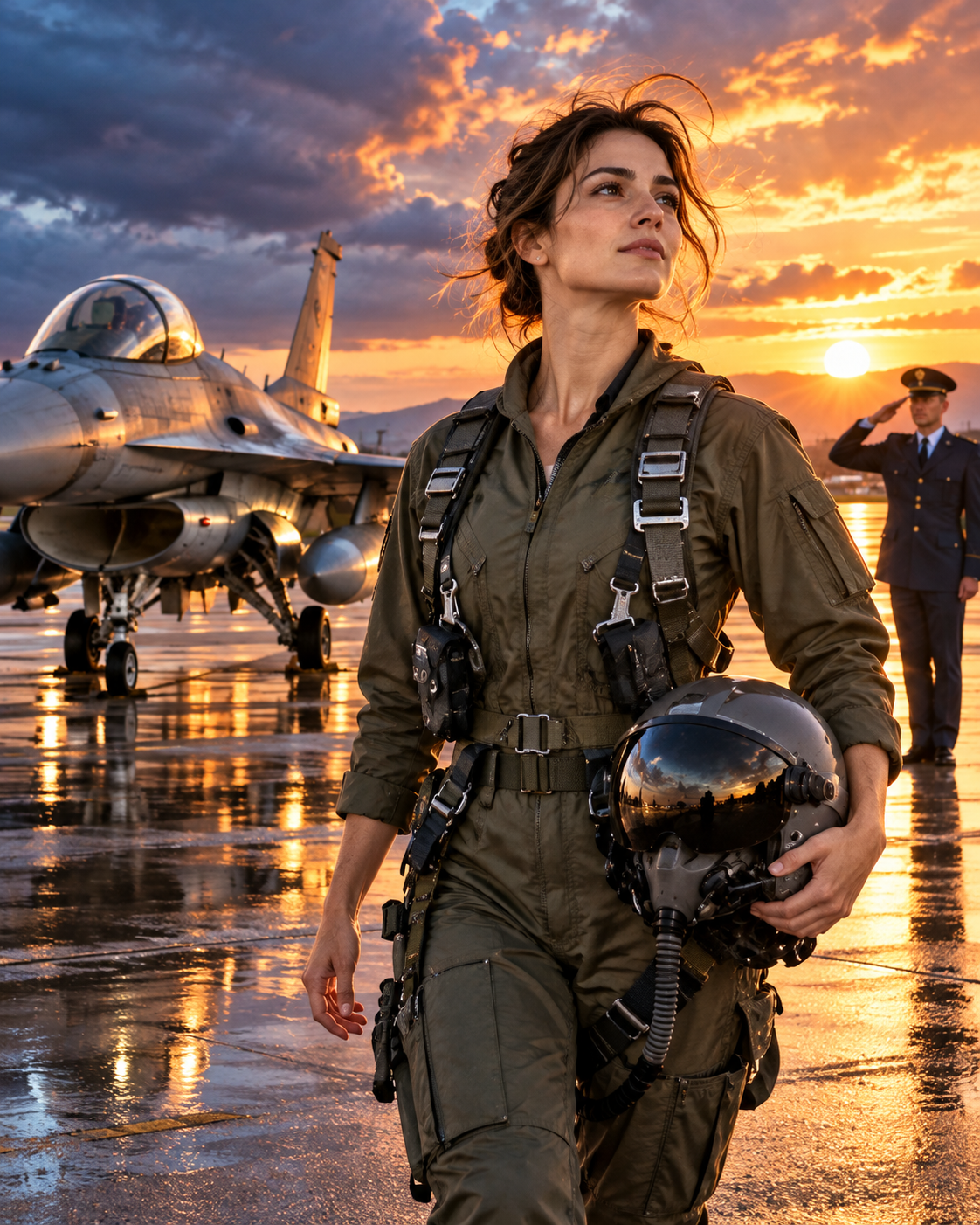
For a moment, the room seemed to lose its air.
Sterling returned to his desk and opened a folder.
“The initial review found several unrelated technical problems. There is no evidence of deliberate interference.”
“Not yet.”
His eyes narrowed.
“What does that mean?”
I had not planned to mention the photograph, but I needed to see his reaction to Daniel’s name.
“I’m reviewing the old Reeves accident records,” I said.
Sterling’s expression changed so quickly that another person might have missed it.
“Why?”
“Because yesterday’s electronic disruptions reminded me of the failures that preceded his crash.”
He closed the folder.
“Captain, that investigation was completed years ago.”
“Then it should withstand another review.”
He stared at me long enough for the silence to become uncomfortable.
Finally, he said, “Be careful about confusing grief with evidence.”
I left his office with my suspicions stronger than before.
But suspicion was not proof, and the uniform I wore did not give me the right to turn an accusation into a verdict.
I needed the original flight records, the maintenance logs, and the communications archive from Daniel’s final mission.
Most of those records had been transferred to a secure historical review unit after the investigation closed.
I submitted a formal request.
It was denied within an hour.
The rejection cited operational sensitivity and the age of the material, a combination that made little sense for an accident supposedly resolved years earlier.
I submitted an appeal and contacted Major Evelyn Brooks, a former flight safety investigator who had worked the original case.
Evelyn and I had never been close, but she had always been fair.
We met at a small restaurant outside the base, where the afternoon crowd provided enough background noise for a private conversation.
When I mentioned Daniel, she set down her glass.
“I wondered when someone would ask again,” she said.
“You never believed the investigation was complete.”
“I believed the official report left questions unanswered.”
“Such as?”
She glanced around before continuing.
“Daniel reported a navigation discrepancy and an unexpected communications interruption shortly before his aircraft began losing stability. The initial maintenance review found evidence of an intermittent sensor fault.”
“That was never in the final report.”
“No. The final report attributed the crash to pilot disorientation during deteriorating weather.”
“Was the sensor fault ruled out?”
“Not conclusively.”
I felt the old anger rising.
“Why did you sign the report?”
“I signed the section confirming the weather data and the recorded flight path. I did not certify every conclusion in the final assessment.”
She took a breath.
“After I objected to the wording, I was removed from the review team. I was told the remaining questions were outside my authority.”
“Who told you?”
“Colonel Peter Harlan, the deputy operations commander at the time.”
I knew the name.
Harlan had retired two years earlier and now served as a consultant to defense technology companies.
“Did he have access to the aircraft’s electronic warfare systems?”
“He oversaw the evaluation program that included Daniel’s aircraft.”
I placed the photograph on the table.
Evelyn looked at it without touching it.
“Where did you get this?”
“An anonymous message.”
Her face grew pale.
“That photograph was taken during the Falcon Shield evaluation.”
“What was Falcon Shield?”
“A classified program testing how aircraft systems behaved under simulated electronic attack. Daniel was assigned to a flight that should have used a controlled test profile.”
“Should have?”
Evelyn leaned closer.
“The day of the crash, the test configuration had been changed. The records I saw showed that the aircraft received a different software package than the one listed in the mission plan.”
I felt as though the floor had shifted beneath me.
“Could that have caused the sensor fault?”
“It could have contributed. I cannot say it did without examining the original logs.”
“Who approved the configuration change?”
“I never found out.”
I looked again at the photograph.
Sterling stood in the background, younger and without the silver at his temples, speaking to Harlan beside the aircraft.
His presence did not prove guilt.
But it meant he had been closer to the program than he had ever told me.
When I returned to Briar Ridge, I began examining the recent interception failure from a different angle.
The twelve hostile aircraft had appeared at a time when several of our defensive systems became unreliable.
The failures had initially been described as separate technical problems, but the sequence resembled the kind of cascading uncertainty that had surrounded Daniel’s final flight.
I requested a meeting with the base’s electronic systems officer, Lieutenant Colonel Marcus Bell.
Marcus had worked in avionics long enough to distrust convenient explanations.
He examined the incident timeline, then leaned back in his chair.
“These failures were not identical,” he said. “Some were mechanical, some involved communications, and some were unreliable data feeds. We haven’t established a common cause.”
“But the timing was unusually concentrated.”
“Yes.”
“Could a single external influence explain part of it?”
“Possibly. But we would need the raw logs, not the summarized reports.”
“Are the raw logs available?”
“They should be.”
He turned to his computer.
A few minutes later, his expression hardened.
“Someone placed an access restriction on the original event archive this morning.”
“Who?”
“The authorization came through the command security office.”
Neither of us spoke.
Marcus finally looked at me.
“Captain, if you think this is connected to the old Reeves case, you need to be very careful. Technical coincidences are not proof of a conspiracy.”
“I know.”
“And if someone is deliberately interfering with military systems, we are dealing with something much bigger than a disputed accident report.”
I nodded.
That was precisely what frightened me.
The next evening, the anonymous sender contacted me again.
Stop looking at the crash. Look at the equipment contractor.
The message included the name of a company: Aegis Dynamics.
I recognized it from the procurement documents associated with Falcon Shield.
Aegis had supplied electronic warfare testing equipment during Daniel’s evaluation, and years later it had won a contract to upgrade several systems at Briar Ridge.
Its technical director was Peter Harlan.
I did not immediately assume that the company had committed wrongdoing.
Defense contractors changed ownership, employees moved between agencies, and old contracts often resurfaced in new projects.
But the overlap was too important to ignore.
I forwarded the message and my concerns to the appropriate security oversight office, requesting that an independent team preserve the relevant records.
Then I did something I had avoided for years.
I called Daniel’s father.
Mr. Reeves answered on the second ring.
“Alex?”
His voice was older, softer, but I recognized the same warmth that had once welcomed me into the Reeves family home.
“I need to ask you something about Daniel.”
The line went quiet.
“Is there new information?”
“I’m trying to establish whether the original investigation left anything unresolved.”
He breathed out slowly.
“We always knew there were unanswered questions. They told us the weather was bad, the aircraft had become unstable, and Daniel had made a mistake. But my son was careful, Alex. He checked everything twice.”
“I remember.”
“He called me the night before his last flight,” Mr. Reeves continued. “He said he was worried about a test configuration that didn’t match the paperwork. He thought someone had changed the plan without telling the pilots.”
My hand tightened around the phone.
“Did he say who?”
“No. He said he was going to raise it through the proper channels.”
“Did he leave you anything?”
Mr. Reeves was silent for several seconds.
“There was a letter among his belongings. It was returned to us after the investigation. We didn’t understand it, so we put it away.”
“What did it say?”
“He wrote that if anything went wrong, we should ask why the flight’s safety restrictions had been waived.”
I closed my eyes.
“Would you be willing to share it with the investigators?”
“If it might help someone find the truth, yes.”
After the call, I sat alone in my quarters and let the memories come.
Daniel had been the kind of pilot who laughed easily, remembered everyone’s birthday, and never treated a nervous trainee as a burden.
When I struggled during my first advanced flight evaluation, he had stayed late to help me review the instrument readings.
“You see things other people miss,” he had told me. “Just don’t let them convince you that noticing a problem makes you the problem.”
His words had followed me into intelligence work, even when I pretended I had forgotten them.
The next morning, I submitted a formal request for an independent review of the Falcon Shield records and provided the information I had gathered.
The request triggered a security inquiry.
For several days, nothing seemed to change.
Then Sterling ordered me to report to his office.
He was standing behind his desk, holding a printed copy of my review request.
“You’ve reopened a closed investigation without consulting your chain of command,” he said.
“I submitted a request through the oversight process.”
“You have implied that a former commander and a defense contractor may be connected to a fatal accident.”
“I have presented questions that deserve examination.”
“Questions can destroy reputations even when the answers prove nothing.”
“So can reports that leave out important evidence.”
His face tightened.
“You think I don’t understand the cost of losing a pilot?”
“I think you understand it very well, sir.”
For a moment, the anger left his expression.
He looked tired.
“Daniel was a good pilot,” he said quietly. “He deserved better than the way his final flight ended.”
“Then help us find out what happened.”
He turned toward the window.
“I cannot discuss classified matters with you outside the authorized review.”
“Then authorize the review.”
He said nothing.
I left his office with no new answers, but I had noticed something important.
Sterling had not denied that the original investigation was incomplete.
Three days later, an independent review team arrived at Briar Ridge.
They secured the relevant system logs, examined maintenance records, and interviewed personnel involved in the recent interception incident.
They also reopened access to portions of the Falcon Shield archive.
Marcus Bell helped the investigators compare the raw electronic records with the summaries in the official reports.
What they found was troubling.
The recent failures did not share one confirmed cause, but several discrepancies showed that the event timeline had been inaccurately summarized.
Some equipment had been declared unavailable before the recorded faults occurred.
Other systems had produced diagnostic data that never appeared in the initial briefing.
The findings did not establish that an adversary had deliberately caused every failure, but they made the original explanation inadequate.
The investigators also found that the old Falcon Shield records contained missing configuration files and an unexplained gap in the communications archive.
Daniel’s letter, provided by his father, prompted the team to examine the safety waiver associated with his flight.
The waiver had been approved shortly before the mission.
The approval bore the authorization of Colonel Harlan.
But the accompanying technical justification cited an evaluation that had never been completed.
Aegis Dynamics had supplied the equipment involved in that evaluation.
The evidence was no longer a collection of uneasy coincidences.
It was a chain of decisions that could be investigated.
Then the review team discovered an encrypted archive preserved on a retired test server.
The archive contained correspondence between Harlan, several Aegis engineers, and a senior military program administrator.
Much of it concerned contract deadlines, test schedules, and disputes over equipment readiness.
One message stood out.
An engineer had warned that the revised configuration could produce unreliable navigation and communications data under certain conditions.
The response instructed the team to proceed with the scheduled evaluation and document any anomalies afterward.
The message did not order anyone to endanger a pilot.
It did show that serious safety concerns had been raised before the test.
Another record showed that Daniel had requested clarification about the configuration change hours before his flight.
His request had been marked as resolved without a technical answer.
I read the summary in the review team’s conference room, my hands resting flat on the table to keep them from shaking.
For years, I had carried Daniel’s death as a private failure.
I had replayed his last flight, wondering whether I could have said something different, recognized something sooner, or persuaded him to refuse the mission.
Now the records suggested that he had done what a responsible pilot should do.
He had noticed a risk.
He had raised it.
And the system had failed to respond.
The review continued for another month.
Investigators interviewed Harlan, examined Aegis’s contract records, and traced the approval process for the disputed configuration.
Harlan denied knowingly authorizing an unsafe test.
He claimed that he had relied on technical assurances from the contractor and believed the necessary checks had been completed.
Aegis maintained that its equipment had been used outside the conditions specified in the contract.
Neither explanation resolved every discrepancy.
But the evidence was strong enough for the oversight authorities to suspend Harlan’s consulting access and refer the procurement and safety issues for further investigation.
Sterling was interviewed as well.
His role in the program turned out to be more complicated than the photograph suggested.
He had been an operations commander during the evaluation period and had attended the briefing before Daniel’s flight.
He had not personally approved the technical configuration, but he had supported the decision to proceed after receiving assurances that the safety concerns were being addressed.
When he learned that Daniel’s request had been closed without a proper technical review, he had accepted the original investigation’s conclusions rather than demand another examination.
He had not caused the crash by himself.
But he had helped preserve a system in which unanswered questions were treated as administrative inconveniences.
When the investigators finished their initial interviews, Sterling asked to see me.
This time, he did not summon me as a subordinate being reprimanded.
He invited me to sit across from him in the same office where he had once called my work useless.
“I read Daniel’s letter,” he said.
“His father provided it to the review team.”
Sterling nodded.
“He was right to question the configuration.”
I waited.
“I should have insisted that the safety concerns be resolved before that flight. I was told the technical team had cleared them, and I accepted the answer because the schedule was already under pressure.”
“Why didn’t you challenge the final report?”
He looked down at his hands.
“Because I believed the investigation had reached the right conclusion. And because reopening it would have meant admitting that the command had failed to ask the right questions.”
His honesty did not erase the years of silence.
But it was the first time he had acknowledged the cost of his decision without blaming the pilot who died.
“Daniel’s family deserved better,” I said.
“Yes.”
“So did the people who trusted those systems at Briar Ridge.”
He met my eyes.
“Yes.”
For a long moment, neither of us spoke.
Then he said, “When I dismissed your report, I thought I was protecting the squadron from an officer who had never faced combat.”
“You were protecting your judgment from being questioned.”
The words landed hard.
Sterling did not argue.
“I think you’re right,” he said.
It was not the apology I had once imagined receiving.
It was quieter and more difficult than that.
He was admitting that his authority had become a shield against uncertainty, and that people had paid for his reluctance to look beyond it.
The official investigation later confirmed that the original safety process had failed and that critical warnings had not been adequately addressed.
It did not identify a single person as solely responsible for Daniel’s death, and it did not establish that every recent system failure had been deliberately engineered.
Those questions remained subject to separate technical and legal reviews.
But the findings led to changes in how flight-test configurations were approved, how unresolved safety reports were escalated, and how commanders documented decisions when technical experts raised objections.
Aegis Dynamics lost access to several pending evaluations while its role was examined.
Harlan faced a formal inquiry into his decisions and the accuracy of his records.
Sterling remained in command during the initial review but was removed from direct oversight of the affected testing program.
For the first time, the official record acknowledged that Daniel had raised concerns before his final flight.
When I visited his father, I brought a copy of that finding.
He read it slowly, then placed it on the table beside the letter Daniel had written.
“They finally listened to him,” he whispered.
I could not tell him that everything was settled.
I could not promise that every unanswered question would receive a satisfying answer.
But I could tell him that Daniel’s warning had not disappeared.
“No one can change what happened,” I said. “But they can’t honestly say he failed to speak up anymore.”
Mr. Reeves pressed his fingers against the paper and began to cry.
I sat beside him until he was ready to talk.
Months passed.
The new safety procedures at Briar Ridge required operational leaders to document unresolved technical concerns and explain any decision to proceed despite them.
Junior officers were given a formal route to challenge assumptions without having to win an argument in front of an entire briefing room.
My tactical report became part of the training curriculum, not because it was a perfect solution, but because it demonstrated how a prepared officer could create options when conventional responses failed.
I was offered a position leading a new tactical assessment unit.
I accepted on one condition: the team would include pilots, intelligence analysts, maintenance specialists, and electronic systems engineers, with each member empowered to challenge the others.
I did not want a room full of people who agreed with me.
I wanted a room where a dangerous assumption could not survive simply because the person who made it wore the highest rank.
Sterling attended our first planning session.
He listened while the team debated the limitations of my interception strategy, asked difficult questions, and identified situations where the approach would be inappropriate.
When a young lieutenant challenged one of his assumptions, Sterling paused before answering.
“Explain your reasoning,” he said.
The lieutenant did.
Sterling listened.
I watched him quietly, remembering the man who had thrown my report across the table and called me a nobody.
People can change, I realized, but only when they stop confusing authority with infallibility.
After the meeting, Sterling approached me near the doorway.
“I owe Daniel an apology I can never deliver,” he said.
“Yes, sir.”
“And I owe you one that should have come much sooner.”
I looked at him.
“You can start by making sure the next person who raises a concern gets heard.”
He nodded.
“I intend to.”
I did not offer him instant forgiveness.
Trust was not restored by one conversation, one salute, or one public admission.
It would have to be earned through decisions made when no one was watching.
On the anniversary of Daniel’s death, I went alone to the small memorial garden outside the base chapel.
His name was engraved beside those of other service members who had died while serving their country.
I placed a copy of the final safety review beneath the flowers, then stood in the cold morning air and remembered the friend who had taught me that courage was more than getting into an aircraft.
It was also the willingness to question a decision when everyone around you wanted to move on.
I used to think the hardest part of losing Daniel was the empty space he left behind.
Now I understood that the hardest part had been the years I spent believing that his death meant I had failed him.
He had raised his concerns.
He had done his duty.
The failure belonged to a process that had not listened.
I could not rewrite his final flight, but I could help change what happened to the next pilot who noticed something wrong.
As I turned to leave, my phone vibrated with a message from the oversight team.
The first line read, The review has identified an additional discrepancy in the original authorization chain.
I stopped walking.
The report did not name a new culprit or claim that the entire case had been solved.
It simply stated that one approval had been entered under a delegated credential whose use had not yet been verified.
Someone had used an authorization they might not have been entitled to use, or a record had been incorrectly attributed.
The investigators were reopening that narrow part of the inquiry.
I looked back at Daniel’s name on the memorial.
For a moment, the old anger returned, sharp and familiar.
Then I folded the message into my pocket and took a breath.
The truth was not a dramatic revelation waiting at the end of a hallway.
It was a difficult record, a witness willing to speak, a question that had to be asked again, and the patience to keep asking when the answer was incomplete.
I walked back toward the operations building, where a new group of young officers was gathering for their first tactical briefing.
I would teach them how to read the sky, how to question a radar return, and how to prepare for the moment when every system they trusted began to fail.
But I would also teach them something no simulator could measure.
Never mistake silence for agreement.
Never mistake rank for proof.
And never let the fear of embarrassing someone powerful become more important than the life of the person depending on you.
Because the sky does not care who has the most medals or whose name is printed on the briefing room door.
It only reveals what is there.
And when the moment comes to act, the most important person in the room may be the one everyone else has learned to ignore.