For nearly 17 years, her family treated her military career like it barely existed.
The bar had gone silent in a way Lucas had never experienced before.
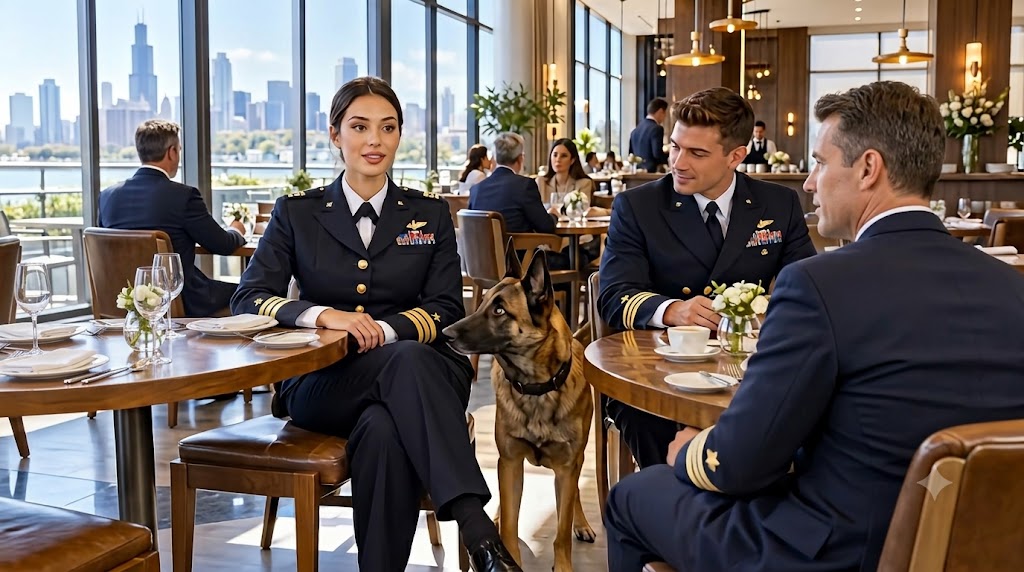
A moment earlier, the room had been filled with laughter, clinking glasses, and the low hum of a country song playing through the speakers. Now, several people stood frozen, watching a Belgian Malinois press his broad head against his sister’s knee as though he had finally found his way home.
His sister, Claire Bennett, sat perfectly still.
For the first time that evening, the confident smile she had worn since arriving in Coronado had disappeared. Her fingers rested against the dog’s neck, moving slowly through the short, sable fur behind his ears.
“Hey, buddy,” she whispered. “You’ve gotten gray around the muzzle.”
The dog let out a soft whine.
Lucas stared at her.
“What the hell is going on?”
Neither of the two Navy SEALs standing a few feet away answered him immediately.
The taller one, a broad-shouldered man with a scar running from his temple toward his hairline, had gone completely rigid. His companion, younger but no less imposing, straightened his back and brought his hand to his brow in a crisp salute.
“Chief Bennett,” the younger man said.
Lucas blinked.
His sister looked up.
“Relax, Miller. We’re off duty.”
“Respectfully, ma’am,” Miller replied, lowering his hand only after the other man had saluted as well, “some things don’t change just because we’re in a bar.”
The older SEAL stepped closer, his expression caught between disbelief and something that looked dangerously close to grief.
“I never thought I’d see him do that again,” he said.
Claire’s hand stopped moving.
“Neither did I, Torres.”
Lucas looked from one man to the other, then down at the dog.
“Wait. You know her?”
Torres turned toward him.
“We served with people who would have followed your sister into hell and never once questioned whether she knew the way out.”
The words struck Lucas harder than he expected.
He laughed awkwardly, searching for the familiar ground of sarcasm.
“Okay, this is getting ridiculous. Claire works with military dogs. She trains them or something. She’s not—”
“Lucas.”
His sister said his name quietly.
He stopped.
She had never needed to raise her voice to make him listen. The problem was that he had spent most of his life choosing not to.
“His name is Ranger,” she said, looking down at the Malinois. “He was my working dog for almost four years.”
Lucas’s mouth opened, but nothing came out.
“Was?”
Claire swallowed.
“He was retired after an injury. I was reassigned during my recovery, and he went to another handler before eventually being adopted into a specialized support program.”
Ranger pushed his nose beneath her palm.
She closed her eyes for one brief moment.
“I thought I’d never see him again.”
Torres glanced at the dog, then at Claire.
“He hasn’t responded to anyone like that since we brought him into the program. He barely lets the regular handlers touch him.”
“And yet,” Miller said softly, “he walked straight past everyone in this room to find you.”
Lucas felt something uncomfortable stir inside his chest.
For seventeen years, he had known Claire as the quiet younger sister who disappeared into military assignments, returned with a few new scars, and never talked much about her work.
He knew she had served in the Navy.
He knew she had spent time overseas.
He knew she worked with dogs.
That was about the extent of what he had bothered to learn.
At family dinners, when their father complained that Claire never seemed interested in building a normal life, Lucas had laughed along.
When his friends asked what his sister did, he had said she played with dogs for a living.
When Claire missed birthdays and holidays, he had accused her of caring more about strangers than her own family.
He had never asked why.
Now two decorated SEALs were standing in front of her like she was someone whose name deserved to be remembered.
And the dog at her feet was looking at her as though she were the one person in the world he had spent years trying to find.
“Claire,” Lucas said, his voice lower now. “What did you actually do?”
She looked at him for a long moment.
Then she turned back to Ranger.
“Tonight isn’t the time.”
She scratched the dog gently beneath his collar.
“Besides, I think somebody owes this old man a treat.”
For the first time that evening, Torres smiled.
“I think we can arrange that, Chief.”
But before they left the bar, Torres handed Claire a folded piece of paper with a phone number written on it.
“Tomorrow morning,” he said. “Eight o’clock. Come to the training facility. There’s something you need to see.”
Claire studied his face.
“What kind of something?”
Torres hesitated.
“Something we should have told you a long time ago.”
Then he glanced at Lucas.
“And if your brother wants to understand what he just witnessed, bring him too.”
Lucas opened his mouth to object.
Claire folded the paper and slipped it into her pocket.
“Eight o’clock,” she said.
She rose, and Ranger rose with her, never straying more than a few inches from her side.
As they walked toward the door, Lucas followed without another word.
For the first time in his life, he had the uneasy feeling that his sister had been living a story he had never even bothered to read.
And by the time the sun rose over Coronado, he would discover just how much of that story had been hidden behind the silence.
The next morning, Lucas arrived at the training facility fifteen minutes early.
He told himself it was because he hated being late.
The truth was that he had barely slept.
Every time he closed his eyes, he saw Ranger pressing his head against Claire’s knee. He heard the way Torres had said her name, with a gravity Lucas had never heard anyone use when talking about his sister.
Most of all, he remembered something Claire had said at dinner three years earlier.
Their mother had asked why Claire never talked about her deployments. Lucas, halfway through a second beer, had joked that there probably wasn’t much to tell.
Claire had looked at him then.
Not angrily. Not even sadly.
Just tired.
“You’d be surprised,” she had replied.
He had changed the subject.
Now, standing outside a security gate beneath a pale California sky, Lucas wished he could go back and listen.
A guard checked their identification and waved them through.
Beyond the gate, the facility stretched across several acres of fenced training grounds, low buildings, obstacle courses, and open yards. Dogs barked from distant kennels. Handlers moved between buildings with the practiced efficiency of people who understood that small mistakes could have serious consequences.
Claire walked beside him in jeans, boots, and a plain navy sweatshirt. She looked like the same woman who had sat across from him at countless family meals.
But Lucas noticed things he had never noticed before.
She checked the corners of buildings without seeming to think about it. She registered every person who approached. When a metal gate slammed somewhere behind them, her head turned instantly, her body shifting half a step between Lucas and the noise.
The movement was subtle.
Automatic.
It made him wonder how many things she did without realizing them anymore.
Torres met them outside a long, low building.
“You came,” he said to Claire.
“You sounded serious.”
“I am.”
His gaze moved to Lucas.
“You too.”
Lucas shoved his hands into his pockets.
“I’d like to know why two SEALs saluted my sister in a bar.”
Torres studied him for a moment.
“Fair enough.”
He led them inside.
The room beyond the door was a combination of briefing room, veterinary workspace, and memorial gallery. Photographs lined one wall. Some showed military handlers with their dogs. Others showed teams standing beside helicopters, transport vehicles, and dusty buildings overseas.
A large framed photograph hung at the far end.
Lucas stopped walking.
It showed Claire several years younger, her hair tucked beneath a helmet, her face streaked with dust. She was crouched beside a Belgian Malinois, one arm wrapped around his chest. Behind them stood Torres and Miller, both younger, both smiling.
Underneath the photograph was a brass plaque.
CHIEF PETTY OFFICER CLAIRE BENNETT
WORKING DOG HANDLER
COURAGE. DISCIPLINE. LOYALTY.
Lucas read it twice.
“Chief Petty Officer?” he murmured.
Claire didn’t look at him.
“I made chief six years ago.”
“Six years?”
“You were at Mom and Dad’s anniversary dinner that week,” she said. “I told everyone.”
Lucas remembered the dinner.
He remembered the restaurant, the cake, and the argument he had started about his promotion at work.
He did not remember her announcement.
Torres gestured toward a table.
“Sit down. There’s a story you need to hear.”
Lucas sat.
Claire remained standing.
Torres opened a folder and removed a photograph.
It showed a damaged building, a stretch of rough ground, and a military vehicle with its rear doors open.
“Five years ago, our team was deployed on a mission that went wrong,” he began. “We were supporting an operation to evacuate personnel from a compromised location. Claire and Ranger were assigned to the forward search element.”
Lucas leaned forward.
“Search for what?”
“Threats. Hidden weapons. Anything that could endanger the people moving through the area.”
Torres paused.
“Ranger was one of the best dogs I’ve ever worked alongside. Fast, focused, and exceptionally good at distinguishing a real threat from background noise. Claire understood him better than anyone.”
Miller pulled a chair closer.
“They didn’t just work together. They trusted each other completely. If Ranger changed his behavior, Claire paid attention. If Claire gave him a command, he responded before most of us had even finished processing what was happening.”
Lucas glanced at his sister.
She was watching the photograph, her face carefully blank.
Torres continued.
“During that mission, Ranger alerted to a danger near a damaged structure. Claire recognized that something was wrong and stopped our team from advancing. Seconds later, part of the structure collapsed.”
He placed another photograph on the table.
This one showed shattered concrete and twisted metal.
“Several people could have been caught in that collapse. Claire’s warning gave us time to get clear.”
Lucas’s throat tightened.
“What happened to her?”
Miller answered.
“She went back for one of our people when the area became unstable.”
Claire’s eyes flicked toward him.
“Miller.”
“No,” he said gently. “He deserves to know what happened.”
Torres nodded.
“During the evacuation, a secondary collapse separated Claire from the rest of the team. Ranger stayed with her. She was injured and couldn’t move safely on her own. The team had to establish a route back through the debris while maintaining security.”
Lucas felt his fingers tighten around the edge of the chair.
“How badly injured?”
“Badly enough that she spent weeks in recovery,” Torres said. “And long enough that Ranger had to be transferred to another handler.”
Claire finally spoke.
“I was fortunate. The medical team did their job, and I got through rehabilitation.”
“Fortunate?” Lucas repeated.
She looked at him.
“What would you like me to call it?”
He had no answer.
Torres set another photograph on the table.
It showed Claire lying on a stretcher, pale and exhausted, one hand extended toward a dog whose muzzle rested against her fingers.
“Ranger wouldn’t leave her until the medical team had to separate them,” he said. “He searched for her for days afterward. When he was eventually returned to work, his behavior changed. He remained capable, but he became more selective about whom he trusted.”
Lucas looked down at the picture.
He had seen Claire’s scars before. A pale line along her shoulder. Another near her ribs. He had once asked if she’d gotten them during training, and she had said yes.
He had accepted the answer because it was easier than asking anything else.
“Why didn’t you tell us?” he whispered.
Claire’s expression changed, but only slightly.
“I tried.”
She pulled out a chair and sat across from him.
“I called home after I got out of the hospital. Mom was worried about Dad’s blood pressure, and you were in the middle of preparing for your promotion interview. I told you I was recovering.”
“I remember that call.”
“You told me not to make everything sound so dramatic.”
Lucas felt the blood drain from his face.
He remembered saying it.
He had been irritated because she had interrupted a conversation he considered more important.
Claire continued, her voice steady.
“I didn’t want to turn every family conversation into a report about the worst day of my life. And I didn’t want to spend the rest of my career explaining why I sometimes needed time to recover.”
She folded her hands on the table.
“Eventually, I learned that if I gave people a simple answer, they stopped asking questions. So I gave them one.”
“I work with dogs.”
Lucas stared at her.
“And we made it a joke.”
“Yes.”
There was no accusation in her voice.
Somehow, that made it worse.
For a long moment, nobody spoke.
Then Miller rose and crossed to a cabinet. He returned carrying a small wooden box.
“There’s another reason we asked you to come,” he said.
He set the box in front of Claire.
She looked at Torres.
“What is this?”
“Open it.”
Inside lay a worn leather collar, a faded photograph, and a small brass tag.
Claire lifted the collar carefully.
Her breath caught.
It was Ranger’s original working collar, scuffed and darkened from years of use.
The photograph showed her and Ranger sitting together on a training field, both of them looking toward the camera with expressions of complete concentration.
On the back, someone had written a date and four words.
WE ALWAYS FIND OUR WAY.
Claire’s fingers trembled.
“I thought this was lost.”
“It was packed with his records when he entered the support program,” Torres said. “We found it while reviewing his history. We were going to send it to you, but the paperwork got complicated, and then your reassignment changed.”
“That’s not the whole reason,” Claire said.
Torres lowered his gaze.
“No. It isn’t.”
He took a breath.
“There’s a position opening at the facility. We need someone to lead the working-dog transition program. The role involves helping retiring military dogs adjust to civilian life, training new handlers, and supporting teams dealing with the emotional aftermath of difficult deployments.”
Claire went still.
“We’ve discussed you for the position,” Miller said. “More than once.”
“I’ve already got a job.”
“We know.”
“And I’m not sure I want to go back into that environment full-time.”
“Then don’t,” Torres replied. “But at least consider it. You know these dogs. You understand what happens when a handler and a working animal are separated before either is ready.”
He glanced at the collar.
“And you understand what it means to be the person everyone assumes is fine because you’re good at hiding when you’re not.”
Claire looked down at the box.
For the first time since Lucas had arrived, she seemed uncertain.
Not afraid.
Just confronted with a choice she had been avoiding.
Before she could answer, a sharp bark came from the hallway.
A handler appeared at the door.
“Torres, we have a situation.”
Torres stood immediately.
“What kind of situation?”
“Ranger’s refusing to leave the transport area. He won’t enter the recovery kennel, and he’s reacting badly to anyone trying to approach.”
Miller swore under his breath.
Torres turned to Claire.
“Would you mind?”
She was already on her feet.
“Show me.”
They hurried outside.
Ranger stood beside an open transport vehicle, his body tense and his ears alert. Two handlers waited several feet away, trying to keep the area calm.
When Claire approached, Ranger’s posture changed.
His tail moved once.
Then he sat.
She stopped several feet from him and lowered herself into a crouch.
“Hey, old man.”
Ranger watched her.
“You’re safe. Nobody’s rushing you.”
She extended one hand, palm turned slightly sideways.
He approached slowly and pressed his nose against her fingers.
The handlers exchanged surprised glances.
Claire didn’t look at them.
“What’s bothering him?”
One explained that a vehicle door had slammed during loading. Ranger had startled, pulled away, and refused to enter the kennel.
“Has he eaten?”
“A little.”
“Any signs of pain?”
“Nothing obvious.”
Claire examined him without forcing contact, watching the way he shifted his weight and held his head. Then she asked the handlers to give him more space and lower the noise around the transport area.
“Let him make the choice,” she said. “We don’t need to win an argument with him. We need to understand what he’s telling us.”
She waited.
For nearly a minute, nothing happened.
Then Ranger took a step toward the kennel.
Claire didn’t move.
He took another.
When he finally walked inside, she followed only as far as the doorway and waited until he settled.
The entire exchange lasted less than five minutes.
Lucas had watched every second.
He had seen people call his sister stubborn. Quiet. Distant. He had heard her described as someone who never seemed to know how to relax.
He had never understood that patience could be a skill, that silence could be a form of attention, or that confidence could mean allowing another living creature to approach on its own terms.
When Claire emerged, Lucas was waiting.
“You were incredible,” he said.
She looked surprised.
“It’s what I do.”
“No.” He swallowed. “It’s what you’ve done all these years. And I never even tried to understand it.”
For once, he didn’t add a joke to soften the confession.
Claire studied him.
“You don’t have to figure everything out today, Lucas.”
“I know.”
He glanced toward the kennel.
“But I need you to know I’m sorry.”
She said nothing.
He continued before he could lose his nerve.
“For calling it playing with dogs. For making fun of your job. For acting like your life was less important because it didn’t look like mine. And for all the times you tried to tell me something mattered and I made you feel stupid for bringing it up.”
His eyes stung.
“I can’t pretend I knew what you were going through. I didn’t. But I could have asked.”
Claire’s expression softened, though the hurt did not disappear.
“Yes,” she said. “You could have.”
The honesty hurt more than forgiveness would have.
Lucas nodded.
“I want to do better.”
“Then start by listening.”
He took a breath.
“Okay.”
For the first time, the word felt like a promise rather than an answer.
That afternoon, Claire agreed to interview for the transition program position. She did not promise to accept it. She wanted to understand the responsibilities, the hours, and the toll the work might take before making a decision.
Torres respected that.
“That’s all we’re asking,” he said.
Before they left, Lucas asked if he could see Ranger again.
Claire looked at him with a hint of amusement.
“You can. But you don’t get to walk up and start patting him because you think he’s friendly.”
“I wasn’t going to.”
“You were absolutely going to.”
Lucas almost smiled.
She showed him how to stand calmly, how to avoid crowding the dog, and how to wait for Ranger to approach rather than reaching toward him.
At first, Ranger ignored him completely.
Lucas stood there feeling foolish while the dog watched Claire.
Then, slowly, Ranger turned his head and sniffed Lucas’s hand.
“That’s a start,” Claire said.
Lucas looked down at the dog.
“I’m working on it.”
Ranger sneezed and walked away.
Claire laughed.
It was a small laugh, but Lucas had not heard one quite like it in years.
That evening, he drove Claire back to her hotel. They sat in the parked car for several minutes, watching the sunset turn the sky above the harbor gold.
Finally, Lucas spoke.
“Do you ever wish you’d chosen something else?”
Claire considered the question.
“Sometimes I wish parts of it had been easier. I wish some things hadn’t happened. I wish I’d been better at telling people when I needed help.”
She looked toward the water.
“But I don’t regret the work. Those dogs trusted me with everything they had. The people I served with did too. That kind of trust changes you.”
“Were you scared?”
She turned toward him.
“Of course.”
Lucas had expected a different answer. Something about training, courage, or learning to control fear.
Instead, she continued.
“Being brave doesn’t mean you stop being scared. It means you learn what matters enough to act even when you’re scared.”
He stared through the windshield.
“I think I’ve spent most of my life being scared of looking like I don’t know something.”
Claire waited.
“So I make jokes. I act like I understand. I turn everything into a competition. If someone is doing something I can’t measure against my own life, I pretend it isn’t important.”
He laughed without humor.
“That’s a pretty ugly thing to realize about yourself.”
“Realizing it is a start.”
He looked at her.
“Can you forgive me?”
Claire didn’t answer immediately.
“I love you, Lucas. You’re my brother. But forgiveness doesn’t erase seventeen years, and it doesn’t mean we can pretend everything is fine tomorrow.”
He nodded, accepting the truth.
“I understand.”
“I hope you do. Because I don’t need you to think I’m a hero. I need you to see me as a person. Someone who gets tired, who makes mistakes, who has bad days, and who sometimes needs her family to ask how she’s doing and actually wait for the answer.”
Lucas felt the words settle somewhere deep.
“I can do that.”
“You can try,” she corrected gently. “And then you can keep trying.”
He nodded again.
The following weeks were not a miracle.
Lucas did not become a perfect brother overnight, and Claire did not suddenly forget every careless remark he had made.
But something changed.
He called her without needing a favor.
He asked about her work and listened when the answers were complicated. When he didn’t understand a term or a decision, he asked rather than pretending.
Sometimes Claire talked about the dogs. Sometimes she spoke about the people she had served with. Occasionally, she mentioned difficult memories, and Lucas learned not to interrupt with reassurance or advice.
He learned that sometimes the most helpful thing he could say was, “That sounds hard. Do you want to tell me more?”
He also learned that loving someone did not give him automatic access to every part of their life. Trust had to be earned, and some doors opened only when the person on the other side felt safe enough to turn the handle.
Claire eventually accepted the position at the transition program, but only after negotiating a schedule that allowed her to continue her recovery and maintain the life she had built outside the military.
She began helping retiring working dogs adjust to new homes and training handlers to recognize the needs that could not be measured by obedience alone.
Ranger became part of the program’s daily routine.
He was no longer required to perform dangerous work. His days were filled with quiet walks, structured exercises, veterinary checkups, and long periods of rest.
He still startled at certain noises.
He still had days when he wanted space.
But he began to settle.
And when Claire visited, he always knew.
Lucas started volunteering on Saturday mornings.
At first, he was assigned the simplest jobs: cleaning equipment, organizing supplies, and helping prepare enrichment activities for the dogs. He was not allowed to handle any animal without guidance, and he quickly discovered that being willing to help was not the same as being qualified.
He took the instruction seriously.
One Saturday, he arrived early and found Claire sitting on a bench outside Ranger’s enclosure.
She looked tired.
Not dramatically tired, not injured, not in need of rescue.
Just tired.
He sat beside her without asking her to explain herself.
After a while, he handed her a coffee.
“Rough morning?”
She accepted it.
“A little.”
“Want to talk about it?”
She smiled faintly.
“Not yet.”
“Okay.”
He stayed beside her.
Several minutes passed before she began speaking.
It wasn’t a major confession. It was a difficult case, a decision she was still considering, and the familiar frustration of wanting to help every animal while knowing she could not solve every problem.
Lucas listened.
When she finished, he didn’t tell her everything would work out.
He simply said, “I’m glad you told me.”
Claire looked at him for a long moment.
Then she leaned her shoulder against his.
It was a small gesture.
For Lucas, it meant more than any dramatic apology could have.
Months later, the facility held a gathering to recognize the people who had helped establish the transition program. Families, handlers, veterinarians, and former service members filled the courtyard.
Ranger lay beside Claire’s chair, his muzzle resting on his paws.
Lucas stood near the back, listening as Torres spoke about the importance of caring for working dogs after their service ended.
“Loyalty isn’t just about what an animal can do for us,” Torres said. “It’s about what we owe them when their work is finished. The same is true of the people who serve beside us. Their worth doesn’t disappear when the uniform comes off.”
Lucas glanced at his sister.
For years, he had measured importance by visible achievements: promotions, salaries, awards, and the stories people told at dinner parties.
He had mistaken what was easy to explain for what was valuable.
Claire had spent much of her life doing work that could not be reduced to a title or a photograph. She had learned to live with experiences she could not easily describe, and she had continued caring for others even when the people closest to her failed to recognize what that care had cost.
He wondered how many people he had misunderstood for the same reason.
After the gathering, Lucas approached Claire while Ranger slept in the late-afternoon sun.
“Can I ask you something?”
“Of course.”
“If I hadn’t seen him walk up to you that night, would you ever have told me the whole story?”
Claire took her time answering.
“Maybe. Maybe not.”
“Why not?”
“Because I had stopped expecting you to be interested.”
The answer was quiet, without bitterness.
Lucas looked down.
“I hate that I gave you that reason.”
“So do I.”
He nodded, accepting that there were no magic words that could make the past different.
Then he crouched beside Ranger, leaving enough space for the dog to choose whether to approach.
“Hey, buddy,” he said softly.
Ranger opened one eye.
Lucas waited.
After a moment, the dog lifted his head and placed his chin on Lucas’s knee.
Lucas froze.
Claire laughed.
“Don’t move too fast. You’ve been accepted for approximately three seconds.”
“I’m going to treasure every one of them.”
“Good. He’s very selective.”
Lucas carefully rested his hand against Ranger’s shoulder.
The dog’s fur was warm beneath his palm.
For a moment, Lucas thought about the years he had wasted believing he already knew his sister. The holidays, the phone calls, the stories he had dismissed before they were finished. The chances he had been given to ask a question and had chosen instead to make a joke.
He could not get those years back.
But he could choose what happened next.
“Claire?”
“Hmm?”
“I’m proud of you.”
She looked at him.
He hurried to add, “Not because those guys saluted you. Not because you have some incredible story. I’m proud of you because of the way you care for these dogs, and because of the person you are when nobody’s watching.”
Claire’s eyes glistened.
“Thank you.”
Then, after a moment, she added, “I’m proud of you too.”
Lucas looked surprised.
“Even though I spent half my life being an idiot?”
“That’s a generous estimate.”
He laughed, and she laughed with him.
It was not the kind of reconciliation that erased pain or turned every old memory into something beautiful. Their relationship still needed patience, honesty, and work.
But it was real.
And for the first time in a very long time, neither of them had to pretend otherwise.
As the sun dipped toward the Pacific, Ranger rose and followed Claire toward the training yard. Lucas walked beside them, no longer trying to get ahead or prove that he belonged.
He simply matched their pace.
Later, he would remember that night in the Coronado bar as the moment everything changed. But the truth was more complicated.
The dog had not taught him that his sister was extraordinary. She had been extraordinary long before he noticed.
What Ranger had done was interrupt the comfortable story Lucas had told himself—the story in which he understood his family, knew what mattered, and had nothing left to learn.
The next morning had forced him to confront the cost of that certainty.
And the real lesson was not that everyone secretly carried a heroic story waiting to be discovered.
It was that people should not have to earn our attention by surviving something terrible.
A sister should not need two SEALs to salute her before her brother asks about her life. A parent should not have to win an award before their child listens. A friend should not have to break down before anyone notices that they have been struggling.
Respect begins long before the remarkable moment.
It begins when we ask a question and care enough to hear the answer.
It begins when we stop mistaking silence for emptiness, humility for weakness, and unfamiliar work for unimportant work.
And sometimes, if we are fortunate, it begins when someone—or some loyal old dog—leads us back to the person we should have been seeing all along.
That evening, Claire and Lucas left the facility together.
Ranger watched them go from the open doorway, his tail moving slowly against the ground.
Lucas glanced back once.
“Do you think he’ll remember me next time?”
Claire smiled.
“He remembers more than you think.”
Lucas considered that as they walked toward the car.
Perhaps people did too.
Perhaps every careless joke, every interrupted sentence, every moment of genuine attention stayed with someone longer than we realized.
And perhaps the same was true of kindness.
A question asked sincerely.
A hand offered without demanding anything in return.
The decision to stay when someone said they weren’t ready to talk.
Those things stayed, too.
Lucas opened the passenger door for his sister, then paused.
“Hey, Claire?”
She turned.
“Next Saturday, can you teach me more about working with the dogs?”
Her smile was small but unmistakably warm.
“Be here at eight.”
“Eight in the morning?”
“That’s generally what eight means.”
He groaned.
She laughed, and the sound followed him all the way home.
For seventeen years, Lucas had believed his sister’s life was a story he already understood.
Now, finally, he was ready to turn the page.