For months, my paycheck had been frozen, my qualifications questioned, and my work dismissed by men who couldn’t tell a precision instrument from a wrench.
For several minutes after Bravo Seven disappeared beyond the clouds, nobody at the airbase seemed willing to speak.
The gunfire had stopped. Emergency vehicles moved across the runway, and security personnel were escorting the surviving attackers into custody. But I barely noticed any of it.
My attention was fixed on the empty stretch of sky where the aircraft had vanished.
Inside its mission module was the only complete copy of the evidence we had recovered. If something happened to that aircraft, the truth about the sabotage, my father’s disappearance, and the people who had manipulated my career might disappear with it.
Arthur Sterling lowered himself onto a nearby equipment crate.
“She’s going to make it,” he said.
I turned toward him.
“You sound awfully confident.”
He managed a tired smile.
“I’m confident in the woman who repaired her.”
Major Owen Blake approached, one hand pressed against the bandage around his arm.
“She’s right about one thing,” he said. “That aircraft shouldn’t have been able to fly with the original software.”
I looked at him.
“That’s why I corrected it.”
He nodded.
For the first time since I’d known him, he seemed genuinely uncomfortable standing in front of me.
“About what I said before,” he began. “When you warned me about the structural defect.”
“Which time?”
He looked down.
“All of them.”
I waited.
“I was wrong. And if you hadn’t refused to sign off on my aircraft, I probably wouldn’t be standing here.”
I didn’t know what to say.
An apology from Owen Blake was something I had never expected to hear.
Before I could respond, Colonel Vance appeared at the far end of the hangar.
His uniform was immaculate despite the chaos around us.
Two security officers walked behind him.
“Everyone remains where they are,” he ordered.
Arthur slowly stood.
“Victor, I think your authority here has expired.”
Vance ignored him and looked directly at me.
“Where is the aircraft?”
“Already airborne.”
His expression changed.
“You had no authorization to transfer classified material.”
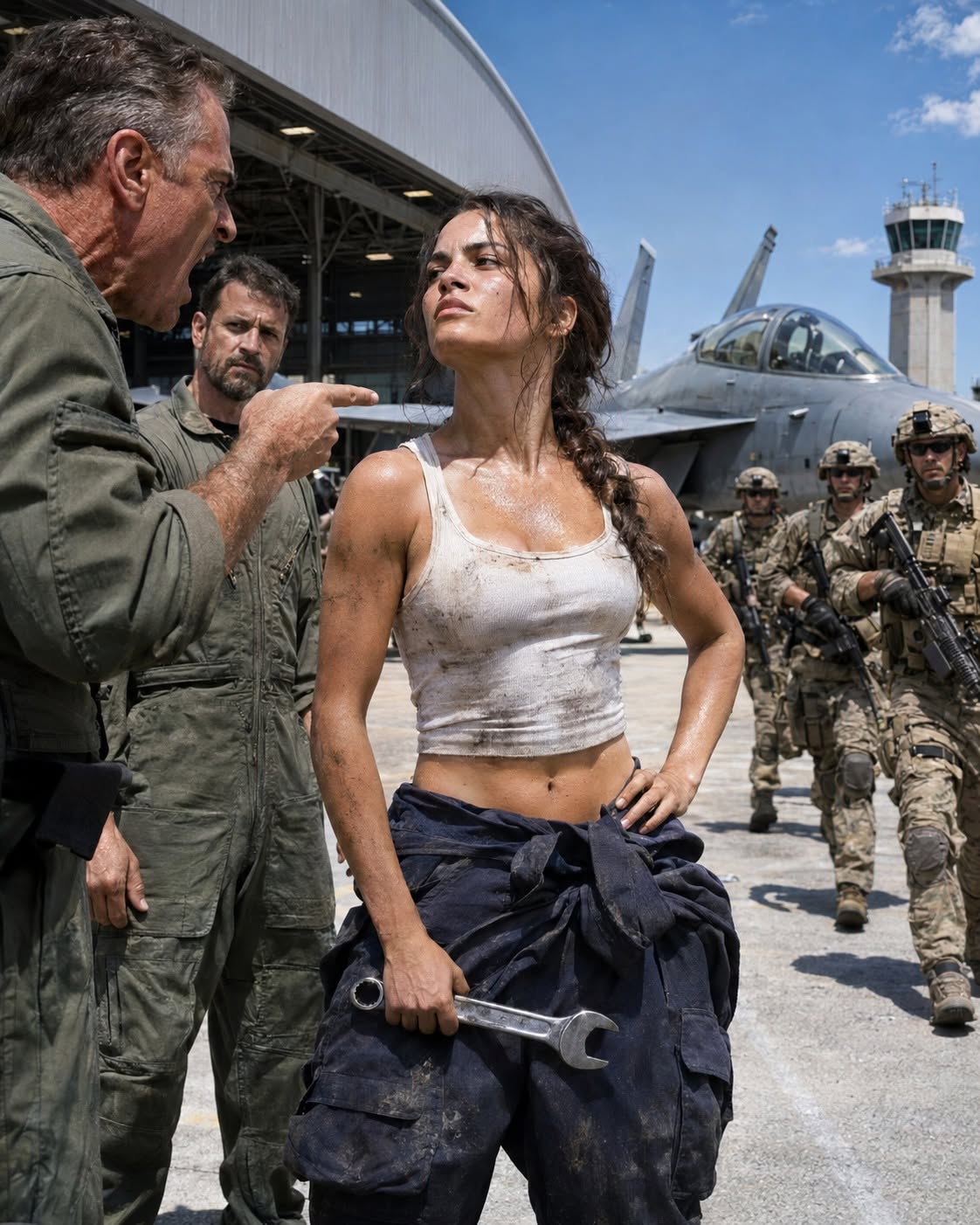
“I had no authorization to let you destroy evidence, either.”
He stepped closer.
“You have absolutely no idea what you’ve done.”
I met his eyes.
“I think I’m beginning to understand.”
Vance turned toward Blake.
“Major, arrest her. She’s compromised military property, stolen classified information, and interfered with an active security operation.”
Blake didn’t move.
“Sir, I saw the sabotage.”
“You saw a damaged aircraft and a frightened technician making accusations.”
“I saw my own aircraft almost kill me.”
Vance’s jaw tightened.
“You’re making a serious mistake.”
Blake straightened despite his injury.
“No, sir. I made a serious mistake when I refused to listen to her.”
For a moment, Vance looked genuinely surprised.
Then the security officers behind him raised their weapons.
“Colonel Vance,” a voice announced from the entrance, “step away from the personnel.”
Everyone turned.
An unfamiliar woman in a dark military uniform entered with four federal investigators.
She carried a sealed authorization document.
“I’m Brigadier General Margaret Hayes, director of the independent military investigations office. Colonel Vance, your command authority has been suspended pending an investigation.”
Vance stared at her.
“On whose authority?”
“An emergency order signed by the acting defense secretary.”
He looked toward the security officers.
Nobody moved to help him.
For the first time, Colonel Victor Vance had no one left to give orders to.
But when General Hayes approached me, I realized the most difficult part of the story was only beginning.
“Where is the mission module?” she asked.
“On Bravo Seven.”
“Good. Because we just received something from the aircraft.”
She handed me a tablet.
A message was displayed across the screen.
MISSION MODULE: EXTERNAL TRANSMISSION RECEIVED.
Below it was a second line.
IDENTITY VERIFICATION REQUIRED: ELIAS MORGAN.
I stopped breathing.
Elias Morgan.
My father’s name.
THE MESSAGE FROM A DEAD MAN
I stared at the screen.
My father had been officially declared dead nineteen years earlier.
His aircraft had disappeared during a classified test operation, and the military had informed my mother that there had been no survivors.
I had been six years old.
I remembered the folded flag, the officers at our front door, and my mother’s expression when she realized that the government wasn’t going to tell us what had happened.
I also remembered the promise my father had made before leaving.
He had told me that he would be home before my next birthday.
He never came back.
“That’s impossible,” I whispered.
General Hayes looked at me carefully.
“Your father was involved in an experimental aerospace program called Project Nightfall. We believe the transmission originated from an archive associated with that operation.”
Arthur looked suddenly pale.
“Where did you get that name?”
Hayes turned toward him.
“You recognize it?”
Arthur didn’t answer immediately.
Then he looked at me.
“Your father wasn’t just a test pilot. He was the chief systems engineer responsible for the original flight-control architecture.”
I frowned.
“He was an engineer?”
Arthur nodded.
“He had an extraordinary understanding of aircraft control systems. He believed that the safest aircraft weren’t necessarily the most advanced ones. They were the ones whose pilots could always trust what the machine was doing.”
I looked back at the tablet.
“Why did nobody tell me?”
Arthur lowered his eyes.
“Because your father’s final project became politically dangerous.”
General Hayes interrupted.
“Before we discuss that, we need to establish whether this message is authentic.”
She contacted the flight-control center.
A few seconds later, a technician appeared on the screen.
“General, Bravo Seven is maintaining its assigned flight path. The mission module has established a secure connection with an external archive.”
“Can you identify the source?”
The technician hesitated.
“It’s an old military research network. The original authentication certificate is registered to Elias Morgan.”
I gripped the edge of the table.
“Can we communicate with it?”
“We can attempt a voice connection, but there’s no guarantee anyone is still monitoring the system.”
General Hayes nodded.
“Try.”
The technician entered a command.
Static filled the room.
Then a faint voice emerged.
A man’s voice.
Older than I remembered.
Rougher.
But unmistakably familiar.
“Archive station, this is Elias Morgan. If this message is being received, the Nightfall program has been compromised.”
My knees nearly gave out.
Arthur caught my arm.
The recording continued.
“Any personnel accessing this archive must understand that the original project was never intended to function as an autonomous weapons platform. Its purpose was to provide pilots with an independent safety system capable of overriding corrupted flight commands.”
I stared at the screen.
My father was speaking.
Not a memory.
Not an old family recording.
A classified transmission preserved for nearly two decades.
“Unfortunately,” he continued, “certain members of the program attempted to convert the system into an operational control network. I refused to authorize the modifications. My aircraft was subsequently grounded, my research credentials revoked, and my reports altered.”
A pause followed.
Then came the words that changed everything.
“If my daughter ever receives this message, tell her that I did not abandon her.”
I covered my mouth.
The room became blurry.
“Tell her I tried to come home.”
The recording ended.
Nobody spoke.
I looked down at the tablet, unable to process what I had just heard.
For nineteen years, I had believed my father had chosen his work over his family.
Now I was hearing him explain that someone had deliberately erased his life.
General Hayes placed a hand on my shoulder.
“I’m sorry.”
I nodded, but I couldn’t speak.
Then Arthur said something that made the room go silent again.
“There is something else you need to know about your father.”
THE MAN WHO KNEW TOO MUCH
Arthur asked the investigators to give us a few minutes.
Once the room was cleared, he sat down across from me.
“I knew Elias before you were born,” he began. “We worked together on the Nightfall program. He was one of the most talented engineers I’ve ever met.”
“Then why did you let me believe he abandoned us?”
Arthur closed his eyes.
“Because I was afraid.”
I stared at him.
He explained that Nightfall had been designed as an independent aircraft safety architecture. It would monitor flight-control commands, detect unauthorized alterations, and protect pilots from malicious software or mechanical failures.
It was revolutionary.
But it could also expose weaknesses in military systems that certain officials wanted to keep hidden.
Your father had discovered that a group of senior officers were deliberately concealing aircraft maintenance defects and manipulating technical reports to meet operational deadlines.
Some aircraft had been cleared for flight despite serious safety concerns.
Pilots had been placed at risk.
Elias had documented everything.
He intended to report the violations.
Instead, his aircraft was involved in a classified test accident.
“Was it an accident?” I asked.
Arthur looked at me.
“We never found the original aircraft.”
I felt my stomach tighten.
“You mean he might have survived?”
“I don’t know.”
Arthur leaned forward.
“After the incident, I received a private message from him. It contained one instruction: protect the Nightfall archive and make sure his daughter never becomes involved.”
I stared at him.
“And you followed that instruction by doing nothing?”
His expression collapsed.
“I thought I was protecting you.”
“You let me grow up believing my father didn’t want me.”
“I know.”
“You watched me apply for an engineering position at this base, and someone deleted my application. Did you know about that?”
Arthur looked away.
“Yes.”
The answer struck harder than I expected.
I stood.
“You knew?”
“I discovered it after your application disappeared. Vance had ordered the personnel system to remove it. He was afraid you might gain access to the engineering archives.”
“And you didn’t tell me?”
“I was waiting for the right time.”
I laughed bitterly.
“Everyone seems to have been waiting for the right time while I spent years being treated like I didn’t belong here.”
Arthur had no defense.
For a moment, I wanted to walk away.
Then he reached into his jacket and placed a small envelope on the table.
It was old, yellowed at the edges, and sealed with a faded strip of tape.
“Your father gave me this shortly before his final mission.”
I picked it up.
My name was written across the front in familiar handwriting.
FOR MY DAUGHTER. WHEN SHE IS READY.
My hands trembled.
I opened it carefully.
Inside was a photograph of a young man standing beside an experimental aircraft.
My father.
He was smiling.
On the back, he had written:
Never let anyone convince you that curiosity is a weakness. The world needs people who are brave enough to ask why.
Beneath the photograph was a handwritten letter.
I read the first few lines before tears blurred the page.
My little girl, if you are reading this, something has gone terribly wrong. I hope you are older now, and I hope you have found something you love enough to fight for. I want you to know that none of this was your fault.
I pressed the letter against my chest.
For the first time in nineteen years, I felt as though my father was speaking directly to me.
But the letter contained one final instruction.
If you ever find Nightfall, do not let anyone use it to control another human being. Technology should protect the people who trust it, not take away their freedom.
I looked up.
“Where is the original Nightfall archive?”
Arthur hesitated.
Then he pointed toward the tablet.
“Somewhere connected to Bravo Seven.”
THE SECOND FLIGHT
Two hours later, Bravo Seven landed at a remote allied airfield.
The recovered mission module had successfully transmitted its contents to an independent evidence repository.
But the aircraft had also received a second message from the Nightfall archive.
It contained coordinates.
An abandoned research station in the mountains, approximately sixty miles from our base.
General Hayes ordered a technical recovery team to investigate.
I was instructed to remain at headquarters.
I refused.
“I’m the only person who understands the software modifications in Bravo Seven. And my father’s authentication key has already recognized my credentials.”
Hayes studied me.
“Your involvement is precisely why I should keep you away from this operation.”
“Then send someone else to interpret the system.”
She didn’t answer.
I continued.
“If you take a team into that facility without understanding what you’re looking for, you could destroy the archive before you even realize what it contains.”
Major Blake stepped forward.
“She should go.”
I turned toward him.
He looked at General Hayes.
“She’s the reason I’m alive. She found the sabotage, corrected the aircraft, and identified the people responsible. If anyone understands this system, it’s her.”
Hayes looked between us.
Then she nodded.
“You will accompany the technical team. But you will not enter the facility alone, and you will follow the mission commander’s instructions.”
“Understood.”
Blake approached me after the briefing.
“You know,” he said, “I used to think the best pilots were the ones who never questioned the people maintaining their aircraft.”
“And now?”
“Now I think the best pilots are the ones who know when to listen.”
He extended his hand.
I shook it.
It was the first time I had felt that we were standing on equal ground.
The team departed shortly after sunset.
The research station was hidden inside a narrow mountain valley.
From the outside, it looked abandoned.
Its windows were broken, its access road was overgrown, and the old antenna tower leaned dangerously to one side.
But the moment we entered the main building, I noticed something.
The power was still running.
A faint blue light glowed beneath the control-room door.
I approached carefully.
Inside was a large wall display showing a three-dimensional model of an experimental fighter.
The aircraft had been designed almost twenty years earlier.
But its control architecture looked remarkably similar to Bravo Seven’s.
I moved toward the main terminal.
A message appeared.
WELCOME, AUTHORIZED ENGINEERING SUCCESSOR.
I frowned.
“Engineering successor?”
Arthur looked at the screen.
“Your father must have configured the archive to recognize his technical credentials.”
I entered my identification.
The screen changed.
ELIAS MORGAN — PRIMARY ARCHITECT.
SECONDARY ACCESS: DAUGHTER AUTHORIZATION ACCEPTED.
Then another message appeared.
FINAL RECORDING AVAILABLE.
I pressed the playback command.
A video began.
My father appeared on the screen.
He looked older than in the photograph.
His hair was disheveled, and there was a deep cut above his left eyebrow.
But he was alive.
At least when the recording was made.
“If you’re watching this,” he said, “then Nightfall has survived.”
He looked directly into the camera.
“And if my daughter is there, I hope I can explain everything before she has to learn it from someone else.”
I leaned closer.
My father explained that the original aircraft had not crashed during the test operation.
It had been forced to divert after its control systems were remotely compromised.
He had managed to land in a remote valley, but his rescue signal was intercepted.
He was captured by a private security group working for the same officials who wanted to take control of Nightfall.
For years, he had been held at several undisclosed facilities.
He had eventually escaped.
But he had been unable to return home because the people hunting him had threatened to target his family.
He had spent the remaining years gathering evidence and trying to expose the network.
Then he said something I would never forget.
“I know you may hate me for not coming back. I know you may believe I chose the work over you. But every day I stayed away, I was trying to make sure the people responsible could never reach you.”
The video paused.
He looked down, as though struggling to find the right words.
“I love you. I always have.”
The recording ended.
I stood motionless.
Arthur lowered his head.
Then a new alert appeared on the screen.
UNAUTHORIZED ACCESS DETECTED.
The terminal began flashing red.
The station’s outer doors slammed shut.
Someone had activated the facility’s security system.
And we weren’t alone.
THE LAST PERSON I EXPECTED
The mission commander ordered everyone to secure the entrances.
Blake, who had accompanied the team as security support, moved toward the corridor.
“Movement outside!”
A series of heavy impacts echoed through the building.
The emergency lights flickered.
I returned to the terminal.
The system was attempting to erase the remaining archive.
“Stop it!” Arthur shouted.
“I’m trying.”
A second access request appeared.
This time, the credentials were familiar.
VICTOR VANCE — AUTHORIZED ADMINISTRATOR.
My blood ran cold.
“Vance is here.”
The commander immediately contacted headquarters.
No response.
The communications system had been blocked.
A voice came through the station’s internal speakers.
“Step away from the terminal.”
Colonel Vance.
I turned toward the doorway.
He stood there with two armed men.
His face was calm.
Almost disappointed.
“You really should have left the past alone,” he said.
Blake raised his weapon.
“Drop yours, Colonel.”
Vance smiled.
“Major Blake, you’re making another mistake.”
“I’m learning from the first one.”
Vance looked at me.
“You have no idea what your father did.”
I stared at him.
“Then explain it.”
“He stole military research, compromised an entire weapons program, and disappeared with classified technology.”
“He was trying to protect it.”
“He was trying to destroy years of work.”
“Because you wanted to turn it into a weapon.”
Vance’s smile vanished.
“Your father was a brilliant engineer with no understanding of strategic necessity. He believed technology should remain under civilian control. He couldn’t accept that military systems require difficult decisions.”
I stepped closer.
“Was that why you deleted my application?”
He said nothing.
“Was that why you used my credentials to sabotage Bravo Seven?”
“You were becoming a problem.”
The admission was so casual that it took me a moment to understand it.
“You tried to kill Major Blake.”
“I tried to prevent an unauthorized investigation from exposing a classified program.”
“By making me look responsible?”
“You were convenient.”
I felt something inside me change.
For years, I had wondered whether I was good enough.
Whether my qualifications were real.
Whether I deserved to be in the engineering division.
And now the man who had made me doubt myself was standing in front of me, admitting that he had deliberately tried to destroy my future.
“You didn’t think I was unqualified,” I said quietly.
Vance looked irritated.
“You were never supposed to reach this level.”
“Why?”
“Because your father built the original system to recognize his technical lineage. We couldn’t risk giving you access.”
I glanced toward the terminal.
The archive was still running.
A small green indicator appeared.
EVIDENCE REPLICATION: 87%.
Vance noticed it.
His expression changed.
“Shut it down!”
One of his men moved toward the terminal.
Blake intercepted him.
The two struggled, crashing into a nearby equipment rack.
The second operative raised his weapon.
Arthur pushed me behind the console as a shot struck the wall.
I reached for the emergency control panel.
My father’s final recording had revealed a hidden function in the archive.
Nightfall could automatically transmit its records to multiple independent repositories if a critical security breach was detected.
But the process required manual confirmation.
The display showed:
FINAL REPLICATION: 12 SECONDS.
Vance saw what I was doing.
He lunged toward me.
I pressed the confirmation key.
The screen flashed.
REPLICATION COMPLETE.
Vance grabbed my arm.
“You have no idea what you’ve done!”
I pulled free.
“I know exactly what I’ve done.”
The building’s emergency doors opened.
Outside, military vehicles were approaching.
General Hayes’s investigation team had finally broken through the communications blockade.
Vance looked toward the entrance.
For the first time, he seemed genuinely frightened.
He tried to run.
Blake stopped him.
“Not this time, Colonel.”
The security team entered and disarmed the remaining operatives.
Vance was placed in restraints.
As he was escorted past me, he stopped.
“You think you’ve won?”
I looked at him.
“No. I think we’ve finally stopped you from deciding who gets to know the truth.”
He was led away.
And the room fell silent.
THE TRUTH ABOUT MY FATHER
The investigation took six months.
During that time, every recovered file from Nightfall was examined by independent engineers, military investigators, and civilian oversight officials.
The evidence confirmed that Colonel Vance had led an illegal program to manipulate aircraft control systems and conceal maintenance failures.
He had also arranged the deletion of my engineering application and used cloned credentials to make it appear that I had sabotaged Bravo Seven.
Several senior officials were implicated.
Some resigned before charges were filed.
Others were arrested.
Arthur Sterling cooperated fully with the investigation.
He admitted that he had known about the deletion of my application and had deliberately withheld information about my father.
His testimony helped investigators understand how the cover-up had operated.
But the most important discovery concerned Elias Morgan.
The original archive contained a series of medical and travel records showing that my father had survived his captivity and eventually escaped.
He had spent several years living under an assumed identity while trying to gather enough evidence to expose the people responsible.
Then, seven years before the events at the airbase, he had disappeared again.
There was no confirmed death record.
No burial site.
No final report.
Just one last encrypted message.
It had been sent from a small coastal town several hundred miles away.
The message contained a photograph.
A man sitting outside a modest house.
His face was older, his hair almost completely gray.
But I recognized him immediately.
My father.
General Hayes arranged for a search team to investigate the location.
I went with them.
We arrived on a rainy Thursday afternoon.
The town was quiet, with narrow streets and small houses overlooking the water.
The address led us to a weathered blue house near the harbor.
I stood outside for nearly five minutes before knocking.
A woman opened the door.
She looked at the investigators, then at me.
“Can I help you?”
I held up the photograph.
“I’m looking for Elias Morgan.”
Her expression changed.
She looked over her shoulder.
Then she stepped aside.
“Come in.”
The house smelled of coffee and old books.
There were engineering drawings on the walls.
A small radio sat on a wooden table.
And beside the window was a photograph of a little girl holding a toy airplane.
Me.
I felt my throat tighten.
The woman pointed toward the back room.
“He’s been expecting this day for a long time.”
I turned.
A man was standing in the doorway.
His hair was gray.
His face was thinner.
He leaned heavily on a walking stick.
But his eyes were the same.
My father.
For a moment, I couldn’t move.
He looked at me.
Then he whispered my name.
I started crying before I could say anything.
He took one slow step forward.
“I don’t know if I deserve to ask you to forgive me.”
I shook my head.
“You don’t get to decide that.”
He stopped.
I moved closer.
“I spent nineteen years thinking you didn’t want to come home.”
His eyes filled with tears.
“I wanted to come home every day.”
“Then why didn’t you?”
He lowered his head.
“Because I was afraid they would hurt you. And because every time I thought I was close to exposing them, another piece of the evidence disappeared.”
I looked at him.
“You should have trusted me with the truth.”
He nodded.
“I know.”
For a long time, neither of us spoke.
Then he opened his arms.
I stepped into them.
His embrace was weak, but it was real.
For the first time since childhood, I could hear his heartbeat.
And suddenly, nineteen years of anger, confusion, and unanswered questions became something I could finally begin to understand.
Not disappear.
Not vanish.
But become part of a story that no longer had to remain unfinished.
THE PROMOTION THEY COULDN’T TAKE AWAY
When we returned to the base, the investigation had already produced another unexpected result.
The military had reviewed my technical record.
Every inspection report, every maintenance correction, and every safety concern I had raised was examined.
The findings were unanimous.
My work had prevented multiple aircraft from being cleared for flight despite serious defects.
The report also confirmed that my engineering application had been deliberately removed by Colonel Vance.
The personnel board formally restored my original application date and offered me the aerospace engineering position I had earned years earlier.
General Hayes personally delivered the decision.
“You should have received this opportunity a long time ago,” she said.
I looked at the document.
For years, I had imagined what it would feel like to hold something like this.
I thought I would feel triumphant.
Instead, I felt strangely calm.
“Thank you, General.”
She smiled.
“Don’t thank me. You earned it.”
Major Blake was waiting outside the office.
When he saw the document, he grinned.
“Well, look at that. The best engineer on the base finally has the title to match.”
I laughed.
“Careful, Major. I might start charging you for inspections.”
He raised both hands.
“After what happened to Bravo Seven, I’ll pay whatever you ask.”
Arthur approached a few moments later.
He looked older than he had six months earlier.
He stopped in front of me.
“I owe you an apology.”
“You already gave me one.”
“I know. But I don’t want you to think that my cooperation with the investigation erased what I did.”
I studied his face.
“Why did you stay silent?”
He took a long breath.
“Because I convinced myself that protecting you meant keeping you away from the truth. Eventually, I couldn’t tell the difference between protecting you and protecting myself.”
I nodded slowly.
“That was the problem.”
He looked down.
“I understand.”
I wasn’t ready to forgive him completely.
But I didn’t want to spend the rest of my life carrying the weight of what he had done.
“Maybe we can start by telling the truth from now on.”
His eyes softened.
“I would like that.”
BRAVO SEVEN RETURNS
A year later, Bravo Seven returned to the flight line.
The aircraft had undergone a complete overhaul.
Its compromised control architecture had been replaced with a new safety system based on the original Nightfall principles.
Every critical software modification now required independent verification.
And every technician involved in the maintenance process had the authority to ground an aircraft if something didn’t look right.
No rank could override a documented safety concern without formal review.
I had become the lead aerospace systems engineer responsible for the upgrade program.
The first time I walked into the hangar with my new title, several technicians stopped to congratulate me.
I thanked them and continued toward Bravo Seven.
Major Blake was standing beside the aircraft.
He looked at the restored fuselage.
“She’s ready.”
I checked the maintenance records.
“Not until I finish the final inspection.”
He groaned.
“Of course.”
I smiled.
“You can wait.”
He stepped aside.
I spent the next forty minutes checking the systems.
Every connection.
Every control response.
Every diagnostic record.
When I finished, I signed the certification.
Blake climbed into the cockpit.
Before closing the canopy, he looked down at me.
“You know, I used to think you were trying to make my life difficult.”
“And now?”
“Now I think you were trying to make sure I had a life.”
I laughed.
“That’s generally the idea.”
The aircraft started.
Its engines roared across the hangar.
I watched as it taxied toward the runway.
Then it lifted into the sky.
For a moment, I felt my father’s presence beside me.
Not as a memory of someone who had disappeared.
But as the engineer whose principles had helped save the aircraft.
The pilot.
The technicians.
And perhaps the entire base.
A LETTER FOR THE NEXT GENERATION
Several months later, my father visited the airbase for the first time.
He was still recovering, but he had regained enough strength to walk through the hangars with assistance.
When he saw Bravo Seven, he stopped.
“She’s beautiful,” he said.
I smiled.
“You should see what we did with her control architecture.”
He laughed.
“I’ve been waiting twenty years to hear someone say that.”
We walked through the maintenance area.
Young technicians were working beneath aircraft, checking components, reviewing diagnostics, and discussing engineering problems.
My father watched them with quiet pride.
Then he turned toward me.
“Do they listen to you?”
I considered the question.
“Most of them.”
“Good.”
He looked at the aircraft.
“Remember something. A good engineer isn’t the person who knows everything. It’s the person who knows how to recognize what they don’t know, and has the courage to speak when something is wrong.”
I nodded.
He continued.
“And never let anyone convince you that asking questions makes you difficult.”
I smiled.
“I learned that one the hard way.”
He laughed.
Later that afternoon, we sat together outside the hangar.
The sun was setting, and the runway lights were beginning to glow.
I showed him the old letter he had written to me.
He read it slowly.
Then he looked at me.
“I wish I could have given you a better childhood.”
I reached across the table and held his hand.
“You can’t change what happened.”
He nodded.
“But we can decide what happens next.”
For the first time, I realized that I had stopped waiting for my father to explain the past.
I finally had the truth.
And that meant I could begin building something beyond it.
THE FINAL INSPECTION
Two years after the attack, the base held a ceremony recognizing the personnel who had exposed the sabotage and helped reform its aircraft safety procedures.
Major Blake stood before the assembled pilots and technicians.
He spoke about the importance of trust between the people who flew aircraft and the people who maintained them.
Then he invited me forward.
I didn’t enjoy standing in front of a crowd.
But I accepted the recognition.
As I approached the podium, I noticed something on the front row.
My father.
Arthur.
General Hayes.
And dozens of technicians who had worked beside me through the investigation.
Blake handed me the microphone.
I looked across the room.
“For a long time, I believed that earning respect meant proving myself to people who had already decided I wasn’t good enough.”
The room became quiet.
“I thought that if I worked harder, stayed later, and made fewer mistakes than anyone else, eventually someone would give me permission to belong.”
I paused.
“But I was wrong about something.”
I looked toward the maintenance crew.
“Respect isn’t a favor handed down by someone with a higher rank. It’s something we owe each other because every person in this building carries a responsibility that can affect another person’s life.”
I continued.
“Pilots trust engineers. Engineers trust technicians. Technicians trust inspectors. And everyone trusts that the person standing beside them will speak up when something isn’t right.”
I glanced at Bravo Seven through the hangar doors.
“That aircraft nearly became a weapon against its own pilot. It was saved because someone paid attention to a detail that others dismissed.”
I took a breath.
“My father once told me that curiosity isn’t a weakness. It’s the beginning of responsibility. I think that’s true.”
Then I looked at the young technicians in the front rows.
“Never sign something you don’t believe is safe. Never stay silent because someone outranks you. And never measure your worth by the opinion of a person who refuses to examine your work.”
The room erupted in applause.
But the moment that mattered most came afterward.
A young female technician approached me.
She looked nervous.
“Ma’am, can I ask you something?”
“Of course.”
“Do you think someone like me could become a lead aerospace engineer someday?”
I smiled.
“Someone like you?”
She nodded.
I looked at her uniform, her maintenance tools, and the notebook she was holding.
“Absolutely. But don’t wait for someone to tell you that you’re allowed to try.”
Her expression brightened.
I placed a hand on her shoulder.
“And when you find something wrong, speak up. Even if the person standing in front of you is a colonel.”
She laughed.
“I’ll remember that.”
I watched her return to her team.
Then I turned toward the runway.
Bravo Seven was preparing for another training flight.
Its engines came alive, powerful and steady.
I thought about the day I had first discovered the hidden code.
The night the base went dark.
The men who had tried to erase my work.
The father I had believed was gone forever.
And the woman I had almost convinced myself I could never become.
I had wanted a promotion.
I had wanted recognition.
I had wanted someone to tell me that I belonged.
But what I found was something far more important.
I found the truth about my family.
I found the courage to challenge people who abused their authority.
And I found a profession where my work could protect lives.
My father walked up beside me.
“Ready for another inspection?” he asked.
I smiled.
“Always.”
He looked at the aircraft.
“Then let’s make sure she brings everyone home.”
I watched Bravo Seven disappear into the morning sky.
For years, powerful men had tried to convince me that I was insignificant.
They had questioned my intelligence, erased my qualifications, stolen my opportunities, and used my name to hide their crimes.
But they had made one mistake.
They had mistaken my patience for weakness.
They had mistaken my silence for surrender.
And they had forgotten that the person who understands how something works is often the person best positioned to discover when someone has secretly broken it.
I didn’t win because I was louder than they were.
I won because I refused to ignore what I knew was wrong.
And in the end, that was the lesson I wanted every young technician, engineer, and pilot at that base to remember:
Your value is not determined by the person who refuses to recognize it. Your responsibility is to keep learning, keep asking questions, and keep doing the right thing—even when doing so costs you something.
Because a title can be taken away.
A career can be delayed.
A reputation can be attacked.
But integrity is something no one can steal unless you surrender it yourself.
I looked up as the aircraft crossed the clouds.
For the first time in my life, I wasn’t trying to prove that I belonged in the sky.
I was helping make sure the people flying through it could come home.
THE END