During a morning briefing aboard a U.S. aircraft carrier, my flight commander publicly questioned who had been foolish
Part 2
The next voice on the radio was not Vance’s.
“Viper 21, this is aircraft control. We have your emergency declaration. Confirm your aircraft status and fuel indications.”
The calm professionalism in that voice gave me something solid to hold on to.
I reported the discrepancy, the fact that the trend persisted, and the checks I had already completed.
I did not speculate about the cause, and I did not exaggerate the danger.
I told them what I knew, what I had observed, and what I could not yet establish.
That distinction mattered.
A few seconds later, the recovery coordination came through, and the training profile was formally terminated.
“Viper 21, proceed with the assigned recovery instructions. Keep us advised of any change.”
“Viper 21 copies.”
Vance came back over the flight frequency.
“Viper flight, maintain communication. Drake, Cross, keep clear of Viper 21 and follow the revised instructions.”
His tone had changed.
The mockery was gone, replaced by the sharp, controlled voice of a flight lead who understood that the situation had moved beyond his personal opinion.
I continued to monitor the fuel indication while preparing for recovery.
The display still did not give me the consistency I expected, and I refused to assume that a reassuring moment meant the problem had disappeared.
My hands remained steady on the controls, but my thoughts had become painfully clear.
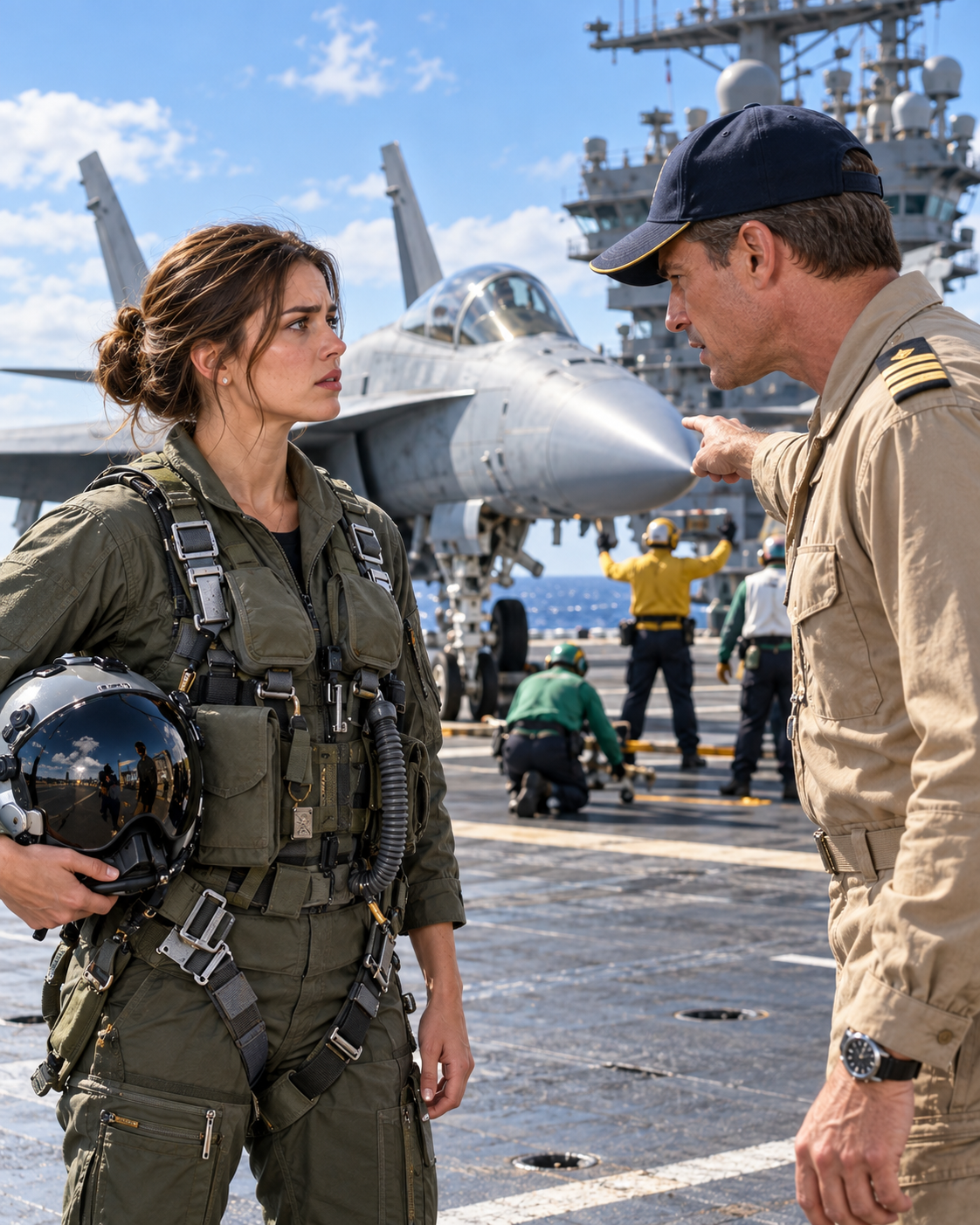
There was no audience now.
There was no briefing-room table, no smirk, and no need to prove that I belonged.
There was only an aircraft with an unresolved abnormality and a ship that needed to bring it home safely.
As the carrier came into view, the ocean beneath us seemed impossibly dark.
The Resolute was a narrow, moving strip of steel against the vast Atlantic, its flight deck alive with controlled motion.
I focused on the recovery instructions, made each required call, and kept my attention on the aircraft.
“Viper 21, confirm you are established for recovery,” control called.
“Viper 21, established and proceeding as directed.”
My heart was beating hard enough that I could feel it beneath the harness, but there was no room for panic.
I had flown in worse conditions.
I had also learned that the memory of worse conditions could become its own kind of trap if I allowed it to take over the present.
This was not that deployment.
These were not those skies.
I was here, now, responsible for this aircraft and the people working to recover it.
The landing came in a series of precise actions and brief, intense moments.
I followed the recovery sequence, maintained the required approach, and brought the Super Hornet onto the carrier deck.
The aircraft struck the landing surface with a heavy jolt.
The arresting system caught it, and the jet decelerated rapidly until the deck crew guided it clear of the landing area.
For one suspended second, I could hear nothing but my own breathing.
Then the sounds of the flight deck rushed back around me.
I had brought the aircraft home.
I followed the post-landing instructions and taxied where directed, keeping my attention on the instruments until the aircraft was safely positioned.
When the engine shutdown sequence was complete, I sat still for a moment, my gloved hands resting near the controls.
The emergency was over.
The cause was not yet known.
That difference was important enough to keep me from celebrating.
A deck crew member signaled that the aircraft was secured, and I began the process of climbing out.
The air smelled of jet exhaust, hot metal, and salt.
My legs felt strangely unsteady when I stepped onto the ladder, though I would never have admitted that while I was still in the cockpit.
Drake and Cross had recovered safely.
They approached as I removed my helmet, both wearing expressions that seemed to have been rearranged during the flight.
Drake spoke first.
“You actually called it.”
I looked at him.
“I declared an emergency.”
“You know what I mean.”
“Yes,” I said. “I know what you mean.”
Cross glanced toward the aircraft.
“Do you think it’s serious?”
“I think maintenance needs to tell us what happened.”
It was not the answer either of them had expected, but it was the only honest one I had.
Before either could respond, a deck crew member approached me with a message.
“Lieutenant Bennett, Air Boss wants you in Primary Flight Control as soon as you’re clear.”
I blinked.
“Did he say why?”
“No, ma’am. Just said to send you up immediately.”
I looked once at my aircraft.
Maintenance personnel were already approaching it, preparing to investigate the discrepancy.
I wanted to stay and hear what they found, but an order from the Air Boss was not something I could casually ignore.
I gathered my helmet and followed the route toward Primary Flight Control, the ship’s flight operations center overlooking the deck.
The passageways seemed narrower than they had that morning.
By the time I reached the control space, the adrenaline had begun to drain away, leaving me with a dull ache behind my eyes and a familiar exhaustion that had nothing to do with the length of the flight.
The Air Boss stood near the windows, watching the deck crew move around the parked aircraft.
He was a weathered captain with silver beginning to show at his temples and the steady posture of someone who had spent years making decisions while other people waited for answers.
He turned when I entered.
“Lieutenant Claire Bennett?”
“Yes, sir.”
For a moment, he studied my face.
Then his expression changed in a way I could not immediately understand.
“Good Lord,” he said quietly. “I wondered if that was really you.”
I stood a little straighter.
“Sir?”
He looked toward the window again, then back at me.
“Your radio report. The way you described the indication trend. The way you separated what you knew from what you suspected.”
He paused.
“I have heard that voice before.”
My stomach tightened.
The room seemed to become very still.
The Air Boss lowered his voice, as if the next words belonged to another time.
“Raven 6.”
I had not heard that call sign spoken aloud in years.
For an instant, I was no longer standing aboard the Resolute.
I was back beneath a different sky, listening to radios crowded with overlapping voices, watching a mission unravel in ways that no briefing had predicted.
I remembered the exhaustion of a deployment that seemed to stretch beyond the calendar, the terrible responsibility of keeping a flight together, and the faces of people whose names I still carried in the quietest corners of my mind.
Raven 6 had never been a name I wore for attention.
It was a call sign earned during a grueling combat deployment, one that had left a permanent mark on everyone who had flown through it.
Some people remembered Raven 6 because of the missions.
Others remembered the decisions made when those missions stopped going according to plan.
I had never told my new squadron about that chapter of my life because I did not believe a history of hardship gave me the right to demand special treatment.
I wanted to be judged by the work I did in front of me.
But standing in Primary Flight Control, hearing that name from a man who clearly knew what it meant, I realized the past had arrived before I could decide whether to open the door.
The Air Boss watched me carefully.
“I thought you had moved on from operational flying.”
“I did for a time, sir. Then I returned to the fleet.”
“And you never mentioned Raven 6 during your arrival?”
“No, sir.”
“Why not?”
I searched for an answer that would not sound rehearsed.
“Because it happened before I joined this squadron. I didn’t think it was relevant to the job I was assigned to do here.”
He held my gaze for a long moment.
Then he nodded slowly.
“That’s a rare answer.”
I was not sure whether he meant it as praise.
He gestured toward a chair.
“Sit down, Lieutenant. Tell me exactly what you observed during the flight, beginning with the first abnormal indication.”
So I did.
I described the initial reading, the subsequent changes, the checks I had completed, and the point at which I could no longer establish that continuing the training profile was safe.
I explained what I had told Vance and what I had not been able to determine.
The Air Boss listened without interrupting.
When I finished, he folded his arms.
“You made the correct call based on the information available to you.”
I felt some of the tension leave my shoulders, but I did not mistake his judgment for a technical diagnosis.
“Thank you, sir. Maintenance still needs to establish the cause.”
A faint smile touched his face.
“Exactly.”
He turned toward the window, where the maintenance team was now working around my aircraft.
“People sometimes think experience means knowing the answer before anyone else. It doesn’t. Sometimes it means recognizing the moment when you don’t know enough to keep going.”
I looked down at my hands.
For the first time since the briefing, I felt something close to relief.
Not because the Air Boss recognized my call sign, and not because someone important had defended my decision.
It was because he had listened to the report itself.
He had judged the evidence before the reputation.
That was all I had wanted from the beginning.
Then he said something that made me look up.
“Commander Vance will be joining us shortly. I believe he has some things to learn from this morning.”
My relief faded into uncertainty.
I had not asked for an apology.
I had not asked for Vance to be reprimanded.
I had only wanted to bring my aircraft back safely.
But as I followed the Air Boss’s gaze toward the flight deck, I realized that the most difficult part of the day might not have been declaring the emergency.
It might be what happened after everyone learned why I had been willing to stand my ground.
Part 3
The maintenance team took nearly two hours to complete its initial investigation.
I spent most of that time in a small room near the squadron spaces, drinking coffee that had gone cold and replaying the flight in my head.
I did not need a medal.
I did not need Vance to be embarrassed in front of the squadron.
I needed to know what had happened to my aircraft, because the answer mattered to the next pilot who might sit in that seat.
When the call finally came, I returned to the maintenance area and found a technician standing beside the aircraft with a clipboard.
“We’ve confirmed an abnormality in the fuel indication system,” he explained. “The readings were not behaving consistently with the expected system response. We’re continuing the inspection to establish the precise cause and determine whether anything else was affected.”
“So the indication was genuinely abnormal.”
“Yes, ma’am. Your report gave us a clear starting point.”
I nodded, feeling neither triumph nor surprise.
The aircraft had given me information I could not explain, and I had refused to pretend otherwise.
That was the whole story.
The Air Boss’s words had meant something, but the maintenance finding meant more because it was grounded in evidence.
I asked a few questions about the inspection and the documentation, then made sure my observations had been recorded accurately.
Only after that did I return to the squadron spaces.
Vance was waiting outside.
He stood with his hands resting on his hips, his flight suit creased from the long morning, his usual confidence replaced by an expression I could not read.
For several seconds, neither of us spoke.
Then he said, “Bennett, do you have a minute?”
“Yes, sir.”
“Not here.”
He led me to a small briefing room and closed the door behind us.
The silence felt different from the one in the morning briefing.
Then, he had used silence to make me uncomfortable.
Now, he seemed to be struggling to find words that would not make things worse.
He motioned toward a chair but remained standing himself.
“I’ve been reviewing the initial maintenance findings and your flight report.”
I waited.
“The indication was abnormal. You were right to report it, and you were right not to let me talk you out of taking it seriously.”
His voice was measured, but I could hear the effort behind it.
“I should have listened to the information you were giving me instead of making assumptions about the person giving it.”
I looked at him carefully.
This was the man who had questioned my place in his flight before I had even sat down that morning.
He had treated my quiet manner as a sign of inexperience and my presence as something that needed to be justified.
Now he was standing in front of me, admitting that his judgment had been clouded by his own expectations.
“I appreciate you saying that, sir,” I replied.
He exhaled slowly.
“I owe you more than a sentence.”
I did not answer.
He pulled a chair out and sat across from me.
“The Air Boss told me about Raven 6.”
There it was.
The name that had followed me into the room before I had decided whether I wanted it there.
Vance watched my expression, perhaps expecting me to confirm some dramatic story about my past.
I gave him no such story.
“Then you know I served on a previous deployment,” I said.
“I know enough to understand that you’ve done things I had no idea about.”
“That’s true of a lot of people, sir.”
He looked down.
For the first time, I saw something in his face that had not been there during the briefing.
Not fear.
Not even embarrassment, exactly.
It was the discomfort of a man discovering that the simple story he had told himself about another person was wrong.
He had assumed I was inexperienced because I was new to his squadron.
He had assumed my silence meant uncertainty because I did not advertise my history.
And when I reported a problem, he had heard the voice of a nervous newcomer instead of listening to the actual information being transmitted.
“I’ve spent years leading pilots,” he said. “I thought I was good at recognizing who could handle pressure.”
“You may be,” I replied. “But you can’t recognize it if you decide who someone is before they have a chance to show you.”
The words came out more firmly than I had intended.
Vance accepted them without interrupting.
After a moment, he nodded.
“That’s fair.”
He leaned forward, resting his forearms on the table.
“I want to review the flight data with you. Not to challenge your decision, and not to find a way to make my response look better. I want to understand what you saw and what I missed.”
I studied him for a long moment.
There was no guarantee that one apology would transform him into a different commander.
There was no guarantee that tomorrow’s briefing would be kinder than today’s.
But the request was specific, and it was rooted in the one thing that mattered more than pride.
Learning.
“I’d be glad to review it with you, sir.”
He nodded.
“And Bennett?”
“Yes?”
“I am sorry for the way I spoke to you this morning. In front of the squadron, especially. You hadn’t done anything to deserve that.”
I felt the old instinct to make the moment easier for him, to shrug and tell him it was nothing.
It would have been simple.
It would also have allowed him to walk away believing that humiliation was harmless as long as the person receiving it was strong enough to endure it.
So I chose a different answer.
“It mattered, sir. Not because I needed you to like me, but because the next time someone new reports a problem, I don’t want them wondering whether you’ll hear them.”
Vance’s eyes lifted to mine.
For several seconds, he said nothing.
Then he nodded once, slowly.
“You won’t have to wonder about that.”
I hoped he meant it.
But I had spent enough years in uniform to know that promises were easiest to make in quiet rooms.
The real test would come when the flight deck was loud, the schedule was slipping, and the person reporting a problem was someone nobody had learned to respect yet.
We reviewed the flight data later that afternoon.
I walked him through the sequence without dramatizing it, explaining the difference between what the instruments had shown and what I could reasonably conclude from those indications.
He asked careful questions.
Some were technical, some concerned my decision-making, and others revealed that he was trying to understand how his own assumptions had shaped his response.
At one point, he stopped the review and leaned back.
“I heard you say the discrepancy persisted,” he admitted. “I treated that as a lack of confidence because you didn’t sound alarmed.”
“Sounding alarmed wouldn’t have made the information more accurate.”
“No,” he said quietly. “It wouldn’t have.”
He looked at the display again.
“I was listening for the wrong thing.”
That sentence stayed with me long after the review ended.
Because it was true, and because it was not limited to the cockpit.
People often listened for confidence when they should have been listening for evidence.
They listened for familiarity when they should have been listening for competence.
They waited for someone to sound important before deciding that the words coming out of their mouth deserved attention.
The next morning, the squadron gathered for the flight briefing.
I arrived early and took my usual place near the end of the table.
Vance entered with the mission roster in one hand and a cup of coffee in the other.
For a moment, I wondered whether he would say anything about the previous day.
He set the roster down and looked around the room.
“Before we start, I want to address yesterday’s flight.”
The pilots became quiet.
Vance did not look at me immediately.
He looked at the entire squadron.
“Lieutenant Bennett reported an abnormal fuel indication and recommended recovery. I dismissed the concern before I had properly considered the information she was giving me. Maintenance subsequently confirmed an abnormality in the indication system.”
He paused.
“My response was not good enough. I let an assumption about a pilot’s experience influence my judgment, and that is not acceptable from a flight lead.”
No one moved.
“I am responsible for listening to the reports I receive, especially when they challenge the plan. From now on, I expect every pilot in this squadron to report what they observe clearly and honestly, and I expect those reports to be evaluated on their merits.”
His eyes briefly met mine.
“Rank, reputation, and time in the squadron do not change the data.”
The room remained silent for another second.
Then he opened the roster and began the briefing.
There was no grand speech, no demand for applause, and no attempt to turn the morning into a celebration of his apology.
For that, I respected him more than I would have if he had tried to make himself look noble.
Change, when it was real, did not need an audience.
It needed repetition.
Over the following weeks, I watched to see whether his words would survive the pressures of ordinary squadron life.
They did not survive perfectly.
Vance was still demanding, still impatient with sloppy preparation, and still capable of cutting through a discussion with a sharp remark.
But when a junior pilot reported an unexpected indication during a later training flight, Vance asked for the supporting details before deciding what to do.
When Cross questioned a planned adjustment, Vance let him finish before responding.
When Drake admitted that he had misunderstood an instruction, Vance corrected the mistake without turning it into a public judgment about his intelligence.
Small changes.
Easy to overlook.
But in aviation, small changes in how people communicate can have consequences far beyond the room where the words are spoken.
One afternoon, after a routine training sortie, I found Vance standing beside the aircraft I had flown during the emergency.
The maintenance inspection had been completed, the issue had been addressed, and the aircraft had returned to service after the required checks.
He watched a deck crew member finish securing equipment before turning to me.
“I’ve been thinking about what you said.”
“Which part, sir?”
“About the next person who reports a problem.”
I waited.
He looked toward the flight deck.
“I used to think being a strong leader meant making decisions quickly and keeping everyone moving in the same direction. I still think decisiveness matters. But I’ve started wondering how many times I’ve mistaken disagreement for hesitation.”
I considered that.
“Sometimes disagreement is hesitation,” I said. “Sometimes it’s the first sign that someone is paying attention.”
A faint smile crossed his face.
“I suspect I’m going to remember that.”
“I hope you do.”
He nodded, then grew serious again.
“I also wanted to ask about Raven 6. Not the stories. Just one thing. Did that deployment change the way you fly?”
I looked past him toward the ocean.
The question took me somewhere I rarely went during ordinary conversation.
“Yes,” I said eventually. “It changed what I think courage looks like.”
“How?”
“I used to think courage was being able to push through fear. Now I think it’s being willing to say something is wrong even when everyone around you wants to believe everything is fine.”
Vance did not interrupt.
“I’ve seen people keep quiet because they were afraid of looking weak,” I continued. “I’ve seen people pretend they understood a situation because admitting uncertainty felt worse than being wrong. Sometimes the hardest thing you can do is tell the truth while there is still time for someone to act on it.”
He looked down at the deck for a moment.
“I wish I’d learned that sooner.”
“So do I, sir.”
We stood together without speaking for a while.
The wind moved across the carrier, carrying the smell of salt and fuel through the spaces between the aircraft.
Then Vance offered his hand.
Not as a commander rewarding a subordinate.
Not as a man granting respect to a woman whose hidden history had finally impressed him.
As one pilot acknowledging another.
I shook it.
From that day forward, he addressed me as Bennett or Lieutenant Bennett, the same way he addressed the other officers in his flight.
He never again called me the new girl.
I never asked him to.
And I never used Raven 6 to gain special treatment, because the call sign was not a crown and the past was not a debt other people owed me.
It was simply a part of my life that had taught me what I needed to know.
Months later, I stood in another morning briefing aboard the Resolute, listening as a young pilot described an unusual instrument reading.
His voice wavered slightly.
He was new, and I could see him fighting the instinct to make his report sound more certain than he felt.
Before anyone could interrupt, Vance set down his pen.
“Take your time,” he told the pilot. “Tell us exactly what you’re seeing, what you’ve checked, and what you still don’t know.”
The young officer took a breath and began again.
This time, nobody laughed.
I watched Vance listen, his expression focused on the display rather than on the person speaking.
For a moment, I remembered the morning he had looked at my name tag and questioned whether I belonged in his flight.
I remembered the changing fuel indication, the pressure in my headset, and the weight of declaring an emergency while my commander wanted me to continue.
I remembered hearing Raven 6 spoken aloud after years of silence, and the strange discomfort of discovering that the past I had kept private could still enter a room and change the way people saw me.
But that was not what mattered most anymore.
What mattered was the young pilot at the table, whose voice had steadied because someone had finally given him room to speak.
The ocean rolled beyond the carrier’s steel walls.
Above us, aircraft waited for their next missions, and below us, thousands of people prepared for another day in a place where the smallest details could matter enormously.
I had once believed that being respected meant proving I could survive what others could not.
I knew better now.
Real respect was not something earned only after people discovered your history, your accomplishments, or the call sign that made them sit up straighter.
It was something people deserved before they had the chance to prove themselves, because every person in that room might one day be the one who noticed the detail everyone else had missed.
And somewhere in the space between a quiet warning and a decision to listen, a life might depend on whether someone was willing to take that voice seriously.
I had not needed Marcus Vance to know I was Raven 6.
I had needed him to hear Lieutenant Claire Bennett.
In the end, that was the victory I carried with me—not that a commander had finally learned my name, but that he had learned to listen before deciding whose voice mattered.
Because the most dangerous thing in a cockpit is not always a failing system, a sudden warning, or a storm gathering beyond the canopy.
Sometimes, it is the certainty of a person who believes he already knows who deserves to be heard.
And sometimes, the person who saves the day is simply the one who refuses to stay silent when silence would be easier.