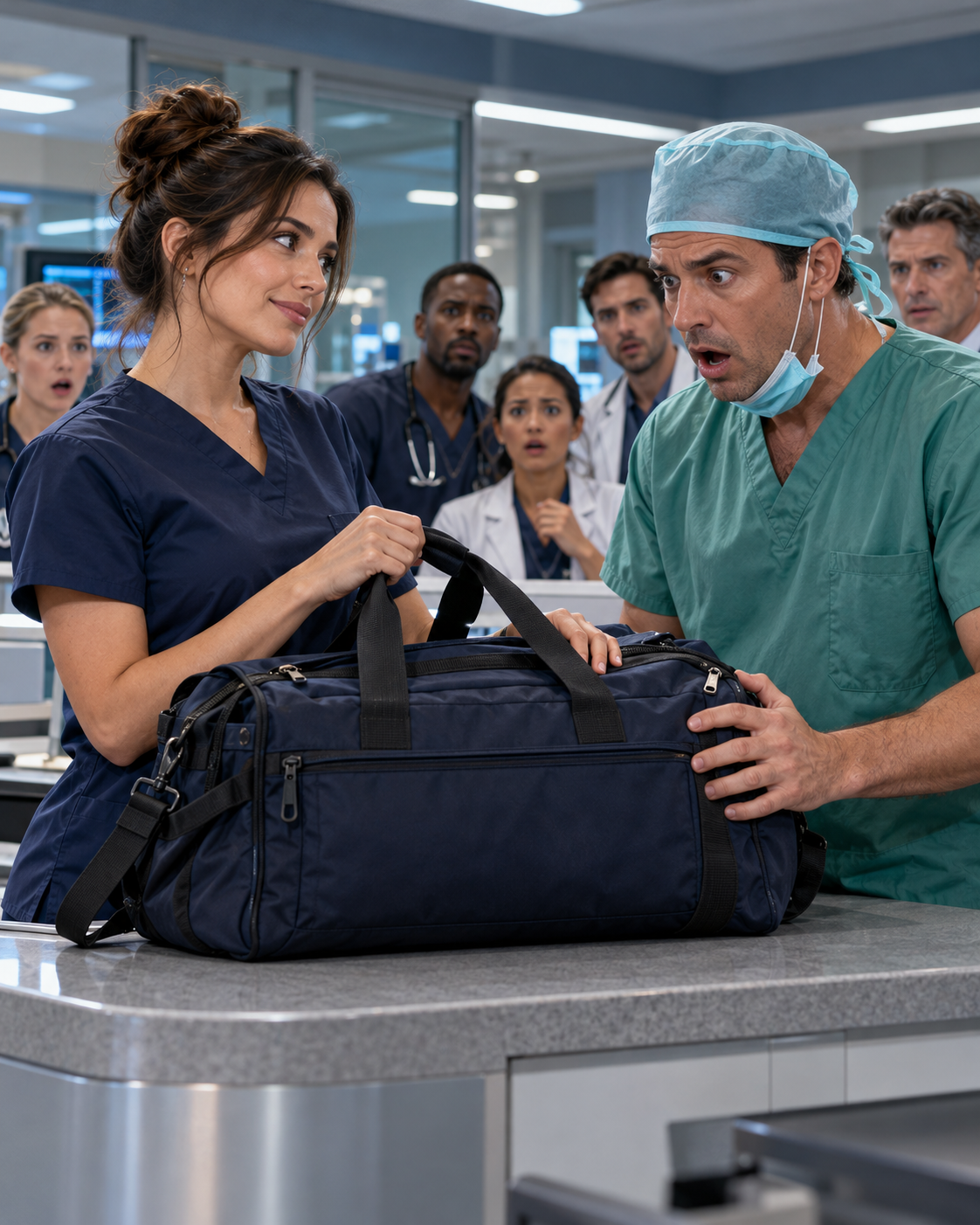
Dr. Vance laughed as he shoved his sweat-soaked gym bag into my arms in front of thirty people at Palmetto Point Naval Medical Center
The envelope felt heavier than paper should have.
Gunner stood across from me in the training center, his muddy boots replaced by polished black shoes, his shoulders squared beneath a clean uniform, and his eyes carrying the same expression I’d seen on the mountain three years earlier.
It was the look of a man who had survived something terrible and was afraid that surviving had cost him more than he understood.
“Where did you get this?” I asked.
“From Naval Special Warfare Command. It was delivered to my commanding officer this morning, with instructions that I bring it directly to you.”
“Why you?”
“Because my name is on the original incident report.”
I looked at the seal again.
The mission number was unmistakable.
So was the date.
For three years, I’d remembered that operation in fragments: a narrow mountain pass, the sharp smell of burned fuel, the weight of an injured sailor against my chest, and a radio that kept repeating coordinates we could no longer reach.
I’d also remembered the moment the extraction helicopter lifted away.
One man had remained behind.
Petty Officer Daniel Mercer.
He had been twenty-four, stubborn, and incapable of telling a joke without laughing at his own punchline.
He’d been the youngest member of Gunner’s team, the one who called me Doc even after I’d corrected him a dozen times.
When the evacuation route collapsed, Daniel had stayed with two injured men while I led the others toward the landing zone.
I’d gone back for him.
I’d reached his position after the second explosion, found him beneath a shattered support beam, and worked desperately to keep him alive.
But his injuries were catastrophic, and the extraction window was closing.
Daniel had gripped my wrist.
“Get them home, Doc.”
I had refused.
He’d squeezed harder.
“That’s an order.”
He had died before the helicopter arrived.
I’d carried his blood on my uniform all the way home, and no amount of scrubbing had ever made the memory disappear.
Now, staring at the sealed envelope, I felt the old mountain wind move through my chest.
“Tell me what’s inside,” I said.
Gunner swallowed.
“I haven’t opened it. But I was told it concerns Daniel’s death and the official report.”
My fingers tightened around the envelope.
“What about the report?”
He hesitated.
“Reaper, I think somebody lied about what happened that night.”
For a moment, the training center vanished.
I heard the fluorescent lights buzzing overhead, the distant chatter of nurses, and the faint squeak of a gurney moving down the hall.
Then I took a breath and broke the seal.
Inside were several pages of classified correspondence, a copy of the original operational timeline, and a handwritten note from an officer whose name I recognized immediately.
Commander Elias Ward.
He had supervised the mission from the forward operations center.
According to the official report, the extraction team had received confirmation that Daniel and the two injured sailors had been evacuated before the route was compromised.
That had never happened.
I had watched Daniel die.
I had watched the other two men being loaded into the helicopter while I held Daniel’s hand.
Yet the report stated that all personnel had been accounted for before the final extraction.
The discrepancy had haunted me for years, but I’d blamed the chaos of battle, my own exhausted memory, and the terrible possibility that grief had rearranged the sequence of events.
The new documents told a different story.
A radio transmission recorded thirty-seven minutes before Daniel’s death showed that the forward operations center had received an accurate report of our position.
A second transmission, sent eleven minutes later, warned that our extraction corridor was compromised.
That warning had not reached our team.
Instead, we had been directed toward the same route.
At the bottom of the page, a handwritten note read: ALTERNATE EXTRACTION DENIED BY COMMAND AUTHORITY.
I read it twice.
“Who denied it?” I whispered.
Gunner pointed toward the final page.
Commander Ward’s initials appeared beside the authorization.
My mouth went dry.
Ward had been the officer who later praised our unit for its discipline and courage.
He had attended Daniel’s memorial.
He had shaken my hand and told me that no one could have done more.
I’d believed him.
Gunner pulled out a chair and sat down slowly.
“I knew the radio traffic didn’t make sense,” he said. “After we got back, I asked why the alternate route had been rejected. They told me the command center had lost contact with us.”
“But they hadn’t.”
“No.”
“Did you challenge the report?”
“I tried. My commanding officer told me the investigation was closed and warned me that further questions could jeopardize the survivors’ careers.”
I stared at the documents.
The hospital corridors seemed impossibly bright around me.
For years, I had blamed myself for Daniel’s death because guilt was easier to carry than uncertainty.
If I’d moved faster, if I’d chosen a different route, if I’d ignored the order to withdraw, perhaps I’d have reached him sooner.
I’d replayed every decision until the memory had become a room without doors.
Now I was learning that the mission might have been lost before I ever reached the mountain pass.
“Why send this now?” I asked.
Gunner pointed to the last paragraph.
A routine review of historical operational records had uncovered inconsistencies between the radio logs and the official report.
The review had been triggered by an unrelated inquiry into missing communications data.
Someone had finally compared the records.
Someone had noticed that Daniel’s death had been documented in a way that contradicted the surviving evidence.
And someone had decided the information could no longer be buried.
I sat down.
For a long moment, I couldn’t speak.
Gunner waited without interrupting.
Then I said the words I’d been afraid to say for three years.
“I thought I abandoned him.”
Gunner’s eyes filled.
“You didn’t.”
“I left him there.”
“You went back for him. You fought until there was nothing left to fight with.”
“But I couldn’t bring him home.”
“No,” Gunner said softly. “None of us could.”
He leaned forward, his hands clasped tightly between his knees.
“That was the part we never understood, Reaper. We all thought you knew something we didn’t. We saw you come back from that mountain carrying his blood, and then we watched you disappear into a hospital job where nobody knew your name.”
“I wanted to be useful without having to hear gunfire in my sleep.”
“And you were.”
He glanced toward the training room, where a group of sailors were practicing emergency response techniques.
“You saved Nathan. You saved people in that pediatric hallway. You’re teaching others to survive things they never imagined they’d face. Daniel would have been proud of you.”
I turned away before he could see the tears.
I had learned how to stop bleeding, how to hold an airway open, how to make decisions while fear clawed at my throat.
I’d never learned how to forgive myself for surviving.
The following morning, Captain Hayes summoned me to his office.
Gunner accompanied me, carrying the documents in a sealed evidence folder.
Captain Hayes read every page without speaking.
When he reached the radio transcript, his expression tightened.
“Have you contacted Naval Special Warfare Command?” he asked.
“Not yet,” I replied. “I wanted to make sure the records were authentic.”
“They are. I’ll have the proper investigative authority verify them and preserve the originals.”
He closed the folder carefully.
“Commander, I need you to understand something. This hospital can support you, but it cannot conduct a military criminal investigation. We will forward the evidence through the appropriate channels and protect the integrity of the process.”
“I understand.”
He studied me for a moment.
“Do you want to proceed?”
The question struck harder than I’d expected.
For three years, I’d wanted answers.
But answers could reopen wounds, damage reputations, and expose people who had built their lives around a version of the past they preferred.
If the report had been altered deliberately, then someone had allowed Daniel’s family to grieve without knowing the truth.
His parents had received medals, condolences, and a formal explanation that described his death as an unavoidable consequence of combat.
They had never been told that an alternate extraction route might have been available.
I thought of his mother standing beside his photograph at the memorial, holding a folded American flag against her chest.
I thought of the letter she’d sent me afterward.
She had thanked me for bringing her son home as far as I could.
I had never answered because I couldn’t find words that didn’t sound like an apology.
“Yes,” I said.
My voice trembled, but the decision did not.
“I want the truth established. Whatever it costs.”
Captain Hayes nodded.
“Then we’ll make sure the evidence reaches the people responsible for investigating it.”
Within days, the documents were transferred to the appropriate military investigative authorities, and I was instructed to preserve my recollections without discussing unverified details publicly.
I submitted a formal statement.
Gunner submitted his.
Other members of the team were contacted, and their accounts revealed similar inconsistencies.
No one promised us a quick resolution.
The investigation would take time, and some questions might remain unanswered.
For the first time, though, I no longer had to carry those questions alone.
I returned to the training center and threw myself into the work.
The program had grown faster than anyone expected.
Nurses came from neighboring facilities to learn how to recognize deterioration before a patient collapsed.
Sailors practiced controlling bleeding and responding to airway emergencies.
Civilian first responders trained alongside military medical personnel, discovering that the first minutes of a crisis often mattered more than the equipment available.
I taught them to look beyond the obvious.
A patient who suddenly became confused might be deteriorating.
A frightened teammate might need calm instructions before they could follow them.
A room full of experienced professionals could still make dangerous mistakes if everyone waited for someone else to take responsibility.
I never taught them to worship rank.
I taught them to recognize competence, communicate clearly, and speak up when a decision threatened someone’s life.
Dr. Vance became one of the program’s most dedicated participants.
The change in him was not immediate, and I didn’t mistake attendance for redemption.
He still struggled with impatience.
He still had moments when his pride outran his judgment.
But he began listening when nurses raised concerns, and he stopped treating questions as personal challenges.
One afternoon, I found him in the simulation room helping a young nurse reset a training mannequin.
She had made a mistake during a scenario and was visibly embarrassed.
“I should have noticed the change sooner,” she said.
Vance shook his head.
“You noticed it eventually. Now we work out what made you miss it the first time.”
He paused, then added, “That’s how people get better.”
The nurse looked surprised.
So did I.
When he noticed me standing at the door, he straightened.
“Commander.”
“Doctor.”
He glanced at the mannequin.
“I used to think being in charge meant making sure nobody questioned me.”
“And now?”
“Now I think it means making sure someone does when I’m wrong.”
It wasn’t a perfect apology, but it was an honest beginning.
I nodded and left him to finish the exercise.
Weeks later, Nathan returned to Palmetto Point for a follow-up appointment.
He walked into my office without assistance, his leg fully healed except for a faint scar near the bite site.
Gunner came with him, carrying a paper bag filled with coffee and pastries from a bakery outside the base.
“I was told this is where the legendary Reaper hides between disasters,” Nathan said.
“I don’t hide,” I replied. “I work.”
“That’s exactly what someone hiding would say.”
For the first time in a long while, I laughed without feeling guilty about it.
Nathan placed a small folded card on my desk.
Inside was a photograph of the SEAL team standing together after his recovery.
Someone had written across the bottom: WE GOT TO GO HOME.
I ran my thumb over the words.
It was such a simple sentence.
I’d spent years measuring success by the people I couldn’t save, as if the ones who survived were somehow less deserving of my attention.
The photograph reminded me that every person who made it home carried a future that might otherwise have vanished.
“I don’t know how to thank you,” Nathan said.
“You already did.”
He frowned.
“How?”
“You came back.”
He understood then, and he didn’t try to turn the moment into something grander.
He simply shook my hand.
A month later, the investigative team requested a follow-up interview.
The review had uncovered evidence that the original operational report had been altered after the mission.
Investigators were examining whether the changes had been made to conceal an unauthorized command decision or whether other failures had contributed to the discrepancy.
Commander Ward had been relieved of his current operational duties pending the investigation.
No final finding had been issued, and no one offered me a convenient villain to hate.
That was harder than I expected.
I’d imagined that learning the truth would produce a clean, sharp anger I could finally direct somewhere.
Instead, I felt grief for Daniel, frustration at the years of uncertainty, and a strange sadness for the people who had made choices they might spend the rest of their lives trying to justify.
The truth did not bring Daniel back.
It did not erase the moment I had watched him die.
But it gave his death something my guilt had taken away: the right to be remembered honestly.
The following weekend, I traveled to Virginia to visit Daniel’s parents.
I had written a letter to his mother several times and destroyed it each time because every sentence seemed too small.
This time, I carried the documents that had been cleared for disclosure and a photograph of the team.
His mother opened the door.
For a moment, she looked at me without recognition.
Then her eyes widened.
“Lieutenant Commander Arrais?”
“Yes, ma’am.”
She reached for my hands.
“We wondered if we’d ever see you again.”
Inside, Daniel’s father sat beside a window, a newspaper folded across his lap.
His mother’s eyes moved to the folder.
“Is something wrong?”
I sat down opposite them and explained that new evidence had raised serious questions about the official account of Daniel’s final mission.
I told them what I knew, what the investigation had confirmed, and what remained uncertain.
I did not promise that anyone would be convicted.
I did not pretend that every missing answer would eventually be found.
I simply told them the truth as carefully as I could.
When I finished, Daniel’s father lowered his head.
For a long time, the only sound was the ticking of a clock in the kitchen.
Then he asked, “All these years, did you think you failed our son?”
My throat tightened.
“Yes.”
He looked at me with tired, gentle eyes.
“Then you’ve been carrying something that was never yours alone.”
His wife reached across the table and covered my hand with hers.
“Daniel loved his team,” she whispered. “He trusted you. I don’t believe he spent his final moments thinking you had failed him.”
I began to cry.
Not the silent tears I’d learned to hide in hospital bathrooms, but the kind that made it difficult to breathe.
Daniel’s mother stood and embraced me.
For the first time since the mountain, I allowed someone to hold me while I grieved.
When I returned to Palmetto Point, the hospital was preparing for its first large-scale emergency readiness exercise.
Hundreds of staff members, sailors, and civilian responders would participate.
Captain Hayes asked me to lead the opening briefing.
I stood before the assembled crowd and looked at the faces watching me.
Some knew my record.
Some knew only that I was the nurse who had stopped a room full of people from making a bad situation worse.
A few had heard rumors about the investigation, but I refused to let the past become a spectacle.
I spoke instead about responsibility.
“An emergency doesn’t care about your title,” I told them. “It doesn’t care how long you’ve worked here or how many people have applauded your decisions. It asks one question: when someone needs help, will you recognize what must be done and act?”
The room was silent.
“Sometimes the person who saves a life will be the most experienced officer present. Sometimes it will be the youngest nurse, the quietest corpsman, or the person nobody bothered to listen to. If you remember nothing else from this program, remember this: never confuse someone’s silence with a lack of strength.”
I saw Dr. Vance standing near the back.
He didn’t look away.
After the exercise, the team gathered in the training center for a final review.
A simulated mass-casualty scenario had exposed several weaknesses in our communication procedures, but the participants had corrected their mistakes and improved their response times.
The program was working.
Not because I had made everyone fearless, but because I’d taught them how to function when fear arrived.
Captain Hayes shook my hand.
“You’ve changed this hospital.”
“We’ve changed it,” I corrected.
He smiled.
“That’s why I offered you the position.”
As the room began to empty, Dr. Vance approached carrying my battered gym bag.
The same bag he’d once shoved into my arms while an audience laughed.
Its fabric had been repaired, but the embroidered insignia remained visible.
He held it carefully.
“I owe you another apology,” he said.
“You’ve already apologized.”
“I apologized for what I did to you. I don’t think I ever acknowledged what it revealed about me.”
I waited.
“I saw someone quiet and assumed she was weak. I saw a nurse and assumed she was beneath me. And because everyone laughed, I convinced myself that being cruel was the same thing as being confident.”
He looked down at the bag.
“I can’t undo that.”
“No,” I said. “You can’t.”
His shoulders tightened, but he nodded.
“I can make sure I never do it to someone else.”
That was the first apology I believed might survive beyond the room in which it was spoken.
I took the bag from him, then paused.
“Actually, Doctor, I have one more assignment for you.”
He looked up cautiously.
“Name it.”
“Tomorrow’s training session needs an instructor for the communication exercise. You’ll be working with the junior nurses, and they will be allowed to challenge every decision you make.”
For a second, I thought his pride might win.
Then he smiled, faintly and without arrogance.
“That sounds terrifying.”
“Good. You might learn something.”
He laughed, and this time, nobody laughed at anyone else.
That evening, I stayed late to finish the training reports.
Outside the windows, the base lights shimmered against the dark water.
I took Daniel’s photograph from the drawer and set it beside my desk.
For years, I had believed that honoring the dead meant refusing to feel happiness in the lives I had left.
Now I understood that grief was not a debt I could repay by suffering forever.
I could remember Daniel without punishing myself.
I could carry the men we’d lost without abandoning the people still standing in front of me.
And I could be Reaper when the world demanded it, while allowing myself to be simply Arrais when it did not.
My phone vibrated.
A message had arrived from Gunner.
The investigative team had discovered another communication record, one recorded several minutes before the alternate extraction route was denied.
The message contained only a brief note.
They want you to review the final transcript.
I stared at the screen, feeling the old fear stir beneath my ribs.
There would be more questions.
Perhaps there would be answers that hurt worse than the ones I’d already received.
I slipped the phone into my pocket and looked once more at Daniel’s photograph.
Then I turned off the office light and walked toward the doors, carrying the bag that had once made an entire hospital laugh.
It had become a reminder of everything I had survived, everything I had lost, and everything I still had the power to change.
I no longer needed the world to recognize the name stitched onto its front.
I needed only to make sure that when the next frightened person reached for help, somebody answered.
And somewhere beyond the hospital walls, a final piece of Daniel’s story was waiting to be heard.