Dr. Trevor Ashford shoved a mop into my hands in front of the entire emergency department at Cedar Harbor Naval Medical Center
The three letters were simple: S.O.S.
For several seconds, I couldn’t breathe.
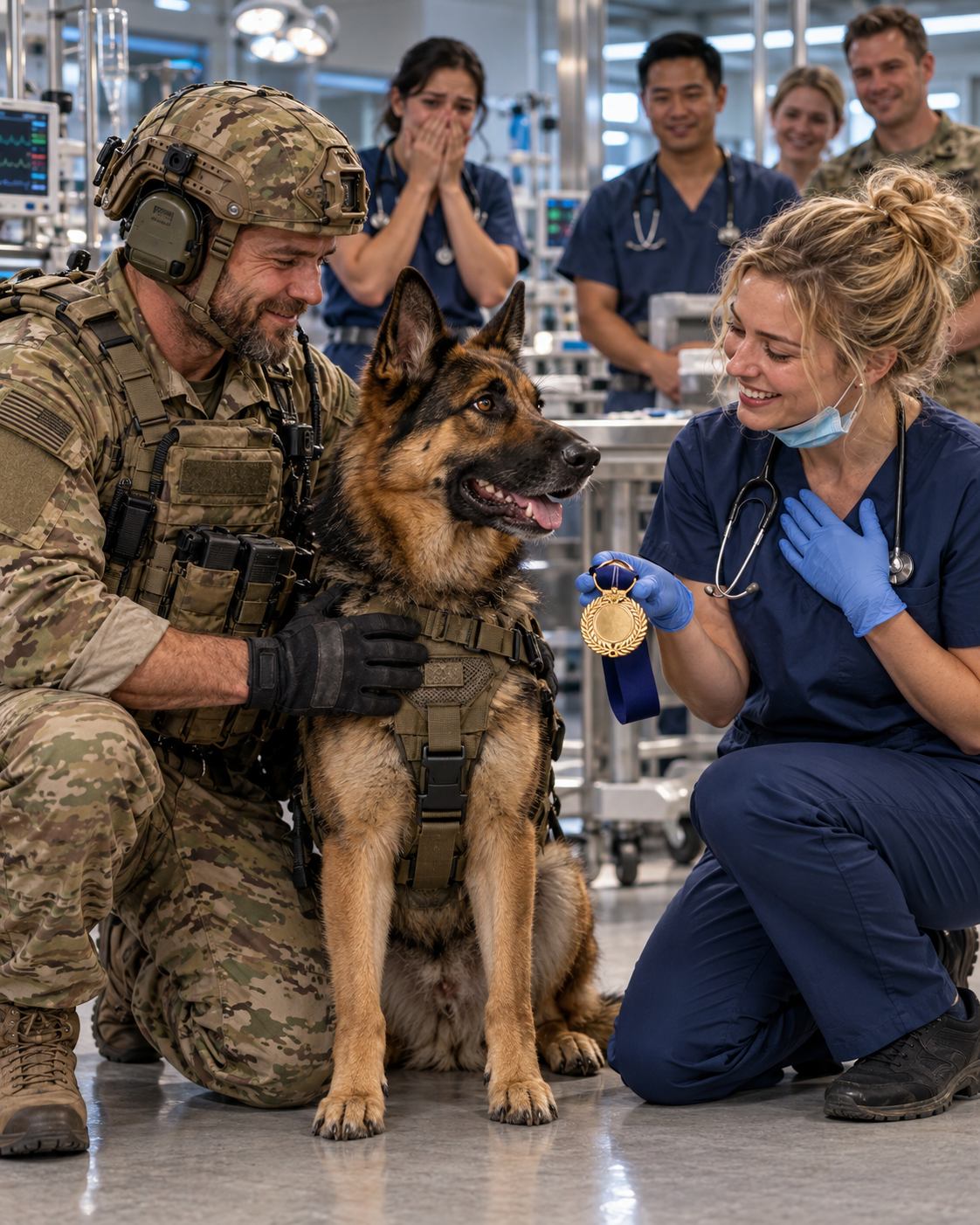
I turned the golden trident over beneath the desk lamp, searching for anything else hidden along its battered edges, but there was nothing except the familiar scratches Eli had made years ago when he dropped it on a training course.
Eli used to joke that a soldier’s equipment always told the truth, even when the soldier couldn’t.
“If something looks wrong, Sparrow,” he’d told me once, “don’t waste time asking whether you’re imagining it. Start asking who benefits from you believing it isn’t real.”
I had laughed at him then.
Now, sitting alone in the Cedar Harbor staff room with Coda resting his chin on my boot, I couldn’t stop hearing those words.
Eighteen months earlier, Eli Marsh had died during a classified maritime operation in the North Atlantic.
That was what the official notification said.
There had been no body for me to identify, no final conversation, and no chance to say goodbye.
The Navy had given me a sealed envelope, a folded flag, and an explanation that contained just enough information to make further questions seem disrespectful.
I had attended the memorial in my dress uniform, watched the flag pass into his mother’s trembling hands, and stood through the ceremony without shedding a tear.
Then I had gone home and broken every glass in my kitchen.
Eli had been more than my best friend.
He had been the person who knew what I sounded like when I was afraid and what my silence meant when I couldn’t explain it.
He had pulled me out of a burning transport vehicle during our second year together, then sat beside my hospital bed until I woke up.
When I asked why he had stayed, he shrugged.
“Because somebody has to make sure you don’t try to escape before the doctors clear you.”
I had believed him when he said we would grow old enough to complain about our knees.
Now his insignia lay in my hand, and the dog he had loved was staring at me as though I were the only person left who could understand.
I knelt beside Coda.
“Where did you get this, boy?”
His ears lifted at Eli’s name.
Then he rose, walked to the staff room door, and looked back at me.
It was not a random movement.
He was asking me to follow.
I took my coat, slipped the trident into my pocket, and followed him outside.
The rain had weakened to a cold mist, but the wind still swept across the parking lot.
Coda led me past the ambulance bay toward a row of maintenance sheds behind the hospital, stopping at a dented metal door that had been secured with a rusted chain.
He sniffed the ground, scratched once, and sat.
Something lay beneath the bottom edge of the door.
A small waterproof pouch.
My pulse quickened as I retrieved it.
Inside was a folded sheet of paper, a flash drive, and a photograph so waterlogged that the corners had begun to peel apart.
The photograph showed Eli standing beside two men near a fishing boat.
One was the patient we had pulled from Lake Michigan.
The other wore civilian clothes, but I recognized the distinctive scar running from his temple to his jaw.
Commander Nathan Voss.
He had supervised the operation that supposedly killed Eli.
On the back, someone had written a date, a time, and six words.
“Ask why the boat was empty.”
I read the sentence twice.
The boat that overturned the previous night had supposedly been carrying three recreational fishermen, according to the preliminary report.
Yet the photograph showed three men who were clearly not strangers to one another.
Why had a Navy commander been meeting Eli and the drowning victim?
Why had Coda arrived at Cedar Harbor with the trident?
And why had the photograph been hidden behind a maintenance shed?
My first instinct was to call Bear.
My second was to remember the classified debriefing after Eli’s memorial.
I had asked whether Commander Voss had been the last person to see him alive.
The officer across the table had closed the folder in front of him.
“That information is restricted, Chief.”
I had pressed harder.
He had leaned forward and said, “Your friend served with honor. Don’t let grief turn into suspicion.”
I had stopped asking questions after that.
Not because I believed him, but because I was exhausted from fighting a machine that could bury a truth more thoroughly than any grave.
I returned to the hospital and locked myself in an empty consultation room.
The flash drive contained only one encrypted file.
I tried the dates, Eli’s service number, and the coordinates of the operation where he supposedly died.
Nothing worked.
Then I remembered the phrase he used whenever we needed to confirm each other’s identity during training.
“The sea keeps no secrets.”
I typed the words.
The file opened.
A video appeared, recorded in a dim cabin with the camera angled toward a narrow window.
Eli sat in front of it.
He looked thinner than I remembered, with dark circles beneath his eyes and a healing cut across his forehead.
But he was alive.
I grabbed the edge of the desk so hard my fingers hurt.
“If you’re seeing this, Sparrow, something went wrong,” he said.
His voice was low and hurried.
“I can’t contact you directly. There are people monitoring the channels, and I don’t know how long I can stay off their radar.”
He glanced toward the window.
“Voss has been moving equipment through civilian maritime contractors. We thought it was a supply diversion at first, but the records don’t match the shipments. Personnel are being listed as dead before their assignments are finished.”
My stomach tightened.
“There’s a second operation running beneath the first one. The boat on Lake Michigan is connected to it. Hayes has the ledger, and Coda knows where the original files are hidden.”
Eli leaned closer to the camera.
“I need you to understand something. If they tell you I’m dead, don’t go looking for my body. Look for the paperwork.”
The video froze.
Then the screen went black.
I stared at it, unable to move.
The man I had mourned for eighteen months had just spoken to me from the other side of my grief, and his final words had turned every memory of his funeral into a question.
A knock sounded at the door.
I closed the laptop.
“Paige?”
It was Bear.
I opened the door, and one look at my face made him step inside.
“What happened?”
I showed him the photograph, the trident, and the video.
He watched the recording without interrupting.
When it ended, the old lines around his eyes deepened.
“Where did you get this?”
“Coda led me to it.”
Bear looked toward the hallway, where the dog was waiting.
For a long moment, he said nothing.
Then he lowered himself into a chair.
“Voss told us Eli’s team had been compromised. He said there was evidence of a leak, and that Eli had gone off mission before the final contact.”
“Did you believe him?”
“I believed the official report,” Bear admitted. “And I hated myself for it, because the report never explained why the extraction coordinates had been changed.”
He rubbed a hand over his face.
“Two operators were injured that night. One was listed as medically evacuated, but I never found a record of where he went. The other was declared dead without a recovery.”
“Hayes,” I whispered.
Bear nodded slowly.
“Then we need to find out what he knows.”
We returned to the emergency department, where Hayes lay in intensive care under careful observation.
His lungs had taken a serious beating, and the doctors were monitoring him for complications after his near-drowning.
When he opened his eyes, I was standing beside his bed.
He looked at me, then at the golden insignia resting in my palm.
His expression changed.
“Where did you get that?”
“Coda brought it to me.”
Hayes tried to sit up, but pain stopped him.
“Is he safe?”
“He’s downstairs with Bear.”
Relief washed over his face.
Then he looked toward the door.
“Did you watch the file?”
“Yes.”
He closed his eyes.
“Then they know I’m alive.”
“Who?”
“Voss.”
The name seemed to drain the warmth from the room.
Hayes swallowed painfully.
“Eli discovered that Voss was falsifying personnel records and diverting specialized equipment through private contractors. The equipment was supposed to support classified maritime operations, but some of it was being sold to people who should never have had access to it.”
“Why didn’t you report him?”
“We did. The report disappeared, and the officer assigned to investigate it was transferred before he could finish.”
Hayes looked at me with exhausted eyes.
“Eli realized the operation had become compromised. He wanted to get the original records out before Voss could destroy them.”
“Why did the Navy declare him dead?”
“Because Voss needed time. If everyone believed Eli was gone, nobody would keep looking for the man who knew where the evidence was.”
My throat tightened.
“Where is he?”
Hayes hesitated.
“I don’t know where he is now. The last time I saw him, he was alive.”
The words should have filled me with hope.
Instead, they frightened me more than anything I had heard.
Before I could ask another question, Bear entered with Captain Ferrante and a hospital security officer.
“We have a problem,” Bear said.
He held up his phone.
A security camera image showed a man entering the hospital through the staff parking entrance.
He wore a dark coat and carried a visitor badge.
The image was grainy, but I recognized the scar on his temple.
Nathan Voss had come to Cedar Harbor.
Captain Ferrante immediately ordered the hospital placed on restricted access, while Bear contacted the appropriate military authorities.
I remained beside Hayes.
“How did he find you?”
Hayes’s eyes shifted toward the window.
“I sent a signal before the boat went over. I knew I couldn’t keep running forever.”
“Did you capsize the boat on purpose?”
“No,” he said sharply. “Voss’s people found us before we could reach shore. The engine failed, and somebody cut the emergency radio cable. I got the ledger into a waterproof container before the boat rolled.”
“Where is it now?”
Hayes looked toward Coda, who had slipped quietly into the room.
The dog approached the bed and pressed his nose against Hayes’s hand.
“The original records are not on that flash drive,” Hayes whispered. “Eli hid them somewhere nobody would think to search.”
“Where?”
Hayes looked at me.
“At the place where you buried him.”
For a moment, the room seemed to tilt.
Eli’s memorial had taken place at a small coastal cemetery outside town, beside the lake he had loved.
There was no body in the grave, only a folded flag and a plaque bearing his name.
I had visited it every month for eighteen months.
And now I wondered whether I had been mourning a man who was still somewhere in the world, waiting for someone to find him.
Before we could leave, a nurse rushed into the room.
“There’s a man downstairs asking for Nurse Sutton. He says he’s a federal investigator.”
Bear’s expression hardened.
“Did he show identification?”
“Yes, but security says the badge doesn’t match the agency he claims to represent.”
Captain Ferrante turned toward the door.
“Lock down this floor.”
The lights flickered.
Not another storm this time, but a brief interruption as the backup system shifted loads.
When the corridor lights returned, the security officer who had been standing outside Hayes’s room was gone.
So was Coda.
My heart lurched.
I ran into the corridor and found the emergency stairwell door swinging slowly shut.
A faint metallic clatter echoed below.
“Coda!”
I raced down the stairs, Bear close behind me.
We reached the lower service level just as the dog appeared around a corner, barking furiously at a man in a dark coat.
Voss stood beside an open maintenance door, one hand gripping a small black case.
His expression changed when he saw me.
“Paige Sutton,” he said calmly. “You’ve made a terrible mistake.”
“No,” I replied. “I made one eighteen months ago when I believed your report.”
He smiled without warmth.
“You have no idea what you’re interfering with.”
“Then explain it.”
He glanced toward Bear, who had drawn closer with controlled, deliberate steps.
Voss’s hand tightened around the case.
“That evidence is classified. Hand it over, and I can make sure your career survives this.”
I looked at the case, then at the man who had turned Eli’s death into a wall of silence.
“My career isn’t what I’m worried about.”
Voss moved suddenly toward the maintenance door.
Bear blocked his path, and the security team arrived seconds later.
The confrontation ended without a shot, but Voss’s composure collapsed when Captain Ferrante announced that the authorities had already secured his communications records and requested an immediate review of the maritime operation.
The black case contained copies of the falsified shipping manifests and personnel records, but not the original ledger.
Voss had come to destroy what Hayes had recovered.
He had failed.
That afternoon, with Hayes stable and the hospital secured, I drove with Bear to the cemetery.
Coda rode in the back seat, his head resting against the window.
The sky had cleared, leaving the lake gray and restless beneath the winter light.
I stood before Eli’s memorial plaque and pressed my gloved hand against the cold stone.
“I kept my promise,” I whispered. “I didn’t forget you.”
Bear waited several feet away.
I knelt beside the base of the monument and noticed a narrow seam between two stones.
Behind the loose panel lay a small metal container wrapped in oilcloth.
Inside was a notebook, a sealed envelope, and a photograph.
The notebook contained names, dates, shipment numbers, and enough corroborating records to expose the operation.
The envelope bore my name in Eli’s handwriting.
My fingers trembled as I opened it.
“Sparrow,” the letter began, “if you found this, it means you did the one thing I always knew you would do. You kept going, even when the truth hurt.”
I had to stop reading.
The words blurred as tears gathered in my eyes.
“Eighteen months ago, I made a choice that may have cost you the chance to say goodbye. I thought distance would keep you safe. I was wrong to decide what you could survive without asking you.”
I pressed the letter to my chest.
“I don’t know when I’ll be able to come home,” he had written. “But if I can’t, remember this: your life was never supposed to belong to the battlefield. You were always meant to save people, even if you had to learn how to save yourself first.”
At the bottom was one final sentence.
“If you ever hear that I came back, don’t trust the first person who tells you why.”
I read it again.
Then I noticed the photograph beneath the letter.
It showed Eli standing beside a small cabin on a wooded shoreline.
On the back, he had written a set of coordinates and a date from three weeks earlier.
Bear leaned over my shoulder.
“Paige,” he said quietly, “that date is after the Navy officially declared him dead.”
The wind swept across the cemetery, carrying the distant sound of waves against the shore.
For eighteen months, I had believed grief meant learning to live with an absence.
Now I understood that sometimes grief was a question someone else had answered for you.
I folded the letter carefully and placed it inside my coat.
The investigation into Voss expanded over the following weeks. His records exposed a network of falsified reports, diverted equipment, and deliberate efforts to silence people who had questioned the operation.
Captain Ferrante issued a formal correction to my personnel file and apologized for the hospital’s failure to recognize my documented qualifications before the storm.
Dr. Ashford was removed from his leadership position after the review confirmed his public misconduct and his repeated disregard for patient safety concerns.
He sent me a brief message through hospital administration, admitting that he had mistaken quietness for incompetence.
I did not answer.
An apology could acknowledge the damage, but it could not erase the humiliation he had caused or the risks created by his arrogance.
I chose to move forward without carrying his judgment into every room I entered.
At Cedar Harbor, I became the nurse younger staff members approached when they were afraid to speak up.
I never told them they had to be fearless.
I told them that fear was not proof they were wrong, and that a patient could not afford our silence.
Coda remained close to me, though sometimes he would stand by the emergency department doors and stare outside as if waiting for a familiar silhouette.
I understood that feeling.
Some nights, after the last trauma patient had been transferred upstairs and the corridors finally grew quiet, I took Eli’s letter from my pocket and read it again.
I was still angry with him for leaving.
I was still frightened by the possibility that he might never return.
But beneath those feelings was something I had not allowed myself to experience since the day of his memorial.
Hope.
Six weeks after the storm, an envelope arrived at the hospital with no return address.
Inside was a photograph of the same wooded cabin shown in Eli’s letter.
This time, the image had been taken from much closer.
A man stood in the doorway, one hand resting on the frame.
His face was partly hidden by shadow, but I knew the angle of his shoulders, the tilt of his head, and the way he stood as though he were listening for something beyond the trees.
On the back, four words had been written in blue ink.
“Not yet. Keep her safe.”
I stared at the message until the paper began to shake in my hands.
Her.
Not me.
Someone else.
I called Bear immediately.
He arrived within twenty minutes, studied the photograph, and requested a secure review of the coordinates.
The cabin had been unoccupied for months, according to the initial records, but a recent utility reading suggested that someone had been there.
We agreed not to rush in without a proper assessment.
For the first time, I understood that being brave did not mean running toward every unanswered question.
It meant knowing when to wait, when to protect the people already in your care, and when to let trained investigators do their work.
The next morning, I returned to the emergency department.
A frightened young nurse was struggling with a critical patient while an attending physician dismissed her concern about a sudden change in his breathing.
I stepped beside her.
“Tell me what you’re seeing,” I said.
She explained the changes, her voice shaking at first and strengthening as she spoke.
I listened, checked the patient myself, and called for the appropriate intervention.
Within minutes, the team was moving together, and the patient was receiving the care he needed.
Afterward, the young nurse looked at me.
“I thought nobody would believe me.”
I remembered the mop in my hands, the laughter, and the shame that had once made me stare at the floor.
“I believe you,” I told her. “Now let’s make sure the patient is safe.”
That evening, Coda rested beside my chair while I watched the last light fade across Lake Michigan.
I no longer wore my old uniform, and I no longer needed to prove that I could survive a battlefield.
My mission was here, among the frightened families, the exhausted paramedics, and the people whose lives could change in a single breath.
Yet Eli’s photograph remained locked in my desk, its four words haunting me.
Not yet. Keep her safe.
I did not know who the woman was, why Eli was protecting her, or whether the man in the cabin was truly the friend I had mourned.
But I knew one thing with absolute certainty.
The next time someone tried to bury the truth, I would not lower my eyes.
And when the emergency department doors opened that night, Coda suddenly lifted his head, stood, and began to whine.
A figure was approaching through the glass.
I rose slowly, my heart pounding against my ribs.
The doors unlocked.
And from the darkness outside, a familiar voice whispered my name.