Dr. Richard Hayes publicly called me “the slowest nurse in Chicago Metro Medical Center”
For several seconds, I couldn’t hear anything except the rain tapping against the hospital windows.
The photograph trembled between my fingers.
I recognized the helicopter’s broken tail, the black smoke rolling across the desert, and the figure standing beside the wreckage.
His face was partly obscured by dust, but I knew the scar above his left eyebrow.
“That’s impossible,” I whispered.
The federal agent introduced himself as Special Agent Marcus Reed, then glanced toward the operating room where John Doe was recovering.
“My name is irrelevant right now, Captain. We need to know what you remember about the incident at Forward Operating Base Falcon.”
I looked at him sharply.
“I remember that six people died.”
“And one person was officially declared dead without a body being recovered.”
I lowered the photograph.
“Daniel Mercer.”
Reed nodded.
My throat tightened around a name I hadn’t spoken aloud in three years.
Daniel had been my flight commander, my closest friend, and the man who had dragged me out of a burning aircraft when I could no longer feel my left leg.
He had taught me how to remain calm when everything around me was collapsing.
He had also been the last person I saw before the explosion swallowed our helicopter.
I had spent months in rehabilitation, fighting to walk without a limp and struggling with the guilt of being the only surviving member of my immediate crew.
When the military investigation concluded, I accepted an honorable discharge and disappeared into civilian life.
I never returned to the memorial service.
I couldn’t bear to stand in front of six names and explain why mine wasn’t among them.
“Why are you telling me this now?” I asked.
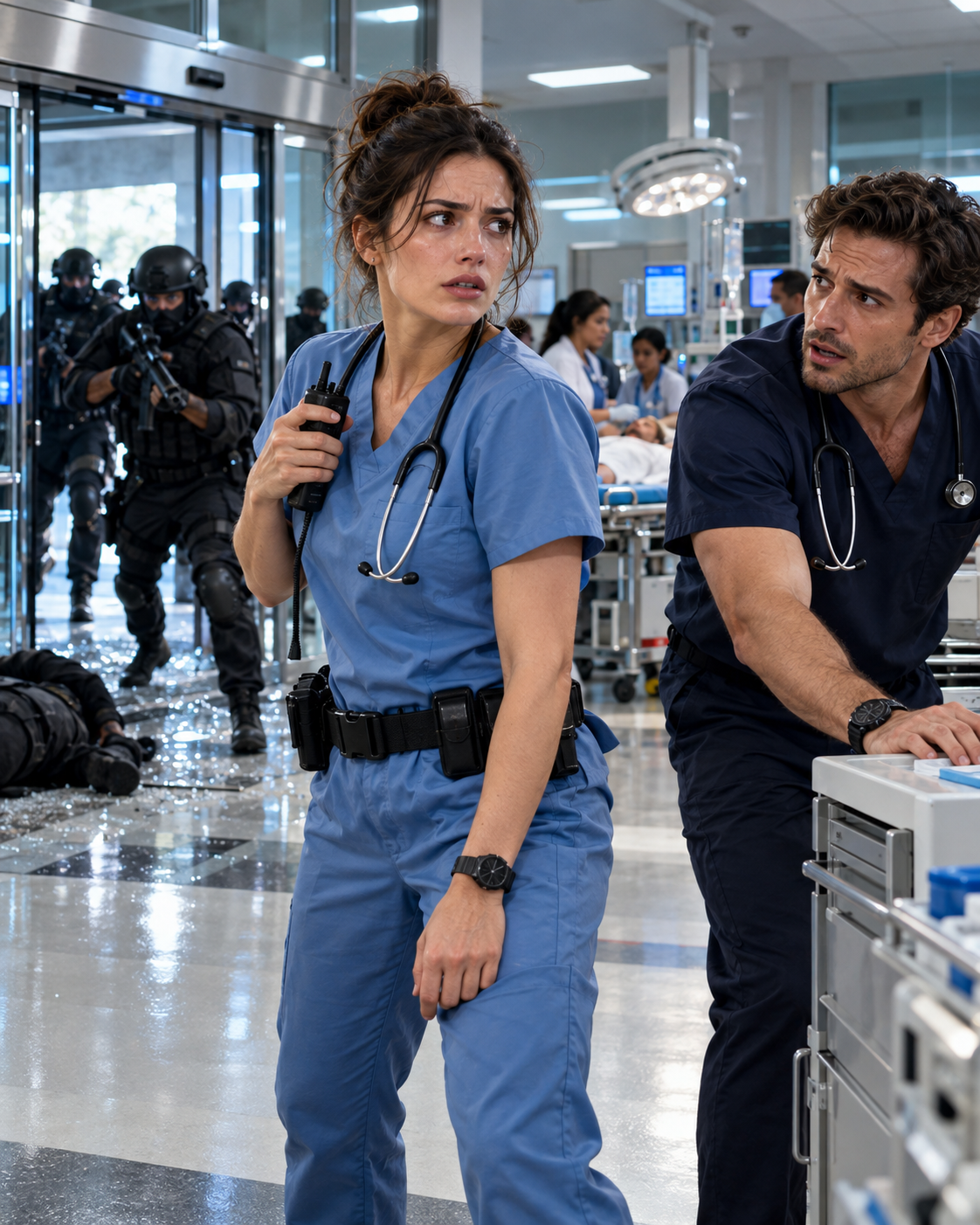
“Because the man you saved tonight was carrying intelligence connected to a network selling military information to private contractors. We believe Mercer is involved.”
My hands went cold.
“Daniel would never do that.”
“Then you should be interested in hearing the evidence.”
Before I could answer, the operating room doors opened.
Dr. Hayes stepped out, removed his surgical cap, and looked from Reed to me.
“John Doe is stable,” he said. “But he specifically asked for Captain Carter.”
Reed’s expression hardened.
“Did he say anything else?”
Hayes hesitated.
“He said the woman who saved him needed to know that Falcon wasn’t an accident.”
The hallway seemed to tilt beneath me.
For three years, I had convinced myself that the explosion was an unavoidable tragedy, that the aircraft had been struck during a routine extraction, and that Daniel’s disappearance was one more cruel consequence of war.
Now a stranger was telling me that the story I had survived might have been built on a lie.
I stood.
“Take me to him.”
Reed stepped in front of me.
“Not until we secure the room.”
“I just spent the night keeping armed men from killing him. You can either explain what you know, or move out of my way.”
His eyes narrowed, but he finally stepped aside.
When we entered the recovery room, John Doe was awake beneath a tangle of monitoring wires.
He looked younger without the blood and grime, though exhaustion had carved deep shadows beneath his eyes.
“Captain Carter,” he rasped.
“Who are you?”
“Ethan Cole. Former defense contractor. I used to manage communications for a security company that handled overseas logistics.”
“Why were mercenaries trying to kill you?”
“Because I copied files that prove someone sold the coordinates of your helicopter before the Falcon mission.”
I gripped the bed rail.
“Who?”
Ethan looked toward Reed.
The agent gave a small nod.
“Tell her.”
Ethan swallowed.
“Daniel Mercer.”
I shook my head.
“No.”
“He survived the crash,” Ethan continued. “He was recovered by a private team operating in the area. The people who found him were already working with the network responsible for the leak.”
“Why would he work with them?”
“Initially, he didn’t. He was injured, isolated, and believed his own command had abandoned him. They convinced him the mission had been deliberately sacrificed to cover up an operation involving stolen intelligence.”
I stared at him.
“That’s not true.”
“I don’t know what he was told,” Ethan said. “I only know what the files show. He eventually began working with the same people who recovered him.”
Reed placed a second photograph on the bedside table.
It showed Daniel entering a building in Virginia three months earlier.
Older, thinner, but unmistakably alive.
I felt an old wound opening inside my chest.
“Why didn’t anyone tell me?”
“The original investigation was compromised,” Reed said. “Several records were altered, and your sealed personnel file was accessed twice this week. We believe someone discovered that Ethan intended to contact you.”
I looked toward the door.
“So the men who attacked the hospital weren’t just after the drive.”
“They were also looking for you,” Reed answered. “Your name appeared in a recovered communication.”
For the first time since the lights had gone out, I felt truly afraid.
Not of the weapons or the men who had carried them.
I was afraid because the life I had built around forgetting had become a target.
I had wanted ordinary days, quiet dinners, and a job where I could help people without watching the sky for threats.
Now my past had found me in the one place where I thought I could finally be safe.
Reed closed the folder.
“We can arrange protection and ask you to assist with the investigation.”
“No.”
He looked surprised.
“No?” he repeated.
“I spent three years trying to become someone who wasn’t defined by that mission. I’m not going back into the field because somebody has decided my past is useful again.”
“Captain, people may die if we don’t recover the rest of the evidence.”
I looked at Ethan.
He was barely strong enough to lift his head, yet he had risked everything to expose the truth.
“I’ll help you establish what happened,” I said. “But I won’t become a weapon for anyone who refuses to tell me the whole story.”
Reed studied me for a long moment.
Then he nodded.
“Fair enough.”
When I returned to the emergency department, the hospital had begun to resemble itself again.
Staff members cleaned broken glass, security guards replaced damaged doors, and exhausted nurses checked on patients who had spent the night terrified and confused.
Chloe sat at the nurses’ station with a blanket around her shoulders.
The moment she saw me, she stood.
“Are you really a military captain?”
I almost smiled.
“I used to be.”
“You performed that procedure like you’d done it a thousand times.”
“I’ve had a lot of practice.”
She looked toward the corridor where the police had taken the last attacker.
“Dr. Hayes said you saved everyone.”
“No,” I replied gently. “A lot of people did their jobs under pressure. I just remembered some training.”
Chloe hesitated.
“I was scared.”
“So was I.”
She stared at me in disbelief.
“You didn’t look scared.”
“Being afraid and being unable to act are two different things. Don’t let anyone convince you that courage means you never feel fear.”
She nodded slowly.
I recognized the expression on her face.
It was the same look I had seen in the mirror during my first month after the crash, when I couldn’t bear to close my eyes without seeing flames.
Before I could say anything else, Richard approached us.
His white coat was stained, his face drawn with exhaustion.
“Carter, can we talk?”
Chloe began to leave, but I motioned for her to stay.
Richard glanced at her, then back at me.
“I owe you both an apology. I have spent years treating confidence as competence and quietness as weakness.”
He paused.
“When the power failed, I was afraid, and I let that fear make me useless for several seconds. You kept the patient alive while I stood there arguing about authority.”
“You were frightened,” I said. “That doesn’t make you useless.”
“It doesn’t excuse the way I’ve treated you.”
“No, it doesn’t.”
He accepted the answer without defending himself.
“I’d like to change that,” he said. “Not because of what the agents told me, and not because you have some extraordinary history. You deserved respect before I knew any of it.”
That was the first thing he had said to me that morning that I fully believed.
I returned to my duties, but the day passed in fragments.
Every ringing phone made my shoulders tighten.
Every unfamiliar face near the nurses’ station drew my attention.
At noon, I discovered a folded piece of paper tucked beneath my locker door.
There were only six words written on it.
You should have stayed dead, Emily.
I carried it directly to Reed.
He didn’t look surprised, which frightened me more than the message itself.
“Your name hasn’t been released publicly,” he said.
“Then whoever wrote this already knew who I was.”
“Yes.”
“Is Daniel responsible?”
“We don’t know.”
I looked at the words again.
For three years, I had believed my old identity was buried with the men I lost.
Someone had just proved otherwise.
That evening, security escorted me to a temporary safe location while investigators examined the hospital’s surveillance footage.
Camille, my older sister, met me there after Reed contacted her.
She was furious when she heard what had happened.
“You nearly died in a hospital, and now someone is threatening you because of something that happened overseas?”
“I know how it sounds.”
“It sounds like you have spent years trying to outrun a fire that never stopped burning.”
Her words struck deeper than I wanted to admit.
“I thought if I left that life behind, I could finally be normal.”
Camille sat beside me.
“Emily, normal isn’t a place you reach by pretending nothing hurt you. It’s a life where you can tell the truth about what hurt you and still find reasons to wake up tomorrow.”
I leaned against her shoulder.
For the first time that day, I let myself cry.
I cried for Daniel, for the crew I had lost, and for the younger version of myself who had believed survival was something she needed to apologize for.
The next morning, Reed called with an update.
Investigators had recovered part of the intelligence drive from the hospital attackers.
The files included communications linking a private security network to the leak before the Falcon mission.
But one section remained encrypted.
They believed Daniel possessed the key.
“Do you want me to contact him?” I asked.
“We have an intermediary who can arrange a meeting,” Reed replied. “But I need you to understand that we cannot guarantee what he’ll do.”
I thought about the photograph.
The scar above his eyebrow.
The man who had pulled me from the burning aircraft.
And the man who might have helped send us into it.
“Arrange it,” I said.
The meeting was scheduled for two days later at an abandoned aviation hangar outside the city.
Reed insisted on a federal team nearby, but Daniel had refused to meet anyone else.
I arrived wearing plain clothes, carrying no weapon, and wondering whether I was about to see a ghost or a stranger wearing a familiar face.
The hangar smelled of dust, oil, and wet concrete.
A single light burned above a workbench.
Then a man stepped out of the shadows.
Daniel looked older than the photograph suggested.
His left arm moved stiffly, and a pale scar crossed his temple.
But his eyes were the same.
“Emily,” he said.
I had imagined this moment thousands of times.
In some versions, I struck him.
In others, I demanded answers until he broke down and confessed that everything had been a misunderstanding.
In the worst versions, he looked at me without recognition.
Instead, I stood motionless.
“You’re alive.”
He gave a bitter laugh.
“That’s what everyone keeps telling me.”
“Six people died at Falcon.”
His expression changed.
“I know.”
“You were declared dead.”
“I know.”
“You let us believe you were gone.”
His jaw tightened.
“I thought it was the only way to survive.”
“Survive what, Daniel? The crash, or what you did afterward?”
He looked away.
For a moment, I saw the man who had once shared his last bottle of water with a frightened young medic and stayed awake all night to make sure I was breathing after a difficult extraction.
Then he spoke.
“The people who recovered me told me the mission had been compromised by our own command. They showed me communications that appeared to prove we had been sent into a trap.”
“Were they real?”
“Some were. Some had been altered.”
“Did you know that?”
“Not at first.”
I waited.
He looked at me, and I saw the answer before he said it.
“Eventually, yes.”
The hangar seemed to grow colder.
“When?”
“About a year after the crash.”
“And you stayed with them?”
“I had already done things I couldn’t explain. I thought if I exposed the truth, I’d lose the only people who could protect me.”
“You chose your own protection over the truth.”
“Yes.”
The word fell between us like a door slamming shut.
I had wanted an explanation that would make his betrayal understandable enough to forgive.
Instead, he gave me something far more painful: a reason that explained his choices without making them right.
“Did you sell the coordinates?” I asked.
“No. I helped conceal the people who did. I knew where some of the records were, and I told myself I was buying time until I could expose the network.”
“Meanwhile, they kept operating.”
“Yes.”
“And people kept getting hurt.”
He bowed his head.
“Yes.”
I felt anger rise through the grief.
“You taught me that the mission never mattered more than the people we were sent to protect.”
“I know.”
“No, you don’t get to say that as if understanding the words is the same as living by them.”
He flinched.
I stepped closer.
“I spent three years believing I had failed you. I thought I should have reached you sooner, searched harder, found some way to bring you home.”
His eyes filled with tears.
“You couldn’t have found me.”
“I know that now. But you knew I was alive, Daniel. You knew I was carrying the memory of that crash, and you let me believe you were dead.”
He covered his face with his hand.
“I was ashamed.”
“So was I. The difference is that I didn’t make other people live inside my shame.”
For a long time, neither of us spoke.
Then Daniel reached into his jacket and removed a small encrypted storage device.
“This contains the original communications and the names of the people who arranged the leak. It also shows who altered the investigation afterward.”
He placed it on the workbench.
“I’ll testify.”
I looked at the device, then back at him.
“Why now?”
“Because I saw the hospital footage. I saw you standing between those men and that patient, and I realized you were still doing what we used to do.”
He swallowed hard.
“You were protecting someone who couldn’t protect himself. And I was still hiding.”
I wanted to believe him.
But wanting to believe someone had never been proof that they deserved it.
“Turn yourself in,” I said. “Tell the truth, even when it costs you everything.”
He nodded.
“I will.”
As I turned to leave, he called my name.
“Emily?”
I stopped but didn’t turn around.
“I’m sorry I survived and then made you carry the weight of believing I hadn’t.”
My eyes burned.
I had dreamed of hearing those words for three years.
Now that they had finally arrived, they couldn’t return the people we had lost or restore the trust he had abandoned.
“I hope you mean that,” I said. “But I can’t carry you out of this.”
Then I walked toward the exit.
Federal agents entered the hangar moments later.
Daniel surrendered without resistance.
The investigation lasted several months.
His testimony helped investigators uncover a network of contractors and former officials who had concealed the intelligence leak and profited from the aftermath.
Several people were charged, and the original investigation into the Falcon crash was reopened.
The findings confirmed that the mission’s coordinates had been compromised before our aircraft went down.
They also established that Daniel had concealed evidence after learning the truth.
He had not caused every tragedy that followed, but he had helped prolong a deception that harmed others.
When the findings became public, I read them alone in my apartment.
I thought I would feel relief.
Instead, I felt a quiet grief for the years I had spent blaming myself for something that had never been mine to carry.
Daniel sent me a letter through his attorney.
He didn’t ask for forgiveness or tell me that his actions had been unavoidable.
He wrote that he was trying to accept the consequences without turning his regret into another demand that someone comfort him.
I folded the letter and placed it in a drawer.
Maybe one day I would write back.
Maybe I wouldn’t.
For the first time, I understood that forgiveness did not require me to reopen every door that had once been important to me.
At Chicago Metro Medical Center, life gradually returned to its ordinary rhythm.
Richard changed the way he treated the staff, though I knew that one night of terror could not erase years of arrogance.
He began listening during handoffs, asking questions without humiliating people, and acknowledging when a nurse noticed something he had missed.
Chloe grew more confident.
One evening, I watched her calmly direct a crowded trauma bay while a new doctor struggled to keep up.
Afterward, she approached me.
“I used to think brave people weren’t afraid,” she said.
“What do you think now?”
She smiled faintly.
“I think brave people are the ones who remember what matters while they’re afraid.”
I felt something inside me finally loosen.
I had spent years believing that my military past was a wound I needed to hide if I wanted to build a peaceful life.
Now I understood that I didn’t have to choose between the woman who had survived the battlefield and the nurse who wanted to help people heal.
They were both me.
Neither one needed to apologize for existing.
On the anniversary of the Falcon crash, I visited the memorial for the first time since leaving the service.
Six names were carved into a dark stone wall.
I brought six small white flowers and placed one beneath each name.
Then I stood in the cold morning air and finally spoke the words I had never been able to say.
“I survived. I’m sorry it took me so long to understand that surviving wasn’t a betrayal.”
The wind moved through the trees.
Nothing answered.
But for the first time, the silence didn’t feel like punishment.
I returned to the hospital that afternoon and found a note from Richard on my desk.
It read, “You don’t have to be extraordinary to deserve respect. I should have known that before I knew your story.”
I kept the note.
Not because I needed his approval, but because it reminded me how easily people mistake quietness for weakness and how much damage that mistake can cause.
Months later, a new nurse asked me whether I ever missed my old life.
I thought about the aircraft, the desert, the men I had lost, and the friend whose choices had forced me to confront a truth I had spent years avoiding.
“I miss the people,” I said. “I don’t miss believing that I have to carry everything alone.”
She nodded, then hurried back to her patient.
I watched her go and felt grateful for the ordinary sounds around me: the monitor alarms, the rolling carts, the voices calling for supplies.
They were not the sounds of a battlefield.
They were the sounds of people trying to keep one another alive.
I still kept my old military identification in a box at home.
Sometimes I opened it and remembered the young medic who had believed that courage meant never showing fear, never asking for help, and never allowing grief to slow her down.
I wished I could tell her that strength was not the absence of pain.
It was the willingness to face the truth without letting pain decide who you became.
The hospital had taught me that lives could change in a single moment.
The crash had taught me that survival could leave wounds nobody else could see.
And Daniel had taught me that even people we love can make choices we cannot excuse.
But the most important lesson came after the gunfire ended, when there were no enemies left to fight and no orders to follow.
I had to decide what kind of life I wanted to build with the time I had been given.
I chose a life where I could be quiet without being invisible, strong without being invulnerable, and compassionate without surrendering my boundaries.
I chose to keep helping people, not because I could save everyone, but because each person deserved someone who would take their pain seriously.
And I finally understood that I did not need to return to the battlefield to prove I had been brave there.
Sometimes courage was simply showing up for another shift.
Sometimes it was telling the truth.
Sometimes it was walking away from someone you loved because their choices had made staying unsafe.
And sometimes it was allowing yourself to live after years of believing that survival was all you had left.
On a rainy Friday night, I had entered a hospital believing I had buried my past.
By sunrise, I had discovered that the past was not a place I could escape or a secret I could keep hidden forever.
It was part of my story, but it was not the whole of me.
I was Emily Carter.
I was a nurse.
I was a survivor.
And I no longer needed to pretend that those truths contradicted one another.
A week after the investigation concluded, Reed called me with one final update.
The network had been dismantled, but investigators had found a message in Daniel’s recovered files that had been sent shortly before the Falcon mission.
It contained a name that had never appeared in the official report.
Reed asked whether I recognized it.
I did.
It belonged to the officer who had personally approved our flight that night—and who had stood at the memorial three years earlier, telling our families that every possible avenue had been explored.
I stared at the name on my phone as the hospital lights hummed above me.
Daniel had not been the only person who had hidden the truth.
And somewhere beyond the quiet life I had fought so hard to reclaim, another unanswered question was waiting.
This time, however, I would not face it by disappearing.
I would face it with my eyes open, my boundaries intact, and the knowledge that courage was not about never being afraid.
It was about refusing to let fear make your decisions for you.