Dr. Mercer slammed the disciplinary notice onto the nurses’ station while Evelyn Ross called me a reckless nobody in front of everyone
The handwriting was unmistakable.
I had seen it in mud, blood, and snow.
I had seen those letters scratched onto the back of a field map while helicopters circled somewhere beyond the ridge.
Maya held the photograph out to me with both hands.
“My mom said Dad wrote this before he died.”
I looked at the five words again.
DO NOT TRUST THE MAN WHO CAME HOME.
For a moment, the hospital classroom disappeared.
I was back on that mountain twelve years earlier, kneeling in freezing mud with Maya’s father, Daniel Sterling, bleeding against my chest.
He had been thirty-two years old.
A husband.
A father.
A man who kept asking me whether his little girl was safe.
I had promised him she was.
I had promised him I would find a way home.
And then he had looked past my shoulder and whispered, “Harbor, if I don’t make it, watch who comes back.”
Those had been his final words.
I never understood them.
Until Maya placed that photograph in my hands.
“Who is the man?” she asked.
I swallowed.
“I don’t know.”
That was a lie.
I knew exactly who he meant.
But I needed to know why.
The following morning, Colton arrived before sunrise.
He took one look at my face and knew something had happened.
“What did you find?”
I handed him the photograph.
His jaw tightened.
“Where did she get this?”
“Maya brought it.”
Colton studied the handwriting.
“Daniel wrote this after the convoy was hit.”
“I thought everything from that mission had been sealed.”
“It was.”
“Then why does this exist?”
He looked toward the hallway.
“Because someone wanted it hidden.”
We went into an empty conference room and closed the blinds.
For years, I had convinced myself that Daniel’s death was one more terrible event in a war filled with terrible events.
The convoy had been attacked.
Three soldiers died.
Daniel survived long enough for me to reach him.
Then he didn’t.
That was the official story.
But Colton had never believed it.
“There were discrepancies,” he said.
“Such as?”
“Someone changed the convoy route.”
I stared at him.
“Who?”
“We never proved it.”
He pushed a folder across the table.
Inside were copies of old military reports, redacted communications, and photographs from the mountain.
At the bottom was a name.
Julian Mercer.
My heart stopped.
“Mercer?”
Colton nodded.
“Before medical school, he served as a civilian contractor supporting military trauma operations.”
I remembered the first time Dr. Mercer had looked at me.
Not with curiosity.
Not even contempt.
Recognition.
That was why.
He had known my face.
He had been waiting to see whether I would recognize his.
I stood so quickly the chair scraped backward.
“Why didn’t he say anything?”
“Because he wasn’t sure you were Harbor.”
“And now?”
Colton looked toward the hospital doors.
“Now he knows.”
I wanted to confront Mercer immediately.
Instead, I went upstairs.
He was alone in the physicians’ lounge, staring through the window at the rain.
I closed the door behind me.
“You knew me.”
He didn’t turn around.
“I suspected.”
“You knew Daniel Sterling.”
Mercer finally faced me.
His arrogance was gone.
For the first time, I saw exhaustion in his eyes.
“I knew him.”
“Did you change the convoy route?”
His face went pale.
“No.”
“Then who did?”
He sat down.
“I don’t know.”
“You’re lying.”
“I wish I were.”
He opened a drawer and removed a small envelope.
“I received this three months before I came to Alderwood.”
He handed it to me.
There was no return address.
Inside was a single sentence.
KEEP HARBOR QUIET.
My hands began to shake.
“Who sent it?”
“I don’t know.”
“Why didn’t you report it?”
“Because I thought it was a threat against me.”
“And then you saw me.”
He nodded.
“I thought whoever sent it wanted you found.”
I looked at him for a long time.
“You treated me like I was worthless.”
His eyes dropped.
“I was afraid.”
That answer hurt more than an excuse would have.
Fear had made him cruel.
It had made me invisible.
And somewhere between those two things, an eight-year-old girl had nearly died.
Mercer whispered, “I’m sorry.”
I wanted to hate him.
Part of me still did.
But another part remembered his trembling hands manually ventilating that child during the blackout.
He had been terrified.
He had still kept squeezing the bag.
“Then help me find the truth,” I said.
He nodded.
That afternoon, Evelyn Ross joined us.
She looked older than she had weeks earlier.
“I owe you more than an apology,” she said.
I said nothing.
She placed a USB drive on the table.
“I found this in an archived administrator file.”
“What is it?”
“Something I was told never to open.”
On it was a security recording from the night before the blackout.
Someone had entered the hospital records department at 2:13 a.m.
The face was hidden beneath a hood.
But the person walked with a slight limp.
Mercer stared at the screen.
“That’s impossible.”
“What?”
He pointed.
“That gait.”
He knew it.
So did I.
The figure stopped at a locked cabinet.
Pulled out a file.
Then looked directly at the security camera.
As though they knew they were being watched.
The footage ended.
Evelyn whispered, “The cabinet contained archived records from military patients.”
My stomach tightened.
“Daniel’s records?”
She nodded.
The next day, we learned the cabinet had been emptied.
Someone had gotten there before us.
That was when the investigation became personal.
Colton contacted former members of my unit.
Mercer searched old contractor databases.
Evelyn quietly pulled every access log she could find.
And I began noticing things I had ignored for eleven months.
People who stopped talking when I entered rooms.
A maintenance worker who never looked at my face.
A consultant who asked too many questions about my military background.
A locked supply room that had somehow been opened three times after midnight.
The hospital had never felt so large.
Or so dangerous.
Then Maya disappeared.
It happened during a rainstorm.
Her mother had brought her for a follow-up appointment.
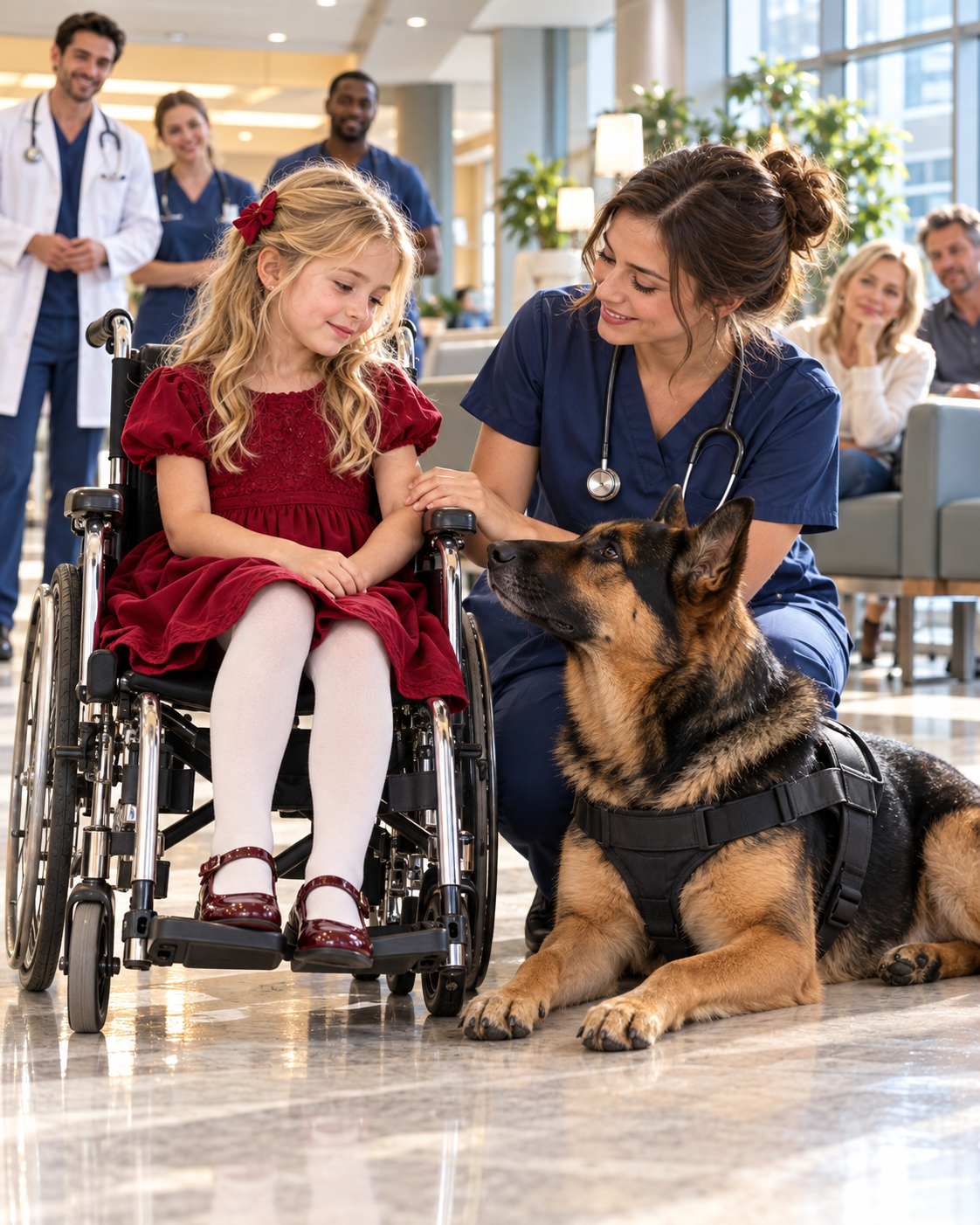
Trooper was beside her.
One moment they were in the pediatric waiting area.
The next, Maya was gone.
Her wheelchair was still there.
Trooper’s leash was on the floor.
My blood turned cold.
I ran.
The security desk showed me the camera feed.
A man in maintenance clothing had pushed Maya toward a service elevator.
Trooper had followed.
No one had stopped him.
I grabbed the radio.
“Lock the building.”
Evelyn hesitated.
“Clara—”
“LOCK IT DOWN.”
The command came from somewhere deeper than thought.
Doors sealed.
Elevators stopped.
Colton and two former teammates who happened to be nearby moved toward the basement.
I followed.
We found the service elevator open.
The basement lights were flickering.
Trooper’s collar bell could be heard somewhere in the darkness.
“Maya!” I shouted.
No answer.
Then a small voice echoed.
“Clara?”
I ran toward it.
We found her inside an old records room.
The maintenance worker was gone.
Maya was frightened but unharmed.
Trooper stood between her and the doorway, teeth bared.
I knelt beside her.
“Are you hurt?”
She shook her head.
“He wanted Dad’s picture.”
My heart sank.
“What did he say?”
“He said Dad left something behind.”
I looked at the old shelves.
One file box sat open.
Inside was a sealed military medical report.
Daniel Sterling’s name was printed across the front.
But beneath it was another name.
Julian Mercer.
Mercer arrived seconds later.
He saw the document and stopped breathing.
“I never wrote that.”
I opened it.
The report claimed Daniel had survived for eleven minutes after I left him.
That was impossible.
I had stayed beside him until his final breath.
Then I noticed the signature.
It was mine.
Forged.
The report claimed I had abandoned him.
My stomach turned.
Someone had spent twelve years building a story in which Harbor was the villain.
A story that could destroy me if it ever became public.
Maya looked up at me.
“Did you leave my dad?”
I couldn’t speak.
Colton stepped forward.
“No.”
Maya stared at me.
“Then why does it say you did?”
“Because someone wanted you to believe it.”
She reached for my hand.
“I believe you.”
Those four words nearly broke me.
That night, we discovered the final piece.
The forged report had been uploaded to a private database years earlier by a medical contractor.
The contractor’s name belonged to a company that no longer existed.
But its former director did.
He lived outside Portland.
And his name was Evelyn Ross.
I stared at her.
She looked devastated.
“I didn’t know.”
“You worked for him.”
“Years ago.”
“Why didn’t you tell me?”
“Because I was ashamed.”
She explained that before Alderwood, she had worked for a private medical organization contracted to review military casualty files.
She had seen Daniel’s case.
She had questioned the inconsistencies.
Then she had been ordered to stop asking.
The man who gave the order had threatened her career.
She had walked away.
But the records had followed her.
Someone had used her old credentials to access them.
And someone had used Alderwood as a hiding place.
The blackout hadn’t been an accident.
The generators had been deliberately sabotaged.
The purpose was to create chaos while someone accessed the military archive.
The four dying children had nearly become collateral damage.
I closed my eyes.
The hospital had not been targeted because of me.
It had been targeted because of what it knew.
And I had been hiding in plain sight while someone searched for the truth.
Two days later, the police arrested the former contractor director.
The maintenance worker was found trying to leave the state.
He confessed to stealing Daniel’s records.
But he refused to identify the person who hired him.
Then Colton received a message.
One sentence.
HARBOR WAS NEVER THE TARGET.
We stared at the screen.
“Then who was?”
Colton didn’t answer.
Maya’s mother walked into the room carrying the photograph.
She turned it over.
There was writing beneath Daniel’s final message.
Something none of us had noticed.
Three words.
PROTECT OUR DAUGHTER.
Not Maya.
Our daughter.
Plural.
Maya had always believed she was Daniel’s only child.
Her mother went completely still.
“That’s impossible.”
I looked at her.
She began crying.
“Daniel had a daughter before we met.”
Silence filled the room.
“Where is she?”
Her mother shook her head.
“We lost contact years ago.”
Colton looked at me.
I knew that look.
Another mission was beginning.
Not military.
Not violent.
Something harder.
Finding the truth before someone else buried it.
Months passed.
Alderwood changed.
Mercer stopped dismissing nurses who spoke up.
Evelyn rebuilt the emergency protocols from the ground up.
I taught every department how to recognize silent deterioration, how to move patients during a blackout, and how to remain calm when fear became contagious.
I never wore oversized scrubs again.
But I also never stopped being Clara.
Because Harbor had saved lives on battlefields.
Clara learned how to save them in quiet rooms.
Maya visited every Thursday.
Trooper always slept beneath my desk.
One afternoon, Maya brought me a new photograph.
It showed Daniel smiling beside a woman I didn’t recognize.
On the back was an address.
Beneath it were six words.
SHE KNOWS WHY HE REALLY DIED.
I looked through the hospital window as rain began falling over Portland.
For the first time in twelve years, I wasn’t afraid of what the truth might cost me.
I was afraid of what it might cost Maya.
So I folded the photograph carefully and placed it in my pocket.
Then Trooper lifted his head.
He was staring at the door.
Someone was standing on the other side.
Three quiet knocks followed.
I opened it.
A young woman stood there, soaked from the rain.
She looked at me.
Then she whispered the name I had buried for twelve years.
“Harbor.”
And behind her, someone was holding Daniel Sterling’s original military dog tags.
That was when I understood the truth had never been finished with us.
It had only been waiting for someone brave enough to look it in the eye.
Sometimes the people who appear weakest are the ones carrying the greatest battles, and sometimes the quietest person in the room is the one who knows exactly what to do when everyone else is afraid.
I had spent years believing survival meant becoming invisible.
I finally understood that survival was never the end of the story.
It was the moment you decided what your survival was going to mean.
And as I looked at the stranger standing in the rain, I realized mine had just begun again.