Dr. Locke humiliated me in front of eight physicians in Tidewater General’s emergency room
Part 2
The CT scanner room was colder than the emergency department, and the air seemed to vibrate with the steady mechanical hum of the machine.
Owen lay on the narrow table, his face turned slightly to the side, his left arm motionless against his body.
Dr. Locke stood near the control panel, speaking to the radiology technician as if the entire situation had already been reduced to a checklist.
“Let’s get the images and rule out a bleed. If the scan is clean, we’ll revisit the other possibilities.”
I stood near Owen’s head and watched his chest rise.
Once.
Twice.
The third breath came with a faint, shallow gasp.
I leaned forward.
“Chief Meiser, can you hear me?”
His eyes opened, but they did not seem to focus.
The monitor beeped.
His oxygen saturation dropped to ninety-one percent, then eighty-eight.
“His breathing is getting worse,” I said.
Dr. Locke glanced at the screen.
“Increase the oxygen and repeat the reading.”
“I already have.”
“Then check the sensor.”
I checked it.
The reading was real.
Owen’s chest moved again, but the left side barely expanded.
His pulse accelerated.
A sheen of sweat appeared along his forehead.
I had seen enough.
“Stop the scan.”
Locke looked at me as if I had insulted him.
“Excuse me?”
“His condition is deteriorating. We need to get him out of the scanner and assess his chest immediately.”
“We are in the middle of a diagnostic study.”
“He may be developing a tension pneumothorax.”
The words came out before I could soften them.
A tension pneumothorax was not simply air trapped around a lung. Under increasing pressure, that air could compress the lung and impair blood flow through the chest, turning a breathing problem into a rapidly fatal emergency.
Owen’s symptoms were moving in that direction.
Locke stepped toward me.
“You are not qualified to make that diagnosis.”
“Then examine him.”
“I am examining the available data.”
“Then look at the patient.”
For a moment, neither of us moved.
His face reddened.
“Get out of my way.”
He ordered the technician to continue.
I looked at Owen, and the room narrowed around the sound of his breathing.
A memory surfaced with such force that my hands began to tremble.
Years earlier, I had been strapped into the cockpit of an F-35, climbing through thin air during a training flight when a cabin pressurization failure turned a routine mission into a fight for survival.
The warnings had come too quickly.
My vision had blurred.
My body had begun to feel strangely distant, as if my arms and legs were no longer fully connected to me.
I remembered the pain in my chest and the terrifying realization that the aircraft was not the only thing failing.
I had survived that day.
But the decompression injury had ended my flying career, and the months that followed had taught me how to live with a future I had never chosen.
I had spent years learning to breathe without thinking about the cockpit.
I had spent even longer learning how to introduce myself without mentioning the uniform.
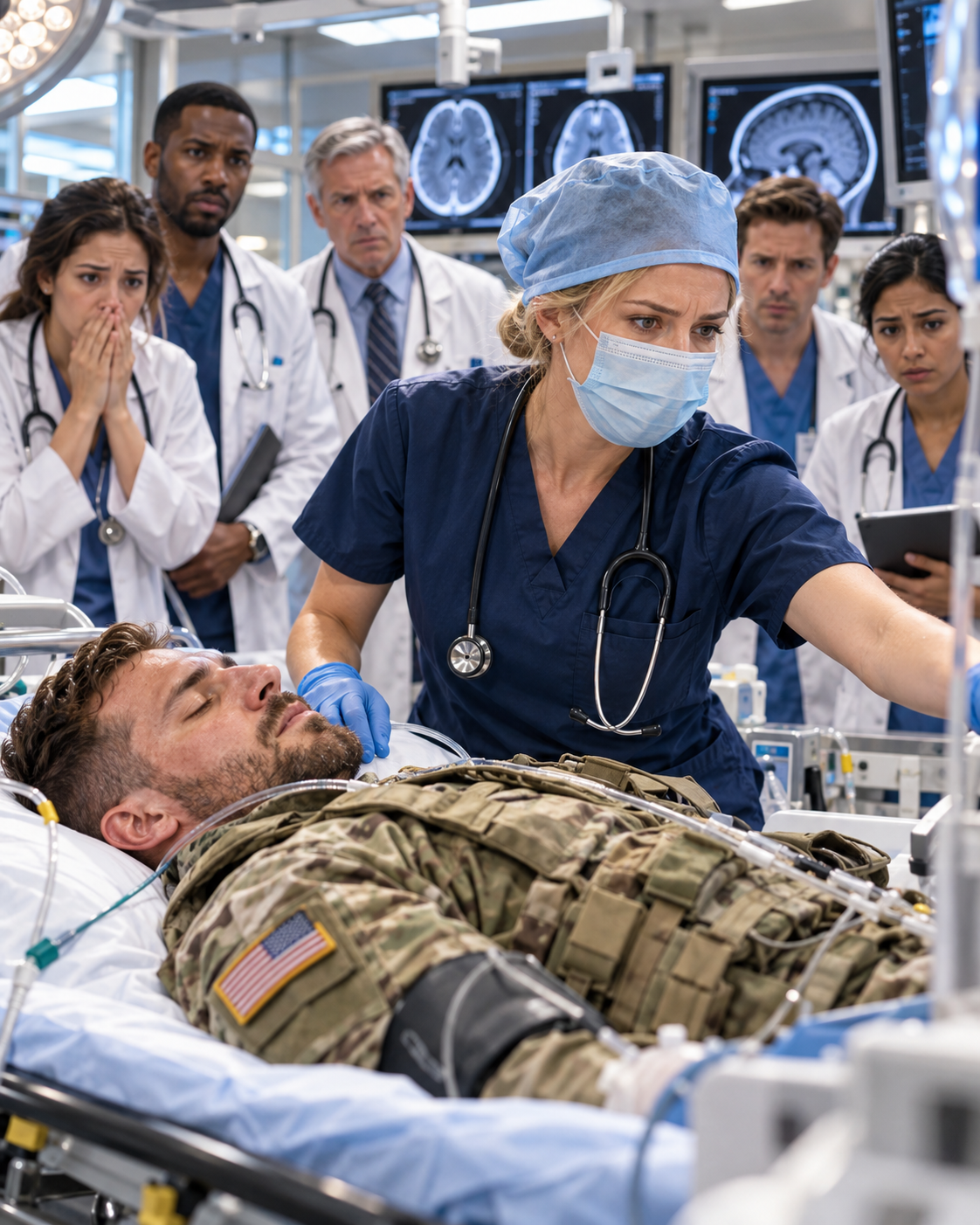
Now a thirty-six-year-old Navy SEAL was lying in front of me, and his body was telling me the same terrible story in a different language.
Owen suddenly arched against the table.
His monitor shrieked.
The oxygen saturation fell again.
His pulse raced, then became frighteningly weak.
“He’s crashing!” the technician shouted.
Dr. Locke rushed to the table.
“What happened?”
“His left chest isn’t moving,” I said. “He’s deteriorating. We need emergency treatment now.”
Locke placed his stethoscope against Owen’s chest.
His expression changed, but only for a second.
“Get him back to the trauma bay.”
The table began moving.
Owen made a small, broken sound.
Then the monitor’s rhythm became erratic, and his blood pressure plunged.
There was no time left for another argument.
I knew the emergency signs.
I knew the consequences of delay.
And I knew that the combination of rapidly worsening breathing, falling oxygen levels, circulatory instability, and markedly reduced movement on one side of the chest demanded immediate action.
But knowing something and having the authority to do it were two very different things.
“Call the trauma team,” Locke shouted. “Get respiratory therapy in here!”
I reached for the emergency equipment.
“Nurse Voss, step away from the patient!”
I did not move.
The decision I made next would be examined by people who had never stood in that room, by administrators who would read every line of the report, and perhaps by a licensing board that would not care how terrified I had been.
But I could already imagine the alternative.
Owen’s wife receiving a telephone call.
A child learning that a father who had left for work would never come home.
Two men in civilian clothes standing beneath fluorescent lights, carrying the memory of a preventable death.
I could not let that happen without trying to save him.
I tore open the emergency catheter kit and called for immediate assistance.
“Suspected tension pneumothorax. I need the physician here now.”
Locke spun around.
“What are you doing?”
“Trying to keep him alive.”
I acted under the pressure of a rapidly collapsing emergency, following the emergency decompression procedure I had been trained to recognize and perform in the military, while calling for the appropriate physician-led intervention and definitive chest treatment.
There was no cinematic burst of relief.
There was only the terrifying awareness that Owen was critically ill, that I could not afford to be careless, and that every second mattered.
I followed the emergency protocol as best I could while the team converged around us.
The tension in Owen’s chest began to ease, and the team moved immediately to support his breathing and circulation.
“Get respiratory therapy in here!” someone shouted.
“Bring the chest tube tray!”
Locke stood beside the table, staring at the equipment in my hands.
For the first time since I had met him, he had nothing to say.
The room erupted into motion.
The technician cleared the scanner.
A respiratory therapist arrived with a ventilation bag.
Someone called for the trauma surgeon.
And I remained at Owen’s side, watching for the smallest sign that he was still with us.
His oxygen level began to recover.
Not enough to make him safe.
Enough to give us a chance.
My knees nearly gave way.
I had not realized how tightly I had been holding my breath until the air escaped my lungs in a shaking exhale.
Then a new voice cut through the room.
“Who recognized the diving injury?”
The man entering the scanner suite was in his late sixties, with silver hair, a military bearing, and a dark jacket thrown over hospital scrubs.
Dr. Samuel Ortega ran Tidewater General’s hyperbaric unit.
Before that, he had been an Air Force colonel, and his reputation for recognizing unusual pressure-related injuries had brought patients to him from across the region.
He took one look at Owen, then at the dive computer in my hand.
“What happened here?”
Locke recovered enough to answer.
“The nurse initiated an emergency intervention without waiting for my authorization.”
Ortega’s eyes moved to me.
“Your name?”
“Hannah Voss.”
He stared at me for a long moment.
Then he looked at my face more closely, as though a memory had just surfaced from a place he had not visited in years.
“Hannah Voss?” he repeated.
I felt my stomach tighten.
“Yes, sir.”
He took one step closer.
“Commander Hannah Voss, formerly of the United States Air Force?”
The room fell silent.
Locke turned toward me.
“What?”
I could hear the monitor.
I could hear the respiratory therapist calling out the next reading.
I could hear my own heartbeat, loud and uneven, as the past I had buried rose around me.
I had spent years trying to become someone whose identity was not defined by a cockpit, a medical report, or the day I had lost the future I thought I would have.
But Dr. Ortega remembered.
And in that moment, so did everyone else.
Part 3
I had not used my former rank in years.
I had not worn my flight suit since the medical board grounded me.
I had learned to answer questions about my past with careful half-truths, explaining that I had served in the military without discussing the aircraft, the accident, or the long road back to ordinary life.
I had not expected my history to become public in a scanner room while a critically ill man fought to survive.
Dr. Ortega looked from me to Owen, then back at the dive computer.
“Tell me exactly what you saw.”
I swallowed.
“The ascent profile shows a serious violation of the recommended decompression limits. He has neurological deficits, mottled skin consistent with cutis marmorata, and progressive respiratory failure. I became concerned about decompression sickness, followed by a possible tension pneumothorax when his breathing and circulation deteriorated.”
Ortega listened without interrupting.
Then he looked at the monitor, examined Owen, and began issuing orders.
“Prepare him for definitive chest treatment and continue full respiratory support. Contact the hyperbaric chamber team immediately. I want the dive profile, estimated bottom time, ascent rate, and every treatment we’ve given documented.”
He turned to the trauma team.
“We are treating this as a life-threatening pressure injury unless the evidence tells us otherwise.”
Locke opened his mouth.
“Samuel, we were investigating a possible stroke—”
“And the stroke evaluation can continue alongside emergency stabilization,” Ortega replied. “But the dive history, the skin findings, and the rapid deterioration cannot be ignored.”
His voice was not loud.
It did not need to be.
He examined the catheter site and the available clinical findings, then gave a brief, decisive nod.
“The concern about tension physiology was justified. The emergency response may have bought us the time we needed.”
I felt something inside me loosen, but relief was quickly followed by exhaustion.
Ortega looked at me again.
“I remember your case, Commander. The cabin pressurization failure. The decompression injury. The medical review that followed.”
I looked away.
“I’d rather not discuss it here.”
“Understood.”
He did not press me.
That small act of restraint meant more to me than I could explain.
Locke, however, looked as though the floor beneath him had shifted.
“You were a fighter pilot?”
“Formerly.”
“And you never told anyone?”
“I was hired as a nurse, Doctor. My employment history was disclosed to the hospital. I don’t introduce myself by listing every painful thing that has happened to me.”
The words came out more sharply than I intended.
For the first time, Locke seemed to see something beyond the novice nurse he had dismissed for five weeks.
He saw a person who had already lost one career, rebuilt a life from its remains, and arrived at his hospital hoping to do honest work without being judged by the worst day of her past.
But there was no time to make peace with any of that.
Owen needed treatment.
The team stabilized his breathing, addressed the suspected tension pneumothorax, and prepared him for urgent hyperbaric evaluation.
The journey from the scanner to the specialized treatment area felt endless.
Every corridor seemed too long.
Every change in the monitor made my heart tighten.
I walked beside the stretcher, watching Owen’s face beneath the oxygen equipment.
He looked younger now.
Without the rigidity of his military bearing, without the strength he had carried through the emergency department doors, he was simply a man whose body had been pushed beyond its limits.
At the hyperbaric unit, Ortega took charge of the pressure-injury evaluation and coordinated the next stage of treatment.
The team reviewed his dive profile and neurological findings while preparing the chamber according to the facility’s protocols.
The treatment would take hours.
There were no guarantees.
Severe decompression sickness could damage the nervous system, impair movement, and cause lasting injury even when treatment began promptly.
Owen’s lungs had also suffered a potentially fatal complication.
We had not saved him simply because one decision had gone right.
We had given him a chance by recognizing several dangers, responding to the emergency, and working together before his body failed completely.
As the chamber team prepared to begin treatment, Ortega asked me to stay and help coordinate the bedside observations and clinical documentation.
I agreed.
For nearly five hours, time became a series of readings, examinations, adjustments, and quiet exchanges between exhausted professionals.
The chamber’s systems hummed steadily.
The room smelled of plastic tubing, disinfectant, and coffee that had been left untouched for too long.
I documented every change in Owen’s condition and watched for signs that his neurological function was improving.
At first, there was little to encourage us.
His left arm remained weak.
His breathing required close monitoring.
Each time a physician entered the room, I searched their expression before they spoke.
I had learned that silence could be more frightening than bad news.
Around the third hour, Ortega came to stand beside me.
“How long have you been a nurse?”
“Five weeks.”
He gave me a sideways look.
“That wasn’t the answer I expected.”
“Neither was today.”
He smiled faintly, but the expression faded as he looked through the observation window.
“You know, the military teaches people to recognize patterns under pressure. Medicine does too, when we remember to look beyond the first explanation.”
I kept my eyes on Owen.
“I nearly lost everything once because of a pressure injury.”
“You lost your flying status,” Ortega said gently. “That is not the same as losing everything.”
I felt the words strike somewhere deep inside me.
For years, I had treated the grounding decision as a verdict on who I was.
I had survived the accident, but I had never completely forgiven my body for failing me.
I had believed that leaving the cockpit meant leaving behind the only version of myself who could truly be useful.
Nursing had been my attempt to find another way to help people.
Yet I had entered the profession carrying a quiet fear that I had become less than the person I used to be.
That night, watching Owen fight through the consequences of a mistake in the water, I began to understand how unfairly I had judged myself.
My past had not disappeared.
It had changed shape.
The same instincts that had helped me recognize a dangerous pressure problem in the sky had helped me recognize one in a diver.
The same discipline that had kept me focused in a cockpit had kept me attentive when a crowded room dismissed the evidence.
And the same fear that had followed me into the hospital had not stopped me from acting when someone needed help.
Near the end of the fifth hour, a member of the hyperbaric team approached Ortega with an update.
Owen’s neurological signs were beginning to improve.
His left arm showed a small but definite response.
His respiratory status was more stable, and the team continued monitoring him closely for complications.
It was not a miraculous recovery.
It was something better.
A real, fragile improvement that gave us reason to keep going.
I lowered myself into a chair outside the treatment area and covered my face with both hands.
Only then did I allow myself to cry.
I cried for Owen, for the people who had brought him to us, and for the years I had spent believing that the most important part of my life was the part I had lost.
I cried because a man I had never met was alive enough to have a future, and because I had finally begun to believe that I might have one too.
When Owen was stable enough for continued recovery outside the chamber, the hospital team arranged ongoing neurological and respiratory monitoring.
The following morning, I returned to his bedside.
His face had more color.
His breathing was easier, though he remained exhausted and weak.
When I entered, his eyes followed me.
“You’re the nurse,” he said, his voice rough.
“I am.”
“The one who wouldn’t leave me alone.”
I smiled.
“I was worried you might complain about the attention.”
A faint smile tugged at the corner of his mouth.
“I’ve had worse briefings.”
For the first time since he had arrived, I heard something resembling the man he might have been before the dive.
He looked down at his left hand and slowly tried to move his fingers.
They responded, weakly but unmistakably.
His expression changed.
“I thought I was done.”
I pulled a chair closer to the bed.
“You were very sick, Chief. You’re going to need time, and there may be more challenges ahead, but you’re here.”
He swallowed hard.
“Thank you.”
Two simple words.
No grand speech.
No dramatic salute.
Just a man acknowledging that he had been close to death and that someone had refused to look away.
I had no idea what to say, so I squeezed his hand gently and stayed beside him until his breathing settled.
Later that afternoon, Dr. Locke found me in the staff corridor.
He looked as though he had not slept.
For several seconds, he studied the floor between us.
Then he spoke.
“I reviewed the timeline.”
I waited.
“Your concerns about decompression sickness were supported by the findings. The patient’s deterioration required immediate intervention, and the team believes the response helped stabilize him.”
He stopped, then forced himself to meet my eyes.
“I dismissed you before I had properly considered what you were telling me.”
It was not a perfect apology.
It did not erase the weeks of belittling comments or the fear I had felt in the scanner room.
But it was the first time he had acknowledged that his certainty might have been part of the danger.
“I’m glad Chief Meiser survived,” I said.
“So am I.”
He hesitated.
“I should have listened.”
I nodded once.
“Yes, you should have.”
For a moment, I expected him to defend himself, to explain the pressure of the emergency department or the burden of making decisions.
He did not.
He simply accepted the answer.
That mattered.
In the weeks that followed, the hospital reviewed the case, including the decisions made before Owen reached the scanner and the emergency response that followed.
The review emphasized the importance of recognizing diving-related illness, obtaining an accurate exposure history, responding promptly to a suspected tension pneumothorax, and ensuring that clinical concerns were heard regardless of who raised them.
My actions were evaluated alongside the decisions of the entire team, as they should have been.
I was not declared a hero who could do no wrong.
I was a nurse who had recognized a dangerous pattern, raised concerns, and acted during a rapidly evolving emergency.
There were lessons to learn, protocols to clarify, and questions about how the team could have worked together sooner.
I accepted those lessons.
I also accepted that my military experience was not something I needed to hide in order to be a good nurse.
Dr. Ortega later asked whether I had considered returning to a military medical role or pursuing a position that drew more directly on my aviation background.
I told him I had considered it.
Then I told him I wanted to remain at the bedside.
He seemed surprised.
“You could do a great deal with your experience.”
“I know.”
“Then why stay here?”
I thought about the question for a long time.
Because in a cockpit, I had learned to read instruments and recognize danger before it became visible.
In the hospital, I had learned to look at the person behind the numbers.
I had learned that people could be frightened, confused, proud, or too ashamed to explain what had happened to them.
I had learned that the smallest change in a patient’s expression could matter as much as a dramatic alarm.
And I had learned that I did not need to return to the life I had lost in order to make the life I had now meaningful.
“Because this is where I want to be,” I said. “I want to be the person who notices when someone is getting worse, who asks one more question, and who stays when the room becomes frightening.”
Ortega nodded.
“Then I think you’ve found your place.”
Months later, Owen returned to Tidewater General for a follow-up appointment.
His recovery had taken patience, rehabilitation, and more difficult days than he cared to count, but he was walking independently and had regained much of the movement in his left arm.
He found me at the nurses’ station.
For a second, I barely recognized him without the oxygen equipment and the gray pallor that had made him look like a ghost beneath the emergency department lights.
He carried a small envelope.
“I wanted to bring you something,” he said.
Inside was a photograph of his SEAL team standing beside the ocean, their faces bright beneath a clear blue sky.
On the back, he had written a few words.
“To Nurse Voss, who saw me when I couldn’t explain what was happening. Thank you for giving me the chance to come home.”
I read the message twice.
Then I looked up at him.
“Your team did a lot to get you here.”
“They got me to the hospital,” he said. “You helped make sure I had a chance to leave it.”
I could not answer immediately.
He shook my hand, thanked the people working at the station, and walked toward the exit.
I watched him go until the doors closed behind him.
That evening, I stood alone for a moment beside the emergency department window.
Outside, rain blurred the lights in the parking lot, and a black SUV rolled past the entrance.
For an instant, I remembered the night Owen had arrived, carried between two men who could not explain what was wrong.
I remembered the purple pattern across his chest, the dive computer in my hand, and the cold certainty that something terrible was unfolding while people with more authority than me refused to see it.
I remembered Dr. Locke’s contempt.
I remembered the scanner’s mechanical hum.
And I remembered the moment Dr. Ortega spoke my former rank aloud, exposing the identity I had hidden for years.
I used to think my life had split into two halves: the pilot I had been and the nurse I had become.
I believed one had ended in failure and the other was an attempt to make peace with it.
Now I understood that the two lives had never been separate.
The pilot had taught me to recognize danger.
The injury had taught me humility.
The recovery had taught me patience.
And nursing had taught me that saving a life did not always look like flying through hostile skies or walking away from a burning wreck.
Sometimes it looked like noticing a change in someone’s skin.
Sometimes it meant asking a question that made the room uncomfortable.
Sometimes it meant speaking when your voice shook, knowing that people might punish you for being right.
I still worked bedside shifts at Tidewater General.
I still checked medication orders carefully, listened to patients who struggled to explain their pain, and learned from physicians who knew more than I did.
I also learned to speak up without apologizing for every question.
Dr. Locke and I did not become close friends, but our working relationship changed. He began asking what I had observed before dismissing my concerns, and I made a point of giving him the clearest information I could.
Neither of us became perfect.
We became more willing to listen.
That was enough to begin with.
I never flew an F-35 again.
For a long time, I thought that fact would always feel like a wound.
It still hurt sometimes, especially when I heard the distant roar of a jet overhead and instinctively looked toward the sky.
But I no longer believed that the sky was the only place where my training mattered.
I had spent years trying to prove that losing my former career had not destroyed me.
Now I no longer needed to prove anything.
I only needed to show up, pay attention, and have the courage to act when the evidence demanded it.
Because the most dangerous thing in a room is not always a failing monitor, a hidden injury, or a body slipping toward death.
Sometimes it is the certainty of people who have stopped listening.
And sometimes the person everyone overlooks is the one who has learned, through loss and survival, exactly what to look for.
I had once been Commander Hannah Voss, an Air Force fighter pilot grounded by an injury she could not outrun.
Now I was Hannah Voss, a nurse who had found another way to serve.
I no longer saw those identities as enemies.
They were both parts of the same woman, and neither had to erase the other.
The night Owen Meiser came through our doors, I had feared that trusting my instincts would cost me the future I had worked so hard to build.
Instead, it reminded me why I had built it.
I had not become less capable when I lost the cockpit.
I had simply found another place where paying attention could make the difference between a person going home and a family receiving the worst phone call of their lives.
And from that day forward, whenever someone dismissed a quiet voice in a crowded room, I remembered the purple lace across Owen’s chest and the terrible minutes when everyone had looked at the numbers but failed to see the man.
I remembered that courage was not always loud, that experience did not always announce itself, and that the truth did not become less true just because the person speaking it had the lowest rank.
Sometimes, the person who saves a life is not the one everyone expects.
Sometimes, the most important thing anyone can do is stop, look again, and listen to the person brave enough to say, “Something is wrong.”
And sometimes, the life you thought you had lost is still there, waiting for you to discover that it has been preparing you for something you never imagined.