Dr. Julian Sterling shoved a blood-soaked chart against my chest in front of the entire emergency department
Part 2
The first thing I heard was the click of the scalpel leaving its wrapper.
The second was Sterling shouting my name.
“Vance, put that down!”
I didn’t look at him.
“Dave, keep the oxygen moving. Watch the chest.”
Dave, one of our most experienced respiratory therapists, stepped into position.
His expression told me he was frightened, but his hands were steady.
That was enough.
The soldier’s airway was failing, and every second spent arguing about authority was another second we could never return to him.
I made the emergency airway incision and secured the breathing tube while Dave supported ventilation.
The monitor flickered.
For an agonizing moment, the oxygen level continued to fall.
Then the numbers began to turn.
“Air movement confirmed,” Dave said. “We’re getting ventilation.”
“Keep watching him.”
I moved to the leg.
Blood continued to spill from the wound, and the patient’s blood pressure was collapsing.
There was no time to wait for the operating room to become ready or for someone else to accept the responsibility in front of us.
I placed my gloved hand directly into the wound and compressed the damaged femoral artery against the femur.
The bleeding slowed.
Then it stopped.
Pain crossed the soldier’s face, but he was too unstable to react fully.
“Pressure is coming up slightly,” Maria announced.
“Start the blood. Keep it running. We need surgical control immediately.”
She was already moving.
Parker stood frozen beside the equipment cart, staring at me as if he had suddenly discovered a stranger wearing a familiar face.
“Parker,” I said sharply.
He blinked.
“Yes?”
“Call the operating room and tell them we have a critically injured patient requiring immediate operative management. Give them the mechanism, the airway status, and the suspected vascular injury. Tell them we are transferring as soon as the team is ready.”
He snatched up the phone.
“Yes, Nurse Vance.”
Sterling stepped forward again, his face flushed.
“This is completely unacceptable. You have exceeded your authority, and you are compromising the chain of command.”
I finally looked at him.
“The patient is breathing. The hemorrhage is temporarily controlled. You can file every complaint you want after we get him upstairs.”
“You don’t give me orders!”
“No,” I said. “The patient gives us the deadline.”
Something in my voice stopped him.
Perhaps it was the absence of anger.
Perhaps it was the fact that I was no longer trying to make myself smaller.
Or perhaps, for the first time in his career, he understood that the room had stopped listening to him.
The team moved around us with renewed purpose.
Blood products arrived.
The trauma surgeon on call was paged.
A second nurse secured additional intravenous access while Maria coordinated the transfusion.
I kept pressure on the soldier’s artery and watched his face.
“Can you hear me?” I asked.
His eyelids trembled.
“What’s your name, soldier?”
His lips moved beneath the oxygen equipment.
“Ethan,” he whispered.
“Ethan, I’m Rebecca. You’re in a hospital. You’re not alone.”
His eyes found mine.
For a fraction of a second, I saw the same expression I had seen in so many soldiers overseas: a man trying to determine whether he had survived the worst moment of his life or merely reached the beginning of it.
“Am I going to die?” he rasped.
I felt the question strike somewhere beneath my ribs.
I could have offered him certainty.
I could have promised him everything would be fine.
But I had learned what those promises were worth when the world turned cruel.
“We’re fighting for you,” I told him. “Stay with us.”
He gave the smallest nod.
Then his heart rate dropped again.
“Pressure’s falling!” Maria shouted.
I adjusted my position, maintaining compression as the team prepared to move him.
The doors opened, and the senior trauma surgeon rushed in with two additional physicians.
He assessed the monitor, examined the patient’s injuries, and looked at my hand.
“Who has control of the hemorrhage?”
“I do,” I answered.
“Can you maintain it through transfer?”
“Yes.”
He nodded once.
“Then let’s move.”
The stretcher rolled toward the operating suite, surrounded by a team that had finally found its rhythm.
I walked beside it, my hand still buried in the wound, feeling the patient’s pulse flutter beneath the pressure of my fingers.
Sterling followed several steps behind us.
He had stopped shouting.
For the first time since I had known him, he looked less like a man accustomed to giving orders and more like someone trying to understand what had just happened in front of him.
We reached the restricted corridor outside the operating rooms.
A nurse took over the paperwork.
The surgical team prepared for the transfer of care.
I finally withdrew my hand when the vascular surgeon was ready to assume direct control of the bleeding.
My glove was soaked.
My forearm trembled from the sustained effort, but I barely noticed.
Ethan was rushed through the operating room doors.
They closed behind him.
For a moment, I stood in the corridor and stared at my blood-covered hand.
My mind had begun to replay another operating room.
Another patient.
Another moment when the outcome had been beyond my control.
“Rebecca?”
Maria’s voice brought me back.
She stood a few feet away, her face pale.
“You need to sit down.”
“I’m fine.”
“No, you’re not.”
I almost told her she was wrong.
Then I realized I was gripping the edge of the counter so tightly that my fingers had gone numb.
I let go.
Maria pulled a chair toward me.
I sat.
She knelt in front of me and lowered her voice.
“What just happened in there?”
I stared at the floor.
“I did my job.”
“That wasn’t what I asked.”
I couldn’t answer.
Not because I wanted to protect Sterling.
Not because I feared the hospital administration.
Because I had spent a year building a life around the belief that if nobody knew who I had been, the past could no longer reach me.
Now dozens of people had watched the past walk straight into the trauma bay wearing my face.
And I could feel the walls coming down.
A distant rumble vibrated through the corridor.
At first, I thought it was another ambulance.
Then the ceiling lights trembled.
A second later, the windows rattled hard enough to make the blinds jump.
Everyone looked toward the exterior doors.
The unmistakable roar of a helicopter rolled across the hospital grounds.
I felt my stomach tighten.
No.
Not here.
Not now.
Maria stood.
“Is that a medical helicopter?”
I already knew the answer was no.
Through the glass at the end of the corridor, I saw the broad silhouette of a UH-60 Black Hawk settling onto the hospital’s designated landing area.
Its rotor wash sent loose paper skittering across the pavement.
Several uniformed personnel moved toward the entrance.
They wore tactical gear, and their movements carried the practiced precision of people who did not waste time explaining why they had arrived.
My hands went cold.
I knew that formation.
I knew the way the lead officer scanned the exits before looking at the people in front of him.
And I knew the man walking at the center of the group.
Colonel Thomas Mitchell.
I had served under him during the final years of my deployment.
He had once carried a wounded soldier across a field himself because the available medics were occupied with casualties.
He had also stood beside me after Daniel died and told me that grief was not a failure of leadership.
I had hated him for saying it.
I had needed him to say it.
The last time I saw Mitchell, he had shaken my hand outside a transport aircraft and told me that when I was ready to stop running, there would still be people who remembered what I had done.
I had promised to write.
I never had.
Now he was here.
And I was still wearing oversized blue scrubs, still standing beside a trauma bay, and still holding the blood of a stranger on my hands.
“Rebecca,” Maria whispered, “why is a colonel coming into our hospital?”
I had no answer that wouldn’t change everything.
The entrance doors opened.
Mitchell stepped inside with four members of his tactical team.
His eyes moved across the reception area, the security officers, and the staff gathering near the corridor.
A hospital administrator hurried toward him, followed by Sterling, who had apparently decided that the arrival of a senior military officer presented an opportunity to restore his authority.
“Colonel, I’m Dr. Julian Sterling, chief of trauma surgery,” he began. “We’ve been managing the injured personnel from the collision. I personally supervised the emergency response.”
Mitchell barely glanced at him.
“Where is she?”
Sterling blinked.
“I’m sorry?”
“Major Rebecca Vance.”
The name struck the corridor like a dropped instrument.
Every head turned.
Maria slowly looked at me.
Sterling’s mouth opened, then closed.
Mitchell continued toward the trauma bay.
He passed the administrator.
He passed the senior physicians.
He passed Sterling, who moved aside instinctively despite the fact that he had spent years demanding that everyone else move for him.
Then Mitchell stopped in front of me.
His gaze dropped briefly to my bloodstained scrubs.
Something tightened around his eyes.
He understood enough without asking.
I tried to straighten my shoulders.
For one foolish second, I wanted to disappear.
Instead, I stood.
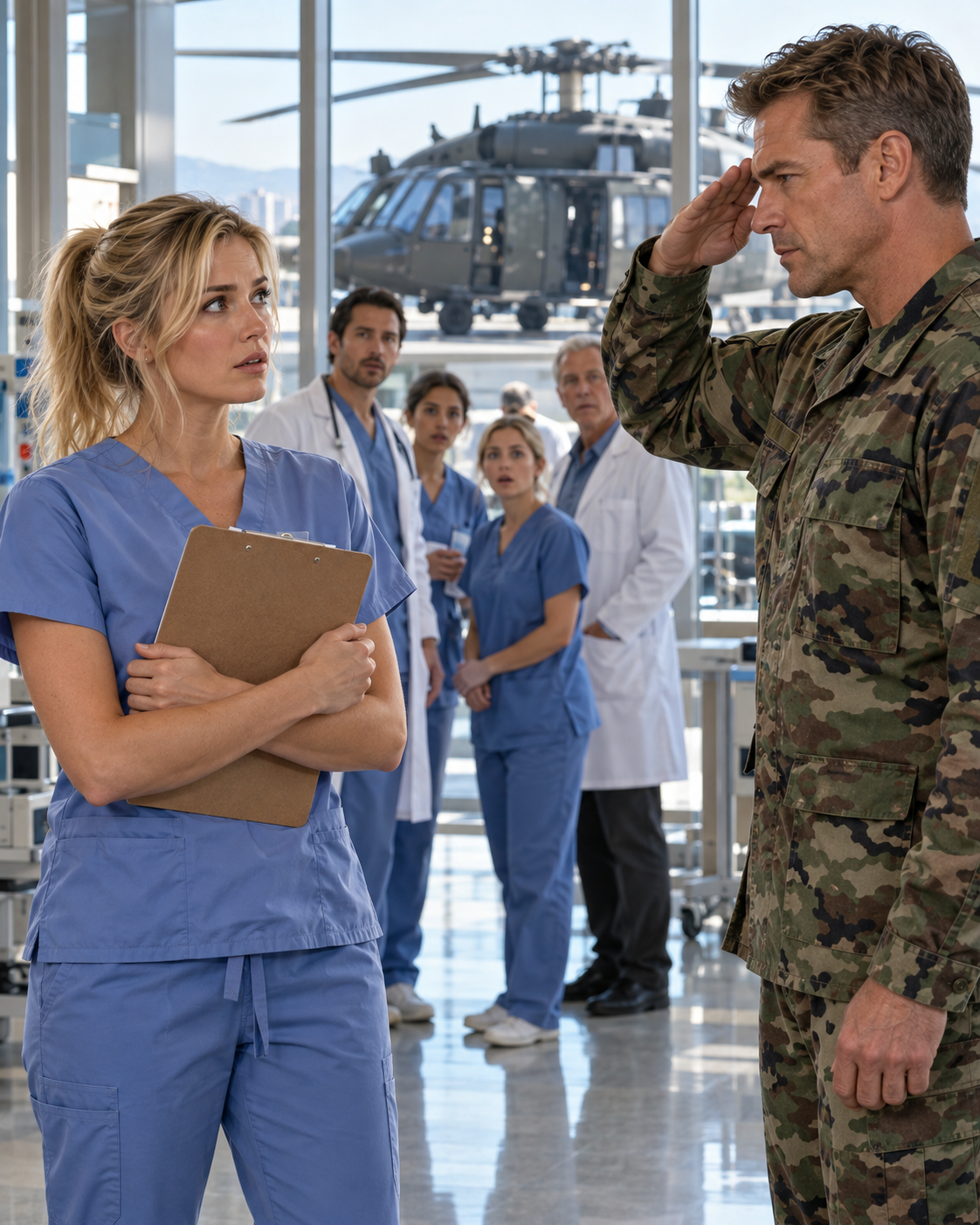
The colonel brought his boots together, raised his hand, and delivered a flawless military salute.
“Major Vance,” he said, his voice carrying through the silent corridor. “Ghost.”
Nobody moved.
Mitchell held the salute.
And the woman everyone at St. Jude had treated as invisible suddenly stood at the center of a room that no longer knew what to do with her.
Part 3
I returned the salute before I could stop myself.
My hand rose with the old precision, and my posture straightened as though the years between my last deployment and this hospital had never existed.
“Colonel Mitchell,” I said quietly.
He lowered his hand.
For a moment, neither of us spoke.
Then his gaze moved to the operating room doors.
“Was that one of ours?”
“Yes, sir. Sergeant Ethan Cole.”
“Is he alive?”
“He made it to surgery. The team is working on him.”
Mitchell closed his eyes briefly.
It was a small gesture, but I knew what it meant.
He had spent too many years receiving names that became memorials before the day was over.
“Thank you,” he said.
I looked down at my hands.
“I haven’t done anything yet.”
“You kept him alive long enough for someone to finish the job.”
His words reached a place inside me that I had tried to keep sealed.
Behind him, Sterling finally found his voice.
“Colonel, there appears to be some confusion. Nurse Vance is a member of our emergency staff. Whatever her previous military service may have involved, she was acting outside hospital protocol.”
Mitchell turned slowly.
“Outside protocol?”
Sterling straightened his coat.
“I am the chief trauma surgeon here. I am responsible for ensuring that medical personnel operate within their authorized roles.”
“And what role were you performing when my soldier stopped breathing?”
The question landed with brutal simplicity.
Sterling’s jaw tightened.
“I was coordinating the response.”
“Were you controlling the hemorrhage?”
“That was being handled by the team.”
“Were you securing the airway?”
Sterling hesitated.
Mitchell stepped closer.
“Then perhaps you should be careful about claiming responsibility for actions you did not perform.”
The administrator intervened, speaking in the cautious tone of someone who could already hear the legal department demanding an explanation.
“Colonel, we appreciate your concern, but this is an internal clinical matter. We’ll review the circumstances and ensure the proper procedures were followed.”
“Review them,” Mitchell replied. “Absolutely. Review every decision, every delay, and every person who helped that soldier survive. I have no interest in protecting anyone from the truth.”
His eyes returned to me.
“But I do have an interest in making sure the truth is recorded accurately.”
I wanted to tell him to stop.
Not because he was wrong, but because every word made it harder for me to retreat into the life I had built.
I had not wanted recognition.
I had wanted peace.
There was a difference, and nobody in that corridor seemed to understand it.
Mitchell’s expression softened.
“Rebecca, may I speak with you privately?”
I nodded.
We walked into a small consultation room near the nurses’ station.
He dismissed his security detail with a gesture and closed the door.
For the first time since he had arrived, the hospital noise faded into the background.
He looked older than I remembered.
There were deeper lines around his eyes, more gray at his temples, and a weariness that no rank could conceal.
“So,” he said, “you finally found somewhere quiet.”
I gave a tired laugh.
“Not particularly quiet today.”
“No.”
He studied me for a moment.
“Why didn’t you tell anyone you were here?”
“Because I didn’t want to be Major Vance anymore.”
“You think a rank is what made you who you are?”
“I think it made it impossible to be anything else.”
Mitchell pulled out a chair but did not sit.
“When Daniel died, you blamed yourself.”
My throat tightened.
“Don’t.”
“I watched you take responsibility for every casualty that day, including the ones you never touched.”
“I said don’t.”
“And I watched you turn down every opportunity to teach other medics because you believed you no longer deserved to stand in front of them.”
I rose abruptly.
“You weren’t there in the room when he died.”
“No,” Mitchell said. “I wasn’t.”
His calmness disarmed me more effectively than an argument would have.
“But I was there when you came out. I saw what you were carrying. And I have wondered ever since whether anyone ever managed to tell you that saving lives does not mean you can save every life.”
I stared at him.
The words were familiar.
I had heard them before.
But grief has a strange way of making even the truest sentence sound like an accusation when you aren’t ready to believe it.
“I told Daniel we had gotten everyone out,” I whispered.
Mitchell’s expression changed.
“I know.”
“He died believing me.”
“He died believing you were there with him. That was not a lie.”
I shook my head.
“I should have pulled him out.”
“You had three other casualties bleeding out, an evacuation route collapsing, and orders to keep the medical station operational until the final transport arrived. You made a decision under conditions no one should ever have to face.”
“He was twenty-four.”
“Yes.”
“He wanted to open a fishing shop.”
“I remember.”
My eyes burned.
I had not said those words aloud in years.
Mitchell moved closer, but he did not touch me.
“Rebecca, you didn’t fail Daniel because you couldn’t stop death. You honored him by refusing to abandon the living.”
I covered my mouth.
The first tear came before I could stop it.
Then another.
I turned away, ashamed of the sound that escaped me, but Mitchell did not look uncomfortable or impatient.
He waited.
For the first time in a long time, I did not have to pretend that I was all right.
“I thought if I became nobody,” I said, “I could finally stop hearing them.”
“Did it work?”
“No.”
He nodded.
“Then perhaps it’s time to stop punishing yourself for surviving.”
A knock sounded at the door.
Maria opened it carefully.
“I’m sorry, Rebecca, but the surgical team has an update.”
I wiped my face and turned.
“Tell me.”
“Sergeant Cole is out of immediate danger. They’re still treating the injuries, but the vascular surgeon believes they have controlled the bleeding.”
I closed my eyes.
The relief was so sharp that my knees nearly gave way.
For a moment, I saw Daniel’s face again.
Then Ethan’s.
Two young men, separated by years and oceans, each one asking the same question without words.
Am I going to make it?
I had not saved Daniel.
But Ethan had another chance.
That mattered.
It had to matter.
When I returned to the corridor, the atmosphere had changed.
Word had spread through the department.
The nurses who had watched me accept Sterling’s insults were now looking at me with a mixture of astonishment and something more difficult to name.
Respect, perhaps.
Or discomfort at realizing how little they had known about someone who worked beside them every day.
Parker approached me first.
He looked exhausted.
“Nurse Vance, I owe you an apology.”
“For what?”
“For freezing. For dropping the instruments. I was so afraid of making the wrong decision that I couldn’t make any decision at all.”
I studied him.
He was young, talented, and painfully aware that everyone had witnessed his worst moment.
I recognized that feeling.
“Fear isn’t the problem, Parker,” I said. “Pretending you aren’t afraid is what gets people hurt. Learn the procedure. Practice until your hands know what to do when your mind is struggling. And when you need help, ask for it before the room becomes a battlefield.”
He nodded slowly.
“Thank you.”
“Don’t thank me yet. You still have a lot to learn.”
A faint smile crossed his face.
“Yes, ma’am.”
Across the hall, Sterling stood beside the administrator.
His usual confidence had vanished, replaced by the rigid composure of a man attempting to calculate the cost of a mistake.
He approached me after Mitchell had stepped away to speak with the military medical liaison.
“Major Vance,” he said.
It was the first time I had heard him use my rank.
I waited.
“I believe there has been a misunderstanding regarding my role during the resuscitation.”
I almost laughed.
“Has there?”
“I was assessing the situation and coordinating resources. I did not abandon the patient.”
I remembered the way he had stepped backward.
I remembered the instrument hitting the floor.
I remembered the soldier’s pulse disappearing beneath my fingertips while Sterling called for someone else to do what needed to be done.
“You were frightened,” I said.
His face hardened.
“That is an unfair characterization.”
“Then tell the review committee what happened. Every second of it. Tell them what you saw, what you decided, and what you did next.”
He glanced toward the administrator.
“You understand that an incident like this could have serious professional consequences.”
“Yes.”
“And your actions will be examined as well.”
“They should be.”
He seemed unprepared for that answer.
I had broken hospital protocol in an extraordinary emergency. My decisions would need to be reviewed, and I would accept legitimate questions about what I had done.
But I would not help him rewrite the truth.
For once, my silence would not be used to protect someone else’s reputation.
The hospital launched a formal clinical review that afternoon.
The records were preserved, the staff were interviewed, and the timeline was reconstructed from monitor data, medication records, and witness accounts.
I answered every question honestly.
I explained what I had seen, why I had acted, and which parts of the emergency had required immediate intervention.
I did not pretend to be infallible.
I did not claim that my military rank automatically made every decision correct.
I simply described the situation as it had unfolded.
The findings later confirmed that the soldier’s condition had deteriorated rapidly and that immediate action had been necessary to preserve his life.
The review also examined the chain of command, the response to the failed airway, and the delay caused by confusion over who should take responsibility.
Sterling was removed from his leadership duties while the hospital conducted a broader assessment of its trauma protocols and staff training.
He was not dismissed overnight, and I did not demand that he be destroyed.
I wanted something more difficult than revenge.
I wanted a department where no nurse would be too intimidated to raise a safety concern, where no resident would be too ashamed to ask for help, and where no surgeon would confuse authority with the right to be obeyed without question.
Weeks later, Ethan Cole came back to St. Jude for a follow-up appointment.
He walked slowly, supported by crutches, with a scar at his neck and a leg that would require months of rehabilitation.
But he was alive.
His mother stood beside him, holding his arm as though she still feared the world might take him away if she loosened her grip.
When he saw me, he smiled.
“Hey, Nurse Vance.”
I smiled back.
“Hey, Ethan. How are you feeling?”
“Like I got hit by a truck.”
“You were in a collision involving a fuel tanker. That’s not an unreasonable description.”
He laughed, then grew serious.
“My mother wanted to meet you.”
The woman stepped forward and took both my hands.
“They told me what happened,” she said, tears gathering in her eyes. “They said you wouldn’t let him die.”
I swallowed.
“I did everything I could.”
She shook her head.
“You stayed when it was terrifying. You didn’t leave him.”
I could not find an answer.
She pulled me into an embrace before I could retreat behind a professional smile.
For one brief moment, I let myself be held.
I thought about Daniel.
I thought about the young medic who had died believing that I had gotten everyone out.
And for the first time, the memory did not arrive as a punishment.
It arrived as a reminder.
The people we lose do not become less important when we allow ourselves to keep living.
That evening, I found Maria waiting beside the lockers.
“So,” she said, “are you going to disappear again?”
I looked at her.
“I wasn’t planning to.”
“Good. Because we’re short-staffed, and apparently our quietest nurse is also the only person in this building who can make a colonel salute in the middle of a shift.”
I laughed.
It surprised me.
Not because the joke was especially funny, but because the sound came easily, without the guilt that had followed every moment of happiness for so long.
“I don’t think the colonel came here to salute me.”
“Of course not. He came to inspect our supply closet.”
I shook my head.
Then my smile faded, and I looked down at my hands.
“I thought being Ghost was the only way I knew how to save people.”
Maria leaned against the locker beside me.
“Maybe Ghost is the part of you that knows how to act when everyone else is afraid. Rebecca is the part that has to live with what happens afterward.”
I looked at her for a long time.
Nobody had ever put it that way.
For years, I had treated my past as a wound that had to be hidden before it could heal.
I had confused being forgotten with being free.
But the past did not disappear because I refused to speak about it.
It waited in the silence, growing heavier each time I mistook shame for humility.
The next morning, I arrived at St. Jude wearing the same blue scrubs.
They were still oversized.
My hair was still tied back.
I still preferred listening to speaking.
But I stood a little straighter as I entered the emergency department.
A young nurse was struggling to prepare a trauma cart, her hands moving too quickly as she checked the supplies.
I recognized the look on her face.
“Take a breath,” I told her.
She looked up.
“Sorry. I know I should be faster.”
“Speed comes with practice. Accuracy comes from slowing down enough to see what you’re doing.”
She nodded and started again.
I stayed beside her until she finished.
Later that week, the department introduced regular mass-casualty drills, clearer escalation procedures, and a formal process for nurses to raise urgent clinical concerns without fear of humiliation.
The hospital asked me to help with the training.
At first, I hesitated.
Teaching meant speaking about the past.
It meant admitting that the years overseas had not only left scars, but had also given me skills that could help others.
I finally accepted.
I did not tell war stories for applause.
I taught people how to recognize the moment a room was beginning to lose control, how to communicate under pressure, and how to support one another when fear threatened to take over.
I told them that confidence was not the absence of doubt.
It was the willingness to act responsibly while doubt was still there.
I told them that a title could establish authority, but only judgment and accountability could earn trust.
And I told them never to mistake the quietest person in a room for the least capable.
Colonel Mitchell visited once more before returning to his command.
We stood outside the hospital entrance as the evening sun settled behind the parking garage.
“I hope you know you don’t have to come back to the military to honor your service,” he said.
“I know.”
“And you don’t have to keep proving you deserved to survive.”
I looked toward the emergency entrance, where another ambulance was pulling up.
For the first time, the sight did not feel like a door opening onto an old battlefield.
It felt like a place where I could make a difference without becoming a ghost.
“I think I’m beginning to understand that,” I said.
Mitchell nodded.
“Good. That’s all I wanted.”
He offered his hand.
I shook it.
Then he left, and I returned to work.
Months later, a framed photograph appeared in the staff room.
It showed the trauma team standing together after a training exercise, exhausted and smiling, their uniforms and scrubs wrinkled from the day’s work.
Maria had somehow persuaded me to stand in the front row.
I was not wearing a medal.
I was not holding a flag.
I was simply Rebecca Vance, a nurse among other nurses, with my shoulders straight and my eyes open.
Someone had written a sentence beneath the photograph.
“Leadership is what remains when fear takes away every excuse.”
I never learned who wrote it.
I didn’t need to.
I had spent a decade believing that the strongest person in a room was the one who could carry the most pain without letting anyone see it.
Now I understood that strength could also mean asking for help, telling the truth, and allowing other people to stand beside you when the memories became too heavy.
I still woke from nightmares sometimes.
I still remembered Daniel’s final question.
And I still could not save everyone.
But I no longer used those truths as reasons to disappear.
When a helicopter passed overhead, I sometimes stopped and listened until the sound faded.
Then I returned to whatever patient was waiting for me.
Because the world would always have moments when fear filled a room and time seemed to stop.
In those moments, someone would have to step forward.
It might be a surgeon.
It might be a nurse.
It might be a frightened resident who finally found the courage to ask for help.
And sometimes, it might be the quiet woman everyone had mistaken for nobody.
I had once believed that Ghost was the only part of me worth keeping.
I was wrong.
Ghost had taught me how to stand firm when lives were slipping away.
Rebecca had to learn how to live when the emergency was over.
And at last, I understood that I did not have to bury one woman to make room for the other.
I could carry both.
Not as a punishment for the people I had lost, but as a promise to the people still waiting to be saved.
The next time Dr. Sterling passed me in the hallway, he did not offer a lecture or a cutting remark.
He stopped, met my eyes, and said, “Good morning, Major Vance.”
I looked at him, then at the busy emergency department behind him.
“Good morning, Doctor.”
And I kept walking.
Not because I had won a battle against him, or because a colonel had saluted me in front of the entire hospital.
I kept walking because, for the first time in years, I no longer needed the world to know who I had been in order to believe I had a reason to be here.
I was not a ghost.
I was a nurse.
I was a survivor.
And I was still here.