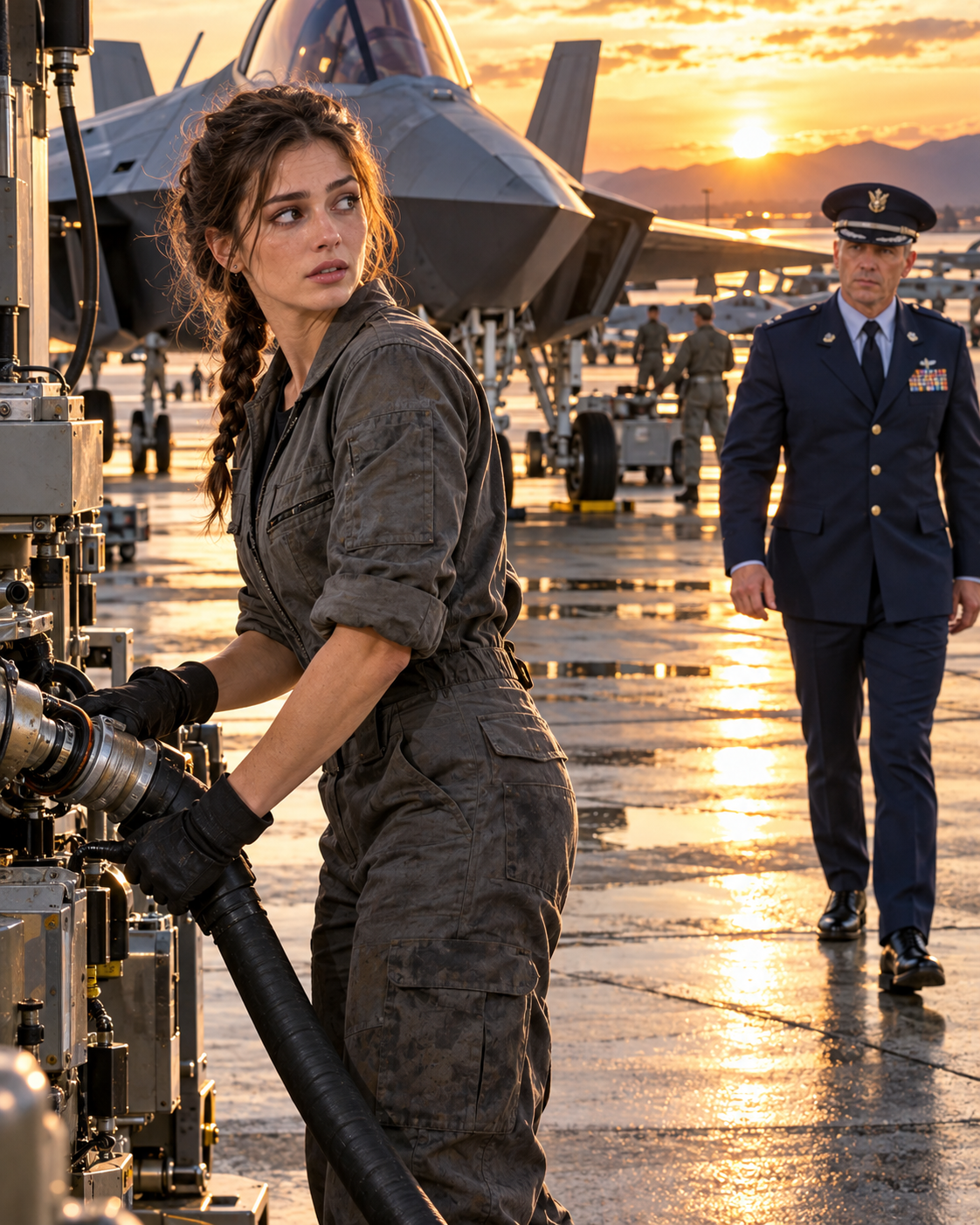
Corporal Miller laughed in front of an entire F-35 maintenance crew when he saw me standing beside my battered
I read Colonel Vance’s note until the words began to blur, then folded it carefully and slipped it into my chest pocket.
For six years, I had tried to leave Airframe 4 where it belonged—in the past, buried beneath archived test reports and the memories of long nights spent chasing numbers that refused to make sense.
Now, apparently, the past had found my fuel truck.
I finished my morning inspections, completed my paperwork, and fueled the aircraft scheduled for departure, but my attention kept returning to that envelope.
Something had happened.
And judging by the colonel’s handwriting, it wasn’t something he wanted discussed over an ordinary telephone call.
At eleven thirty, I reported to his office.
Colonel Vance stood beside a wall covered with photographs of aircraft and personnel. One photograph showed a group of engineers standing outside a hangar in 2019, exhausted but smiling after a successful test series.
I recognized myself immediately.
I looked younger, my hair darker, my uniform clean, and my expression almost painfully hopeful.
I hadn’t seen that photograph in years.
“You remember that day?” the colonel asked.
“Of course, sir.”
“That was the day the team signed off on the corrected system.”
“Yes, sir.”
He placed a thick folder on his desk.
“Three days ago, a contractor conducting a routine review flagged an inconsistency in the archived Airframe 4 data. At first, they thought it was a documentation error. Then they found similar discrepancies in another set of records.”
My stomach tightened.
“What kind of discrepancies?”
“Calibration values that don’t match the original raw telemetry. Some files were revised after the engineering team approved the correction.”
I stared at the folder.
“That shouldn’t be possible.”
“That’s what I thought.”
He opened it and turned several pages toward me.
The data looked familiar, but the revisions did not.
Someone had altered the recorded calibration history, making it appear that the initial sensor configuration had been within acceptable limits.
The final correction was still documented.
The aircraft had passed its subsequent checks.
But the sequence of events had been changed.
“Who had access to these records?” I asked.
“That’s what we’re trying to establish.”
I leaned closer to the page.
The numbers brought back the old nights immediately—the hum of the test equipment, the smell of overheated electronics, the pressure of knowing that a tiny discrepancy could have consequences no one would see until it was too late.
I pointed at a timestamp.
“This revision was entered after the independent measurements confirmed the problem.”
“Exactly.”
“And this approval doesn’t match the original review sequence.”
Colonel Vance nodded.
“Can you explain what that means?”
I hesitated.
“I can explain what it suggests. I can’t tell you who changed the records without more evidence.”
“That’s why I asked you here.”
He closed the folder.
“I don’t want rumors, and I don’t want you accusing anyone based on an old memory. I want an honest technical assessment.”
I understood.
There was a difference between discovering an anomaly and proving misconduct.
I had spent my career respecting that difference.
“I’ll need the original raw data, the revision history, and the calibration equipment logs.”
“You’ll have authorized access to the records. A review officer will supervise the process.”
I looked at him.
“Sir, why bring me back into this?”
For the first time, the colonel’s expression softened.
“Because you were the person who recognized the original problem when other people thought the numbers were harmless. If there’s another problem hiding in the data, I want the person who knows where to look.”
I left his office with a temporary authorization and a feeling I hadn’t experienced since 2019.
Not pride.
Not fear.
Responsibility.
That afternoon, I entered a secure analysis room with two investigators and a civilian data specialist named Rebecca Shaw.
Rebecca was in her forties, with tired eyes and the guarded manner of someone who had spent too long watching people become defensive around difficult questions.
She introduced herself, then placed a laptop beside the archived printouts.
“We’ve reconstructed most of the revision history,” she said. “But one segment is missing from the export.”
“Missing how?”
“The index refers to a record that isn’t in the current archive.”
I studied the screen.
“Could it have been corrupted?”
“It could have.”
“Could it have been removed?”
She met my eyes.
“It could have.”
Neither of us said what we were thinking.
Possibility wasn’t proof.
We began with the raw telemetry.
For several hours, I compared the original pressure readings against the revised calibration tables, checking every conversion and timestamp. The work was slow, repetitive, and painfully familiar.
Then I found it.
The original data showed a small but consistent deviation that matched the anomaly I had identified years earlier.
The revised table made that deviation appear smaller.
Not enough to change the final corrective action, but enough to make the original configuration look less concerning than it had actually been.
I leaned back.
“Someone changed the way the problem was recorded.”
Rebecca moved closer.
“Could that have been a legitimate correction?”
“Possibly. But legitimate corrections leave a traceable explanation. This revision has no corresponding technical justification.”
One of the investigators wrote something in his notebook.
“Does that prove someone deliberately concealed a safety issue?”
“No,” I said firmly. “It proves the record is inconsistent. Intent requires more evidence.”
Rebecca studied me for a moment, then nodded.
“That’s a careful answer.”
“It’s the only kind worth giving.”
We continued until evening.
When I finally returned to the flight line, Miller was waiting beside the maintenance office.
He looked uncomfortable.
“Colonel Vance said you were reviewing some old test data,” he said.
“I am.”
“Is something wrong?”
“I can’t discuss the review.”
He nodded, then glanced at the patch on my sleeve.
“I owe you another apology.”
I frowned.
“For what?”
“For thinking that because your work happens before the aircraft takes off, it somehow matters less.”
He rubbed his jaw.
“My father was a mechanic. He used to tell me that the best work was the kind nobody noticed because nothing went wrong. I thought I understood what he meant. I guess I didn’t.”
For a moment, I saw something beyond his embarrassment.
I saw a young man realizing that confidence wasn’t the same as wisdom.
“Understanding it now is better than never understanding it,” I told him.
He nodded.
Then he asked a question that caught me off guard.
“Do you ever regret leaving engineering?”
I looked toward the aircraft standing beneath the floodlights.
“Sometimes I miss the work. I don’t miss believing that a title determines whether you’re useful.”
Miller was quiet.
“Fair enough,” he said.
He started to leave, then turned back.
“If you need an extra pair of hands for anything, let me know.”
I thanked him, although I doubted he understood how much that small offer mattered.
The following morning, Rebecca contacted me with an update.
The missing record had been recovered from a separate backup maintained during the original test program.
It contained a review comment entered shortly before the final correction was approved.
The comment questioned whether the anomaly had been adequately investigated.
Someone had marked it as resolved.
But the supporting evidence cited in the closure note did not exist at the time the note was entered.
I read the sequence twice.
“Who closed it?” I asked.
Rebecca pointed to the approval field.
A project engineering manager named Daniel Mercer had signed the closure.
I knew the name.
Mercer had been a senior representative on the integration program in 2019. He wasn’t the engineer who discovered the problem, but he had helped coordinate the schedule and communicate with leadership.
He had also been the person who argued that the initial readings were probably harmless.
At the time, I had assumed he was simply trying to keep a complicated project moving.
Now, the old conversation returned with uncomfortable clarity.
He had stood in the laboratory doorway while I showed him the discrepancy.
“We can’t delay every test because a sensor gives us an ugly number,” he had said.
I had replied that the numbers weren’t ugly.
They were inconsistent.
He had looked at the chart for less than a minute before telling me to document my concern and continue the analysis.
I had done exactly that.
The program was delayed only after independent measurements confirmed the problem.
For years, I had remembered Mercer as an impatient manager, not a dishonest one.
I still refused to assume otherwise.
“A signature isn’t a motive,” I told Rebecca.
“No,” she agreed. “But it gives us a direction.”
The investigators began reviewing the approval chain.
I returned to my regular shift while they worked, because aircraft still needed fuel, inspections still had to be completed, and the flight line did not pause simply because an old report had become suspicious.
Some people might have considered that beneath me.
I found comfort in it.
The fuel truck responded to familiar controls. The checklists remained clear. The work had immediate consequences, and every connection I inspected was one less uncertainty for the people climbing into those aircraft.
Then, four days after my meeting with the colonel, everything changed.
An F-35 scheduled for a routine training sortie was held before departure after a maintenance review identified a discrepancy in a component’s recorded service history.
It was not the same issue we had discovered in the archived Airframe 4 records, and no one claimed that it was connected.
But the timing was enough to make everyone uneasy.
Colonel Vance ordered a review of the relevant records and instructed the team not to speculate about a connection before the evidence was available.
By noon, the maintenance building was full of tense conversations.
Miller found me near the fuel station.
“People are saying the old test data might be connected to what’s happening now,” he said.
“People say many things when they don’t have answers.”
“You think it is?”
“I think we need evidence before we decide what it means.”
He looked toward the hangar.
“What if somebody really did hide something?”
I watched a crew chief checking a panel before signing his inspection sheet.
“Then the evidence needs to establish what happened, who knew about it, and whether anyone was put at risk.”
Miller swallowed.
“And if it turns out somebody powerful was responsible?”
“Then the truth matters even more.”
That afternoon, Colonel Vance called me back to his office.
Rebecca was there, along with two investigators and a legal officer.
They had found a chain of internal messages from 2019 discussing the original anomaly.
One message showed that Mercer had been informed of the discrepancy before the final correction.
Another showed that he had asked for the issue to be described as a calibration documentation problem rather than a potential system-level concern.
But a third message complicated the picture.
It showed Mercer requesting an independent verification before the next test flight.
That request had been approved.
The verification had identified the fault, and the correction had been completed before the program resumed.
The evidence suggested that Mercer had tried to narrow the description of the problem, but it did not yet establish why.
“He may have been trying to protect the schedule,” one investigator said.
“Or protect himself,” the legal officer replied.
Colonel Vance looked at me.
“What do you think?”
I studied the messages.
“I think he wanted the problem to look smaller than it was. I don’t know whether he understood the technical risk, whether he was following someone else’s direction, or whether he believed the correction made the original concern irrelevant.”
“And the altered records?”
“Those need a separate investigation. We shouldn’t assume the same person made every change.”
The colonel nodded slowly.
“That’s why you’re useful here.”
I almost laughed at the word.
Useful.
For years, I had been treated as though my usefulness began and ended with a fuel nozzle.
Now people were listening because the work I had done long ago had become important again.
Yet I knew how quickly respect could turn into another form of expectation.
I wasn’t a detective.
I wasn’t a prosecutor.
I was an engineer who had once noticed that the numbers were wrong.
My job was to explain the numbers honestly.
The investigators eventually interviewed Mercer, who had since moved into a senior position with a defense contractor.
He denied altering the archived records and said his 2019 messages had been misunderstood.
He claimed that the language he recommended was intended to distinguish a sensor calibration issue from a confirmed hardware defect.
That explanation was technically possible.
It was also incomplete.
The investigators discovered that several revisions had been made under different accounts, and the available logs did not yet identify the person responsible for every change.
Mercer was placed under review while the inquiry continued.
No public accusation was made, and no one on the base was told to treat suspicion as proof.
For a while, the case seemed to stall.
Then Rebecca called me into the analysis room and placed a printed document on the table.
“This came from the recovered backup,” she said. “It wasn’t included in the original export.”
The document was an engineering note I had written in 2019.
I recognized my handwriting immediately.
I had documented the anomalous readings, the tests I wanted performed, and the reason I believed the issue could not be dismissed as harmless sensor drift.
At the bottom was a handwritten addition.
The words were short.
Do not close this finding until independent verification is complete.
Beneath them was a signature.
Mine.
I stared at the page.
“I remember writing this.”
Rebecca nodded.
“Your note appears in the backup, but the current archive doesn’t show it as part of the original review package.”
“So someone removed it?”
“Someone excluded it from the package we initially received. We still don’t know why.”
I looked again at the note.
For years, I had wondered whether I had been too stubborn, whether I had slowed the program unnecessarily, whether the three-week delay had made me a problem rather than a solution.
I had never questioned the technical finding.
But I had sometimes questioned myself.
Seeing the note brought back the pressure of that period: the long nights, the impatient meetings, the knowledge that an incorrect decision could affect someone who would never know my name.
Rebecca waited while I gathered myself.
“Does this change the investigation?” I asked.
“It establishes that your concern was explicit and documented. It also raises new questions about how the record was assembled.”
I nodded.
“Then follow the evidence.”
The inquiry continued for months.
Some discrepancies were explained by routine archival procedures. Others remained unresolved. Investigators established that the original anomaly had been identified, independently verified, and corrected before the next relevant test flight, but they could not attribute every questionable revision to a single person.
Mercer was ultimately removed from his role in the project pending the resolution of separate records-management concerns, but the findings did not establish that he had deliberately endangered pilots or that he had personally altered every disputed file.
That distinction mattered to me.
I had seen how easily a technical concern could become a rumor, and how quickly a rumor could destroy a person’s reputation before the facts were known.
I wanted the truth.
Not a convenient villain.
Not a dramatic confession.
The truth.
One evening, after another long day of reviewing records, Colonel Vance invited me to walk with him along the edge of the flight line.
The sky was turning amber, and the aircraft lights were beginning to glow against the darkening hangars.
“You could have stayed in engineering,” he said. “You know that, don’t you?”
“I know.”
“You could have taken a contractor position years ago.”
“I had offers.”
“Why didn’t you?”
I watched a young airman secure a safety cover near a parked aircraft.
“My daughter once asked me why I spent so much time working on things nobody could see,” I said. “She was little. I told her that some work mattered most when it meant someone else got to go home safely.”
“What did she say?”
“She asked if anyone ever thanked me.”
The colonel slowed his steps.
“What did you tell her?”
“I told her that wasn’t the point.”
I smiled faintly.
“She didn’t like that answer.”
“Children usually know when adults are avoiding the real question.”
He was right.
My daughter had grown up watching me miss dinners, come home tired, and answer calls at inconvenient hours. She had never asked me to become famous.
She had simply wanted to know that the sacrifices meant something.
“I stayed because I liked knowing the aircraft were ready,” I said. “I liked the people. I liked being part of a system that mattered, even when my name wasn’t attached to the result.”
Colonel Vance looked toward the hangars.
“There’s a difference between being overlooked and choosing not to demand applause.”
“Yes, sir.”
“But that doesn’t mean people should be allowed to disrespect you.”
I considered that.
For a long time, I had treated silence as a kind of armor. If I didn’t argue, nobody could drag me into an argument that wasted time. If I didn’t demand recognition, nobody could take it away.
But silence could also make it easier for others to overlook the people whose work kept everything functioning.
“I suppose I could have corrected a few assumptions earlier,” I admitted.
“You shouldn’t have to reveal your past to deserve basic respect.”
His words stayed with me long after we returned to the building.
The next morning, Miller found me beside the fuel truck.
He carried two coffees and held one out.
“I figured you might need this.”
I accepted it.
“What’s the occasion?”
“No occasion.”
He looked embarrassed again, but this time he didn’t try to hide behind a joke.
“I’ve been thinking about what you said. About remembering that people do important work even when nobody notices.”
“That’s a useful thing to think about.”
He glanced toward the runway.
“When I first arrived here, I thought being good at my job meant knowing everything about the aircraft. Then I learned how much I still had to learn about maintenance, safety, and the people who make everything possible.”
He paused.
“I don’t want to be the kind of person who only respects someone after a colonel tells him to.”
I looked at him for a moment.
“Then don’t be.”
He nodded.
There was no grand reconciliation, no sudden transformation that made him wise overnight.
There was only a young corporal trying to become a better man.
Sometimes that was enough to begin.
Weeks later, the base held a small safety recognition gathering.
Colonel Vance mentioned the review, the importance of accurate records, and the responsibility every person carried when working around military aircraft. He thanked the teams whose careful work had helped identify and correct the original anomaly before the test program continued.
He didn’t turn me into a legend.
He didn’t need to.
When the gathering ended, a young technician approached me.
“Sir, I heard you were the one who found the Airframe 4 problem.”
“I was part of the team.”
“What should I do if I find something that doesn’t make sense, but everyone says it’s probably nothing?”
I thought about the nights I had spent wondering whether I was being difficult, the meetings where people had wanted the numbers to fit the schedule, and the pilots whose lives depended on decisions they would never see.
“Write down what you observe,” I told him. “Check your measurements. Ask for independent verification. Listen when people challenge your reasoning, but don’t ignore a real discrepancy just because someone important is impatient.”
He nodded carefully.
“And if you’re wrong?”
“Then the evidence will show you. Being wrong after an honest investigation is better than pretending you’re certain because you’re afraid of being inconvenient.”
He thanked me and returned to his team.
I watched him go, feeling something settle quietly inside me.
Maybe that was what the work had been for all along.
Not a patch.
Not a title.
Not even the satisfaction of being proven right.
It was the chance to pass on a habit of mind that might help someone else recognize a problem before it became a tragedy.
The next morning, I climbed into my battered fuel truck before sunrise.
The coveralls were still faded. The dashboard still rattled when the engine started. The same cold wind moved across the flight line, and the same aircraft waited beneath the pale morning sky.
Miller passed me on his way toward the maintenance building.
He raised a hand.
I raised mine in return.
No one applauded.
No one announced my old title over a loudspeaker.
I checked the equipment, verified the connections, and began the day’s work.
And for the first time in years, I understood that I had never truly needed the world to know who I was.
I only needed to know that I had done the work honestly.
That afternoon, as I prepared to leave, Rebecca sent one final message about the inquiry.
The review had closed several questions, but one archived revision still had no confirmed author.
Attached was a copy of the original file.
I opened it on my phone.
The revision had been entered six years earlier, shortly after my warning and before the independent verification was completed.
At the bottom was a short comment that had never appeared in any of the official summaries.
If this finding is reopened, review the original authorization—not just the calibration record.
There was no signature.
Only a reference number.
I stared at it as the evening light faded over the flight line.
Someone had known the record was incomplete.
Someone had anticipated that the finding might one day be reopened.
And someone had left behind a warning that the investigation had not yet answered.
I looked toward the hangars, where the aircraft stood ready for another day.
I had spent years believing the most important thing I had done was discover a problem before a pilot ever left the ground.
Perhaps it was.
But as I slipped the phone into my pocket, I realized that another question remained—one that had nothing to do with fuel, airflow, or sensor calibration.
Who had tried to make the truth disappear, and what had they been afraid we would find?
I started my truck and drove into the fading light, carrying the same quiet certainty I had carried for years.
My worth had never depended on whether anyone noticed me.
But the truth?
The truth was still waiting to be found.