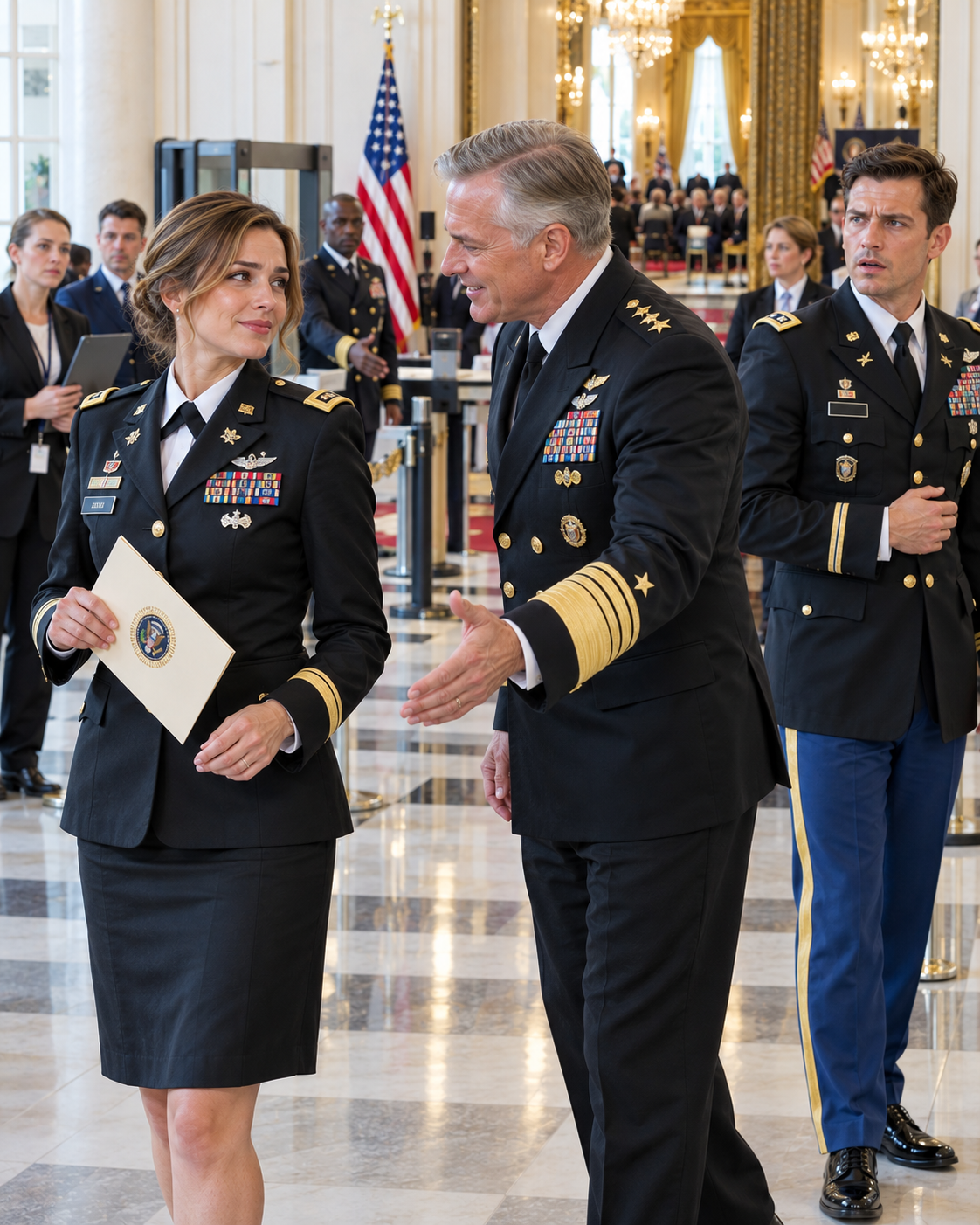
At the White House’s grand East Wing ceremony, my husband leaned close and warned me not to embarrass his military career
For several seconds, I could not bring myself to read the rest of the letter.
The handwriting was Nathan’s, unmistakable in its precise strokes and the small slant he had never managed to correct, even when filling out official reports.
I had seen that handwriting on anniversary cards, birthday notes, and the occasional message he left beside my coffee when he was leaving before dawn.
But I had never seen this letter.
“Why didn’t you send it?” I asked.
Nathan stared at his hands.
“Because I was afraid.”
“Of what?”
“Of admitting that you were doing something I didn’t know how to do, and that it mattered more than I wanted to admit.”
The words landed harder than I expected.
I looked down again.
The letter began with an apology for missing my birthday during a deployment, then shifted into something more honest.
He had written that he was proud of my work, that he knew I was carrying responsibilities most people could never understand, and that he sometimes felt insignificant beside the things I accomplished without anyone noticing.
Then the tone changed.
He had crossed out a sentence and rewritten it so many times that the paper had nearly torn.
Finally, he had written, “I know your work matters, Rachel. I just don’t know how to stand beside you without feeling like I’m standing in your shadow.”
I read the sentence twice.
It explained something, but it did not excuse the years he had spent making that insecurity my burden.
“You could have told me,” I said.
“I know.”
“You could have asked me to help you understand my work.”
“I know.”
“You could have been proud of me without treating my success like an insult to yours.”
His eyes reddened.
“I know that, too.”
The café hummed around us with ordinary life: cups clinking, a child laughing near the window, a couple debating which dessert to order.
It seemed almost cruel that the world could continue so peacefully while two people sat facing the wreckage of a marriage.
Nathan took a breath.
“I don’t expect this letter to fix anything. I don’t even know if you want to hear what I’ve learned. But I couldn’t keep pretending the problem was that you never explained yourself.”
I folded the letter carefully.
“Then tell me what the problem was.”
He looked directly at me.
“I wanted to be admired so badly that I started measuring everything by whether it made me feel important. When you worked late, I called it paperwork. When you solved problems I couldn’t solve, I told myself they weren’t real leadership. And when people praised you, I found ways to make your achievements sound smaller.”
He swallowed.
“I did it because I was afraid of being ordinary, and I made you pay for that fear.”
I had imagined this conversation many times.
In some versions, I shouted until the whole café turned to stare.
In others, I walked away without letting him finish.
But the truth was quieter and more painful than either fantasy.
“I spent years wondering what I had to do to make you proud of me,” I said. “I earned qualifications, accepted difficult assignments, worked through holidays, and kept telling myself that if I could explain my work in the right way, you’d finally understand.”
Nathan’s face crumpled.
“And I kept moving the goalposts.”
“Yes.”
He did not defend himself.
That was new.
For ten years, every difficult conversation had ended with me reassuring him that he was a good officer, a good husband, or a good man who was simply under pressure.
I had confused loving someone with protecting them from the consequences of their choices.
Now I was tired of doing both people’s emotional work.
“I need you to understand something,” I said. “The ceremony wasn’t the moment you lost me. It was the moment I stopped pretending I hadn’t been losing myself for years.”
He nodded slowly.
“I understand.”
“I’m not sure you do yet.”
“Then I’ll keep listening.”
I looked out at the river.
The water moved beneath the afternoon light, carrying fallen leaves past the café’s stone embankment.
For the first time in months, I didn’t feel compelled to fill the silence.
Nathan let it remain.
That small restraint meant more than a dozen dramatic promises would have.
We spoke for nearly two hours.
He told me about his transfer request and the conversations he had begun having with officers who served under him.
He had asked them what he did that made their jobs harder, and the answers had not been comfortable.
One young captain told him that Nathan frequently took credit for successful outcomes while blaming subordinates when plans failed.
Another said that he had learned never to bring Nathan a problem without first preparing a solution, because Nathan treated uncertainty as incompetence.
“I thought I was demanding excellence,” Nathan admitted. “I was teaching people to hide the truth from me.”
I recognized the pattern.
In logistics, hidden problems became emergencies.
A delayed shipment that nobody reported could become a shortage of medical supplies.
A small scheduling error that someone concealed could leave an evacuation route without transport.
The first duty of leadership was not to look infallible.
It was to make it safe for people to tell you when something was wrong.
“What are you going to do about it?” I asked.
“Change how I lead. Not because I want you back, but because the people working for me deserve better than the man I’ve been.”
I studied him, searching for the familiar performance, the polished declaration designed to make an uncomfortable conversation end.
I didn’t find it.
Or perhaps I simply wanted to believe him.
Either way, I knew that words were the easiest part.
“Then do it when nobody is watching,” I said. “Do it when admitting a mistake costs you something. Do it when the person correcting you has less rank than you do.”
He nodded.
“I will.”
I stood to leave, and he rose too.
For a moment, we faced each other beside the table, two people who knew each other’s habits, fears, and favorite meals but had somehow become strangers in the places where it mattered most.
“Can I see you again?” he asked.
I considered the question carefully.
“Not as a promise that we’re getting back together. Just as two people who are trying to be honest.”
“That’s more than I deserve.”
“This isn’t about what you deserve, Nathan. It’s about what I’m willing to offer without abandoning myself.”
He accepted that answer.
We agreed to meet again in a few weeks.
When I walked away from the café, I felt neither healed nor broken.
I felt uncertain, which was uncomfortable but honest.
For years, I had treated certainty as a form of safety.
Now I was learning that a life could be meaningful even when the ending remained unknown.
My new position at the Army logistics university began the following month.
The campus sat on a quiet stretch of Virginia countryside, with brick buildings, old oak trees, and classrooms filled with officers preparing to manage the complicated systems that kept military operations moving.
I was assigned to mentor a group of junior logistics officers, many of whom had arrived believing that leadership meant issuing clear orders and expecting everyone else to make them happen.
During our first session, I placed a simple evacuation map on the board.
“Tell me what you see,” I said.
A lieutenant raised his hand.
“Three primary transport routes, two alternate routes, and a supply depot near the western boundary.”
“Good. What else?”
The room fell silent.
I waited.
Finally, a young captain said, “We don’t know whether the roads can support the weight of the vehicles.”
“Exactly.”
Another officer pointed out that the medical supplies would arrive after the first evacuation convoy unless the loading schedule changed.
A third noticed that the plan depended on a bridge that had not been inspected for months.
The discussion grew more animated as the officers began challenging the assumptions they had initially accepted.
I let them argue, calculate, revise, and discover how quickly an elegant plan could collapse when it ignored the people and systems beneath it.
At the end of the session, one lieutenant approached me.
“Ma’am, I thought logistics was mostly spreadsheets and schedules.”
I smiled.
“Spreadsheets and schedules are where you see the consequences before they happen, if you know what you’re looking for.”
He glanced at the map.
“So the real job is preventing the crisis.”
“Sometimes. And when you can’t prevent it, making sure people still have a way home.”
I watched him leave, remembering the classified evacuation that had brought me to the White House.
The operation had succeeded because dozens of people had done their jobs under pressure, but it had also succeeded because someone had questioned an assumption before it became fatal.
That was what I wanted my students to remember.
Not the medal.
Not the ceremony.
The responsibility.
The recognition from the president had brought my work into public view, but it had not made the work more valuable than it had been the day before.
The lives saved had mattered long before anyone applauded.
I began keeping a small notebook of lessons from my students, writing down the questions they asked and the mistakes they were brave enough to admit.
Some days, their curiosity reminded me of the officer I had once been.
Other days, their confidence reminded me how easy it was to confuse competence with certainty.
I taught them to build plans that could survive bad weather, damaged communications, missing equipment, and imperfect information.
More importantly, I taught them to listen to the mechanic who noticed a failing engine, the medic who recognized a change in a patient’s condition, and the junior officer who questioned a senior commander’s assumptions.
“Rank gives you authority,” I told them. “It does not give you exclusive access to the truth.”
That sentence eventually appeared on a note someone taped beside the classroom door.
I left it there.
Meanwhile, Nathan began doing the work he had promised.
I heard about it indirectly at first, through mutual colleagues who mentioned that he had changed how he ran briefings.
He began asking his team to identify risks before discussing successes.
When a supply convoy was delayed because of an error in his own planning, he took responsibility in front of the officers who had been affected.
He also stopped correcting junior personnel in public unless an immediate safety issue required it.
The changes were not dramatic.
They were small, awkward, and sometimes inconsistent.
But they were visible.
One afternoon, I received an email from him describing a training exercise that had gone wrong because a subordinate had reported an equipment failure late.
The old Nathan would have blamed the officer and demanded a formal explanation.
Instead, he had asked why the officer felt unable to report the problem immediately.
The answer was uncomfortable.
Nathan’s previous reactions had taught the team that bringing him bad news was more dangerous than trying to fix it quietly.
He wrote that he had apologized to the officer and changed the reporting procedure so urgent problems could be raised without fear of public humiliation.
At the end of the message, he added, “I finally understand that the silence I demanded wasn’t discipline. It was fear.”
I read the sentence several times.
Then I closed the email without replying.
I wanted to acknowledge his progress, but I also knew that I could not become the reward he received for learning to treat people properly.
He needed to change because it was right, not because it might bring me back.
That distinction became the quiet boundary around our conversations.
When we met again, we spoke about our work, our families, and the ordinary details that had disappeared from our marriage beneath the constant competition for recognition.
Nathan asked questions about my students and listened to the answers.
I asked about the officers he supervised and learned that he had begun seeking feedback from people who rarely spoke during meetings.
Sometimes our conversations were easy.
Other times, an old remark or familiar gesture brought back memories I had not expected to feel so sharply.
Once, when Nathan casually referred to one of my teaching assignments as “administrative work,” he stopped halfway through the sentence.
“I’m sorry,” he said. “That sounded dismissive.”
“It did.”
He took a breath.
“I meant that the assignment seems demanding in a different way from operational planning, not that it matters less.”
I watched him struggle to find the words.
“Thank you for correcting it,” I said.
It was a small moment, but it showed me something important.
Accountability was not the absence of mistakes.
It was the willingness to recognize them without demanding that someone else pretend they had never happened.
Still, there were wounds that did not close simply because the person who caused them finally understood their shape.
On the anniversary of our wedding, Nathan sent a message asking whether I would be comfortable meeting for dinner.
I stared at the screen for a long time.
A part of me remembered our early years, when he would come home from training exhausted and we would eat takeout on the living room floor, laughing about the smallest things.
Another part remembered the lonely evenings when I had tried to share an achievement and watched his attention drift toward his own reflection in a darkened television screen.
Both memories were true.
I replied that I wasn’t ready for dinner, but I hoped he was doing well.
He answered, “I understand. Thank you for telling me honestly.”
There was no accusation, no attempt to make me feel guilty, and no demand that I reassure him.
I put my phone down and cried.
Not because I had decided to leave him forever, and not because I had decided to return.
I cried because the man I had wanted for years was finally learning to listen, and I could not know whether the lesson had come too late for us.
A few weeks later, I was invited to speak at a leadership conference attended by senior officers and civilian planners.
The organizers asked me to discuss the evacuation operation that had earned me the presidential medal.
I agreed, but I refused to make the presentation a story about a single brilliant individual.
Instead, I spoke about the people who had kept the plan alive when conditions changed: the transport crews who improvised alternate routes, the medical teams who reorganized supply loads, the analysts who corrected outdated assumptions, and the junior officers who challenged decisions before they became disasters.
At the end, a senior commander asked what I considered the greatest leadership lesson from the operation.
I thought about Nathan, about my students, and about the people who had been afraid to speak in rooms where rank mattered too much.
“The greatest danger isn’t always that people will make mistakes,” I said. “It’s that they will become so afraid of admitting those mistakes that everyone else loses the chance to correct them.”
The room was silent for a moment.
Then people began writing.
After the conference, a young officer approached me with tears in her eyes.
“My supervisor keeps telling me I’m too junior to question his plans,” she said. “I thought maybe I needed to stop noticing things.”
I asked her to tell me what had happened.
She described a supply calculation that appeared inconsistent with the number of personnel scheduled for deployment.
We reviewed the figures together and found a genuine discrepancy.
I helped her document the issue and identify the proper reporting channel, making sure she understood that she had a responsibility to raise the concern professionally and a right to have it reviewed.
Before she left, she thanked me.
I thought of the woman I had been ten years earlier, trying to find the perfect words to make her husband understand that her work mattered.
I wished someone had told me sooner that I did not need another person’s permission to take my own judgment seriously.
That evening, I called Nathan.
He answered after the second ring.
“Everything okay?”
“Yes,” I said. “I just wanted to tell you something.”
I explained the young officer’s situation and the discrepancy we had found.
Nathan listened without interrupting.
When I finished, he said, “I hope her supervisor listens.”
“So do I.”
After a pause, he added, “And if he doesn’t, I hope she keeps speaking through the proper channels until someone does.”
I smiled faintly.
“That sounds like something a good commander would say.”
“I’ve been trying to become one.”
There was no self-congratulation in his voice.
For once, he seemed content to let the work speak for itself.
Months later, we returned to the riverside café where we had first begun speaking honestly.
The weather had turned cool, and fallen leaves collected along the water’s edge.
Nathan arrived without a uniform or any visible sign of rank.
I wore an ordinary coat and carried a stack of student papers that I had promised myself not to grade during lunch.
He looked at the papers and smiled.
“Still doing paperwork?”
The old phrase hung between us.
For a fraction of a second, I felt the familiar sting.
Then Nathan’s smile faded.
“I’m sorry,” he said. “That was careless.”
I studied him, then allowed myself a small smile.
“I was about to tell you that the paperwork is the interesting part.”
He laughed softly.
“I deserved that.”
We ordered coffee and sat by the window.
He told me that he had been assigned to lead a training initiative focused on communication and accountability.
I told him that one of my students had developed an evacuation planning model that was better than anything I had expected from the class.
We talked about the future without trying to force it into a promise.
Eventually, Nathan looked at me across the table.
“I still love you,” he said. “I don’t expect that to change just because we’ve been apart.”
I felt the words settle gently between us.
“I still love parts of our life together,” I replied. “And I still care about the man you’re becoming. But love isn’t enough if I have to disappear to make room for it.”
“I know.”
“I need a marriage where my work isn’t treated like a threat, where your achievements don’t require mine to become smaller, and where neither of us has to perform importance for the other.”
He nodded.
“I want that, too.”
“Wanting it is the beginning.”
“I know that as well.”
I looked at him carefully.
For the first time, I could imagine a future with him without immediately imagining the cost.
That did not mean I was ready to return.
It meant I was finally free to choose without fear deciding for me.
We left the café together and walked beside the river, keeping a comfortable distance between us.
At the bridge, Nathan stopped.
“I’ve spent a long time thinking about the White House ceremony,” he said. “I used to believe that the worst part was discovering I didn’t know how important your work was.”
I waited.
“Now I think the worst part was realizing that you had been trying to share your life with me, and I kept treating it like a competition I had to win.”
My throat tightened.
“I didn’t need you to be impressed by me every day, Nathan. I needed you to be interested in me.”
He looked down at the water.
“I wish I’d understood that sooner.”
“So do I.”
We stood quietly until the cold drove us back toward the street.
Before we parted, he asked whether we could meet again the following month.
I said yes.
Not because I had forgiven every hurt, and not because the future had suddenly become simple, but because I wanted to see what honesty might build if we both continued to choose it.
That night, I returned to my apartment and placed the presidential medal in a small wooden box beside a photograph of my family.
For years, I had thought recognition would make me feel seen.
It had, in one sense.
The ceremony had forced a room full of powerful people to acknowledge work they had never known existed, and it had forced Nathan to confront the truth he had spent years avoiding.
But the medal had not repaired my marriage.
It had not erased the loneliness, restored the missed conversations, or given me back the years I had spent trying to earn respect that should never have been conditional.
Those things required something less glamorous and far more difficult.
They required change.
I closed the box and returned to the stack of student papers waiting on my desk.
On the first page, a young officer had written a sentence beside an evacuation plan: “The success of the mission depends on the people whose work is easiest to overlook.”
I underlined it and wrote a note in the margin.
“Remember this when you have the authority to overlook them.”
Then I turned off the lamp and stood by the window, watching the lights of the city appear one by one.
I did not know whether Nathan and I would find our way back to each other.
Perhaps we would build a new marriage from the pieces of the old one.
Perhaps we would discover that the most loving thing we could do was let each other go.
For the first time, I understood that neither outcome would erase who I was.
My worth had never depended on a presidential ceremony, a medal, a husband’s approval, or a title printed beneath my name.
It had been present in every difficult decision, every careful plan, every quiet act of service, and every moment I chose to speak when silence would have been easier.
The next morning, I would return to my classroom and teach another group of officers how to bring people home.
And somewhere across Virginia, Nathan would have to decide whether the lessons he had learned were merely a response to losing me or the beginning of the man he wanted to become.
I hoped he chose the latter.
But this time, I would not put my life on hold while waiting to find out.