At the veterans’ hospital in rural Kentucky, my mother’s fiancé screamed that I had kidnapped her while strangers watched
Part 2
The first crack in Victor’s carefully polished image appeared over a stack of unpaid bills.
I found them tucked beneath a pile of grocery advertisements on the kitchen counter while looking for my mother’s recipe for chicken and dumplings.
There were notices from the truck financing company, overdue utility statements, and a letter from a bank requesting immediate clarification of several recent transactions.
I did not open anything addressed to Victor.
I did not need to.
The dates and amounts on the documents my mother had left visible told enough of the story.
When I asked her about the bills, she sat down slowly, as though her knees had suddenly become unreliable.
“He said his retirement benefits were delayed,” she explained. “He said the truck was an investment because he might start consulting for some defense contractors.”
“Has he shown you any contracts?”
She shook her head.
“Any correspondence from the pension office?”
Another shake.
“Mom, have you seen his bank statements?”
She looked toward the hallway.
“Please don’t make me choose between you.”
The words struck harder than I expected.
I pulled out the chair beside her and sat down.
“You don’t have to choose between me and anyone else. I’m asking whether you’re safe, whether your money is safe, and whether you’re being told the truth.”
She rubbed her thumb over the edge of the table.
“I wanted someone to share things with after your father died. The house felt so empty.”
For the first time since I had arrived, I stopped thinking about Victor and started thinking about the loneliness that had made him welcome.
My father had been dead for four years.
For most of my childhood, he had treated affection like a reward that had to be earned, and after his death, my mother had been left with a house full of memories and nobody to help her carry them.
Victor had arrived at exactly the right moment.
He brought flowers, repaired a loose fence post, and sat with her through the evenings when the silence became unbearable.
He remembered her favorite songs.
He called when he said he would.
He made her feel noticed.
Then, little by little, the kindness acquired conditions.
The flowers became proof of what she owed him.
The repairs became reasons she should trust him with her money.
The calls became demands to know where she was and who she had spoken to.
And the man who once brought her coffee in bed now criticized the way she laughed.
My mother had not been foolish to want companionship.
Victor had simply learned how to turn that need into leverage.
“I don’t want to be alone again,” she whispered.
I took her hand.
“Being alone and being made to feel alone are not the same thing.”
She closed her eyes.
For several seconds, neither of us spoke.
Then the back door slammed, and Victor entered carrying a paper bag from the liquor store.
He glanced at the bills.
“What’s this?”
“Mom and I were talking about the household finances,” I said.
His face hardened.
“Household finances are between Margaret and me.”
“Then you should have no problem explaining the truck payments.”
He stared at me with an expression that suggested he was trying to decide which insult would hurt most.
“You think because you wear a uniform, you can walk into a man’s home and interrogate him?”
“I haven’t interrogated you.”
“You’ve been doing nothing but judging me since you arrived.”
I looked at the muddy boots still resting near the living room doorway.
“That would be a strange thing to do if I hadn’t noticed anything worth judging.”
My mother made a small sound that might have been a laugh, but Victor turned toward her so sharply that it vanished.
“Is this what you’ve been telling her? That I’m some kind of thief?”
“I didn’t say that,” she replied.
“Then don’t sit there looking guilty.”
I rose from my chair.
“Don’t speak to her like that.”
Victor stepped closer.
For a moment, I could see the man he might have been before retirement stripped away the structure that had once defined him.
He looked frightened, and his fear had become anger.
“You’re a guest in this house, Aubrey. You don’t get to tell me how to speak.”
I held his gaze.
“Then behave like a guest yourself.”
His jaw tightened.
He snatched the bills from the counter and shoved them into a drawer.
“This conversation is over.”
He walked away, slamming the bedroom door behind him.
My mother stared at the drawer long after the sound had faded.
That evening, I sat with her at the kitchen table and helped her list every account she controlled, every payment Victor had promised to make, and every document she needed to review with her bank.
I encouraged her to contact the bank directly and consult an independent attorney before making any further financial commitments.
I did not take her checkbook.
I did not access her accounts.
The decisions had to remain hers, because the point was not to replace Victor’s control with mine.
It was to give her back the freedom to choose.
For the first time in months, my mother began asking questions aloud.
She asked why the truck payment came from her account.
She asked why Victor became furious whenever she mentioned his pension.
She asked why he insisted on keeping their finances secret from the family.
Every question seemed to frighten her, but every answer she uncovered made her stand a little straighter.
Victor noticed the change.
He responded by becoming sweeter whenever I was present and crueler whenever we were alone.
He offered to make breakfast, then complained that my mother had bought the wrong coffee.
He praised her garden in front of neighbors, then called it a waste of money after they left.
He told people that his future wife was a generous woman, then reminded her privately that generosity was the least she could offer after everything he had done.
I had witnessed manipulation in many forms throughout my career, but watching it unfold inside my mother’s home was different.
There was no briefing room to leave.
No commanding officer to consult.
No ocean between me and the person who was being hurt.
There was only the woman who had once stayed awake beside my bed when I was sick, and the growing realization that she had begun to fear the sound of her own front door.
The next morning, she told me she had promised to volunteer at the veterans’ hospital.
“I don’t know if I should go,” she said. “Victor gets upset when I leave without him.”
“Did you invite him?”
“No.”
“Then you haven’t broken a promise.”
She hesitated before picking up her purse.
I offered to drive her, but she insisted on taking her own car.
“I need to remember that I can still do things myself.”
I kissed her cheek.
“Then go do something for yourself.”
She left with her shoulders slightly hunched, but she was smiling when she backed out of the driveway.
For about two hours, I allowed myself to believe that something had shifted.
Then my phone rang.
It was my mother.
Her voice was trembling so badly that I could barely understand her.
“Aubrey, please come to the hospital.”
“What happened?”
“Victor is here. He’s telling everyone you’ve kidnapped me.”
For one second, I could not speak.
Then the familiar calm returned, the same calm that had carried me through emergencies at sea.
“Are you hurt?”
“No.”
“Are you somewhere safe?”
“I’m in the reception area, but he’s shouting at the staff.”
“Stay where you are. I’m coming.”
I reached the hospital twenty minutes later.
The lobby was crowded with patients, volunteers, and veterans waiting for appointments.
Near the reception desk, Victor stood with his retired military identification card held high, as though it were a badge granting him unlimited authority.
My mother sat beside a nurse, pale and visibly shaken.
Victor spotted me and pointed.
“There’s the woman who took her!”
Several people turned.
A man in a wheelchair looked up from his paperwork.
An elderly veteran standing near the elevator frowned at me.
A security officer began moving toward us.
Victor raised his voice even higher.
“My fiancée is a vulnerable senior, and this woman has been keeping her away from me. I’m demanding that she be detained immediately.”
I stopped several feet away.
“Mom, do you want to leave with Victor?”
She looked at him.
He glared at her, silently commanding her to answer correctly.
Then she looked at me.
“No,” she said.
It was a small word, but it carried the weight of months of fear.
Victor’s face reddened.
“She’s confused! I’ve been taking care of her!”
My mother rose unsteadily to her feet.
“I came here to volunteer. Nobody brought me against my will.”
The security officer turned to Victor.
“Sir, lower your voice and step away from the reception desk.”
Victor thrust his identification card toward him.
“Do you know who I am? I served this country for twenty-five years!”
The officer glanced at the card, then handed it back.
“That does not give you permission to disrupt this facility.”
Victor looked around, searching for an audience that would validate him.
Instead, he found people watching with growing discomfort.
He turned toward me again.
“You think you’re better than me because you wear civilian clothes and pretend to be some kind of important executive?”
I said nothing.
He mistook my silence for surrender and took another step forward.
“You’re going to regret humiliating me.”
Then he swung his arm toward a flower arrangement near the reception desk, knocking it from its stand.
The vase shattered.
Roses scattered across the tile, their stems snapping beneath the feet of people who scrambled out of the way.
My mother gasped.
The security officer moved between Victor and the crowd.
“Sir, you need to stop immediately.”
Victor shoved at the officer’s arm.
That was when the situation changed from an embarrassing family dispute into a security incident on federal property.
I identified myself to the facility’s security supervisor and asked that the appropriate authorities be contacted.
I did not threaten Victor.
I did not raise my voice.
I gave the supervisor the facts, including the damage, the disturbance, and Victor’s refusal to follow instructions.
Military security personnel arrived, assessed the situation, and took control.
Victor continued shouting as they escorted him away for the applicable procedures and charges to be determined.
“You can’t do this to me!” he screamed. “I’m a retired colonel!”
One of the security personnel replied, “Sir, you have been instructed to leave the area.”
Victor twisted around to glare at me.
“This isn’t over, Aubrey!”
I watched him pass the shattered roses, his face contorted with disbelief.
Then I turned to my mother.
She was crying silently, one hand pressed against her mouth.
I wrapped my arms around her.
“I’m sorry,” she whispered.
I held her tighter.
“You have nothing to apologize for.”
But even as I said it, I knew the worst confrontation might still be waiting at home.
Victor had lost control of a public scene, and men like him rarely accepted humiliation without trying to reclaim their power somewhere more private.
That evening, the rain returned.
My mother and I sat in the kitchen with the curtains drawn, drinking tea that had long since gone cold.
For the first time in years, she told me about her marriage to my father without defending him.
She admitted that she had spent much of her life trying to keep peace between him and the children, hoping that if she worked hard enough, loved hard enough, and asked for little enough, everyone would eventually be happy.
“I thought I was protecting you,” she said.
“You did protect us.”
“Not always.”
I looked at her hands, hands that had packed school lunches, planted roses, and held mine through every childhood disappointment.
“Mom, you were trying to survive your own life. You don’t have to punish yourself forever for the things you couldn’t change.”
Her tears fell then, quietly and without apology.
I stayed beside her until the kitchen clock struck eleven.
Then the back door opened.
Victor stumbled inside, smelling of bourbon and wet wool.
He had been released after the hospital incident, and the anger he carried into the house seemed larger than the doorway through which he entered.
He looked at my mother.
Then he looked at me.
“Get out of my house.”
My mother stiffened.
“This is my house too, Victor.”
He ignored her.
“I’m talking to you, Aubrey.”
I stood slowly.
“Then speak respectfully.”
He laughed, but his eyes were cold.
“Respectfully? You have spent days undermining me, turning Margaret against me, and using your connections to make me look like a criminal.”
“You did that yourself.”
His face twisted.
“Don’t you dare speak to me that way.”
He moved closer until he was standing beneath the kitchen light, his shadow falling across the table.
“I am the superior officer in this house. I give the orders here.”
My mother rose from her chair.
“Victor, stop.”
He slammed his palm against the table.
“Sit down, Margaret!”
She flinched.
And something inside me became perfectly still.
I had spent years believing that silence was the safest way to protect myself from my father’s disappointment.
I had spent three days watching Victor use that same silence as permission to hurt the woman I loved most.
This time, I would not let him mistake restraint for submission.
I reached for my leather bag.
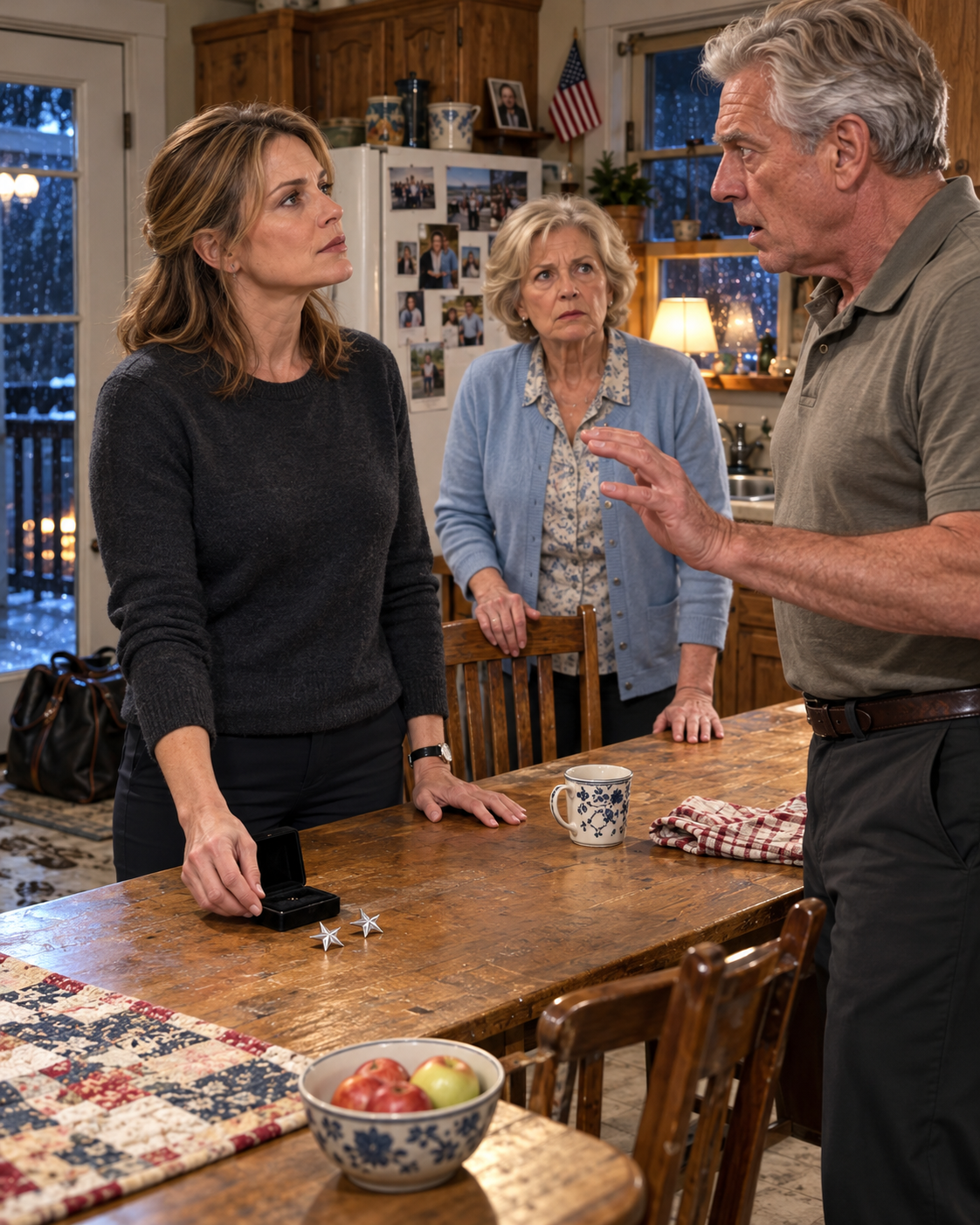
Victor watched me suspiciously as I unfastened the clasp and withdrew the small velvet case.
He sneered.
“What is that supposed to be? Another one of your little certificates?”
I placed the case on the table.
“No,” I said. “It’s a reminder.”
Then I opened it.
Part 3
The kitchen became so quiet that I could hear the rain tapping against the window.
Inside the velvet case lay two silver stars, polished and unmistakable beneath the warm light.
Victor stared at them.
At first, he seemed unable to understand what he was seeing.
Then his eyes widened, and the color drained from his face.
I watched the recognition move through him, stripping away the anger, the swagger, and the practiced superiority he had worn like a second uniform.
He knew those stars.
He knew exactly what they represented.
His heels snapped together before he could stop himself, and his spine straightened with the reflexes of a man who had spent years responding to rank.
For the first time since I had entered my mother’s house, Victor Vance looked at me without contempt.
I did not smile.
I did not raise my voice.
I simply met his eyes.
“Rear Admiral Aubrey Miller, United States Navy.”
His mouth opened, but no sound came out.
I let the silence settle between us.
“For three days, you’ve ordered me around, insulted my career, mocked my appearance, and treated my mother as though she exists to serve you.”
He swallowed.
“I didn’t know.”
“No,” I replied. “You didn’t bother to find out.”
He glanced at the stars again.
I could almost see him searching for a way to rearrange the past three days into something more flattering to himself.
Perhaps he would claim that he had been testing me.
Perhaps he would insist that he had been joking.
Perhaps he would tell me that my rank did not change the fact that I was his future wife’s daughter.
He tried the last one first.
“Well, rank doesn’t make a person better than anyone else.”
For the first time that evening, I almost smiled.
“You’re absolutely right.”
His shoulders loosened slightly.
Then I continued.
“And that’s why I’ve never demanded that anyone treat me as more important than they are. I expect basic respect from everyone, regardless of rank. You seem to expect it only for yourself.”
His face tightened.
“I was a colonel for twenty-five years.”
“So you were.”
“I commanded people. I know what leadership looks like.”
“Then you should understand why shouting at frightened people is not leadership.”
He looked toward my mother, perhaps hoping she would rescue him from the conversation.
But she was standing beside the sink, her hands resting on the counter.
She was no longer looking at the floor.
She was looking directly at him.
I closed the velvet case and rested my palms on the table.
“My rank doesn’t give me ownership of this house, Victor. It doesn’t give me authority over my mother, and it doesn’t make my opinion automatically correct.”
I paused.
“But it does mean that you have spent three days mistaking a senior flag officer for someone you could bully without consequences.”
He stared at me.
I continued before he could interrupt.
“What happened at the hospital was not a military disagreement. You disrupted a federal facility, damaged property, and refused lawful instructions from security personnel. The authorities will handle those matters through the proper process.”
His lips trembled with anger.
“You could have told me who you were!”
“I could have.”
“Then why didn’t you?”
The question hung in the air.
I thought of my father’s coffee table, the boots resting on its polished surface, and my mother’s frightened face when Victor shouted at her.
“Because I wanted to see how you treated someone you believed had nothing to offer you.”
He looked away.
“And now?” he muttered.
“Now I know.”
For several seconds, he stood motionless.
Then he turned toward my mother.
“Margaret, tell her this has gone far enough.”
My mother did not answer immediately.
I watched her take a breath, and I recognized the effort it required.
For years, she had learned to swallow words before they could become arguments.
She had learned to apologize before anyone accused her of wrongdoing.
She had learned to make herself smaller in the hope that the people around her would stop demanding that she shrink.
But something had changed in the hospital lobby.
Perhaps it had been the shattered vase.
Perhaps it had been the sight of strangers witnessing what she had endured in private.
Or perhaps she had simply reached the end of the distance she was willing to travel away from herself.
She stepped away from the sink.
“Victor, I want you to leave.”
He blinked.
“What?”
“I want you to leave my house.”
His expression shifted from confusion to disbelief.
“Margaret, don’t be ridiculous.”
“I’m not being ridiculous.”
“You don’t mean that.”
She glanced at the velvet case on the table, then looked him squarely in the eyes.
“I mean it.”
He laughed sharply.
“After everything I’ve done for you?”
My mother stood straighter.
“You mean the flowers? The repairs? The money you borrowed? The truck you told me you could afford?”
His mouth tightened.
“You agreed to help me.”
“I agreed to help someone I loved. I did not agree to be frightened in my own kitchen.”
He took a step toward her.
“You’re overreacting.”
She did not move.
“No. I’ve been underreacting for months.”
The words seemed to surprise her as much as they surprised him.
For one brief moment, I saw the woman who had raised me, the woman who had endured difficult years without ever losing her instinct to protect the people she loved.
She was still there.
She had simply been waiting for herself to return.
Victor turned toward me.
“This is your doing.”
“No,” I said quietly. “This is her decision.”
He looked back at my mother, searching for the hesitation he had counted on so many times before.
He found none.
“You’ll regret this,” he said.
She shook her head.
“I regret how long it took me.”
That was the moment Victor finally understood that his authority over the house had existed only as long as my mother agreed to surrender her own.
He began moving through the living room, collecting his jacket, his keys, and the belongings he had scattered across my father’s furniture.
He muttered about betrayal, disrespect, and the way people treated veterans after everything they had sacrificed.
My mother did not argue.
When he reached the front door, he turned one last time.
“You’ll be alone again, Margaret.”
She looked at him with a sadness that was deeper than anger.
“Perhaps. But I won’t feel small anymore.”
Victor stared at her, then walked into the cold night.
The door closed behind him with a soft, ordinary click.
No dramatic crash followed.
No thunder rolled across the hills.
There was only the sound of rain, the hum of the refrigerator, and my mother’s uneven breathing as she stood in the hallway.
Then her knees seemed to weaken.
I caught her before she could sit down on the floor.
For a long moment, she clung to me and cried.
I held her the way she had held me when I was a little girl, when the world seemed too large and the dark too frightening to face alone.
Neither of us tried to make the moment smaller with explanations.
There was nothing left to prove.
Eventually, she pulled back and wiped her face.
“I’m sorry I didn’t stand up for you when you were growing up,” she whispered.
I felt my throat tighten.
“Mom.”
“I let your father make you feel as though you were never enough. Then I let Victor do it to me.”
I took both her hands.
“You were enough when you were afraid. You were enough when you were lonely. And you’re enough now.”
She closed her eyes.
“I wish I had learned that sooner.”
“So do I.”
It was the most honest answer I could give her.
We spent the next hour securing the doors, writing down what had happened, and making a practical plan for the days ahead.
My mother would speak with her bank and an independent attorney about her finances.
She would keep records of the money she had lent Victor and review any obligations she had agreed to.
She would also contact the appropriate authorities if he returned and refused to leave.
I promised to help her find the resources she needed, but I made one thing clear.
“I can stand beside you, Mom. I can’t make every decision for you.”
She nodded.
“I understand.”
Then she surprised me by reaching for the velvet case.
“May I?”
I handed it to her.
She lifted the lid carefully and stared at the silver stars resting inside.
“They’re beautiful,” she whispered.
“They’re heavy.”
She looked up.
“Because of what they mean?”
“Because of what they require.”
I told her about the long nights at sea, the decisions that had no perfect answers, and the people whose lives had depended on someone remaining calm when fear threatened to take over.
I told her that command had taught me to listen before speaking, to distinguish confidence from arrogance, and to remember that the person with the most authority in a room was not necessarily the person who understood it best.
She listened without interrupting.
When I finished, she touched one of the stars with the tip of her finger.
“Your father never really understood what you did, did he?”
I looked toward the living room, where his old coffee table stood beneath the lamp.
“No,” I said. “I don’t think he did.”
My mother closed the case and returned it to me.
“Well, I wish I had asked you more questions.”
I smiled sadly.
“I wish you had too.”
It was not a perfect reconciliation.
There were still years of hurt between us, years we could not repair in a single evening.
But for the first time, we were speaking honestly without trying to protect anyone’s pride.
And that was enough to begin.
The following morning, sunlight broke through the clouds for the first time in days.
My mother made coffee, opened the curtains, and stood in the living room looking at the muddy marks Victor had left on the carpet.
Then she glanced at the coffee table.
“I think we should move this.”
I raised an eyebrow.
“Your father’s table?”
“Yes.”
She ran her hand along its worn wooden edge.
“I’ve kept everything exactly the way he left it because I thought changing anything would mean I was forgetting him.”
She paused.
“But I don’t want to live in a museum anymore.”
We moved the table to the wall beneath the front window.
It was a small change, almost insignificant, but my mother seemed lighter afterward.
Over the next several weeks, we began reclaiming the house one room at a time.
We painted the kitchen a soft cream color and replaced the heavy curtains with ones that let the morning light spill across the floor.
My mother donated the furniture she no longer wanted, rearranged the photographs, and planted fresh roses beside the front steps.
She chose yellow ones because, as she explained, they reminded her of the first garden she had ever planted with my father.
When she found herself hesitating over a decision, I encouraged her to trust her own judgment.
Sometimes she did.
Sometimes she called me to talk it through.
Slowly, she stopped apologizing for having an opinion.
I also learned to stop treating every family wound as something I could solve through discipline and careful planning.
I could command ships.
I could coordinate complex operations.
I could sit across from powerful people and negotiate under extraordinary pressure.
But I could not go back in time and give my mother the confidence she had spent years losing.
I could only love her while she found it again.
Victor sent a letter several weeks later.
It was a rambling mixture of apologies, accusations, and explanations.
He wrote that he had been under stress, that retirement had been difficult, and that he had never intended to frighten Margaret.
Near the end, he asked her to remember the good times and consider giving him another chance.
My mother read the letter twice.
Then she folded it, placed it in an envelope, and put it away with the other records she was keeping.
She did not answer.
For once, she understood that forgiveness did not require reopening a door that had finally closed.
The legal and financial questions took longer to resolve.
Some matters required documentation, professional advice, and patience.
There was no magical moment when every consequence disappeared, and I never promised her there would be.
But she approached each problem with a steadiness I had not seen in years.
When the bank asked for clarification, she answered.
When the attorney needed information, she provided it.
When a neighbor asked whether Victor would be returning, she simply said, “No, he won’t.”
She no longer offered explanations to make other people comfortable.
By spring, the roses had begun to bloom.
I returned to Kentucky whenever my duties allowed, sometimes for a weekend, sometimes only long enough to share breakfast before flying back to my responsibilities.
My mother began attending a local gardening club and organizing additional volunteer shifts at the veterans’ hospital.
One afternoon, she called to tell me that a young veteran had thanked her for sitting with him while he waited for an appointment.
“He said I made him feel like somebody cared whether he was there,” she told me.
I smiled.
“You did exactly what you always do.”
“No,” she replied thoughtfully. “I think I’m doing it differently now.”
“How?”
“I’m helping because I want to, not because I’m afraid someone will be angry if I don’t.”
I sat quietly with the phone pressed to my ear.
That sentence meant more to me than any apology she could have offered.
Months later, when I visited again, I found her in the garden wearing an old sun hat, her hands covered in soil.
She looked up and waved me over.
“Come see these.”
The yellow roses had opened along the fence, bright against the weathered wood.
I crouched beside her and touched one of the petals.
“They’re beautiful.”
She smiled.
“They don’t all bloom at once. You have to give them time.”
I looked at her.
For years, I had believed strength meant enduring whatever life placed in front of me without allowing anyone to see how much it hurt.
I had confused silence with control and self-sufficiency with peace.
But my mother’s courage had taught me something different.
Sometimes strength meant speaking when your voice shook.
Sometimes it meant leaving a room, ending a relationship, or admitting that the life you had built was no longer the life you wanted.
And sometimes it meant accepting help without surrendering your independence.
That evening, we sat together in the kitchen, drinking coffee beneath the warm light.
The walls were fresh, the curtains were open, and my father’s coffee table stood in its new place by the window.
There were no muddy boots on it.
There were no shouted orders echoing through the hallway.
Just the ordinary sounds of a house that had finally begun to feel like home again.
My mother looked across the table at me.
“I used to think the strongest person was the one who could make everyone else listen.”
I waited.
“Now I think it’s the person who can hear herself clearly, even when someone else is shouting.”
I reached for her hand.
Outside, the wind moved gently through the yellow roses, and the last light of the day settled across the garden.
I had spent twenty-five years learning how to command in the most difficult circumstances imaginable, yet the most important lesson of my life had not come from a battlefield, a carrier deck, or a room filled with senior officers.
It had come from watching a frightened woman reclaim her own voice.
My silver stars remained in their velvet case, tucked safely inside my leather bag.
They were reminders of a career I had worked hard to earn, of sailors who had trusted me, and of responsibilities I would always carry with humility.
But they were no longer the most important symbols in my mother’s house.
That honor belonged to the yellow roses outside her window, planted by a woman who had finally stopped believing that being loved meant making herself smaller.
I had not needed to shout my rank to prove who I was.
My mother had not needed to shout to reclaim her home.
And Victor had never needed to be defeated by someone more powerful than himself; he had only needed to be held accountable for the way he treated people when he believed nobody could challenge him.
In the end, the stars on my shoulders had never been what made me strong.
The strength was in knowing when to speak, when to remain calm, and when to stand beside someone until they remembered they could stand on their own.
That night, before I left, my mother walked me to the front door and hugged me beneath the porch light.
“Drive safely, sweetheart,” she said.
“I will.”
She held me for another moment.
“And Aubrey?”
“Yes, Mom?”
“I’m proud of you.”
The words were simple, almost ordinary.
Yet they reached a place inside me that twenty-five years of honors, promotions, and commendations had never quite touched.
I kissed her cheek and stepped into the cool Kentucky night.
Behind me, the house glowed warmly through its open curtains.
For the first time in my life, I did not wonder whether my father would have approved of the woman I had become.
I did not need Victor to understand my rank, and I did not need anyone to measure my worth against the volume of my voice.
I knew who I was.
And inside that quiet, newly reclaimed home, my mother was finally learning to know herself again.