At the Vance Apex Gala, a billionaire CEO watched twenty elite engineers fail for four hours
Part 2
Eleanor waited for my answer.
She didn’t glance at Dominic for permission, and she didn’t rush to fill the silence when he shifted impatiently beside her.
That alone told me she was different from the people who had handled my complaint three years earlier.
I stepped toward the diagnostic display.
“The fault may not be electronic in the way you’ve been treating it,” I said. “The auxiliary fuel rail could be responding to vibration differently at this temperature. If the pressure regulator cycles out of phase with the primary injection sequence, the engine control system may interrupt the start before the engine catches.”
One of the German engineers frowned.
“That would require a very specific operating window.”
“Yes,” I replied. “That’s why it can be difficult to reproduce once the engine warms up.”
Werner Baumann, the consortium representative, moved closer.
He was a broad-shouldered man in his sixties with silver hair and a face that looked permanently skeptical.
“You are suggesting a mechanical resonance issue?”
“I’m suggesting a testable possibility. I would want to confirm the readings and inspect the regulator before claiming certainty.”
Werner studied me.
“What would you test first?”
“The relationship between secondary rail vibration and auxiliary pressure cycling during a cold start. Not just the final pressure value. The timing matters.”
A murmur passed through the engineers.
Dominic’s face had become rigid.
“Eleanor, we have specialists who understand this system. We cannot allow an outside mechanic to improvise on a three-million-dollar vehicle in front of our investors.”
I turned toward him.
“Then don’t let me improvise. Let me explain the test, and your team can verify it.”
Eleanor’s eyes narrowed slightly.
“How long would you need?”
“Five minutes to inspect the regulator and confirm whether the behavior matches what I’m describing. If the evidence doesn’t support it, I’ll step away.”
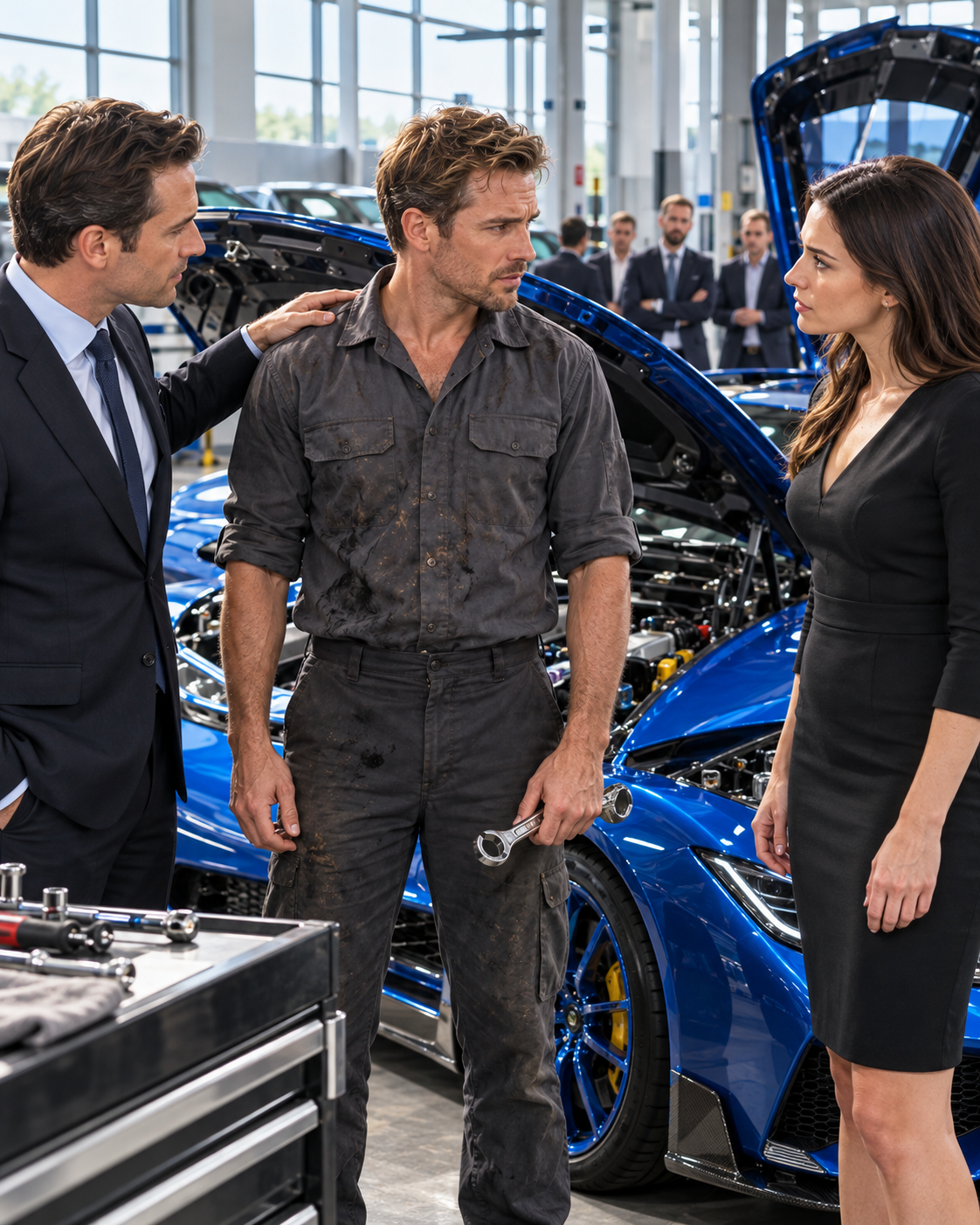
Dominic gave a humorless laugh.
“This is absurd.”
Eleanor raised one hand.
“Five minutes.”
He stared at her.
“Eleanor—”
“Mr. Reese, you have had four hours and twenty engineers. We are not in a position to dismiss a testable explanation simply because you dislike the person offering it.”
A few people looked down at their shoes.
Dominic’s mouth tightened.
Eleanor turned back to me.
“Do what you need to do, within safe limits. One of our lead engineers will supervise.”
I nodded.
“Understood.”
A technician brought me the appropriate tools, including a fourteen-millimeter wrench.
I set my bag beside the service platform and examined the engine bay.
The Bugatti was a marvel of engineering, but beneath its sculpted panels and polished fittings, the same physical principles governed its behavior as any other machine.
Pressure.
Temperature.
Vibration.
Timing.
A system could be extraordinarily sophisticated and still fail because two components disagreed about when they were supposed to work.
I placed my bare hand against the accessible housing near the regulator assembly, feeling for the subtle vibration pattern while the technician prepared the diagnostic cycle.
The engine remained off.
The technician initiated the prescribed test sequence, and I watched the pressure response.
There it was.
A faint oscillation that appeared at the exact point where the auxiliary regulator should have stabilized.
I felt it through the housing before the display fully registered it.
“Stop the sequence,” I said.
The technician halted the test.
I examined the regulator assembly and compared its behavior with the diagnostic history.
The pattern was consistent with the theory, but I still needed to determine whether the regulator itself was sticking or whether the mounting and vibration characteristics were amplifying the cycling problem.
I looked at the lead engineer.
“Can we confirm the regulator’s response against the manufacturer’s service specifications before making any adjustment?”
He nodded.
We checked the relevant readings and the assembly’s operating range.
The regulator was not obviously broken.
It was behaving incorrectly under a narrow set of conditions.
I took a breath.
“I need to make a small, controlled adjustment to the auxiliary pressure regulator, then repeat the test and verify the result against the specifications.”
The engineer hesitated.
“How much?”
I described the three measured adjustments I believed would bring the regulator’s response back within the intended range, subject to the manufacturer’s limits and verification after each step.
He reviewed the figures, then nodded to the technician.
I made the adjustments carefully, checking the response after each one rather than relying on a single movement.
The room had become so quiet that I could hear the soft click of tools being placed on the workbench.
Mia stood near the barrier, watching me.
Her red toy car rested in her palm.
I looked at her and smiled.
She smiled back.
That tiny exchange steadied me more than all the engineers and investors in the room combined.
I completed the final check and stepped away from the engine bay.
“The regulator is within the verified operating range now,” I said. “Let’s repeat the start procedure.”
Eleanor moved beside the vehicle.
“Are you certain?”
“No. I’m confident the readings support the adjustment, but we still need to test the result. If the system behaves abnormally, shut it down and investigate further.”
She nodded.
Then she climbed into the driver’s seat.
The engineers gathered around the display.
Werner stood beside the front fender, his arms folded.
Dominic remained several steps behind them, looking as though he wanted the entire evening to disappear.
Eleanor pressed the ignition.
For one heartbeat, nothing happened.
Then the starter engaged.
The W16 engine caught.
A deep, resonant roar filled the pavilion, rolling beneath the chandeliers and vibrating through the polished floor.
Several people actually stepped backward.
The engine settled into a smooth, steady idle.
No warning interrupted the display.
No immediate fault appeared.
The sound seemed almost impossibly ordinary after four hours of failure.
Eleanor kept her hand on the ignition controls, watching the readings.
“Pressure is stable,” the lead engineer called.
“Synchronization is holding,” another replied.
Werner slowly lowered his arms.
The Bugatti was running.
For several seconds, nobody spoke.
Then the pavilion erupted in overlapping voices.
One engineer hurried toward the diagnostic display.
Another asked for the recorded data.
A third stared at me as if he had just discovered that the man who had been standing beside the wall was fluent in a language nobody else could hear.
Eleanor switched off the ignition and stepped out.
She looked at me with an expression that was no longer merely curious.
“How did you recognize it so quickly?”
I wiped my hands on a clean shop towel.
“Because I’ve seen the same failure pattern before.”
“Where?”
I looked at Dominic.
He had gone pale.
“At Vance Apex. Three years ago.”
Werner’s head turned sharply.
“What do you mean?”
I took a breath.
“The technical explanation I gave you tonight came from a report I submitted while I was employed here. I documented the auxiliary regulator’s behavior under cold conditions and the interaction between the secondary rail vibration and the primary injection sequence.”
Eleanor’s face changed.
“You developed that analysis?”
“Yes.”
Dominic stepped forward.
“That’s not true.”
His voice was louder now, but the confidence had disappeared.
“The report was produced by my engineering group. Daniel was a junior contractor who assisted with testing.”
I met his eyes.
“I submitted the original analysis under my name. You asked for my files, then presented the findings as your own.”
A murmur spread through the room.
Dominic turned toward Eleanor.
“This is a personal grievance. He’s trying to exploit the situation for money.”
I shook my head.
“I haven’t asked you for money.”
“Not yet.”
His accusation struck harder than it should have, because it revealed exactly how little he understood what had happened to me.
I had spent three years struggling to keep a roof over my daughter’s head.
I had taken jobs beneath my qualifications, worked through weekends, and learned to measure grocery purchases against the number of hours I would need to work to pay for them.
Money mattered.
But what Dominic had taken from me was more than a paycheck.
He had taken the truth about my work and used it to build his reputation.
He had made me look dishonest when I tried to defend myself.
And he had left me wondering whether my own daughter would one day grow up believing that her father had failed because he wasn’t good enough.
I looked at Eleanor.
“If you want to understand what happened, don’t take my word for it. Look at the original records.”
She turned toward the senior staff.
“Find them.”
Dominic’s expression tightened.
“Eleanor, the gala is already delayed. We have a partnership decision to make, and the vehicle is running. We should focus on what matters.”
Eleanor’s gaze became colder.
“You’re right, Dominic. We should focus on what matters.”
She turned to Werner.
“Would you be willing to have your technical team review the original diagnostic history alongside the current data?”
Werner nodded.
“Absolutely. If the same failure signature appears in the earlier work, we need to know who identified it and why it wasn’t resolved.”
A young woman near the back of the room stepped forward.
She wore a charcoal suit and carried a thin laptop against her chest.
“I may be able to help with that,” she said.
Dominic looked at her.
“Grace, this isn’t the time.”
Her face tightened, but she did not step back.
“My name is Grace Park. I’m a junior analyst in the engineering records group. I’ve been reviewing historical provenance files as part of the company’s technical audit.”
Eleanor turned to her.
“What did you find?”
Grace opened her laptop.
“I found inconsistencies between the original report metadata, the archived submission logs, and the version later attributed to Mr. Reese.”
Dominic’s expression changed so suddenly that even people who had never worked with him could see it.
Grace continued, her voice trembling slightly but growing steadier as she spoke.
“The original files contain Daniel Mercer’s account credentials and timestamps from three years ago. The later presentation uses the same analytical sequence, including a specific test recommendation and a diagram that appears in the original report.”
She turned the screen toward Eleanor.
“There are also internal audit logs showing that the files were transferred to Mr. Reese’s project directory shortly before his presentation.”
The pavilion went silent again.
This time, the silence was not about the engine.
It was about the man who had spent three years insisting that I had invented a grievance to excuse my own failure.
Eleanor stared at the screen.
“Why wasn’t this discovered during the original complaint?”
Grace hesitated.
“The archived review appears to have relied on the final presentation files rather than comparing the full version history. The original submission was not included in the summary provided to the review panel.”
Werner leaned toward the laptop.
“Can you verify the files independently?”
“Yes,” Grace replied. “The records are preserved in the company’s audit archive, and the timestamps can be checked against the submission system.”
Dominic’s face had turned a deep, angry red.
“Those files are being taken out of context.”
Eleanor closed her eyes for a moment.
When she opened them, the remorse on her face was unmistakable.
“Then we’ll establish the context properly.”
She turned to Grace.
“Secure the records. Make no changes to the originals. Notify the compliance team and legal counsel that an independent review is required.”
Grace nodded and began working.
I watched her, feeling a strange mixture of relief and grief.
The evidence had been there all along.
The truth had not been impossible to find.
It had simply been easier for the company to accept the version of events that came from someone with a title, an office, and a reputation to protect.
Mia walked over to me.
“Daddy, is the big car fixed?”
I knelt beside her.
“It’s running now, sweetheart.”
She looked toward the Bugatti.
“Does that mean everybody can be happy?”
I smiled sadly.
“It means one problem is fixed. We still have to make sure the other problems are put right.”
She considered this, then held out her toy car.
“Mine doesn’t need fixing.”
I looked at the scratched red plastic in her hand.
“No,” I said. “It doesn’t.”
She slipped her hand into mine.
Across the pavilion, Dominic was arguing with the compliance director, insisting that the audit logs could not be trusted.
But the room had changed.
For the first time that evening, people were no longer looking at me as a disgruntled former contractor.
They were looking at the evidence.
And the evidence had a memory.
Part 3
Eleanor asked me to meet her in a smaller conference room away from the gala floor.
I agreed, but I brought Mia with me.
I had no intention of leaving my daughter alone in a strange building while powerful people discussed my future.
The room had a long glass table, a wall of dark windows, and a tray of untouched coffee.
Werner joined us, along with Grace and two members of the company’s compliance team.
Dominic was not invited.
Eleanor stood beside the window when I entered.
For the first time since I had met her, she looked less like a chief executive and more like someone trying to understand how much damage had been done under her watch.
“Mr. Mercer,” she began, “I owe you an apology.”
I said nothing.
She took a breath.
“I knew there had been a dispute over the engineering report. I was told it was an attribution disagreement that had been reviewed and resolved. I accepted that conclusion without insisting on a full examination of the underlying records.”
She looked directly at me.
“I should have asked more questions. I should have made certain that the evidence had been reviewed fairly. Instead, I allowed the company to move forward while your reputation was left damaged.”
Her voice faltered slightly.
“I’m sorry.”
I had imagined hearing those words many times over the previous three years.
In my imagination, I always felt triumphant.
I pictured myself standing tall, delivering a speech about justice, and watching the people who had dismissed me struggle to find an answer.
The reality was quieter.
I felt tired.
I felt sad.
And I felt the memory of a younger version of myself sitting in a small apartment, staring at a termination notice while his daughter slept in the next room.
“I appreciate you saying that,” I replied. “But an apology doesn’t correct the record.”
“No,” Eleanor said. “It doesn’t.”
She sat down.
“That’s why I want to discuss what happens next.”
Werner placed a folder on the table.
“The consortium is willing to delay final approval long enough for an independent technical and authorship review. The engine is running, but we won’t pretend that a successful test resolves the questions raised tonight.”
I nodded.
“That’s reasonable.”
“The partnership may still proceed,” he continued, “but we need confidence that the company’s engineering process is reliable and that its records are accurate.”
Grace opened her laptop.
“I’ve already preserved the original files and requested a formal comparison of the archived versions. The initial evidence strongly supports Mr. Mercer’s account, but the final finding should come from an independent review.”
“Good,” I said.
Eleanor folded her hands.
“We also want to discuss compensation for the harm you suffered.”
I looked at her.
“Before we talk about compensation, I want one thing made clear.”
“Go ahead.”
“I won’t sign an agreement that allows the company to pay me quietly while leaving Dominic’s version of the story in the official record.”
Eleanor nodded slowly.
“That is understandable.”
“I want the original report restored to its proper place. I want the engineering history corrected to identify who developed the analysis, when it was submitted, and how it was used. I want the findings of the review documented rather than buried in a confidential settlement.”
The compliance director shifted in his chair.
“Mr. Mercer, some aspects of the investigation may need to remain confidential while the review is ongoing.”
“I’m not asking you to publish protected information or expose legitimate trade secrets. I’m asking you not to erase the truth again.”
No one answered immediately.
I continued.
“I won’t accept a quick payout in exchange for silence. I won’t trade my daughter’s future for another document that says the company did nothing wrong.”
Mia sat beside me, coloring the wheels of her toy car with a blue crayon.
She didn’t understand the details, but she could sense that this conversation mattered.
Eleanor looked at her, then back at me.
“That’s fair.”
She turned to the compliance director.
“Draft a formal review plan that addresses the original authorship, the handling of Mr. Mercer’s complaint, and the decisions made by the people involved. I want an independent technical reviewer, not a panel selected by the same management chain that approved the original report.”
The director nodded.
“And the findings?” I asked.
“They will be recorded in the official engineering archive, subject to the normal legal and technical review process,” Eleanor said. “If the evidence confirms what Grace has found, the company will correct the attribution and issue a formal statement acknowledging your contribution.”
“Not just a private letter?”
“Not just a private letter.”
I studied her face, looking for the careful evasions I had learned to expect from corporate executives.
I did not find an easy promise that everything would be perfect.
I found something more credible.
A willingness to accept that the process had failed and that correcting it would take more than a conversation.
“Then we can talk about compensation after the record is corrected,” I said.
Werner gave a small nod of approval.
“That is a reasonable position.”
Eleanor leaned back in her chair.
“I want to ask you something, and you don’t have to answer if you don’t want to.”
I waited.
“Why did you take this contract? You knew you would be working on a Vance Apex vehicle.”
I glanced at Mia.
“Because the invoice would cover several months of expenses, and I needed the work.”
“Didn’t you recognize the company name?”
“Of course I did.”
“Then why come back?”
I looked down at my hands.
There were small scars along my knuckles, the kind that accumulated over years of mechanical work.
“Because my daughter needs a father who can pay the bills. I couldn’t afford to turn down a job because the people who hurt me might be in the building.”
Eleanor’s expression softened.
“I understand.”
I shook my head.
“I don’t think you do. Not completely.”
She accepted the correction without arguing.
“You’re right. I don’t know what it was like to make that choice.”
The honesty in her answer surprised me.
For the first time, I began to believe that the conversation might lead somewhere useful.
The independent review took several weeks.
During that time, I returned to my regular contract work and kept Mia’s routine as normal as possible.
I packed her lunches.
I helped her practice writing her name.
I read the same bedtime story so many times that I could recite every page without looking.
Sometimes, she asked whether the big blue car would start again.
I told her that the car had been tested and that the engineers were checking everything carefully before it returned to service.
She seemed satisfied with that answer.
Children have a way of accepting what adults find difficult to understand.
One evening, while I was repairing a lawn mower in our garage, Mia sat on an overturned plastic bucket and watched me work.
“Daddy?”
“Yes, sweetheart?”
“Why was that man mean to you?”
My hands stopped.
I could have told her that some people were selfish, that power could make people cruel, or that grown-ups sometimes chose to protect themselves instead of telling the truth.
But she was five.
She deserved something simpler.
“Sometimes people do the wrong thing because they’re afraid of losing something they want.”
“Like my crayons?”
I smiled.
“Something bigger than crayons.”
She looked at the toy car beside her.
“Did he take your big car?”
“No.”
“Did he take your work?”
I stared at her.
The question was so direct that it took the air from my lungs.
“Yes,” I said. “He tried to.”
She thought about that for a moment.
“Can he take it again?”
I put down the wrench and sat beside her.
“He can try, but I know what I made now. And other people are checking the truth.”
She leaned against me.
“Good.”
Then she returned to coloring the toy car.
I sat there for a long time after she went to bed, thinking about how much of my life had been spent allowing Dominic’s actions to define the story I told myself.
I had lost a job.
I had lost a career path.
I had lost the confidence that came from knowing my work would be judged fairly.
But the analysis had still been mine.
The reasoning had still been mine.
And the truth had survived in files I had once believed nobody would ever bother to examine.
The final review confirmed that my original report predated Dominic’s presentation and contained the key technical analysis later attributed to him.
The audit trail also showed that my complaint had not been evaluated against the full set of archived source files.
The company could not undo the three years I had spent rebuilding my life, but it could correct the record.
Vance Apex issued a formal statement acknowledging my authorship of the original analysis and recognizing that the earlier review had been inadequate.
The engineering archive was updated to preserve the original submission and document how the findings had been incorporated into later work.
Dominic was removed from his leadership responsibilities pending the completion of the company’s personnel process.
The company did not announce every detail of the disciplinary action, and I did not demand that it turn into a public spectacle.
I wanted accountability, not revenge.
The distinction mattered to me more than I expected.
Eleanor called me after the corrected record was published.
“The review is complete,” she said. “Your authorship has been formally restored, and the company has acknowledged the failure in its earlier process.”
I closed my eyes.
For three years, I had imagined what it would feel like to hear those words.
I had expected relief to arrive like a wave.
Instead, it came quietly, like a door unlocking somewhere inside me.
“Thank you for following through,” I said.
“You were right to insist on it.”
She paused.
“We would also like to offer you a permanent engineering position, with a salary that reflects your experience and a role in reviewing the systems your original work helped improve.”
I looked across the kitchen at Mia’s drawings taped to the refrigerator.
A house.
A yellow sun.
Two people holding hands beneath a blue sky.
I thought about the years I had spent trying to survive one contract at a time, and about the work I had once loved before Dominic made me question whether I belonged in the field.
“I need to think about it,” I said.
“Of course.”
She did not pressure me.
That evening, I sat with Mia at the kitchen table while she built a road for her toy car out of wooden blocks.
“Would you like it if Daddy had a different job?” I asked.
She looked up.
“Would you still pick me up from school?”
“Yes.”
“Would you still read my story?”
“Every night.”
She nodded, as if those were the only terms that mattered.
“Then you can have whatever job you want.”
I laughed, and she laughed with me.
For the first time in a long while, the future felt like something I could choose rather than something I had to endure.
I eventually accepted a position that allowed me to return to engineering without abandoning the life I had built with Mia.
I negotiated clear working hours, a stable salary, and a role focused on technical integrity and system validation.
I did not return because the company had suddenly become perfect.
I returned because the work still mattered to me, and because I no longer believed that walking away was the only way to protect my dignity.
The first time I entered the engineering office as an employee rather than a contractor, I stopped outside the door.
The familiar smell of metal, coffee, and electronic equipment brought back memories I had tried to bury.
For a moment, I was afraid I would feel like the man who had been escorted out three years earlier.
Instead, I remembered Mia’s question.
Can he take it again?
No.
Not if I refused to surrender my understanding of my own worth.
Months later, Eleanor invited us to a small engineering event at the pavilion.
It was not another extravagant gala.
There were no investors gathered around the Bugatti, no grand speeches, and no desperate effort to make the company look flawless.
The purpose was to present the findings from the technical review and discuss the improvements made to the validation process.
Grace stood beside the presentation screen, explaining how the company had strengthened its version control and authorship records.
Werner attended on behalf of the consortium and confirmed that the partnership had moved forward after the technical concerns were addressed.
When my name appeared on the screen beside the original analysis, I felt Mia squeeze my hand.
She was wearing the same blue dress she had worn on the night of the gala, though this time she had chosen the shoes herself.
She looked at the screen, then up at me.
“That’s your name, Daddy.”
“Yes, sweetheart.”
“They spelled it right.”
I laughed softly.
“They did.”
After the presentation, Eleanor approached us.
She crouched slightly so she could speak to Mia at eye level.
“Do you remember the blue car?”
Mia nodded.
“The one that wouldn’t start.”
“That’s right. It’s been checked carefully, and the engineers are satisfied that the problem we found has been addressed.”
Mia looked toward the pavilion doors.
“Can I see it?”
Eleanor smiled.
“Of course.”
The Bugatti stood in the adjoining display area, its agave-blue paint glowing beneath the lights.
Mia walked toward it with her little red toy car held in both hands.
She placed the toy on the floor beside the Bugatti’s front wheel, keeping a careful distance from the real vehicle.
For a moment, the contrast was almost comical.
One car had a W16 engine and a price tag that could buy several houses.
The other had scratched plastic wheels and a missing sticker on the driver’s door.
Mia looked from one to the other with complete seriousness.
“Mine is smaller,” she observed.
“That’s true,” Eleanor replied.
“But it still works.”
Eleanor’s smile softened.
“Yes, it does.”
Mia nodded with the satisfaction of someone who had settled an important matter.
Then she picked up her toy car and handed it to me.
“Can you keep it safe, Daddy?”
I took it gently.
“Always.”
She slipped her hand into mine.
I looked at the Bugatti, then at the people gathered around it.
The car had brought the truth into the open, but it had not created that truth.
The work had been mine long before the engine roared back to life.
The evidence had existed long before Grace found it.
And my worth had never depended on whether Dominic Reese admitted what he had done.
I had wanted my name restored because the record mattered, because honest work deserved honest recognition, and because no one should have to choose between feeding their child and defending the truth.
But the most important thing I had recovered was not a title or a salary.
It was the ability to look at my daughter and know that I had not taught her to confuse silence with peace.
She had watched me stand my ground without humiliating anyone in return.
She had watched me demand fairness without asking for revenge.
And she had learned that being small did not mean being powerless.
As we walked toward the exit, Mia swung our joined hands between us.
“Daddy?”
“Yes?”
“Are you happy now?”
I considered the question.
My life was not suddenly perfect.
Emily was still gone.
There were still bills to pay, difficult mornings to survive, and nights when grief arrived without warning.
But the work I loved was mine again, my name was attached to the truth, and the little girl beside me no longer had to wonder whether her father was the failure someone else had claimed he was.
“Yes,” I told her. “I’m happy.”
She smiled and held up her red toy car.
“Even though yours is not as big as that one?”
I laughed.
“Even then.”
She slipped the toy into her pocket and leaned against my side as we stepped into the cool evening air.
Behind us, the pavilion lights reflected across the Bugatti’s blue paint, turning it almost silver.
For years, I had believed that justice would feel like watching the person who hurt me lose everything.
Instead, it felt like standing beside my daughter, holding a scratched toy car, and realizing that I no longer needed Dominic to tell me who I was.
He had stolen credit for my work, but he had never created my ability.
He had damaged my reputation, but he had never defined my character.
And he had taken three years from my career, but he had not taken the part of me that still believed broken things deserved to be understood before they were thrown away.
That night, I finally understood the difference between being recognized and being restored.
Recognition meant people could see what I had done.
Restoration meant I could see my own worth again, even when nobody was watching.
Mia reached for my hand as we crossed the parking lot.
I held it firmly, knowing that my daughter would grow up remembering many things about her childhood, but I hoped she would remember this most of all.
Her father had once been pushed out of a room by a man who believed power could decide whose work mattered.
But he had returned, told the truth, and refused to sell his dignity for a convenient apology.
And when the engine finally roared to life, it wasn’t just an expensive car that had been repaired.
A name had been restored.
A future had opened.
And a little girl had seen that the quietest person in the room could still stand tall, provided he remembered that his worth was never something another person had the right to steal.