At the unveiling of a $600,000 Ferrari in front of hundreds of wealthy guests, a finance executive laughed at my grease
Part 2
The first thing I noticed was how quiet the showroom had become.
Fifteen minutes earlier, these people had been laughing at my jacket, my truck, and the idea that a man who repaired ordinary cars could possibly understand a Ferrari.
Now, nobody seemed willing to make a sound.
I knelt beside the rear access panel while Robert brought over the diagnostic equipment.
The Ferrari’s systems were sophisticated, and I had no intention of pretending otherwise.
The SF90 combined a twin-turbocharged V8 with electric motors and an intricate control system designed to distribute power with extraordinary precision.
When the calibration was correct, the transition between the different sources of torque was almost imperceptible.
When it wasn’t, even a machine this expensive could behave unpredictably.
I studied the diagnostic readings, comparing the commanded torque distribution against the recorded response.
The problem wasn’t a catastrophic component failure.
It was a mismatch between the hybrid torque split mapping and the conditions under which the system had completed its final adaptation.
Someone had approved the calibration without resolving a deviation that should have stopped the car from being presented as ready.
“Can you correct it?” Robert asked quietly.
“I can correct the calibration if the underlying readings remain consistent. But first, I need to verify that nothing mechanical is causing the discrepancy.”
I checked the relevant sensor values, examined the recorded data, and asked Robert to run a second diagnostic sequence.
He watched the screen.
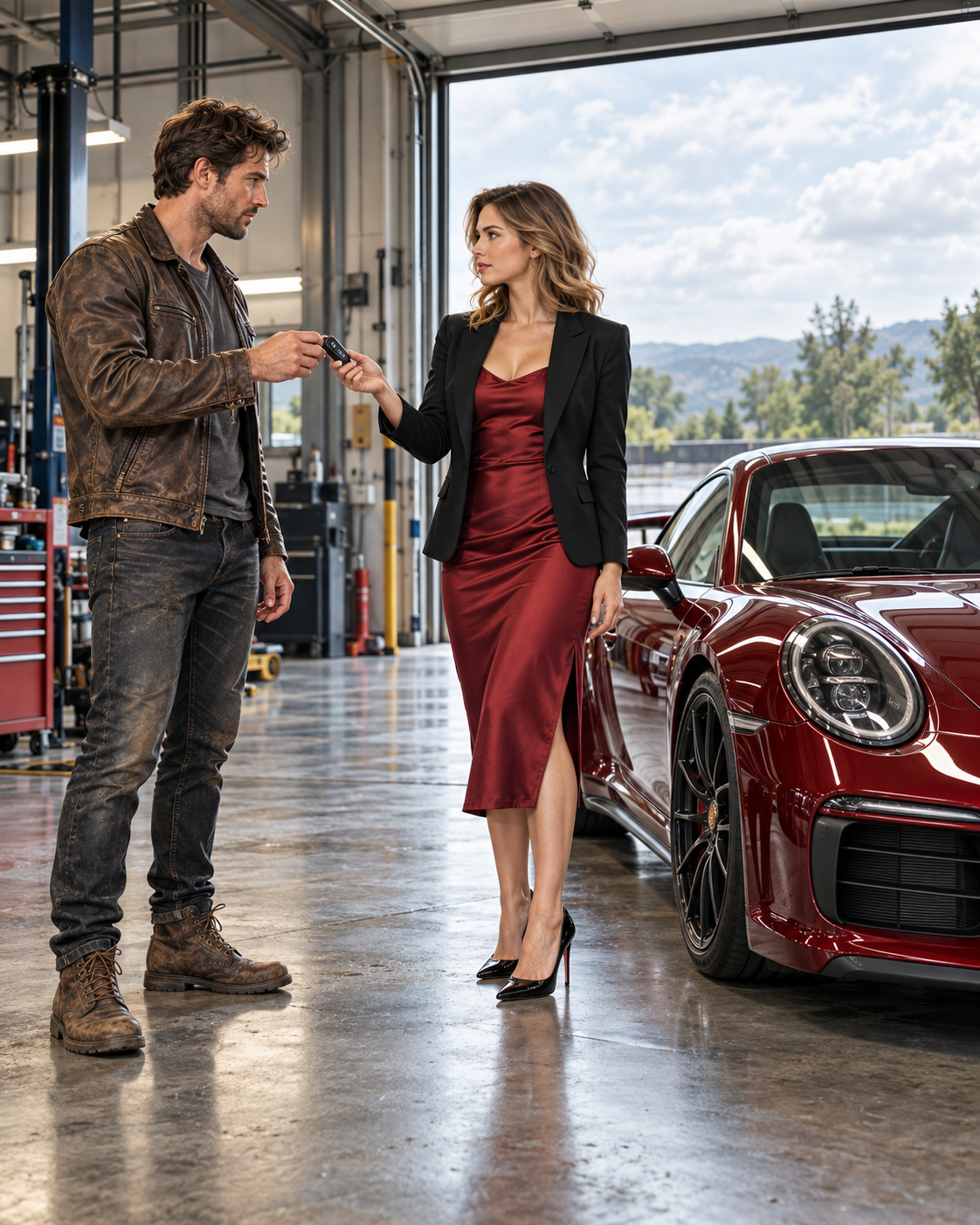
“Everything else is within range.”
“Good. Let’s proceed carefully.”
I connected the authorized service interface and began working through the calibration procedure.
My fingers moved with practiced economy.
I wasn’t trying to impress anyone.
I was trying to make sure the car was safe.
The distinction mattered to me more than it ever had before.
As I worked, memories began surfacing in fragments: a freezing test track in Colorado, a dawn drive through the Italian countryside, an engineer shouting over an engine at full load, and the smell of espresso lingering in a workshop long after midnight.
Then came a memory I had spent years trying not to revisit.
Elena standing in our kitchen, watching me pack another suitcase.
“You promised this would be your last trip,” she had said.
“I know.”
“You always know, Daniel. That’s the problem.”
She hadn’t been angry.
She had been tired.
That was worse.
I forced the memory away and returned to the diagnostic screen.
Robert leaned over my shoulder.
“The deviation is dropping.”
“Don’t interrupt the adaptation sequence.”
He straightened immediately.
Across the room, Julian had stopped smiling.
He stood beside Arthur, whispering urgently, occasionally gesturing toward me as though trying to persuade the CEO that what he was witnessing couldn’t possibly be real.
Arthur didn’t look at him.
He watched my hands.
I completed the adjustment, initiated the prescribed verification sequence, and waited for the system to settle.
The amber warning remained illuminated for several seconds.
Then it disappeared.
Robert stared at the dashboard.
“Fault cleared.”
“Run the verification again,” I said.
He did.
The system returned normal readings.
I checked the final values, reviewed the recorded data, and asked him to confirm that the warning had not reappeared.
“Everything is stable,” he said, his voice barely above a whisper.
I stood slowly, feeling the ache in my knees.
“Then don’t change anything else until you’ve documented the correction and confirmed the car meets its release requirements.”
Robert nodded.
For a moment, nobody moved.
Then Arthur approached.
“What is your name?”
“Daniel Mercer.”
“And what do you do, Daniel?”
“I work at a repair shop.”
Arthur glanced at the Ferrari.
“That isn’t what I asked.”
I wiped my hands on a cloth Robert offered me.
“I fix cars.”
Arthur studied me, perhaps searching for the arrogance he expected to find in someone capable of doing what I had just done.
He found none.
“Where did you learn to work on a system like that?”
I looked at the Ferrari.
“Long story.”
“I have time.”
“I don’t think this is the place to tell it.”
Arthur’s gaze softened slightly.
“Fair enough.”
Then he turned toward the crowd.
“Ladies and gentlemen, I believe our car has just taught us something about expertise.”
Nobody laughed.
Julian stepped forward.
“Arthur, we shouldn’t turn a technical anomaly into a public spectacle. We need to be certain this man didn’t simply get lucky.”
Robert’s head snapped up.
“He didn’t get lucky. He identified the exact fault before I finished the initial diagnostic scan.”
Julian opened his mouth, then closed it.
Arthur continued looking at me.
“Would you and your daughter join me in the VIP area?”
I glanced toward Chloe.
She was still standing beside Clara, clutching the little paper cup of lemonade someone had given her.
When she saw me, she hurried across the floor.
“Dad! Did you fix it?”
I crouched to meet her.
“We found the problem.”
“Are you allowed to touch it now?”
I laughed softly.
“I think we’ve earned a little more respect for the moment.”
She wrapped her arms around my neck.
Arthur watched us with an expression I couldn’t quite interpret.
The VIP area was separated from the main showroom by a velvet rope, the same rope Clara had been preparing to use to escort us away.
Now she held it open for us.
Chloe walked through first, her eyes widening at the tables of food.
There were miniature sandwiches, pastries, fresh fruit, and tiny chocolate desserts arranged on silver trays.
“Dad,” she whispered, “can I have one of those?”
“You can have three.”
She looked horrified by my generosity.
“Three?”
“It’s a special occasion.”
For the first time that afternoon, she smiled without looking over her shoulder to see who might be laughing.
I watched her choose a chocolate pastry and sit beside a window overlooking the city.
The relief I felt was almost painful.
Arthur joined me a few minutes later, carrying two cups of coffee.
He offered me one.
“Your daughter seems happy.”
“She deserves to be.”
“And you?”
I looked at Chloe.
“I’m working on it.”
Arthur didn’t press.
Instead, he asked Robert to send him the diagnostic report and a copy of the car’s calibration history.
Then he turned back to me.
“Daniel, I would like to understand how you recognized that problem so quickly.”
I took a breath.
“I spent nine years in Italy.”
Arthur went still.
“Doing what?”
I looked down at my hands.
“Test and development engineering. Powertrain calibration. Ferrari, in Maranello.”
For the first time that afternoon, the CEO looked genuinely stunned.
“Ferrari?”
“Yes.”
Arthur glanced toward the red SF90, then back at me.
“What happened?”
I didn’t answer immediately.
Across the room, Chloe laughed at something Clara said, a bright, unguarded sound that cut through the weight gathering in my chest.
“Life happened,” I finally replied.
Arthur seemed to understand that the answer was not the whole story.
He didn’t ask another question.
But I saw the decision forming in his eyes.
He was going to find out who I had been.
And once he did, there would be no way to return to the quiet life I had built around the pieces of the man I used to be.
Part 3
By the time Chloe finished her third chocolate pastry, Arthur Sterling had already begun making phone calls.
He didn’t announce what he was doing, and he never asked me for permission.
He simply stepped away from the VIP table, spoke briefly to his executive assistant, and requested access to the archived technical records connected to my name.
I noticed because I had spent enough years around senior executives to recognize the difference between curiosity and an investigation.
I didn’t stop him.
There was nothing in my past that I had stolen, and nothing in my work that I was ashamed of.
But there were things I had left behind for reasons that had nothing to do with professional ambition.
Arthur returned to the table just as Chloe was trying to balance a strawberry on top of a miniature cheesecake.
“Having a good time?” he asked her.
She nodded enthusiastically.
“Your food is really good.”
Arthur smiled.
“I’m glad someone appreciates the catering.”
She giggled.
Then she looked at him with the directness only a child could manage.
“Why were those people mean to my dad?”
Arthur’s smile faded.
He pulled out a chair and sat beside her.
“Sometimes people make mistakes about others because they judge what they can see instead of taking the time to understand what they can’t.”
“Are they going to say sorry?”
Arthur looked toward Julian, who was standing alone near the display wall.
“I think they should.”
Chloe considered this, then returned to her cheesecake.
Children often understand justice more simply than adults.
A few minutes later, Arthur asked if I would walk with him through a quieter corridor adjoining the event space.
We stopped beside a large window overlooking the city.
He held a tablet in one hand.
“I found your name in an old technical archive,” he said.
I said nothing.
“You worked on powertrain development in Maranello for nine years. Several programs you contributed to went on to win major racing championships. Your colleagues described you as one of the most precise calibration engineers they’d ever worked with.”
I stared through the glass at the traffic moving below.
“People tend to remember the results.”
“They remember the people who made those results possible, too.”
“Not always.”
Arthur studied me.
“I also spoke with a man named Samuel Brooks in Colorado. He mentored you early in your career, correct?”
I nodded.
Samuel had taught me to listen before touching a machine.
He used to say that an engine always told you what was wrong, provided your ego wasn’t louder than the noise.
Arthur continued.
“He said you were offered opportunities most engineers would spend their entire lives pursuing. Then you walked away.”
“I didn’t walk away from engineering.”
“You walked away from Ferrari.”
“I walked away from the life attached to it.”
Arthur lowered the tablet.
“Why?”
I had answered that question in my head a thousand times.
Every answer sounded inadequate.
Finally, I told him about Elena.
We had met in Colorado before my career carried us overseas.
She was a schoolteacher who loved old bookstores, mountain roads, and the kind of quiet evenings that left room for conversation.
When we moved to Italy, she tried to embrace my world.
She learned enough Italian to order coffee, made friends in a country where she sometimes felt like an outsider, and celebrated every professional victory as if it belonged to both of us.
But the longer I worked, the more the job consumed me.
There were new prototypes, impossible deadlines, unexpected test failures, and opportunities that seemed too important to refuse.
I kept telling myself that the sacrifices were temporary.
Then Chloe was born, and Elena began asking me for something I couldn’t measure with a stopwatch.
Time.
Not a week in a beautiful hotel after a successful project.
Not an expensive gift brought home from another trip.
Time.
The kind that meant sitting on the floor while Chloe learned to build a tower of wooden blocks.
The kind that meant listening to Elena describe her day without checking my phone.
The kind that meant being present before a moment passed forever.
I had believed there would always be another weekend.
Another vacation.
Another chance to make up for the days I missed.
Then, four years ago, Elena died.
It happened during a winter storm on a Colorado highway while she was driving home with Chloe after visiting her parents.
Chloe survived with minor injuries.
Elena didn’t.
I remembered the hospital corridor more clearly than I remembered the funeral.
I remembered the fluorescent lights.
The cold coffee.
The doctor speaking gently while my mind refused to understand the words.
And I remembered Chloe asking why her mother wasn’t coming home.
I had spent years building machines that could withstand tremendous forces, yet there was nothing I could repair that night.
Nothing I could recalibrate.
Nothing I could take apart and put back together until it worked again.
I returned to Colorado permanently.
I left the international circuit, declined the next position that came my way, and took a job at a neighborhood repair shop.
The owner needed someone who understood engines.
I needed work that ended at a predictable hour.
Most importantly, Chloe needed a father who would be there when school let out.
I learned to pack lunches, braid hair badly enough that Chloe eventually took over, and attend every school performance even when I had to sit in the back wearing work boots.
I stopped following racing news.
I boxed up my old credentials and technical notebooks.
Eventually, I stopped telling people what I had done.
It was easier to say I fixed cars.
It was true, after all.
Arthur listened without interrupting.
When I finished, he looked down at his tablet.
“Samuel said something else.”
I waited.
“He said you were the best engineer he ever mentored, but that your greatest achievement might have been learning when to leave.”
I looked away.
For years, I had wondered whether leaving meant I had failed.
Whether I had abandoned the work that had defined me.
Whether I had become a smaller version of myself simply because I chose a quieter life.
Arthur seemed to read the question in my face.
“You don’t owe the world your entire life because you’re good at something,” he said.
I looked at him.
“That’s a generous thing to hear from a CEO.”
He gave a faint smile.
“I’m trying to become the sort of CEO who remembers it.”
We returned to the showroom together.
The atmosphere had changed.
Robert had finished reviewing the diagnostic records and was speaking with two engineers, both of whom appeared eager to understand the correction.
Arthur asked him to document the issue thoroughly, including the original fault, the adjustments performed, and the verification results.
He made it clear that the car would not be represented as ready for delivery until every required check had been completed.
I appreciated that.
An impressive demonstration meant nothing if the people responsible for the vehicle failed to learn from it.
Then Arthur turned toward Julian.
“Mr. Vance, I’d like you to explain your conduct this afternoon.”
Julian straightened his tie.
“Arthur, I think we’ve all gotten carried away. There was a technical issue, and Daniel happened to recognize it. That doesn’t make the earlier conversation relevant to—”
“You mocked a guest because of his clothes and his vehicle,” Arthur interrupted. “You encouraged others to laugh at him in front of his daughter. Then you questioned his competence after he identified a fault our own team had missed.”
Julian’s jaw tightened.
“I was making a joke.”
“Your jokes revealed what you thought of someone before you knew anything about him.”
The room had become quiet again, but this time the silence belonged to Julian.
Arthur continued.
“I’m reconsidering the partnership discussions between our companies. I expect my business associates to demonstrate sound judgment, especially when they believe nobody important is watching.”
Julian’s face drained of color.
“Surely you’re not going to jeopardize a major commercial relationship over a misunderstanding.”
“No,” Arthur said calmly. “I’m reconsidering it because of the judgment you demonstrated when you thought you understood the situation.”
Julian glanced at me.
For one brief moment, I saw anger beneath his embarrassment.
Then he looked toward Chloe, who was sitting at the VIP table with a napkin tucked beneath her chin, carefully finishing the last crumbs of her cheesecake.
Something in his expression shifted.
Perhaps he finally understood how small he had made himself look.
He approached me a few minutes later.
“Mr. Mercer,” he said stiffly. “I apologize for the way I spoke to you.”
I studied him.
“Do you understand what you did wrong?”
His mouth tightened.
“I made assumptions.”
“You did more than that. You taught a little girl that people deserve less respect when they don’t look wealthy.”
He glanced at Chloe.
She was watching us.
“I shouldn’t have done that,” he admitted.
“No,” I said. “You shouldn’t have.”
I didn’t offer him an easy smile or pretend that his apology erased what had happened.
But I nodded once, because I wanted Chloe to see that accepting an apology didn’t require humiliating the person who gave it.
Julian left shortly afterward.
The event continued, but the attention around the Ferrari was no longer focused entirely on its price or performance.
People began asking Robert questions about the calibration fault.
Others approached me, some with sincere curiosity and some hoping to discover a connection that might benefit them.
I answered a few technical questions, declined several invitations, and kept returning to Chloe.
That evening, Arthur made me an offer.
He wanted me to consult with Sterling Automotive Group on powertrain development and technical validation.
The work would be challenging, the schedule flexible, and the arrangement designed around my responsibilities as a father.
He made no promises about making me famous or restoring some lost version of my life.
He simply offered me the opportunity to use my experience again without asking me to sacrifice everything else.
“I don’t want to leave Chloe without a father who’s there,” I told him.
“Then don’t,” he replied. “Let’s build the position around the life you have, not demand that you abandon it.”
I didn’t accept immediately.
I took the offer home and thought about it for several nights.
I spoke to Chloe about it in the kitchen while she drew pictures at the table.
“Would you have to travel?” she asked.
“Sometimes, but not like before.”
“Would you miss my school things?”
“I won’t promise that I’ll never miss anything. Nobody can promise that. But I’ll make sure being your dad comes first.”
She studied her drawing.
It was a red sports car beside a little blue pickup.
“Could you do both?” she asked.
“Do both what?”
“Fix fancy cars and still pick me up from school.”
I smiled.
“I think we can figure that out.”
She nodded, apparently satisfied with the engineering plan.
Several weeks later, I began working with Arthur’s team on a limited consulting basis.
I spent mornings at the development facility and afternoons at the neighborhood shop when the schedule allowed.
I helped younger engineers understand that diagnostic software was a tool, not a substitute for judgment.
I reminded them that a fault code was a clue, not a verdict.
And whenever a machine behaved strangely, I taught them to listen before they reached for the parts catalog.
Robert became a friend.
He never stopped asking questions about the years I’d spent in Italy, and I never stopped learning from the things he’d discovered in the years I’d been away.
Arthur kept his promise about my schedule.
When Chloe had a school performance, I was there.
When she got sick, I stayed home.
When she wanted to spend Saturday afternoons helping me clean tools at the repair shop, I gave her a small pair of safety glasses and let her ask a hundred questions.
My life became larger again, but it no longer depended on how many people knew my name.
Months after the showcase, Arthur invited Chloe and me to a private test session at the development facility.
The Ferrari SF90 stood on the track beneath a pale morning sky, its red body gleaming in the sunlight.
Robert had completed the remaining verification work, and the car had passed the required checks.
Chloe stood beside me in her little jacket, holding a pair of oversized ear protectors.
“Is that really the car from the showroom?” she asked.
“The very same one.”
“The one you fixed?”
“The one we helped fix.”
She grinned.
Arthur approached with two sets of visitor passes.
“I thought your daughter might like to see what a proper test session looks like.”
Chloe’s eyes widened.
“Can I hear the engine?”
“With the right protection, absolutely,” Arthur said.
We walked toward the track together.
For a moment, I watched the Ferrari sitting in the sunlight and remembered the man I had been before Elena died.
I thought of the years in Italy, the midnight tests, the victories, and the career I had once believed was the only measure of my worth.
Then I looked at Chloe.
She was bouncing on her toes, waiting for the engine to start, her face bright with the uncomplicated excitement I had spent years trying to protect.
I understood something I hadn’t fully understood in the showroom.
I had not lost everything when I left my old life.
I had lost a woman I loved, and no achievement would ever make that loss smaller.
But I had also been given the responsibility of raising the little girl who remained, and that responsibility was not a consolation prize.
It was a life.
A life that deserved my attention as much as any machine, any title, or any applause.
Arthur stood beside me as the technicians prepared the car.
“You know,” he said, “most people would have spent the afternoon proving Julian wrong.”
I watched Chloe adjust her ear protectors.
“I wasn’t trying to prove him wrong.”
“What were you trying to do?”
I thought about her flushed cheeks when the crowd had laughed, and the way she had asked whether we had done something wrong.
“I wanted my daughter to know that she didn’t have to be ashamed of me.”
Arthur followed my gaze.
“I think she already knew that.”
Maybe he was right.
The engine started, filling the track with a deep, powerful roar.
Chloe laughed with delight, and I felt her small hand slip into mine.
She looked up at me.
“Dad?”
“Yeah, sweetheart?”
“Your truck is still my favorite.”
I laughed so hard that, for the first time in years, I felt the weight in my chest loosen.
“Mine too.”
We stood together as the Ferrari rolled onto the track, its engine note rising into the morning air.
I didn’t need to drive it.
I didn’t need to own it.
And I didn’t need a room full of wealthy strangers to recognize what I was worth.
Because the most important person in that showroom had never cared about my jacket, my paycheck, or the name on my old truck.
She had cared whether I held her hand.
And as the sound of the Ferrari faded into the distance, I held on to hers, knowing that the greatest thing I had ever built wasn’t a championship-winning powertrain or a machine capable of extraordinary speed.
It was a life in which my daughter would never have to wonder whether she mattered more than the things I could accomplish.
Some people spend their entire lives trying to prove they are worth something.
I had spent four years learning that I didn’t need to prove it to the world.
I only needed to show up for the people I loved.
And this time, I intended to stay.