At the Quantico Joint Assessment Center, my stepfather, General Howard Marsh, laughed in front of twenty decorated officers
Colonel Prescott did not finish his sentence immediately.
He studied Howard over the edge of the folder, as though deciding how much truth the general could withstand in front of an audience.
The officers around us had gone quiet again, and the silence felt heavier than the applause that had followed my shot.
Howard forced a laugh.
“If this is some kind of joke, Colonel, I assure you I have no patience for it.”
“It isn’t a joke,” Prescott replied.
Then he turned toward me.
“Vivian, do you authorize the release of the restricted summary?”
I knew what he meant before he said another word.
The summary contained information I had spent years trying to forget, including the operation that had ended my military career as I once understood it and changed the way I saw my family.
I glanced at Howard.
He had humiliated me at his estate, dismissed me in front of officers, and treated my silence as proof that he had been right about me all along.
For one bitter moment, I wanted him to feel everything I had carried.
Then I remembered the people whose names were buried inside that file.
“Release the summary necessary to explain my credentials,” I said. “Nothing that compromises the people who served with me.”
Prescott nodded.
“Understood.”
He opened the folder and removed a single page.
“General, Meridian was assigned to special operations units whose personnel records are restricted because disclosure could compromise ongoing missions and the safety of former team members. Her eight deployments were verified, and her long-range performance was evaluated repeatedly under operational conditions.”
Howard stared at the page.
“You’re telling me my stepdaughter was doing this while she was living in my house?”
“I am telling you that her service was real, her credentials are legitimate, and her record is not yours to question.”
Donovan had barely moved since the shot.
He looked at me with an expression I had never seen on his face before, a mixture of admiration, confusion, and something close to shame.
“Why didn’t you tell us?” he asked.
The question should have been easy to answer.
Instead, it opened a door to every dinner where Howard had interrupted me, every holiday when my accomplishments had been turned into jokes, and every occasion when Donovan had watched without asking why I stopped speaking.
“Would you have believed me?” I asked.
His eyes dropped.
He had no answer.
Howard recovered first, or tried to.
“This is absurd. I raised her. If she had accomplished anything of this magnitude, I would have known.”
I almost smiled at that.
“You knew what I allowed you to know.”
“I was protecting you.”
“No,” I said, my voice quiet enough that he had to listen. “You were protecting the version of me that made you comfortable.”
The words landed harder than I expected.
For years, I had imagined confronting him, rehearsing speeches in the dark and inventing perfect sentences that would finally make him understand.
Standing there, I discovered that the truth did not need to be loud.
It only needed to stop apologizing.
Prescott closed the folder.
“The general’s family relationship has no bearing on this assessment. However, his conduct toward an authenticated operator and his attempt to interfere with the range procedure will be documented.”
Howard’s face hardened.
“You intend to file a report against me?”
“I intend to record what happened accurately.”
For the first time that morning, Howard had no immediate response.
A senior officer approached the range master and began discussing the evaluation schedule, while another quietly escorted the rifle back to its secured station.
The world was moving on without Howard’s permission.
I should have felt triumphant.
Instead, I felt tired.
The applause, the astonishment, the sudden respect in the officers’ eyes could not return the years I had spent believing that affection was something I had to earn by becoming smaller.
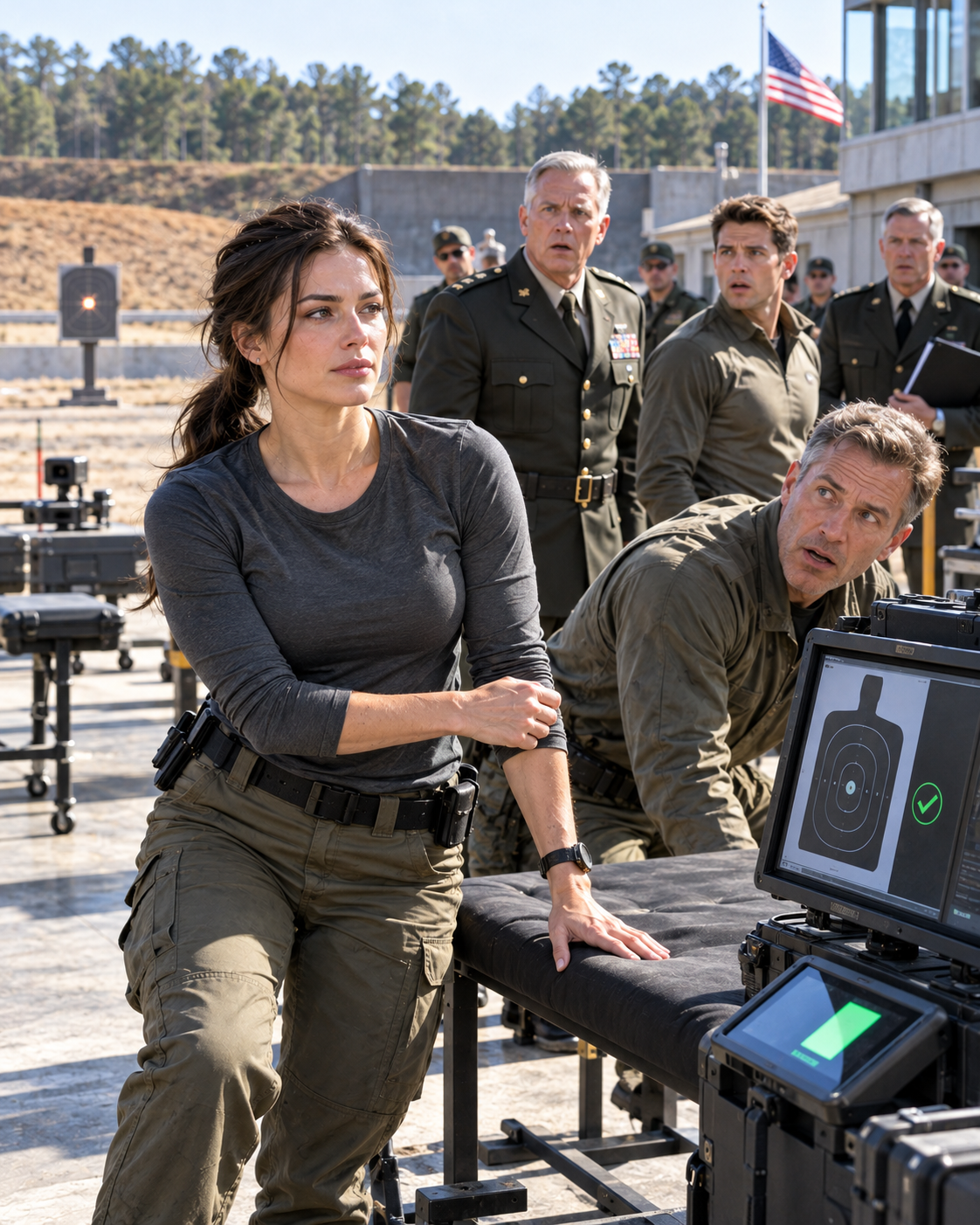
Prescott noticed my expression.
“Walk with me,” he said.
We moved away from the firing line, toward a row of bare trees beyond the observation area.
When we were out of earshot, he lowered his voice.
“I owe you an explanation.”
“About what?”
“The reason I came here today.”
He handed me the folder again.
Beneath the credentials summary was a sealed document bearing a classification marking and an authorization code I recognized immediately.
My stomach tightened.
“That operation was closed,” I whispered.
“The field portion was closed,” Prescott corrected. “The administrative review was never completed.”
I looked at him.
“What review?”
He took a breath.
“An independent inquiry has reopened questions surrounding the final deployment of your team.”
The wind moved through the trees, carrying the distant metallic ring of another target being reset.
For an instant, I was no longer standing in Virginia.
I was back in a darkened operations room, listening to a radio that had gone silent at the worst possible moment.
I remembered rain against a transport window, the glow of coordinates on a screen, and the voice of a teammate telling me to hold position.
Then came the order that had never made sense.
Withdraw.
No explanation.
No confirmation that the extraction team had arrived.
Only silence.
My unit had completed the mission, but one of our people had never come home.
Captain Daniel Reed had been the last person I spoke to before communications failed.
For years, I had been told that the loss resulted from a rapidly changing threat environment and an unavoidable delay.
I had accepted the official conclusion because there had been no evidence to challenge it, and because the people who survived were expected to carry on.
Now Prescott was telling me that somebody had begun asking questions again.
“Why now?” I asked.
“An archived communication was recovered during a separate review. It suggests the withdrawal order may have been altered after it was issued.”
My fingers tightened around the folder.
“Altered by whom?”
“We don’t know yet.”
“Then why bring this to me?”
“Because the recovered record contains your callsign, and because your original statement described a discrepancy that was never resolved.”
I remembered writing that statement in a windowless room after the deployment.
I had reported the timing inconsistency, the broken authentication sequence, and the fact that the withdrawal instruction carried a confirmation marker I had never seen used by our command.
My concerns had been acknowledged, then buried beneath a final report.
I had been told not to speculate.
I had obeyed.
Not because I stopped wondering, but because I could not bear the thought that Daniel’s death might have been preventable.
Prescott watched me carefully.
“Vivian, this is not a request to return to operations. You’re not being ordered into the field. We need your help understanding what you saw and what you remember.”
I looked down at the sealed document.
“I remember enough.”
“Then I need you to understand something else. Someone with access to the original records has requested that your identity remain excluded from the review.”
A cold sensation traveled down my spine.
“Who?”
“The request came through an office associated with the same chain of command that authorized the original withdrawal.”
It was not proof of wrongdoing.
I knew that.
But it was enough to make every old uncertainty feel suddenly alive.
Before I could answer, a voice came from behind us.
“Vivian?”
Donovan stood several feet away, his hands shoved into his pockets.
Prescott gave me a questioning look.
“It’s all right,” I said.
The colonel stepped away, leaving the two of us beneath the trees.
Donovan looked toward the firing line, where Howard was speaking sharply to another officer.
“He’s furious,” he said.
“I imagine he is.”
“He thinks you deliberately embarrassed him.”
I turned to face my stepbrother.
“Did I?”
Donovan rubbed his forehead.
“No. I suppose he embarrassed himself.”
For a moment, we were children again, standing in the hallway of Howard’s estate while the adults argued behind closed doors.
Donovan had always been the one praised for his potential, while I was told to be realistic.
I had resented him for years, though part of me understood that he had grown up inside the same system of approval and fear.
“Why did you never tell me you were serving?” he asked.
“Because I wanted one part of my life that didn’t belong to this family.”
He flinched.
“I didn’t know it was that bad.”
“You didn’t ask.”
He looked away, and the silence between us became its own confession.
After a while, he said, “When I couldn’t take the shot, I thought Dad would finally see that I wasn’t ready. Instead, he looked at you as if you were the problem.”
“He has always needed someone to be the problem.”
Donovan swallowed.
“I’ve done that too, haven’t I?”
I could have told him yes and listed every time he had laughed along with Howard.
I could have made him feel the weight of it.
Instead, I said, “You can decide what you do from now on.”
He nodded slowly, as though the answer hurt more because I had not offered him an easier one.
We returned to the observation area separately.
Howard was waiting near the entrance, his expression carefully composed.
“Vivian, we need to discuss this privately.”
“For what purpose?”
“I’m your family.”
The words would once have been enough to make me follow him.
Now they sounded like a claim he believed he still owned.
“Then you should have treated me like family when nobody was watching.”
His face changed.
For a moment, I saw something behind the anger that looked almost like regret.
“I never wanted you to fail,” he said.
“You made sure I never had to fail in front of you. You never gave me the chance to succeed, either.”
He opened his mouth, but no words came.
I walked past him.
That afternoon, Prescott arranged a secure interview for the following week, and I left Quantico without giving the officers another demonstration.
I had nothing to prove to the people who had witnessed my shot.
The difficult part was still ahead.
Over the next several days, I reviewed my old notes, reconstructed the sequence of communications, and compared what I remembered with the newly recovered records.
I was careful not to jump to conclusions.
A missing confirmation could indicate a technical failure. An altered timestamp could result from a transfer between systems. Suspicion was not evidence, and a dead teammate deserved better than a theory built from grief.
But one detail refused to fit.
The withdrawal order had been authenticated through a channel that should have been unavailable at the time it was sent.
Someone had either used a valid authorization in an invalid way or created a record that made it appear that someone had.
The review team found a second discrepancy in the archived logs.
A message acknowledging the order had been recorded before the order itself was transmitted.
It did not establish who had manipulated the sequence, but it showed that the official timeline could not be trusted without further verification.
When I learned that, I sat alone at my kitchen table for nearly an hour.
I had spent years trying to make peace with the idea that Daniel’s death was the result of circumstances no one could control.
Now I had to consider the possibility that someone had made a decision, hidden it, and allowed his family to believe there was nothing more to learn.
I wanted answers.
I also feared what those answers might do to the few memories of Daniel I had managed to keep untouched.
During the formal review, Prescott asked me to describe the final minutes of the deployment.
I told the investigators what I remembered, including the unusual authentication marker and the moment the withdrawal instruction arrived.
They asked whether I could identify the person responsible.
“No,” I said. “I can identify a discrepancy. I cannot identify its author without evidence.”
That answer earned a long look from the lead investigator.
It was the same answer I would have given in the field, where a confident mistake could cost lives.
The inquiry continued for weeks.
Howard did not call me.
Neither did I call him.
Then, one rainy evening, Donovan appeared at my apartment carrying a small cardboard box.
“I found something in Dad’s study,” he said.
I stared at the box.
“Why were you looking through his study?”
“Because he asked me to find the paperwork from his old command appointments. I came across this behind a locked drawer.”
He placed the box on my table but did not open it.
“I didn’t know what it was. I only recognized your name.”
Inside lay a faded photograph of a special operations team standing beside a transport aircraft.
The faces were younger, exhausted, and unfamiliar to anyone who had not known that world.
I recognized Daniel immediately.
I recognized myself beside him.
And at the far edge of the photograph stood a senior officer whose name I had seen in the inquiry documents.
Howard had never mentioned knowing him.
Beneath the photograph was a folded letter, its envelope bearing a date from several months after Daniel’s death.
The letter contained no operational details, only a brief acknowledgment that a sensitive matter had been referred for internal review and that further correspondence should be handled through official channels.
It was not proof that Howard had been involved.
It was not even proof that he had known what the review concerned.
But the letter established that someone had contacted him about a matter connected to the same command structure.
Donovan watched me read it.
“Do you think Dad knew?”
“I don’t know.”
“Would you ask him?”
I folded the letter carefully.
“Yes.”
Howard agreed to meet us the next afternoon at his estate.
The same dining room where he had once told twenty officers that I belonged in the kitchen looked smaller than I remembered.
He stood beside the fireplace, hands clasped behind his back, trying to reclaim the authority that had always come naturally to him.
When I placed the photograph and letter on the table, the color drained from his face.
“Where did you get these?”
“Donovan found them in your study.”
He looked at my stepbrother, then back at me.
“Those documents are old.”
“That isn’t an answer.”
For several seconds, Howard seemed to struggle with a decision.
Then he sat down.
“I knew the officer in that photograph,” he said. “We served on a joint planning committee years ago.”
“Did you know about the inquiry into Daniel Reed’s death?”
His eyes lifted sharply.
“I knew there had been questions.”
“Did you know the withdrawal order might have been altered?”
“No.”
The answer came too quickly, and we all heard it.
Howard closed his eyes.
“I was told the review had found no misconduct. I was told that pursuing the matter would compromise other operations and accomplish nothing.”
“Who told you?”
He gave us the name of a former senior official, a man whose role the investigators had already begun examining.
“Did you contact anyone to keep my identity out of the new review?”
“No. I swear to you, Vivian, I did not.”
I studied his face.
I wanted to believe him, but belief was no longer something I could offer merely because someone asked for it.
“Then you’ll tell the investigators everything you remember.”
He nodded.
“I will.”
It was the first time I had ever given Howard a direction without wondering whether he would punish me for it.
The inquiry eventually established that the original records had been mishandled and that an unauthorized change had obscured the sequence of communications surrounding the withdrawal order.
The evidence did not establish that Howard had ordered the change, and no responsible investigator claimed that it did.
The review identified serious failures in recordkeeping and oversight, and it referred the evidence of possible deliberate interference for further investigation.
The truth came in fragments, not as a single dramatic confession.
Some questions were answered.
Others remained open.
Daniel’s family received a formal acknowledgment that the original review had been incomplete, along with a commitment to correct the record where the evidence supported it.
When I visited his mother, she held my hands and asked whether her son had known that we were trying to bring him home.
I told her the truth.
“I believe we did everything we could with the information we had. But I won’t pretend we understand every decision that was made.”
She cried, and so did I.
There was no perfect sentence that could return her son.
There was only the promise that his death would no longer be hidden behind a conclusion nobody had adequately tested.
Months later, I returned to Quantico for another assessment.
The range was familiar, but I was different.
I no longer felt compelled to demonstrate my worth every time someone doubted me.
Major Ellis greeted me with a respectful nod, and Prescott informed me that my testimony had helped investigators identify questions that should never have been dismissed.
Donovan had begun working to improve his own skills, not to compete with me but to understand what real preparation demanded.
He called occasionally, and our conversations slowly became more honest.
Howard’s change was less dramatic.
He did not transform overnight into a gentle father, and an apology could not erase decades of contempt.
But he began asking questions instead of making assumptions.
One evening, he called and said, “I don’t know how to make up for what I did.”
I stood by my window, watching headlights move through the rain.
“You can’t give me back the years,” I told him. “But you can stop treating the truth like something you have to control.”
He was quiet for a long time.
“I’ll try,” he finally said.
For once, I believed that he understood the difference between trying and demanding forgiveness.
I did not promise him that everything would be all right.
I promised only that if he continued to change, I would judge him by what he did next.
On the anniversary of Daniel’s death, I visited the memorial where his name had been engraved among those who never returned.
I laid a small white flower beneath it and stood in silence.
I thought about the woman who had once believed that being underestimated was a wound she had to hide.
I understood now that my silence had protected some things worth protecting, but it had also allowed other people to mistake my restraint for weakness.
I could not control what others believed about me.
I could control whether I continued to abandon my own voice to keep them comfortable.
As I turned to leave, my phone vibrated.
A message from Prescott appeared on the screen.
The inquiry had received another authenticated record, he wrote, and it might resolve one of the remaining questions about the withdrawal order.
Then came a second message.
The record contained a name the team had not previously considered.
I read it twice, my breath catching as the past opened beneath my feet once more.
I called Prescott immediately, but he did not answer.
A moment later, an unknown number appeared on my screen.
The message contained only seven words.
“Meridian, stop looking. Daniel wasn’t the only one.”
I stood beneath the memorial lights, staring at the screen until it went dark.
For the first time since the inquiry began, I felt the old fear return—not the fear of being dismissed, and not the fear of discovering that I had been wrong, but the fear that someone was still trying to bury the truth.
I slipped the phone into my pocket and looked once more at Daniel’s name.
Then I walked toward the waiting car, knowing that whatever came next, I would no longer mistake silence for peace.
And somewhere beyond the gates, someone already knew I had started looking again.