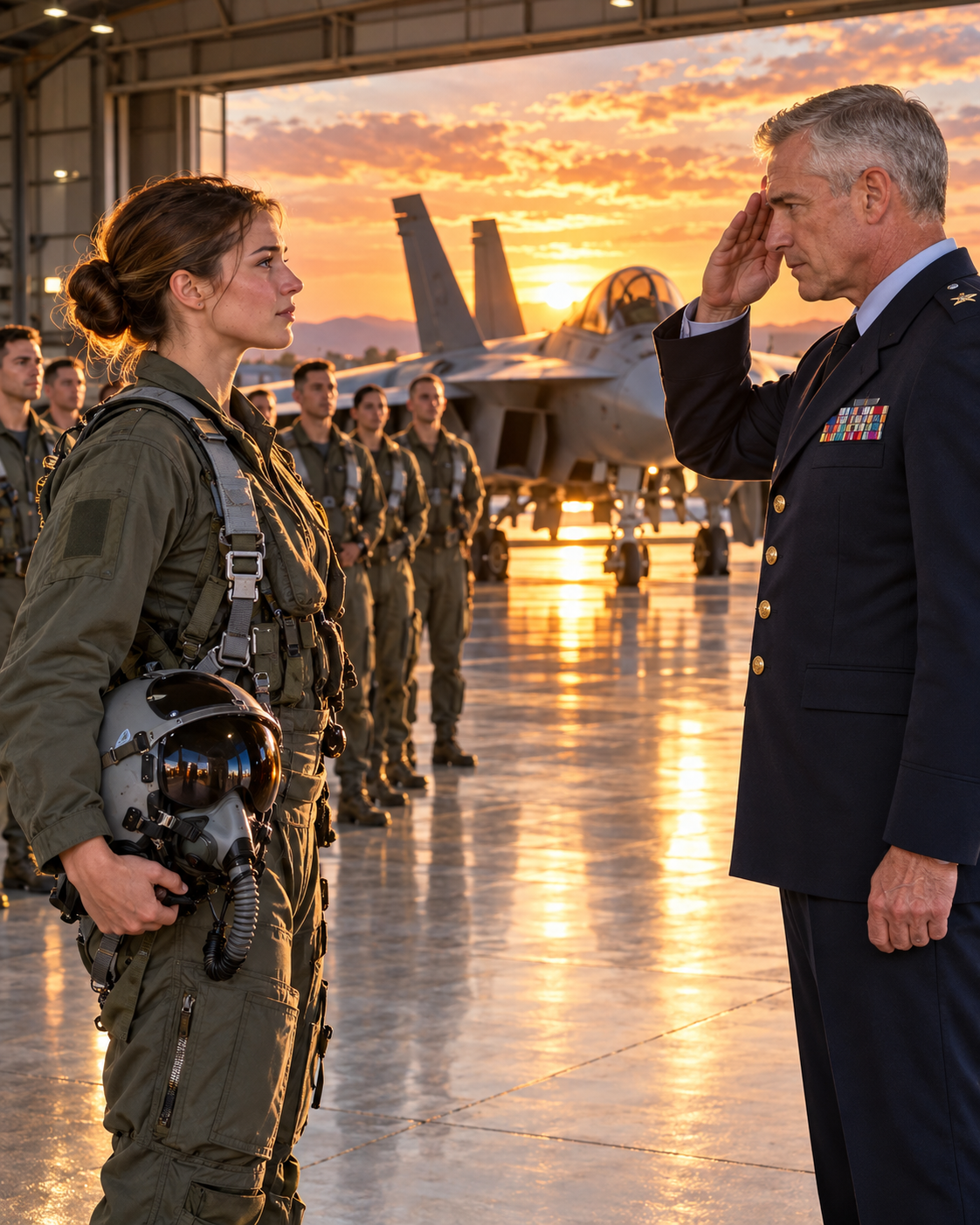
At the Pacific carrier hangar, General Mercer ignored every officer in the room and walked straight toward me
Part 2
The moment I broke formation, the cockpit became strangely quiet.
No jokes.
No opinions.
No voices except the breathing of the men who knew what I had just done.
I switched channels and called Toby again.
“Lieutenant Mercer, this is Navarro.”
Static answered me.
Then, barely audible, “I can’t see anything.”
“You don’t need to see anything.”
“My systems are dead.”
“Not all of them.”
There was a long pause.
“What?”
“Listen to me.”
I pulled up the backup electrical sequence I had memorized so many nights before.
“You’re going to breathe first.”
“I can’t.”
“Yes, you can.”
“I’m going down.”
“I know.”
The words sounded brutal, even to me.
But panic needed something stronger than comfort.
It needed structure.
“Mercer, breathe in.”
I heard him struggling.
“Again.”
He inhaled.
“Good. Now listen carefully.”
The storm shook my aircraft hard enough to make my teeth hit together.
Lightning flashed somewhere beyond the clouds.
For a few seconds, I saw nothing but white.
I recalculated his position.
His aircraft was descending toward the ocean.
“Toby, check the backup bus.”
“It’s not responding.”
“Don’t touch anything else.”
“I’m losing control.”
“You’re not losing control yet.”
I could hear the terror in his breathing.
I knew that terror.
Not from being inside a failing aircraft.
From being alone with the possibility that you weren’t good enough.
That fear had lived inside me for years.
“You’re going to tell me what you have.”
“Partial control.”
“Good.”
“My standby instruments are intermittent.”
“Good.”
“My heading is unstable.”
“Then we’re going to make it stable.”
There was silence.
Then he whispered, “I don’t think I can do this.”
I closed my eyes for half a second.
“Yes, you can.”
“What if I can’t?”
“Then I will stay with you until you do.”
The storm threw my aircraft sideways.
I corrected.
Then I began calculating.
His altitude.
His descent rate.
His heading.
The carrier’s position.
The wind.
The crosswind.
The time available.
Every number mattered.
Every second mattered more.
“Mercer, give me your altitude.”
He answered.
I calculated.
“Reduce your descent rate.”
“I can’t see the instruments.”
“Then use your standby reference.”
“I can’t.”
“You can.”
His voice cracked.
“Why do you sound so calm?”
I almost laughed.
“I’m not calm.”
“What?”
“I’m just busy.”
For the first time, he laughed.
It was weak.
But it was enough.
I guided him through the first correction.
Then the second.
His aircraft stabilized for six seconds.
Then the nose dropped again.
“Mercer, pull slightly.”
“How much?”
“Two degrees.”
“Two?”
“Two.”
He did it.
The descent slowed.
I could hear the carrier deck crew coming over the channel.
They were preparing for an emergency recovery.
The storm was still thick around us.
“Toby, you’re going to have one chance.”
“Understood.”
“You will not chase the runway.”
“What?”
“You will fly the instruments.”
“But I can’t see the deck.”
“You don’t need to see it yet.”
I calculated the crosswind.
“Turn three degrees left.”
He did.
“Hold.”
Static.
“Hold.”
His breathing became slower.
Then the clouds began to thin.
A faint gray shape appeared below him.
The carrier.
“Toby, do you see it?”
“Not clearly.”
“Keep descending.”
“I have the deck.”
“Stay with it.”
The aircraft came in too high.
I told him to correct.
Then the crosswind caught him.
“Right.”
He moved.
“More.”
The nose drifted.
“Easy.”
The deck rushed toward him.
“Hold.”
The aircraft slammed onto the carrier.
For one terrifying second, I thought he had missed the arresting wire.
Then the wire caught.
The aircraft lurched violently.
Metal screamed.
The jet stopped.
Silence filled the radio.
Then Toby whispered, “I’m down.”
I exhaled.
“Welcome back.”
He started laughing.
Then he started crying.
I heard both.
“Captain Navarro?”
“Yes?”
“Thank you.”
I looked at the storm outside my canopy.
“You did the flying.”
I returned to the carrier exhausted.
My hands were shaking when I climbed down.
Nobody said anything.
The flight deck crew looked at me differently.
Not warmly.
Not yet.
But differently.
Colonel Sterling was waiting near the edge of the deck.
He looked at me for a long moment.
“Why did you know that backup procedure?”
I hesitated.
“Because I studied it.”
He nodded.
“Apparently you studied the right thing.”
That was all.
I didn’t know what happened inside Toby’s cockpit after that.
I didn’t know who his father was.
I didn’t know that the audio from his emergency transmission had been preserved.
And I certainly didn’t know that General Raymond Mercer, a three-star commander whose name could make entire rooms stand straighter, was listening to it.
Days later, our squadron was ordered into formation inside the main hangar.
Everyone assumed it was a routine address.
Two hundred people stood in rigid rows.
Pilots.
Crew chiefs.
Officers.
Technicians.
I stood near the back.
Ghost.
Still the outsider.
Still the woman who had once been laughed at for studying backup systems too obsessively.
Colonel Sterling entered first.
Then several senior officers.
Then General Mercer.
The room became perfectly still.
He walked past the front row.
Past the squadron leaders.
Past the officers who had spent years deciding who belonged.
Then he kept walking.
Straight toward the back.
Toward me.
I felt every eye in the hangar follow him.
He stopped three feet in front of me.
For a second, he said nothing.
Then General Raymond Mercer raised his hand.
And saluted me.
The room seemed to stop breathing.
I stared at him.
He lowered his hand slowly.
“My son is alive because of you.”
Nobody moved.
Then he said the words that changed everything.
“Captain Sofia Navarro.”
My real name sounded strange in that room.
Almost sacred.
He continued.
“I listened to the entire recording.”
His eyes moved briefly across the squadron.
“I also learned how some of you chose to address her.”
No one looked at me.
They looked at the floor.
The walls.
Their boots.
Anywhere but my face.
General Mercer turned back toward me.
“You were never a ghost.”
His voice was quiet.
“You were simply standing among people who were too blind to see you.”
For the first time in two years, I felt the weight of that call sign leave my shoulders.
Not because someone had ordered them to stop using it.
Because it no longer meant what they intended.
It had become proof that I had survived them.
Part 3
After the general left, nobody spoke for several seconds.
Then Colonel Sterling stepped forward.
“Dismissed.”
The formation broke.
But something had changed.
Not dramatically.
There were no sudden hugs.
No apologies from every person who had laughed.
Real life rarely gives you that kind of clean ending.
Instead, the next morning, the mess hall was quieter.
When I entered, conversations paused.
A pilot looked up.
Then he nodded.
I nodded back.
That was enough.
Toby found me later beside the aircraft.
He stood there awkwardly.
“I owe you something.”
“You don’t.”
“I do.”
He rubbed the back of his neck.
“You saved my life.”
“I helped you save it.”
He smiled.
“That’s what you told my father.”
“I wasn’t going to let him think you were helpless.”
Toby laughed.
“That’s exactly why I want you as my wingman.”
I stared at him.
“You serious?”
“Completely.”
I smiled.
“Then stop calling me Ghost.”
He looked confused.
“Why?”
“Because you know my name.”
He nodded.
“Captain Navarro.”
“Exactly.”
From then on, Toby flew beside me.
The same pilot who once nearly disappeared into a storm became one of the people I trusted most in the air.
We flew missions together.
We trained together.
We made mistakes together.
And every time the weather turned ugly, I remembered the night when a frightened voice had come through my headset and asked if he could survive.
I remembered what I told him.
You can.
Years passed.
There were medals.
Commendations.
Promotions.
Photographs.
Ceremonies.
Articles.
People eventually learned the story and repeated it until it sounded almost too perfect to be true.
But the truth was much quieter.
There had been no perfect moment.
No magical transformation.
Just a scared young pilot, a failing aircraft, a storm, and a woman who had spent sixteen years preparing for the one moment nobody else could have predicted.
Sometimes I think about my grandmother.
She never saw the carrier deck.
She never heard the emergency transmission.
She never met General Mercer.
She never knew how many nights I had cried in silence because someone told me I didn’t belong.
But she knew something important before I did.
She knew that promises are not made powerful by how loudly you announce them.
They become powerful when you keep them after the world gives you every reason to quit.
Years after the incident, I returned to her old backyard.
The house was smaller than I remembered.
The trees were taller.
The folding chair was gone.
I stood in the same patch of grass where I had once watched those two fighters tear across the sky.
A jet passed overhead.
I looked up.
For a moment, I was seven again.
Barefoot.
Amazed.
Certain.
I remembered telling her, “One day, I’m going to fly one.”
I smiled.
“I did.”
But the older I became, the more I understood that earning wings had never really been the hardest part.
The hardest part was learning not to measure my worth by the people who refused to recognize it.
I had spent years believing that if I worked hard enough, studied long enough, and performed perfectly enough, they would finally decide I belonged.
I was wrong.
Belonging was never something they had the power to give me.
It was something I had to stop asking them for.
That night over the Pacific taught me something even deeper.
When lives are hanging in the balance, nobody cares about your nickname.
Nobody cares who invited you into the mess hall.
Nobody cares whether you fit their idea of an insider.
They care whether you can stay steady when everything else is falling apart.
They care whether you know what to do when the instruments go dark.
They care whether you can hear fear in another person’s voice and answer it with something stronger.
Years later, I still kept the old rejection letters.
I kept the engagement ring too.
Not because I wanted the past back.
Because I wanted to remember the person I had been before I understood what those losses were teaching me.
Every closed door had convinced me that my future depended on someone else saying yes.
Every rejection had taught me to keep moving without permission.
Every insult had forced me to decide whether I believed the person saying it or the child in my grandmother’s backyard.
I chose the child.
I chose the sky.
And somewhere along the way, I stopped needing anyone else to understand why.
People sometimes ask what the most important award of my career was.
They expect me to name a medal.
A promotion.
A citation.
They are usually surprised by my answer.
It was the moment General Mercer walked through that hangar.
Not because a powerful man saluted me.
Because for the first time, two hundred people who had spent years looking past me were forced to see what had always been there.
Not a ghost.
Not an outsider.
Not a woman who had somehow slipped into a place she didn’t deserve.
A pilot.
A professional.
A person who had prepared when nobody was watching.
And when the moment finally came, preparation had spoken louder than every insult.
That is the part of the story I carry with me.
Not the applause.
Not the medals.
Not even the rescue.
The silence before the salute.
Because in that silence, I understood something I wish I had known at seven.
You do not prove your worth by convincing people to believe in you.
You prove it by becoming the kind of person who can still do what is right when nobody believes in you at all.
And sometimes, the people who tried hardest to make you feel invisible are the ones who eventually have to stand in silence and watch the whole world learn your name.