At the Nebraska State Capitol, my uncle publicly called me a disgrace to our family while two hundred people watched
# Part 2
For a moment, the Capitol ballroom seemed to tilt beneath my feet.
Abel Quintanilla had been one of the few people who recognized my potential before I had learned how to recognize it myself.
During flight training, I had been the only woman in a class of men who assumed I had been admitted to fill a quota.
I responded by working until my hands cramped, studying until sunrise, and practicing emergency procedures until I could perform them while exhausted.
Abel never offered me sympathy.
He offered me standards.
“Nobody gets to lower the bar for you, Henderson,” he once told me. “But nobody gets to raise it just because they’re uncomfortable seeing you clear it.”
I had carried those words through every deployment.
Now he stood before my family, holding a folder he had apparently brought for the occasion, and looked at me with the quiet pride of someone who had watched a frightened young officer grow into a leader.
“Colonel Tavares has given you the story of Dustoff 61,” he said. “I’ll give you the facts.”
He opened the folder.
“During the Kunar Valley operation, Lieutenant Maya Henderson was serving as aircraft commander on a medical evacuation mission. Eleven soldiers were pinned down after an engagement, with casualties increasing and the available approach corridors exposed to hostile fire.”
The room was so quiet I could hear the ventilation system humming above us.
“The original rescue plan had been compromised. Visibility deteriorated, communications became unreliable, and the terrain left the extraction team with almost no margin for error.”
Abel lifted his eyes from the page.
“Lieutenant Henderson identified a narrow approach through the valley, coordinated with the ground team, and brought the aircraft into the landing zone under fire. Her crew loaded the wounded while she maintained control of the aircraft and adjusted the approach as conditions changed.”
He did not embellish.
He did not describe me as fearless.
He knew better than anyone that I had been terrified.
“The aircraft sustained damage during the operation,” he continued. “But she got those eleven soldiers out. Colonel Tavares was among them.”
Mateo Tavares nodded, his jaw tight.
“I was bleeding through my uniform,” he said quietly. “I remember asking the medic whether we were going to make it. He told me to save my breath.”
A few people gave a nervous laugh, but it faded quickly.
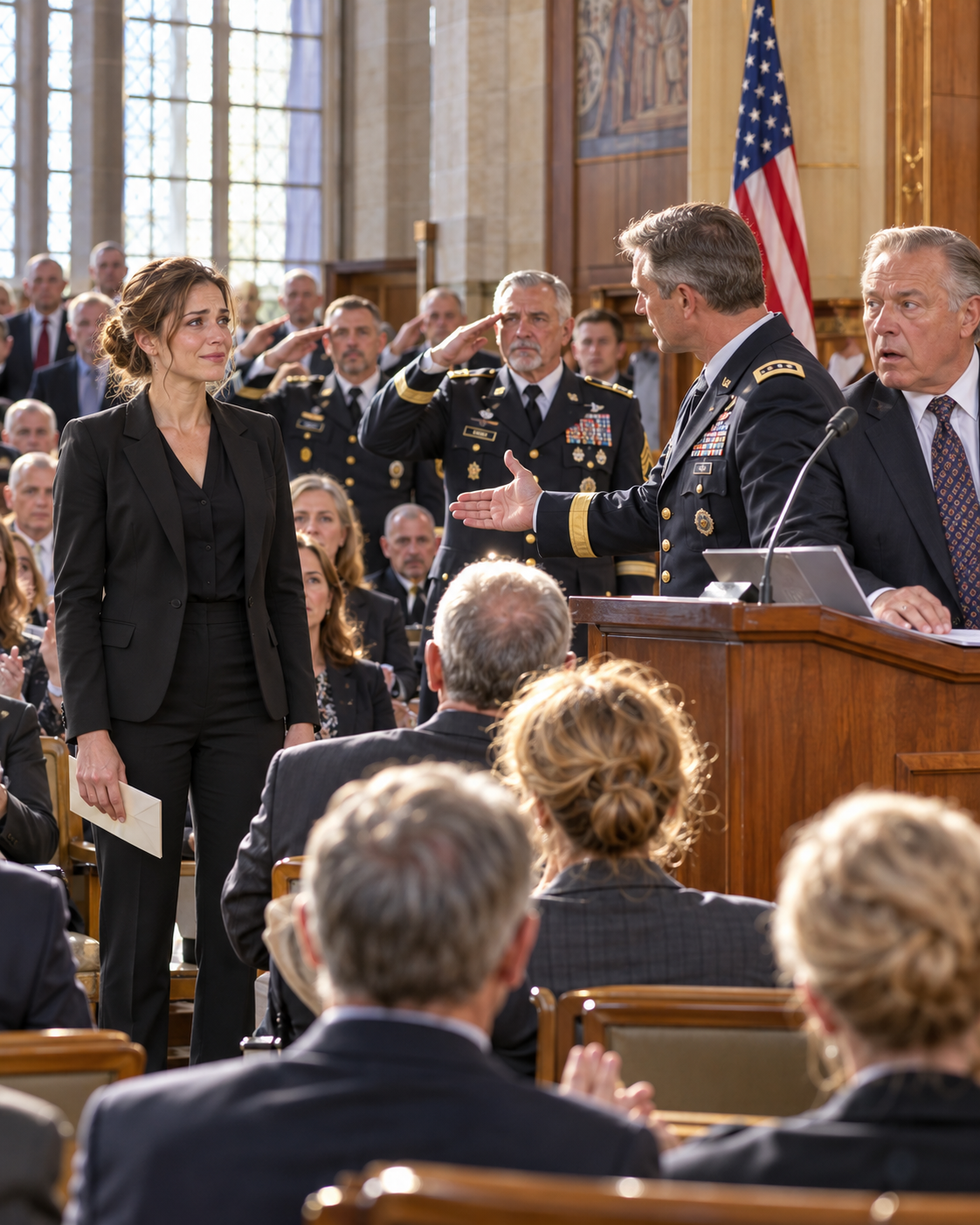
“Then I heard the pilot over the headset. She said, ‘Nobody gets left behind tonight.'”
My throat tightened.
I remembered that voice too.
It had been mine, though at the time I barely recognized it as my own.
Tavares stepped away from the podium.
“I never learned her name until later. By then, she’d already moved on to another assignment. I wrote letters. I asked people to find her. Every time I received a response, I was told she was serving somewhere else.”
He looked at me with an expression that carried the weight of years.
“I wanted to thank her before the memory faded. It never did.”
My eyes burned.
I had never imagined that one of those eleven soldiers would remember a sentence I had spoken while trying to keep my own fear from spreading through the aircraft.
Lowell cleared his throat.
“That’s certainly an impressive story,” he said, attempting to recover his composure. “But surely there are many people involved in a mission like that.”
“There are,” Abel replied. “And every one of them deserves recognition.”
He closed the folder.
“But this gathering is about the people who built a legacy. If we’re going to discuss responsibility, perhaps we should also discuss the responsibilities Maya has carried since that night.”
Lowell’s expression hardened.
Abel turned toward the audience.
“Lieutenant Colonel Maya Henderson currently commands an aviation battalion at Fort Riley. She is responsible for the training, readiness, and leadership of soldiers who depend on her judgment every day.”
A murmur spread through the room.
My cousin, who had spent the afternoon posing beside the Whitlock family portraits, stared at me as though he had just discovered that I had been living under a different name.
Abel continued.
“Her promotion was earned. Her command is not ceremonial. And the people who serve under her do not measure her worth by whether she attends family gatherings.”
That sentence struck deeper than I expected.
For years, I had imagined returning to Alder Grove with some accomplishment large enough to silence my uncle.
A promotion.
A medal.
A story dramatic enough to force everyone to reconsider the girl they had dismissed.
But standing there, listening to Abel defend my career, I realized that the fantasy had always contained a hidden cruelty.
I had been trying to earn a verdict from people who had never intended to judge me fairly.
Tavares returned to the podium.
“Lieutenant Colonel Henderson,” he said, “on behalf of the men who came home that night, thank you.”
He saluted.
For a heartbeat, nobody moved.
Then Abel snapped to attention and returned the salute.
A retired general seated in the front row stood.
Another officer rose beside him.
Within seconds, nearly half the room was on its feet, military hands lifting in a sharp, disciplined gesture of respect.
I had been saluted before.
I had received decorations, commendations, and the kind of praise that could make a person uncomfortable if she believed it was meant for someone more extraordinary.
But this was different.
These people were not saluting a story.
They were saluting the responsibility I had carried when no one was watching.
I returned the salute, my eyes fixed on Tavares, and held it until he lowered his hand.
When I finally looked toward Lowell, his face had lost every trace of its practiced confidence.
He looked not merely embarrassed but bewildered, as if the world had violated an agreement he had never realized existed.
He had assumed I was insignificant because I had never fought him for attention.
He had mistaken restraint for weakness.
And now he had no idea what to do with a room full of people who respected the very life he had mocked.
Lowell leaned toward me when the applause ended.
“Maya,” he said under his breath, “you could have told us about all this.”
I stared at him.
“I tried telling you I was a pilot.”
“That isn’t what I mean.”
“I know.”
His mouth tightened.
“You didn’t have to let me stand up there looking foolish.”
The words were so familiar that for a moment I nearly laughed.
Even now, even after the truth had entered the room and rearranged everything, he was more concerned with his humiliation than the years he had spent humiliating me.
I looked past him at the portraits.
“That was never my responsibility, Uncle Lowell.”
Before he could answer, the committee president approached me.
Her name was Margaret Ellison, a retired county judge with silver-rimmed glasses and a careful manner that suggested she had spent her career listening to people explain why rules should not apply to them.
“Lieutenant Colonel Henderson,” she said, “I understand you have something to deliver to the committee.”
I reached into my purse.
My mother’s envelope felt strangely warm against my palm.
For six weeks, I had carried it like a final instruction from someone who knew she was leaving me a burden as well as a gift.
“Yes, ma’am,” I said. “My mother asked me to give you this personally.”
Lowell stepped between us.
“There’s no reason to turn a family celebration into a legal dispute.”
Margaret looked at him.
“Mr. Whitlock, if this concerns the family’s historical records, the committee has a duty to receive it.”
“It concerns private family matters.”
“Then the committee can determine whether those matters fall within its authority.”
He turned to me, his voice dropping.
“Don’t do this, Maya.”
I had heard those words before, usually when someone feared that a truth might cost them something they believed they owned.
At my mother’s funeral, he had asked me not to mention the debts she had quietly paid for him.
When the family began preparing the centennial celebration, he had asked me not to raise questions about Agnes’s place in the farm’s history.
And when my mother became too ill to attend meetings, he had asked me not to upset her with disagreements over the family property.
Every request had sounded like a plea for peace.
Every request had required someone else to remain silent.
I placed the envelope in Margaret’s hands.
“My mother believed the history being celebrated today was incomplete,” I said. “She wanted the record corrected.”
The committee president studied the handwriting on the front.
“Agnes Whitlock?”
I nodded.
“Yes, ma’am.”
Lowell went pale.
That was when I understood that my mother’s secret had frightened him long before I had walked into the Capitol.
He had not been afraid of my career.
He had been afraid of what I might finally learn about the land.
Margaret opened the envelope carefully and removed a folded letter, followed by a sealed packet bearing the stamp of the county recorder’s office.
She read the first page without speaking.
Then she turned to the next.
Her expression changed.
“Mr. Whitlock,” she said, “I think you should sit down.”
He did not move.
“What is that supposed to mean?”
Margaret lifted her eyes from the documents.
“It means the history of your family’s ownership may not be what this ceremony has represented.”
A low murmur rose through the room.
Lowell reached for the packet.
Margaret drew it back.
“These documents have been submitted for review. They are not yours to remove.”
For the first time that afternoon, my uncle had nothing to say.
I watched the man who had spent my childhood teaching me that I did not belong discover that the land beneath his feet might never have belonged to him in the way he believed.
And I realized my mother had not sent me to the Capitol to win an argument.
She had sent me there to finish one she had been fighting alone for decades.
# Part 3
The committee did not announce a final decision that afternoon.
There were procedures to follow, records to authenticate, and questions that could not be settled by a dramatic moment beneath a marble ceiling.
But Margaret Ellison confirmed that the packet contained official county title documents, including historical conveyances and supporting records that required a formal review of the Whitlock farm’s ownership history.
The documents traced the land back to 1921, when Agnes Whitlock was a young widow struggling to keep the farm alive after her husband died.
For generations, our family had told the story as though the men had built everything and the women had simply kept the house warm while history happened outside.
The records told another story.
Agnes had worked the fields herself.
She had negotiated debts, arranged equipment purchases, and entered agreements that kept the property from being lost during a period when several neighboring farms collapsed under financial pressure.
She had done the work while raising children and managing a household, often with no help beyond what she could find herself.
The documents suggested that her legal interest in the property had been obscured by later family transfers and a simplified account of ownership that credited the men almost exclusively.
Some questions remained unresolved, including the legal effect of later conveyances, but the committee had enough evidence to know that the official family narrative required correction.
And that was why Lowell had looked frightened when Margaret spoke Agnes’s name.
My mother had spent years gathering records, comparing dates, and searching county archives whenever she could escape the demands of the farm.
She had not been trying to destroy the family.
She had been trying to restore a woman to a history that had taken everything from her except her labor.
Margaret placed the papers back into the envelope.
“The committee will preserve these documents and refer the ownership questions to the appropriate legal authorities,” she said. “The historical record will also be reviewed before any further public recognition is issued.”
Lowell stared at her.
“You’re going to let one letter undo a hundred years of family history?”
“No,” Margaret replied. “We’re going to let the records tell us what happened.”
The simplicity of her answer seemed to drain the room of air.
Lowell had spent his life treating family history as something that could be managed through speeches, portraits, and carefully selected memories.
He had assumed that whoever controlled the microphone controlled the truth.
But the truth was not a microphone.
It was a record of what people had done when no one was applauding.
He turned toward me.
“Your mother had no right to put the family through this.”
I thought of her sitting at the kitchen table long after midnight, a magnifying glass beside a stack of county documents, her fingers stained with ink.
I remembered the way she would stop whenever someone entered the room, folding the papers as though she were hiding something shameful.
I remembered asking her why she never stood up to Lowell.
She had looked at me with a sadness I had not understood.
“Sometimes, Maya, you spend so long keeping a family together that you forget you’re allowed to tell it the truth.”
Now I understood.
My mother had not been silent because she believed Lowell was right.
She had been silent because she was tired, because she loved people who disappointed her, and because she hoped there would come a day when the truth could be told without destroying the people she had spent her life protecting.
That day had arrived too late for her to witness it.
But it had arrived.
I turned to Lowell.
“She didn’t do this to hurt you.”
“Then why now?”
“Because she ran out of time.”
He flinched.
For a moment, I saw something beneath his anger that might have been grief.
He had lost my mother too, although I suspected he had never understood how much she had done for him.
But grief did not make him innocent, and it did not erase the years he had spent using her kindness as a shield.
“I was trying to protect what your grandfather built,” he said.
I looked toward Agnes’s missing portrait, then at the photographs of the men whose names had filled the program.
“Maybe you were protecting the story you wanted people to believe.”
He lowered his eyes.
I did not wait for an apology.
Some apologies arrive too late, and some never arrive at all.
Neither can give you back the years you spent believing you had to become extraordinary before you deserved ordinary respect.
I left the Capitol shortly after the committee concluded its preliminary review.
Colonel Tavares caught up with me near the broad staircase.
Outside, the wind moved across the grounds, carrying the smell of damp leaves and distant rain.
“Ma’am,” he said, “I hope you don’t mind if I tell you something.”
“Of course not, Colonel.”
He looked at me for a moment, choosing his words.
“That night in Afghanistan, I spent a long time believing I survived because someone was braver than I was.”
I waited.
“Over the years, I’ve learned that courage isn’t always the absence of fear. Sometimes it’s the decision to keep making the right choice while you’re afraid.”
He offered his hand.
“I hope you know that the eleven men you brought home remember you for more than the flight.”
I shook his hand.
“Thank you, sir.”
He hesitated before releasing it.
“And for what it’s worth, you didn’t owe that room an explanation.”
I felt the truth of those words settle somewhere deep inside me.
For years, I had imagined that being recognized would feel like a door opening.
Instead, it felt like a weight slipping from my shoulders.
Abel was waiting at the bottom of the stairs.
He did not salute me this time.
He simply opened his arms, and I stepped into an embrace that smelled faintly of wool, cold air, and the coffee he had always carried in a battered travel mug.
“You did good, Henderson,” he murmured.
I laughed through the tears that finally came.
“You always said I could do better.”
“I also said there would come a day when you needed to stop proving it.”
He stepped back and studied my face.
“Looks like that day finally arrived.”
I drove back to Alder Grove the next morning.
The highway stretched through Nebraska beneath a pale autumn sky, past harvested fields and grain silos, past farmhouses where smoke curled from chimneys and old pickup trucks rested beside barns.
I had spent years leaving this landscape behind, convinced that distance was the only way to escape the people who had taught me to feel small.
Yet as I drove past the fields, I realized I had never hated the land itself.
I hated the version of myself I had learned to become on it.
The girl who carried water because she was told to stay out of the way.
The teenager who swallowed her anger because she did not want to make her mother cry.
The young officer who secretly hoped one day to return home with enough medals to make her uncle regret every cruel word.
I had carried all of them into the cockpit.
I had carried them through storms, emergency landings, and nights when the world outside the windshield seemed to have dissolved into darkness.
They had helped me survive.
But I no longer needed them to tell me who I was.
The farmhouse stood at the end of a gravel lane lined with bare cottonwoods.
My mother had always kept the front steps swept, even during the final weeks when walking across the room exhausted her.
Now dry leaves had collected in the corners, and the porch swing moved gently in the wind.
I unlocked the door and stepped inside.
The house smelled of cedar, old paper, and the lavender soap my mother kept beside the kitchen sink.
For several minutes, I stood without moving.
Then I remembered the key.
The metal box was hidden beneath a loose floorboard in the small room my mother had used as an office.
I found the board beside the old desk, lifted it carefully, and reached into the dark space beneath the floor.
The box was heavier than I expected.
Its surface was scratched, and one corner had rusted through, but the lock opened when I turned the key.
Inside lay a stack of flight certificates tied with faded ribbon.
My earliest aviation qualification.
My instrument rating.
My military flight records.
Copies of commendations and promotion orders.
Photographs of aircraft I had flown and crews I had served beside.
At the bottom lay a thick bundle of letters.
Every one of them was addressed to my mother.
Some had been written during training, when I was exhausted and frightened and unsure whether I belonged in the sky.
Others came from deployments, written in the narrow margins of whatever quiet moments I could steal.
I opened the first letter.
Mom, today I finally completed my first solo flight. I thought I would feel fearless once I left the ground, but mostly I felt how much I still had to learn. I wish you could have seen the sunrise from the cockpit.
My mother’s reply was tucked behind it.
Maya, you have always looked toward the horizon, even when everyone around you wanted you to stare at the floor. Don’t let anyone convince you that the sky belongs to someone else.
I sat down on the floor.
There were dozens of letters, some written in my hurried handwriting and others in the careful script she had used until her hands became too weak.
She had saved everything.
Not because she needed evidence that I had succeeded.
Because she had wanted me to remember that I had been becoming myself all along.
Near the bottom of the box, I found a final letter sealed in an envelope marked with my name.
My hands shook as I opened it.
My dearest Maya,
If you’re reading this, then I’ve finally stopped postponing the truth I should have told you years ago.
I am sorry for every time I asked you to be patient with people who were hurting you.
I told myself I was keeping the peace, but too often I was only asking you to carry the cost of it.
You were never the difficult child.
You were the child who refused to become smaller just because the room was built for someone else.
I watched you leave for the Army with fear in my heart, not because I doubted you, but because I knew how hard this family would try to make you doubt yourself.
I saved your letters because I wanted you to have proof of something I should have told you every day.
I was proud of you before your first certificate, before your first promotion, before anyone saluted you, and before you ever saved a single life.
I was proud of you when you were a little girl standing in the barn doorway, looking at the sky as though it had called your name.
You do not have to earn your place in this world by suffering.
You do not have to win the approval of people who benefit from your silence.
And you do not have to carry this family on your back to prove that you love it.
The truth about Agnes matters because a woman’s work should not disappear simply because men are more comfortable taking credit for it.
The truth about you matters for the same reason.
I cannot change what I allowed to happen, but I can leave you something better than an apology.
I can leave you the truth.
When the day comes that you are ready to go, please go without guilt.
Love the land if you want to.
Remember the people who were kind to you.
But never confuse your roots with the chains someone else tries to fasten around your feet.
You were never meant to spend your life asking permission to stand tall.
All my love, Mom.
I read the letter twice.
Then a third time.
When the tears finally came, they came without the tight, controlled restraint I had practiced for years.
I cried for my mother, for the girl I had been, for the father I had lost, and for every moment I had mistaken endurance for belonging.
I cried because she had understood me.
And because I had spent so long believing that being understood by my family was something I still needed to earn.
The afternoon light moved slowly across the floor.
Eventually, I folded the letter and placed it inside my uniform jacket, close to my heart.
Then I carried the box into the kitchen and set it on the table where my mother had spent so many nights working on the documents that would finally restore Agnes’s place in the record.
I did not know what the legal review would uncover.
I did not know whether the family would accept the truth or fight it until every possible appeal had been exhausted.
I did not know whether Lowell would ever understand what he had done.
For the first time, I realized that I did not need to know.
The truth had been delivered.
The record would be examined.
The rest belonged to time, to the law, and to the choices other people made when they were no longer able to hide behind a comfortable story.
I walked outside just before sunset.
The air was cool, and the fields stretched toward the horizon in long bands of brown earth and fading gold.
I stood beside the old fence where I had once watched my father repair a broken gate, his hands rough from work and his voice gentle when he explained why a thing worth keeping required attention.
I had spent years believing that home was a place where people finally recognized your value.
Now I understood that home could also be the place where you stopped asking them to.
I thought of the eleven soldiers in the Kunar Valley, of the way their faces had looked beneath the dust and blood, of the voices over the headset that had trusted me to bring them out.
I thought of Agnes working her fields a century earlier, carrying responsibilities that history would later pretend had belonged to someone else.
I thought of my mother, quietly collecting the proof that the truth deserved to survive her.
And I thought of the girl I had once been, standing at the edge of a farmyard while the men discussed important things inside the house.
I wished I could go back and tell her that the world was larger than the people who dismissed her.
I wished I could tell her that one day she would fly above mountains, command soldiers, and bring frightened strangers home through a sky full of fire.
But more than anything, I wished I could tell her that none of those achievements would be the reason she deserved love.
She had deserved it before she ever left the ground.
The wind moved through the dry grass, bending it gently before allowing it to rise again.
For the first time in years, I did not feel the need to turn that moment into a promise, a lesson, or a victory.
I simply stood there, breathing.
The earth beneath my boots did not ask for my rank.
It did not ask how many lives I had saved or whether my uncle finally respected me.
It did not ask me to prove that I belonged.
It carried my weight without question.
And standing beneath the wide Nebraska sky, with my mother’s letter against my heart and the truth finally moving beyond the walls of our family, I understood what she had tried to teach me all along.
A legacy is not the name carved above a doorway, nor the portrait hung in a place of honor, nor the applause that rises when powerful people tell the story they prefer.
A legacy is the truth we leave behind, the lives we protect, and the courage it takes to stop repeating a lie simply because it has been called tradition.
I had spent half my life trying to become impossible to dismiss.
Now I was finally free to live without asking anyone to look at me.
I turned toward the farmhouse, where the lights had begun to glow in the windows, and walked inside.
Behind me, the October wind moved across the fields, carrying the fallen leaves wherever they needed to go.
For once, I let it.
And for once, I did not look back.