At the Navy base mess hall, a cocky SEAL pointed at my plain uniform, laughed in front of his teammates
Part 2
“My older brother, Daniel, was the reason I joined the Navy,” I told him.
Brandon pulled out the chair opposite me, then hesitated until I gave a small nod of permission before sitting down.
Wyatt remained standing nearby, his tray forgotten in his hands.
“When I was seventeen, Daniel was already serving in the Navy. He wasn’t the kind of person who talked about himself very much, but he wrote letters whenever he could.”
I could still remember the sound of our mailbox opening on cold mornings, the metallic click followed by the soft scrape of envelopes against the bottom.
His handwriting had always leaned slightly to the right, and he filled every available inch of paper as though he were afraid the world would change before he could finish telling me about it.
“He wrote about the ocean, the people he served with, and the strange little moments that made him miss home. Sometimes he would describe a sunrise over the water. Other times, he would tell me about a sailor who had helped someone through a difficult night without expecting anything in return.”
I smiled faintly at the memory.
“Those were the stories I loved most. Not the ones about medals or promotions, but the ones about ordinary people doing something important when nobody was watching.”
Brandon listened without interrupting.
“One letter arrived during a particularly difficult year for our family. I had been struggling to decide what I wanted to do with my life, and everyone seemed to expect me to have an answer. Daniel wrote that service wasn’t about being the most impressive person in a room. It was about becoming someone other people could depend on when things went wrong.”
I paused, feeling the old ache of missing him.
“I kept that letter.”
“Is he still serving?” Wyatt asked quietly.
I lowered my eyes to my notebook.
“No. Daniel died years ago.”
Neither man moved.
“He was killed in an accident during a deployment. I won’t pretend that his death was some beautiful, necessary lesson. It was painful, and it left a hole in our family that never really closed.”
I drew a slow breath.
“But before he died, he taught me that service is not measured by how many people know your name. Sometimes the most important thing you can do is make certain someone else gets to go home.”
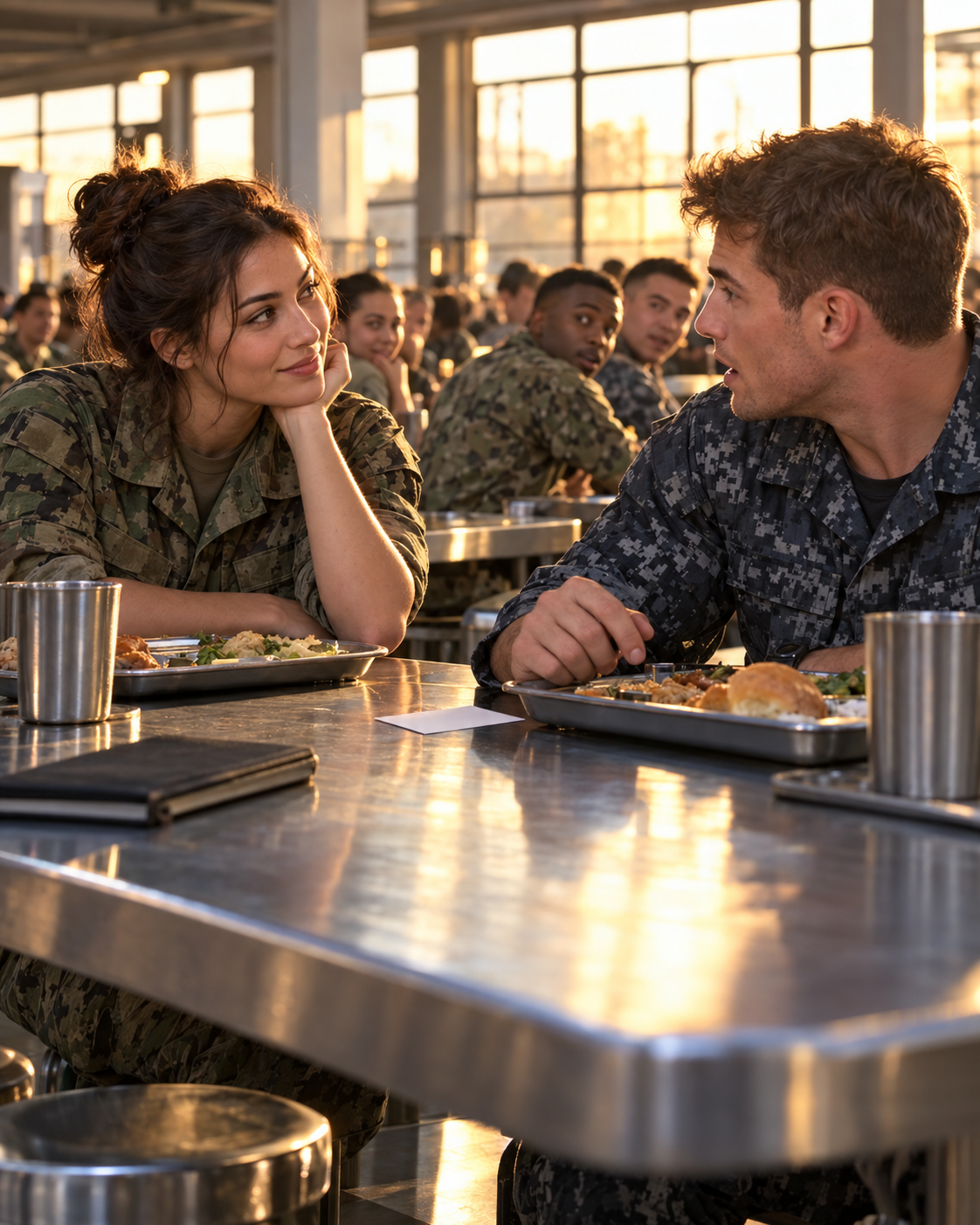
For several seconds, the mess hall seemed very far away.
I could hear the ventilation system humming overhead and the faint clink of silverware from the tables behind us.
Brandon looked at his hands.
“I’m sorry about your brother,” he said.
“Thank you.”
“I didn’t know.”
“You weren’t supposed to know. My personal history isn’t something I expect strangers to carry for me.”
I let those words settle before continuing.
“But you didn’t need to know my history to treat me with respect. You didn’t need to know my rank, either.”
His eyes lifted toward mine.
That was the part I needed him to understand.
Respect that appeared only after someone discovered a person’s authority was not respect at all.
It was caution dressed up as courtesy.
“I’ve worked with analysts who have spent entire careers protecting people they’ve never met,” I told him. “Some of them will never see the places where their work matters most. They will never stand beside the operators who benefit from their decisions. They won’t receive applause when a mission succeeds, because most people will never know their names.”
I thought about the faces behind the reports, the analysts who stayed awake through the night, the specialists who questioned an assumption everyone else had accepted, and the young officers who were still learning how to recognize uncertainty before it became danger.
“They do their work anyway. Because someone is out there depending on them.”
Brandon nodded slowly.
“That sounds familiar,” he said. “Just from the other side.”
“It should.”
He glanced toward the windows.
Outside, sunlight fell across the pavement, where a group of sailors crossed the base carrying equipment toward a waiting vehicle.
“I’ve always thought the people doing the dangerous work were the ones who had to carry the most responsibility,” he admitted. “You train for years, you learn to make decisions under pressure, and then you go out there knowing something can go wrong.”
“That responsibility is real,” I said. “I’m not dismissing it.”
I leaned forward slightly.
“But there is a difference between accepting risk and believing risk makes you more valuable than everyone who supports you.”
He absorbed that in silence.
“Your team trusts you to recognize danger in the field,” I continued. “My team trusts me to help identify danger before it reaches you. Neither responsibility makes the other insignificant.”
For the first time, Brandon seemed to see our work as two sides of the same obligation rather than separate worlds.
“I guess I never thought about it that way.”
“Most people don’t, until something forces them to.”
His face flushed.
“I’ve probably done that more than once.”
I didn’t rush to reassure him.
Sometimes people need to sit with the truth long enough for it to become uncomfortable.
“Then you have an opportunity to do better,” I said. “Start with the people around you. The junior sailor who cleans up after a long shift. The analyst who asks you to repeat an answer during a debrief. The quiet specialist whose name you may never remember but whose work might matter more than you realize.”
Brandon nodded.
“And don’t make someone earn basic decency by proving they deserve it.”
He looked up sharply, as though that sentence had reached a place the others had not.
“I understand, Commander.”
I studied his expression.
I couldn’t know whether he understood everything, and I had no interest in pretending that one uncomfortable conversation could transform a person’s entire character.
But I could see that he was no longer looking for a way to escape embarrassment.
He was trying to figure out what to do with it.
That was a start.
Brandon stood, then hesitated.
“Would it be all right if I asked you something else?”
“Go ahead.”
“When you read our mission reports, do you actually know what happens to the people in them? I mean, beyond the objectives and the assessments.”
It was a fair question, and one I hadn’t expected from him.
“Not always,” I admitted. “Reports tell us what happened, what decisions were made, and what we can learn. They don’t tell us everything about the people who lived through those moments.”
I glanced at the documents beside my tray.
“That’s why we listen during debriefings. That’s why we ask questions. Intelligence is not just information collected from a distance. It’s an effort to understand the reality other people are facing, even when we can’t experience it ourselves.”
Brandon considered that.
“Then I owe your team an apology, too.”
“That would mean more if you made it to them without expecting anything in return.”
“I will.”
He said it simply, without a dramatic promise or an attempt to turn the moment into a story he could tell later.
I believed he intended to follow through.
Whether he would was something only time could answer.
I gathered my notebook and stacked the documents neatly beside my tray.
Brandon stepped aside to give me room.
Before I left, I looked at him one last time.
“Remember this, Brandon. A person’s appearance can tell you what they look like. It cannot tell you what they have endured, what they know, or how many lives their work has touched.”
“Yes, ma’am.”
“And never confuse a quiet person with an unimportant one.”
His expression changed.
Not because he was afraid of me, but because he finally understood that I had never needed him to be afraid.
I needed him to be thoughtful.
I picked up my tray and walked toward the exit, leaving the two men beside the table.
Behind me, the conversations gradually resumed.
But the laughter that had greeted Brandon’s joke did not return.
Something had shifted in that room, and although I couldn’t have known it at the time, the real test of that afternoon was still waiting for him.
Part 3
The following Monday, I arrived at my office before sunrise.
The building was quiet, the corridors washed in the pale blue light of early morning, and the first reports of the day were already waiting on my desk.
I had almost forgotten about the mess hall incident when my assistant mentioned that a group of SEALs had requested a meeting with the intelligence coordination team.
“They said they wanted to thank the analysts who supported their recent operations,” she explained. “Apparently, Commander, they have a few things they’d like to discuss.”
I looked up from my paperwork.
“Did they say why?”
“Only that it was overdue.”
I recognized Brandon’s name on the appointment request.
For a moment, I wondered whether he was trying to repair his reputation after being embarrassed in front of his teammates.
That would have been understandable.
People sometimes mistake public apologies for genuine change because public apologies are easier to measure.
But when the meeting began, Brandon walked in with Wyatt and three other members of his team, and none of them carried the defensive expressions I’d expected.
Brandon stood at the head of the table.
“Commander, thank you for making time for us.”
“Of course. Have a seat.”
He remained standing for another moment.
“I wanted to apologize properly, not just for what I said in the mess hall, but for the attitude behind it.”
The room grew quiet.
“I’ve spent a lot of time respecting people who do what I do, and not enough time thinking about everyone whose work makes our jobs possible. I treated you like you were beneath me before I knew anything about you.”
He swallowed, but kept his eyes on mine.
“That’s not the kind of teammate I want to be.”
I said nothing for a moment.
Then I gestured toward the chairs.
“Thank you for saying that. Now tell me what you need from this meeting.”
He sat down.
That was when I knew the apology might be real.
He hadn’t come to ask me to forgive him again, and he hadn’t come to receive praise for admitting he was wrong.
He had come to do something useful.
Brandon explained that his team wanted to improve communication with the intelligence personnel supporting their operations.
They had noticed that some questions during debriefings were being answered too quickly, while other concerns raised by analysts were sometimes dismissed as unnecessary caution.
“We thought we were saving time,” Wyatt admitted. “But we might have been cutting off information we needed.”
One of the other operators leaned forward.
“We want to understand what your people need from us, and what we can do to give them better information.”
The meeting lasted nearly an hour.
We discussed debriefing procedures, how to distinguish a confirmed observation from an assumption, and why seemingly minor inconsistencies sometimes mattered more than dramatic details.
No one left with a magical solution.
Real improvement rarely arrives that way.
But by the time the team departed, we had agreed on a few practical changes that would make our communication clearer and our assessments more useful.
Brandon thanked every analyst in the room before leaving.
He did not single me out.
I appreciated that more than he could have known.
In the weeks that followed, I began noticing small differences around the base.
Brandon started asking junior personnel for their input during planning sessions, even when their answers challenged his assumptions.
When an analyst interrupted a briefing to flag an inconsistency, he stopped talking and listened instead of waving the concern away.
He learned people’s names.
He thanked the specialists who prepared information for his team, and when a new sailor hesitated to speak during a debriefing, Brandon made room for him to finish.
None of these changes made him less capable as an operator.
If anything, they made him a better one.
I watched the shift from a distance, never mentioning the mess hall conversation unless someone else brought it up.
I had not changed Brandon by humiliating him in return.
I had given him a chance to see himself clearly, and he had decided that what he saw needed to change.
Months later, during a routine coordination meeting, a young intelligence specialist named Ethan presented a concern about an assumption in an operational assessment.
He was new, nervous, and visibly struggling to explain why one detail troubled him.
Several experienced people around the table glanced at the clock.
Brandon, sitting near the far end, raised a hand.
“Give him a minute,” he said. “Let’s hear him out.”
The room settled.
Ethan continued, explaining that a discrepancy in the available information might change how the team interpreted a potential threat.
It was not a dramatic revelation.
It was a small observation, carefully explained, and it deserved to be examined.
We reviewed the evidence, requested additional verification, and adjusted the assessment when the new information supported his concern.
Afterward, Brandon caught up with Ethan in the corridor.
I happened to be passing by when I heard him say, “Good catch. Don’t let anyone make you think you have to be the loudest person in the room to have something worth saying.”
Ethan smiled with the relieved expression of someone who had expected to be dismissed and discovered instead that he had been heard.
I kept walking.
There was no reason to interrupt them.
That afternoon, as I reviewed the latest reports in my office, I found myself thinking about Daniel’s letters.
I still kept one in a small box at home, its paper softened at the folds from years of being opened and read.
I sometimes wondered what he would have thought of the life I had built.
He would probably have teased me about the hours I spent staring at reports, then asked whether I was eating properly and sleeping enough.
He would have understood the work, though.
He had always understood that the most meaningful acts of service were not necessarily the ones people noticed.
And he would have liked knowing that someone who once needed to be taught that lesson was now passing it along.
The Navy remained the Navy.
There were still difficult personalities, long nights, competing priorities, and moments when the pressure made people forget the human beings on the other side of their decisions.
One conversation could not erase all of that.
But it could change what one person did next.
And sometimes, that was enough to begin changing a culture.
Nearly a year after the afternoon in the mess hall, I returned there for lunch.
The same trays rattled across the counter, the same coffee machine sputtered in the corner, and sunlight stretched across the tables beside the windows.
I sat alone with a simple meal and my notebook.
For a few minutes, I reviewed the day’s work, grateful for the quiet.
Then a young sailor approached, holding his tray against his chest.
“Excuse me, Commander. Is this seat taken?”
I looked up and smiled.
“No. Go ahead.”
He sat down carefully, then noticed the notebook beside my plate.
“Are you working on something important?”
I considered the question.
“Usually.”
He laughed softly, unsure whether I was joking.
I turned a page.
Across the room, Brandon stood with Wyatt and several members of his team.
He noticed us, gave me a brief nod of acknowledgment, and returned to his conversation without making a spectacle of the moment.
I nodded back.
That was all the recognition either of us needed.
As I watched the young sailor settle into his lunch, I remembered the way Brandon had once looked at me, how quickly he had decided who I was before I had spoken a word.
I remembered the silence that followed when he discovered my rank, and the deeper silence that came when he realized rank had never been the point.
The lesson was not that a quiet woman might secretly outrank a confident man.
It was not that people deserved respect because they possessed impressive titles, difficult jobs, or access to important information.
The lesson was that they deserved respect before any of those things were known.
I closed my notebook and finished my lunch.
Outside, the base continued its work, full of people whose names would never appear in headlines and whose contributions might never be fully understood by the people they protected.
Some would lead from the front.
Others would sit behind desks, study reports, ask difficult questions, and catch the small details that could make an enormous difference.
All of them carried a piece of the same responsibility.
And somewhere among them, a young sailor who might once have been afraid to speak was learning that his voice mattered, not because he had earned the right to be treated like a human being, but because he had always possessed that right.
I gathered my tray and stood.
For the first time that day, I allowed myself to think of Daniel without feeling only the ache of his absence.
I could almost hear his voice in the memory of his letters, reminding me that the measure of a life was not the number of people who recognized your name, but the good you did when recognition never came.
Then I walked toward the exit, back into the work that waited for me.
I did not need the mess hall to know my rank.
I did not need the room to fall silent when I entered.
And I did not need anyone to understand every part of my story.
I only hoped that the next time someone saw a quiet person sitting alone, they would pause before deciding that silence meant weakness, that simplicity meant insignificance, or that the absence of a title meant the absence of value.
Because the person across the table might be carrying a burden you cannot see, protecting a life you will never meet, or doing work that will matter long after the moment has passed.
And if you have to discover someone’s rank before you can treat them with dignity, you have already misunderstood what makes a person worthy of respect.