At the naval training base in Virginia, Mason Vance laughed at the scar on my neck and called me a coward
Part 2
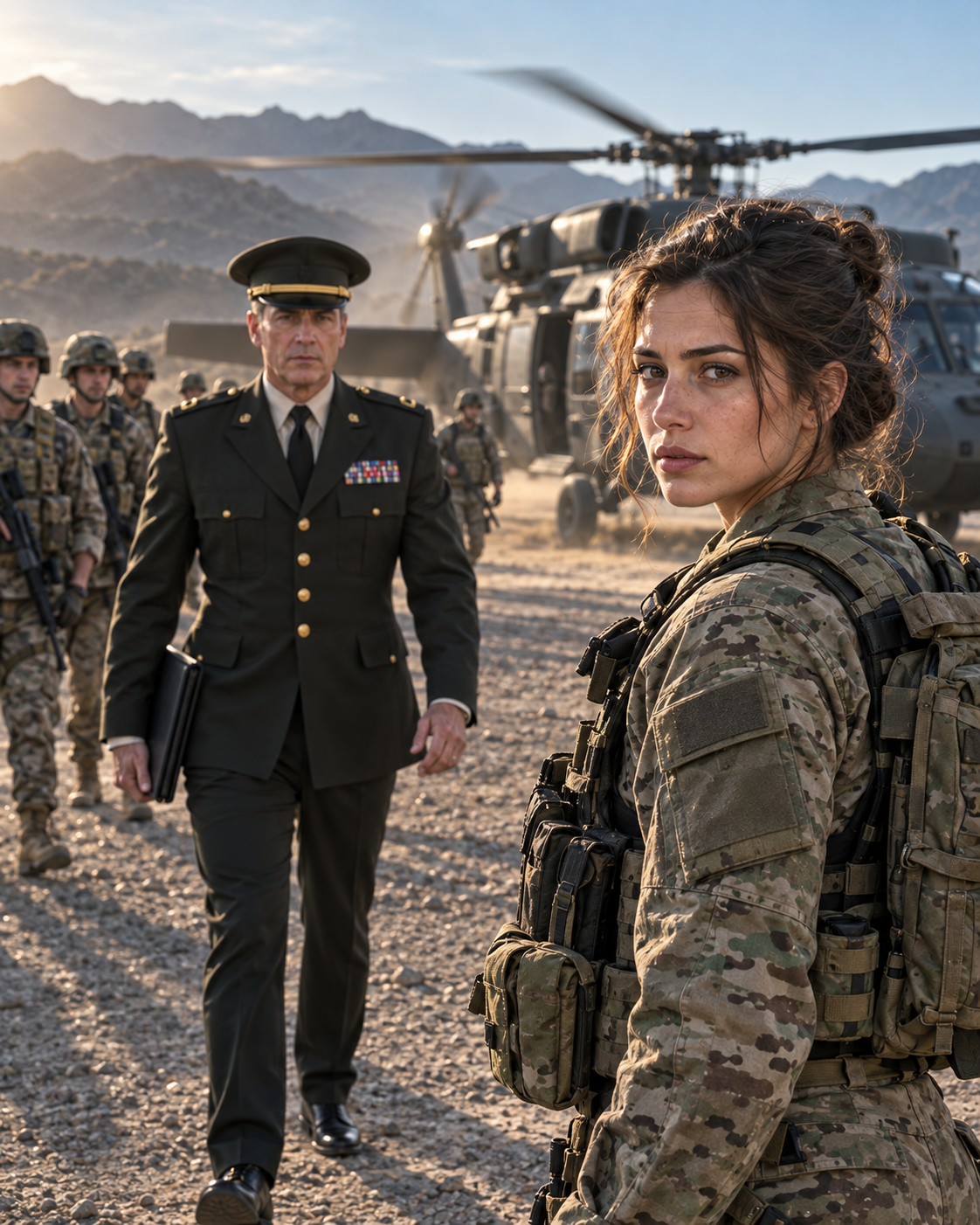
The general crossed the training field with the deliberate pace of a man who had spent his life making decisions that could not be taken back.
The dust settled behind him, but the candidates remained gathered near the helicopter, watching.
Mason stood at the front of the group, his arms folded across his chest.
He looked amused at first.
Then he noticed the general was not heading toward the training commander’s office.
He was heading toward me.
I stepped away from my desk and stood at attention.
“Admiral’s office informed me you might arrive,” I said.
“Then they left out the important part,” General Whitaker replied.
He stopped in front of me and extended his hand.
“It’s good to see you standing, Mercer.”
I shook it.
“Good to see you, sir.”
His grip was firm, but his eyes lingered on the scar at my neck.
For a moment, the noise of the base seemed to fade.
I remembered the last time I had seen him, in a hospital room where the lights were too bright and the doctors were still discussing how close I had come to losing my life.
He had stood beside my bed and told me the pilots were safe.
Then he had asked me what I needed.
I had told him I needed time.
He had given it to me without asking me to explain myself.
Now he looked at the papers on my desk.
“Still keeping busy?”
“Someone has to make sure the candidates have batteries.”
A small smile crossed his face.
“I see your sense of humor survived.”
“Most of it, sir.”
He nodded, then turned slightly toward the gathering crowd.
“Petty Officer Mercer, I need you to come with me.”
There was nothing dramatic in his voice.
That made the request more serious, not less.
I glanced at the unfinished paperwork.
“Of course.”
Before I could move, Mason stepped forward.
“Sir, excuse me.”
The general turned his head.
Mason’s confidence returned in a hurry, as though he believed a senior officer would appreciate his willingness to speak.
“We were just wondering if Petty Officer Mercer is being transferred. He’s been handling logistics here, and we didn’t know he was important enough for a general to visit personally.”
A few candidates shifted uncomfortably.
I could have stopped Mason.
I could have told him to return to his duties.
But General Whitaker raised one hand, and the entire group went silent.
“What is your name, candidate?”
“Vance, sir. Mason Vance.”
“Are you responsible for the comments I have been hearing about this petty officer?”
Mason blinked.
“Sir?”
“The jokes about his scar. The nickname. The suggestions that he has no experience beyond a supply desk.”
Mason’s face changed so quickly that I almost felt sorry for him.
“Sir, it was just messing around. Nothing serious.”
The general looked at him for several seconds.
“Nothing serious,” he repeated.
Then he turned toward the rest of the candidates.
“Since there appears to be some confusion about who stands before you, I will clarify one thing.”
My chest tightened.
“Sir,” I said quietly, “there’s no need.”
He looked back at me.
“I disagree.”
His voice wasn’t angry.
It carried something heavier: the refusal to let a truth be buried merely because the person who lived it preferred silence.
“Three years ago, an American aircraft was brought down over hostile territory,” he began. “Two pilots survived the crash but were separated by several miles, injured, and surrounded by an enemy force actively searching for them.”
The candidates stood motionless.
Mason’s arms had dropped to his sides.
“Conditions made a conventional recovery impossible within the time available. A classified operator was inserted to locate both pilots and bring them to an extraction point.”
The general paused.
“That operator was Petty Officer Daniel Mercer.”
No one laughed.
No one even seemed to breathe.
I kept my eyes fixed ahead, feeling the old instinct to disappear behind the nearest closed door.
General Whitaker continued.
“Mercer located the first pilot, stabilized him, and moved him to concealment. He then crossed hostile terrain to reach the second pilot, despite the loss of communications and the presence of enemy patrols.”
He didn’t describe the details of the fight.
He didn’t reveal the unit’s name, the location, or anything that could endanger people who were still serving.
He didn’t need to.
“The two pilots returned alive,” he said. “Mercer returned with a wound to his neck that could easily have killed him. The scar you have been mocking is the mark he carries from that operation.”
Mason looked at my neck.
For the first time, he seemed to understand that a scar could be more than a flaw in someone’s appearance.
It could be the part of a terrible night that had followed them home.
The general reached into a folder carried by his aide.
“His actions were formally recognized through channels that remain classified. His service record speaks for itself, even if he has chosen not to speak about it.”
He closed the folder.
“And his decision to take an administrative assignment while recovering was made through the proper medical and command channels. It was not a failure of courage.”
Those last words landed harder than anything else.
I hadn’t realized how much I needed to hear them until he said them aloud.
For three years, I had quietly wondered whether stepping away had meant that something inside me had broken beyond repair.
I had watched other operators return to their work while I struggled to sleep through a night without waking at the sound of distant engines.
I had told myself that healing was a task, no different from any other.
Yet some nights, I still felt guilty for surviving when survival had come at such a cost.
General Whitaker’s words did not erase those nights.
But they reminded me that recovery was not a debt I owed anyone.
It was part of staying alive.
He turned back to the candidates.
“You are training to become members of a community that places enormous demands on its people. Physical strength matters. Technical skill matters. Discipline matters.”
His gaze moved across the line of faces.
“But none of those qualities gives you permission to decide another person’s worth based on what you can see from across a room.”
Mason swallowed.
“Sir, I didn’t know.”
The general’s expression hardened.
“That is precisely the point, Candidate Vance. You didn’t know, so you decided.”
The words seemed to strip the air from the training field.
I could see Mason trying to find a way out of the moment, a sentence that would return him to the version of himself who had been laughing only minutes earlier.
Nothing came.
General Whitaker looked at me again.
“I have official orders recalling you to active operational duty. Your former unit has requested your return for an urgent mission.”
The word return moved through me like a pulse.
I had known the day might come.
I had imagined it in quiet moments, sometimes with longing, sometimes with dread.
But hearing it aloud brought back the weight of the equipment I had once carried, the voices I had learned to trust, and the knowledge that the next decision could matter far beyond the walls of a training base.
I glanced at the desk behind me.
There were supply forms stacked in neat piles, a coffee mug gone cold, and a small photograph tucked into the corner of my monitor.
It showed two pilots standing beside a rescue aircraft, pale and exhausted but alive.
They had sent it to me months after the operation.
Neither man knew the full details of what had happened that night, but both had written the same words on the back.
Thank you for bringing us home.
I had kept the photograph because it reminded me why I had gone.
I had never kept it because I wanted anyone else to see it.
“When do I leave, sir?” I asked.
“Now.”
I nodded once.
“Understood.”
The general’s face softened.
“Mercer, before we go, is there anything you need to finish here?”
I looked at the paperwork.
Then I looked at the candidates.
“No, sir. Everything important is already accounted for.”
A faint smile returned to his face.
“That’s what I expected you to say.”
He stepped aside to let me collect my things.
As I crossed the room, the candidates moved out of my way without being told.
The silence followed me, but it was no longer the silence of a room waiting for a joke.
It was the silence of people discovering that the story they had told themselves about someone else had been wrong from the beginning.
Mason stood near the counter.
I could have walked past him without speaking.
For a moment, I intended to.
Then I noticed his hands.
They were clenched so tightly that the knuckles had gone pale.
“Petty Officer Mercer,” he said.
I stopped.
He looked as though the words were difficult to get out.
“I’m sorry, sir.”
The apology was small and awkward.
It did not undo the laughter, the drawings, or the mornings I had spent pretending not to hear him.
But it was the first honest thing he had said to me.
I studied him for a moment.
“Don’t apologize because a general told you to,” I said.
His eyes lifted to mine.
“Apologize because you understand what you did.”
He looked down again.
“Yes, sir.”
I picked up my duffel bag.
“And remember that the next person you call weak might be fighting something you know nothing about.”
Then I walked out into the sunlight.
Behind me, the training base had gone completely quiet.
Ahead of me, the Black Hawk waited with its rotors turning.
I had spent three years learning how to live with what I had left behind.
Now I had to decide whether I was ready to carry it forward.
The general followed me toward the aircraft.
“Your unit is assembling now,” he said over the rising rotor noise. “The situation is serious, but I won’t ask you to go unless you’re fit to make that decision.”
I stopped beside the open cabin door.
For the first time that morning, I didn’t answer immediately.
I thought about the nights I had woken gasping, the way my pulse still jumped at certain sounds, and the private fear that returning to operational work might reveal how much I had changed.
Then I thought about the two pilots who had survived.
I thought about the people who had once stood beside me without needing to know what I was feeling.
And I remembered that courage had never meant being untouched by fear.
It meant being honest about the fear and deciding what to do next.
“I’m ready to be evaluated, sir,” I said. “And if I’m cleared, I’m ready to serve.”
General Whitaker nodded.
“That is all I can ask.”
I climbed into the helicopter, settled my bag between my boots, and reached for the harness.
Through the open door, I saw Mason standing with the other candidates.
He was no longer smirking.
He was watching me as if he were seeing a person instead of a punchline.
The rotors gathered speed.
The base began to blur beneath the rising dust.
And as the aircraft lifted into the morning sky, I understood that the general had not come to make me a hero in front of those men.
He had come because the Navy needed me again.
The lesson the candidates received was simply the consequence of finally seeing the truth.
Yet the moment the helicopter cleared the trees, I realized that the hardest part of my return had nothing to do with the men I would meet or the mission waiting ahead.
It had to do with the man I would have to become again.
I pressed my thumb lightly against the scar beneath my collar.
For years, I had treated it like a door that should remain closed.
Now I wondered whether I could carry its memory without allowing it to decide who I was.
The helicopter turned toward the coast, and the training base disappeared behind us.
For the first time in a long while, I let myself look forward.
Part 3
The flight lasted less than an hour, but every mile brought me closer to a life I had deliberately placed out of reach.
General Whitaker sat across from me, reading the briefing on a tablet while the aircraft shook around us.
He didn’t try to fill the silence.
I appreciated that.
Some people treated silence as a problem that needed to be solved.
The men I trusted had learned that silence could be a place where a person gathered himself before doing something difficult.
When the helicopter landed at a secure facility, two officers were waiting beside the pad.
One carried a folder with my name on it.
The other was someone I had not seen in three years.
Commander Elias Reed had more gray in his hair than I remembered, and the lines around his eyes had deepened.
But his handshake was the same.
“Mercer,” he said.
“Commander.”
He looked at my neck, then at my face.
“You look better than the last time I saw you.”
“I had a little more sleep.”
“Good. You deserved it.”
There was no pity in his voice, and no expectation that I should pretend to be completely healed.
That mattered more than he knew.
Inside the briefing room, the details of the new assignment came into focus.
My former unit needed an experienced operator for a mission that required knowledge of a region I had worked in before, along with a particular set of field skills.
I would not be sent directly into danger simply because my record contained a successful extraction.
First, I would undergo medical and operational evaluations.
My return would depend on whether I was ready, not on whether someone else wanted a familiar name on a roster.
I agreed without hesitation.
Over the next several days, I faced the work I had avoided for years.
There were medical appointments, physical assessments, long conversations with specialists, and quiet hours spent reviewing old procedures until my hands remembered what my mind had feared forgetting.
Some days went well.
Others did not.
During one evaluation, a sudden metallic bang from the adjoining corridor sent my heart racing so violently that I had to sit down.
I hated the embarrassment of it.
The physician did not look disappointed.
“Your body remembers what happened,” she told me. “That doesn’t mean it gets to make every decision for you.”
I thought about that sentence for the rest of the day.
I had spent years believing that healing meant reaching a point where nothing hurt anymore.
Perhaps I had been wrong.
Perhaps healing meant being able to feel the pain without allowing it to define the limits of every choice.
I worked steadily, without pretending that determination alone could replace proper evaluation.
When I was cleared for the assignment, I signed the orders with a hand that no longer shook.
The mission itself was demanding, but it was not the dramatic return I had once imagined.
There were long hours of planning, careful coordination, and moments when the safest decision was to wait rather than move.
I followed the people responsible for each part of the operation, trusted their judgment, and contributed what experience I could.
There were no speeches.
No audience.
No one stood nearby to tell me what my actions meant.
That was how the work was supposed to be.
We completed the assignment and returned safely.
When I stepped off the transport, the morning air smelled of rain and jet fuel.
I stood for a moment with my bag in my hand and realized that the scar on my neck had not changed.
I had.
I was no longer waiting for the past to release me before I allowed myself to live.
I could carry the memory of that first extraction, acknowledge the nights it had taken from me, and still accept the possibility of another tomorrow.
A few days later, I received a message from the training base.
It was a short note from an instructor who had been present when General Whitaker arrived.
He told me that the incident had become a topic of discussion among the candidates, but not in the way I might have expected.
Mason Vance had asked to speak with the instructor privately.
He had admitted that he had turned me into a joke because he believed anyone who did not advertise his accomplishments must have none.
He had also admitted that he had encouraged the others to join in because their laughter made him feel important.
The instructor had required him to take responsibility for his conduct and make amends without turning the apology into another performance.
Mason had agreed.
I read the message twice, then set my phone down.
I didn’t feel triumphant.
There was no satisfaction in knowing that someone who had humiliated me had finally been embarrassed himself.
What I felt was quieter.
I hoped he had learned something that would stay with him long after the story of the helicopter faded.
Because the truth was that General Whitaker had not created my worth that morning.
He had merely made it visible to people who had refused to look.
A week later, a letter arrived at the facility.
It was handwritten, with my name printed carefully across the envelope.
Inside, Mason had written less than a page.
He apologized for the nickname, the jokes, and the way he had encouraged others to treat my silence as proof that I was beneath them.
He did not ask me to forgive him.
He did not explain that he had been tired or stressed or trying to impress his friends.
He simply admitted that he had been wrong.
At the bottom, he had written one final sentence.
“I thought respect was something you earned by showing people how tough you were, but I never considered how much strength it might take to carry something you couldn’t talk about.”
I folded the letter and placed it inside the drawer beside my desk.
I didn’t know whether Mason would become a better leader.
An apology could be sincere and still lead nowhere if a person returned to the same habits.
But at least he had taken the first step without demanding a reward for it.
Months passed.
My operational assignment continued, and I settled into a new rhythm.
Some nights were still difficult.
Some sounds still pulled me backward before I could remind myself where I was.
But I stopped treating those moments as evidence that I had failed.
I learned to ask for help before exhaustion became a wall.
I learned that the people worth trusting were not the ones who expected me to be invulnerable, but the ones who understood that strength could include a quiet admission that I needed time.
Eventually, I visited the two pilots I had rescued.
They had both recovered, returned to their families, and continued with their lives.
We met in a small restaurant near the coast, where the windows looked out toward a harbor full of boats rocking gently against their moorings.
The first pilot, Captain Andrew Cole, recognized me before I reached the table.
He stood so quickly that his chair scraped across the floor.
“Mercer.”
We shook hands, then he pulled me into a brief, awkward embrace.
The second pilot, Lieutenant James Holloway, rose more slowly, favoring a knee that had never fully recovered.
He studied the scar on my neck.
“I still think about that night,” he said.
“So do I.”
“I used to wonder what I would have done if you hadn’t come.”
I looked through the window at the water.
“You would have kept fighting to get home.”
He shook his head.
“Maybe. But I wouldn’t have made it without you.”
For a moment, none of us spoke.
Then Andrew raised his glass.
“To the people who bring us home.”
We drank to that.
It was not a celebration of heroism.
It was a recognition of how fragile a person’s future could be, and how often survival depended on someone else choosing not to look away.
After dinner, the two pilots gave me a small photograph in a plain wooden frame.
It showed the three of us standing beside the rescue aircraft on the day we had reunited after the original mission.
My face was thinner than I remembered, and the scar was still red against my skin.
But I was smiling.
On the back, they had written a message together.
“You carried us home. We hope you remember that you deserve to come home to yourself, too.”
I sat with those words for a long time after I returned to my room.
I had spent so much energy trying to leave the worst night of my life behind that I had forgotten the most important part of surviving it.
I had come home.
I was still coming home, one difficult day at a time.
Several months later, I returned to the training base for a short professional visit.
The logistics office looked exactly as I remembered it.
The same shelves lined the walls.
The same battered counter stood beneath the window.
And the same filing cabinet occupied the corner where someone had once taped a drawing of a man falling off a bar stool.
The drawing was gone.
In its place sat a small, neatly printed sign reminding candidates that respect was expected of everyone, regardless of rank or assignment.
Mason was outside on the training field, working with a group of newer candidates.
He saw me near the entrance and excused himself from the exercise.
For a moment, I saw the old uncertainty in his face.
Then he approached.
“Petty Officer Mercer.”
“Candidate Vance.”
He stood straighter.
“I wanted to thank you for the letter you sent back.”
I frowned slightly.
“I didn’t send you a letter.”
He looked confused.
Then he realized what I meant and shook his head.
“Sorry. I meant the fact that you didn’t send it back. I wasn’t sure you’d even read mine.”
“I read it.”
“Thank you.”
He hesitated, then glanced toward the younger candidates.
“I’ve been trying to change how I act around them. I don’t always get it right.”
“Then keep working on it.”
He nodded.
“I will.”
For a moment, neither of us spoke.
Then he asked, “Can I ask you something?”
“You can ask.”
“Do you ever wish you’d told us who you were from the beginning?”
I considered the question.
The easy answer would have been yes.
It would have been satisfying to say that if I had revealed my history earlier, I could have spared myself the jokes and forced everyone to treat me differently.
But that would have missed the point.
“No,” I said at last. “Because then you might have learned to respect my record without learning to respect me.”
Mason looked down.
I continued, keeping my voice calm.
“Anyone can show respect when they think the other person has power over them. The harder thing is showing respect when you believe the other person has nothing to offer you.”
He was quiet for a long time.
Then he nodded.
“I understand.”
“I hope you do.”
I left him there and walked toward the logistics office.
Inside, a young petty officer was sorting a stack of supply forms.
He looked up as I entered.
“Can I help you, sir?”
“I used to work here.”
His gaze briefly touched the scar at my neck before returning to my face.
“Oh. Welcome back.”
There was no mockery in his voice.
No attempt to guess what had happened to me.
He simply made room at the counter so I could pass.
It was a small gesture.
Most people would have forgotten it before the day ended.
But I remembered it because it was the opposite of what had happened when I first arrived.
I had come to that office believing that silence was the safest way to survive.
I left understanding that silence could protect a person, but it could also allow others to mistake ignorance for truth.
I still did not tell my story to everyone I met.
The people who needed to know the details had access to the appropriate records.
The people who didn’t need to know were entitled to their privacy, not my history.
But I no longer felt that I had to hide the scar as though it were something shameful.
It was part of me.
So were the difficult nights.
So was the time I had needed to recover.
And so was the decision to return when I was ready.
None of those things canceled out the others.
On my way back across the training field, I passed a group of candidates resting beneath the afternoon sun.
One of them was laughing about a mistake another trainee had made during an exercise.
The laughter was harmless at first, but it began to sharpen as more people joined in.
Then one candidate noticed the discomfort on the other man’s face and stopped.
“That’s enough,” he said. “He made a mistake. Help him fix it.”
The others fell quiet.
The embarrassed trainee looked up, surprised.
I continued walking, but a small smile touched my face.
Perhaps Mason had learned something.
Perhaps someone else had.
Perhaps the lesson would spread farther than any one of us could see.
I reached the far side of the field and looked toward the coast, where sunlight glimmered on the water beyond the buildings.
My scar caught the warmth of the afternoon.
For years, I had thought of it as the mark of the night I nearly died.
Now I understood that it was also the mark of the life that had continued afterward, a life that did not have to be loud to be meaningful and did not have to be witnessed to be real.
I had never needed the candidates to think I was a hero.
I had needed to learn that I could be a human being again, even after doing something extraordinary, even after carrying something painful, and even when nobody around me understood the cost.
As I walked away from the office, I passed the window where my desk had once stood.
The paperwork was being processed by someone else.
The room was quiet.
For once, the silence felt peaceful.
And I carried one final thought with me, not as a lesson I had earned the right to preach, but as a truth I hoped I would never forget.
You do not have to know someone’s history to treat them with dignity.
You do not have to see their wounds to believe they have endured something.
And you should never wait for a general, a medal, or a dramatic helicopter landing to remind you that every person standing quietly in front of you has a story you have not heard.
Some of the strongest people you will ever meet will never tell you what they survived.
They will simply show up, do their work, help someone else make it home, and carry on.
My scar remained.
My memories remained.
But they no longer felt like a debt I had to pay for surviving.
They were part of my story, not the whole of it.
And that, I finally understood, was what coming home really meant.