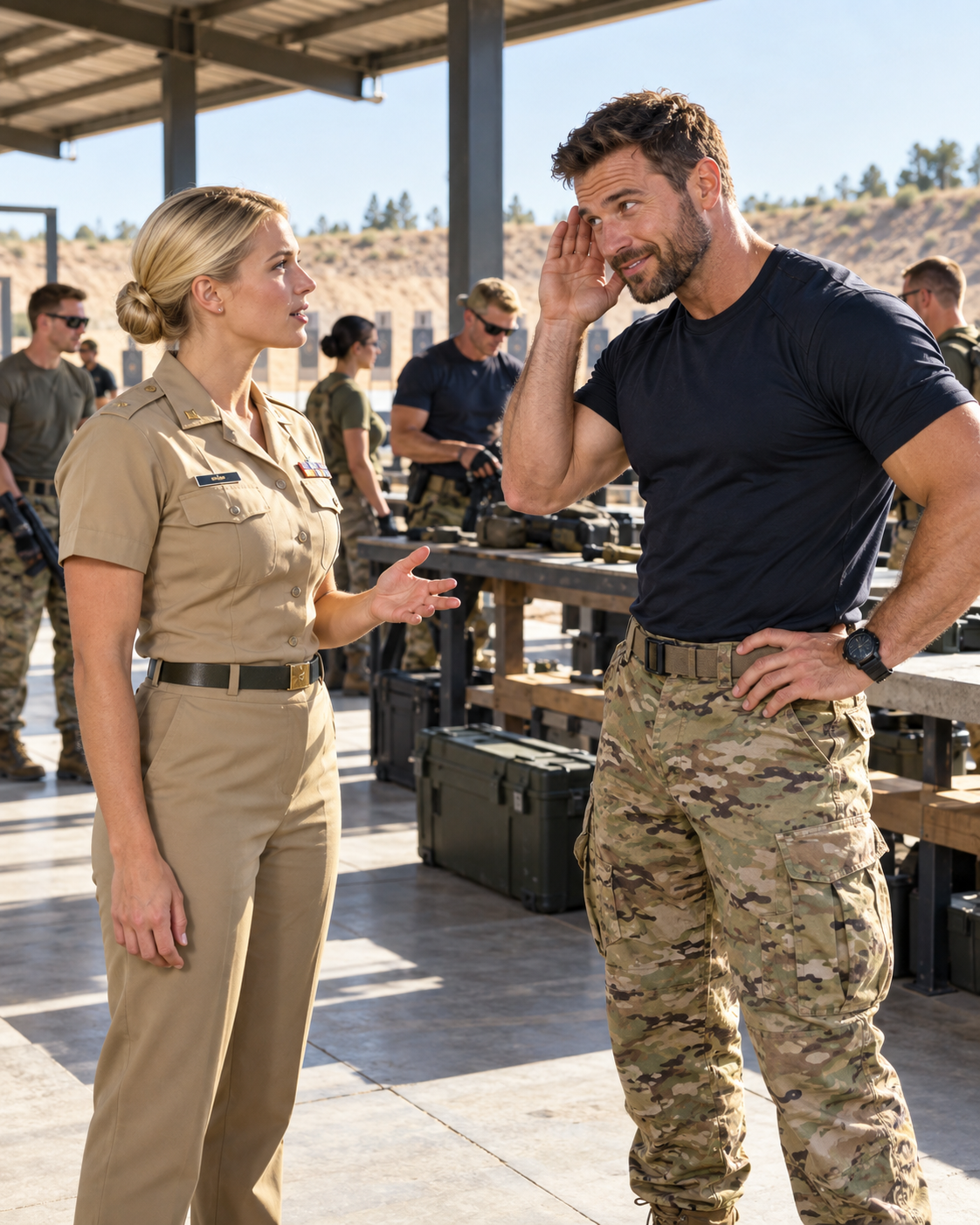
At the naval range in Virginia, a young operator laughed at my civilian clothes, demanded my call sign
Part 2
Evelyn Miller lived in a small brick house outside Norfolk, Virginia, with a blue mailbox and a porch crowded with potted flowers.
I sat in my car across the street for almost twenty minutes.
I had faced enemy fire with less fear.
My hand hovered over the steering wheel.
Then I saw an older woman walk onto the porch carrying a mug.
She looked up.
Our eyes met through the windshield.
She knew.
I don’t know how.
Maybe mothers recognize the people who carry their children’s names.
I stepped out of the car.
She opened the door before I reached it.
For several seconds, neither of us spoke.
Then I said the words I had rehearsed for seventeen years.
“I’m sorry.”
Evelyn stared at me.
I expected anger.
I expected questions.
I expected the sentence I had punished myself with for years.
Why didn’t you save my son?
Instead, she walked down the steps.
She wrapped her arms around me.
I froze.
Her hands trembled against my back.
“Thank you,” she whispered.
I couldn’t breathe.
She pulled away and looked into my eyes.
“You brought eleven boys home.”
“Lucas wasn’t one of them.”
“No,” she said.
“He wasn’t.”
There was no accusation in her voice.
Only grief.
She touched my sleeve.
“But he told us about you.”
I stared at her.
“What?”
“His letters.”
She smiled through tears.
“He wrote about the rescue crews.”
“He said the pilots were fearless.”
I looked away.
“I wasn’t.”
Evelyn shook her head.
“You were human.”
That word broke something inside me.
I had spent years believing that if I admitted fear, then maybe the rescue meant less.
If I admitted grief, maybe the eleven lives became a consolation prize.
If I admitted that I had failed Lucas, maybe every life I saved became an excuse.
Evelyn reached into her pocket and pulled out a small, worn metal challenge coin.
She placed it in my palm.
Lucas’s initials were scratched into the edge.
“He carried this after training,” she said.
“I thought you should have it.”
I closed my fingers around the coin.
“I can’t take this.”
“You already carried him for seventeen years.”
Her eyes filled with tears.
“Let someone else carry him with you.”
I cried in front of her.
Not quietly.
Not professionally.
Not like an officer.
I cried like the twenty-something-year-old pilot who had climbed away from that valley and never really returned.
When I left her house, I sat in the car with Lucas’s coin in my hand until the sun went down.
For the first time, the weight felt different.
Not lighter.
Shared.
The next morning, I drove to my parents’ farm in western Pennsylvania.
My father, Walter, was standing inside the old mechanic shed when I arrived.
The smell of oil and metal hit me before I even opened the door.
Some memories never leave.
They just wait.
When I was a child, I used to tell him I would fly helicopters.
He always shook his head.
“Flying isn’t a dream, sweetheart.”
“It can be.”
“It’s a machine.”
He was a mechanic.
He trusted machines because machines could be repaired.
People were harder.
Dreams were worse.
My mother, Martha, had always understood.
She never argued with him.
She simply saved every newspaper clipping, every photograph, every article that mentioned my career.
She kept them in a wooden box beneath her bed.
I found out years later.
Walter never knew I knew.
When I walked into the shed, he looked at me for a long moment.
“You look tired.”
“I am.”
He wiped his hands on a rag.
“Command?”
“In a few weeks.”
He nodded.
Then he glanced toward the open barn doors.
The afternoon sky was enormous.
Blue stretched over the fields like an endless runway.
“I heard about the range.”
I stiffened.
“How?”
“Your mother talks.”
I laughed despite myself.
Walter looked at me.
“She said you told them your call sign.”
“Yes.”
He nodded slowly.
“Sabre One.”
He said it like he was trying the words out.
“I always wondered why you never told us.”
“I didn’t want you to worry.”
He gave a short laugh.
“I was your father.”
“I know.”
“I worried anyway.”
Silence settled between us.
Then he said something I had waited half my life to hear.
“I was wrong.”
I looked at him.
He stared toward the sky.
“When you were little, I thought if I made you afraid of flying, I could keep you safe.”
His voice cracked.
“Turns out I just made you learn how to hide.”
I swallowed hard.
“I learned from you.”
He nodded.
“I’m sorry.”
For years, I had imagined this conversation ending with anger.
Instead, it ended with my father placing a grease-stained hand on my shoulder.
Then he looked toward the sky.
“That’s my girl.”
I started crying again.
He smiled.
“Go fly, hero.”
I shook my head.
“I’m not a hero.”
He pointed upward.
“Maybe you don’t get to decide that.”
A few weeks later, I stood behind the curtain at my change-of-command ceremony.
My uniform felt heavier than usual.
Not because of the decorations.
Because of the names.
Lucas.
Dean.
The eleven.
Every crew member who had flown into darkness because someone needed help.
I looked through the opening in the curtain.
Tyler stood near the back.
He was different now.
Quieter.
Straighter.
His commanding officer had told me he had volunteered for difficult training assignments instead of chasing recognition.
He had apologized to several junior sailors he had once dismissed.
He had started teaching younger operators that confidence was not the same thing as superiority.
When he saw me, he nodded.
I nodded back.
That was enough.
Then I saw my parents.
Martha was holding the old wooden box against her chest.
Walter sat beside her, looking uncomfortable in formal clothes.
I smiled.
Then I saw Evelyn.
She was holding Lucas’s challenge coin.
My heart stopped.
She had come.
I had not asked her to.
She had simply come.
The ceremony began.
Names were called.
Orders were read.
Flags moved through the room.
When it was time for me to speak, I walked to the podium.
For seventeen years, I had believed that silence was strength.
That if I said nothing, I could protect the people I had saved from the ugliness of how close they had come to dying.
That if I kept my head down, Lucas could remain mine alone.
I finally understood how wrong I had been.
I looked across the room.
Dean was there.
Tyler was there.
My parents were there.
Ten of the eleven sailors from the valley were there.
And beside them stood Evelyn.
I took a breath.
Then I spoke.
Part 3
“My name is Captain Sarah Walker, and for seventeen years I carried one name with me: Lucas Miller.”
“I could not bring him home, but because of him, I will never forget what it means to fly toward someone else’s darkness.”
“To the eleven who came home, and to every family waiting for their door to open, your lives are not numbers in my logbook; they are the reason I kept going.”
“And to Lucas, wherever you are, I am finally learning that bringing people home also means letting them carry you.”
The room remained silent.
For one long second, nobody moved.
Then Evelyn stood.
She was the first.
She raised Lucas’s challenge coin in one hand.
Then Dean stood.
Then another veteran.
Then another.
Soon all ten survivors were on their feet.
My mother rose.
My father rose.
Tyler rose.
Then the entire room followed.
The applause came slowly at first.
Then it became overwhelming.
It filled the hall like rotor blades beating against the air.
I stood behind the podium and let it happen.
For once, I did not look down.
I did not disappear.
I did not calculate the names of those who had not made it.
I looked at the people who had.
Dean caught my eye.
Tyler was crying.
My father was smiling.
My mother was holding that old wooden box like it contained my entire life.
And Evelyn was looking at me with the same expression she had worn on her porch.
Not forgiveness.
Not pity.
Gratitude.
Something deeper.
Recognition.
After the ceremony, Tyler approached me.
He stopped several feet away.
“Ma’am.”
“Petty Officer.”
He took a breath.
“I’ve been trying to figure out what to say.”
“You don’t need a speech.”
He nodded.
“I thought I did.”
A small smile crossed his face.
“Turns out I just needed to listen.”
I smiled back.
“That’s a good place to start.”
He looked at the crowd behind me.
“Can I ask you something?”
“Sure.”
“Why did you protect me after what I did?”
I thought about it.
“Because someone once gave me room to become better than my worst moment.”
He nodded.
“Who?”
I looked toward my father.
“Several people.”
Tyler followed my gaze.
Then he understood.
Later that evening, I walked outside alone.
The base was quiet.
The last light of sunset stretched across the runway.
Aircraft rested beneath the floodlights, their silhouettes dark against the sky.
I reached into my pocket.
Lucas’s challenge coin was still there.
I turned it over in my hand.
For seventeen years, I had thought remembering Lucas meant remembering the moment I failed him.
Now I understood something different.
Remembering him meant remembering why I had gone back.
Why I had descended.
Why I had stayed as long as I did.
Why eleven men were alive.
Why ten of them were standing in that room.
Why their children would grow up with stories instead of photographs.
Why their mothers had received phone calls instead of folded flags.
Lucas was still part of the story.
He always would be.
But he was no longer the weight I carried alone.
I looked up.
A helicopter crossed the evening sky in the distance.
Its navigation lights blinked against the dark.
For a moment, I was seventeen years younger.
I could hear the radio.
I could hear the alarms.
I could hear Lucas saying my call sign.
“Sabre One, I can see you.”
I closed my eyes.
“I see you too,” I whispered.
Then I opened them.
The helicopter disappeared beyond the horizon.
For the first time, I did not feel like I was watching something leave.
I felt like I was watching something continue.
My father had spent years believing the sky was where he might lose me.
My mother had spent years quietly keeping proof that I had found myself there.
Nia had forced me to stop hiding behind an old wound.
Evelyn had shown me that gratitude could exist beside grief.
Dean had reminded me that survival has a memory.
Tyler had reminded me that people can change when someone chooses not to destroy them.
And Lucas had taught me the hardest lesson of all.
Sometimes the person you could not save becomes the reason you spend the rest of your life saving others.
I had spent seventeen years believing that courage meant flying into the darkness.
Maybe it did.
But that night, standing beneath the open sky with Lucas’s coin in my hand, I finally learned that courage can also mean stepping into the light afterward.
It can mean allowing people to thank you.
It can mean admitting that you were afraid.
It can mean saying the name of the one you lost without using that loss to punish yourself forever.
And sometimes, after years of carrying everyone else’s lives, courage is simply letting someone carry a little of yours.
I slipped the coin back into my pocket.
Then I walked toward the hangar lights, no longer trying to disappear.
For the first time in seventeen years, Sabre One did not feel like a secret.
It felt like a promise.
And somewhere in the darkness behind me, I could almost hear eleven voices coming home.