At the Naval Medical Center, Dr. Mitchell Graves pointed at my hidden prosthetic arm and sneered that he wouldn’t trust a broken
Part 2
I remember the silence that followed my words more clearly than I remember the alarms.
It was not real silence, of course.
The monitors were still screaming, the respiratory therapist was calling out numbers, and someone near the door was asking for additional emergency equipment.
But inside my head, everything had gone quiet.
I moved to Danny’s bedside and looked at the team.
“Prepare the emergency airway equipment. Call for the senior anesthesia physician. Now.”
Graves stepped between me and the cart.
“You are not taking over this case.”
“I’m not asking to take over,” I replied. “I’m telling you that he needs an immediate airway rescue.”
“I am the attending physician.”
“And he’s losing oxygen.”
His jaw tightened.
For a moment, I thought he might physically stop me.
Then Danny’s monitor emitted another piercing alarm, and the argument ended without either of us winning it.
Graves turned back toward the patient.
“Prepare for a surgical airway,” he ordered, his voice strained.
I pulled my right sleeve back.
The matte-black prosthetic emerged beneath the fluorescent lights, its articulated fingers catching a faint reflection from the overhead lamps.
A few people glanced at it.
I ignored them.
I had learned long ago that a prosthetic did not need to look natural to be useful, and I had no time left to worry about whether anyone found it unsettling.
The airway procedure was a last-resort emergency intervention, and the team needed to act under the direction of qualified clinicians with the appropriate equipment and training.
I was not there to pretend that a nurse could replace an entire medical team.
I was there because I recognized the moment when delay itself became dangerous.
“Claire,” one of the respiratory therapists whispered, “are you sure?”
I met her eyes.
“Get ready to assist.”
There was no room for a speech, no time to recount my past, and no reason to ask anyone to believe in me before I did the work.
I had spent years practicing the discipline of controlling fear without pretending it did not exist.
Now I had to use it.
I positioned myself where I could assist with the emergency airway intervention, relying on my training and the attending physician’s authorization as the team prepared to establish an alternate route for oxygen.
Graves took one look at Danny’s color and finally stepped aside.
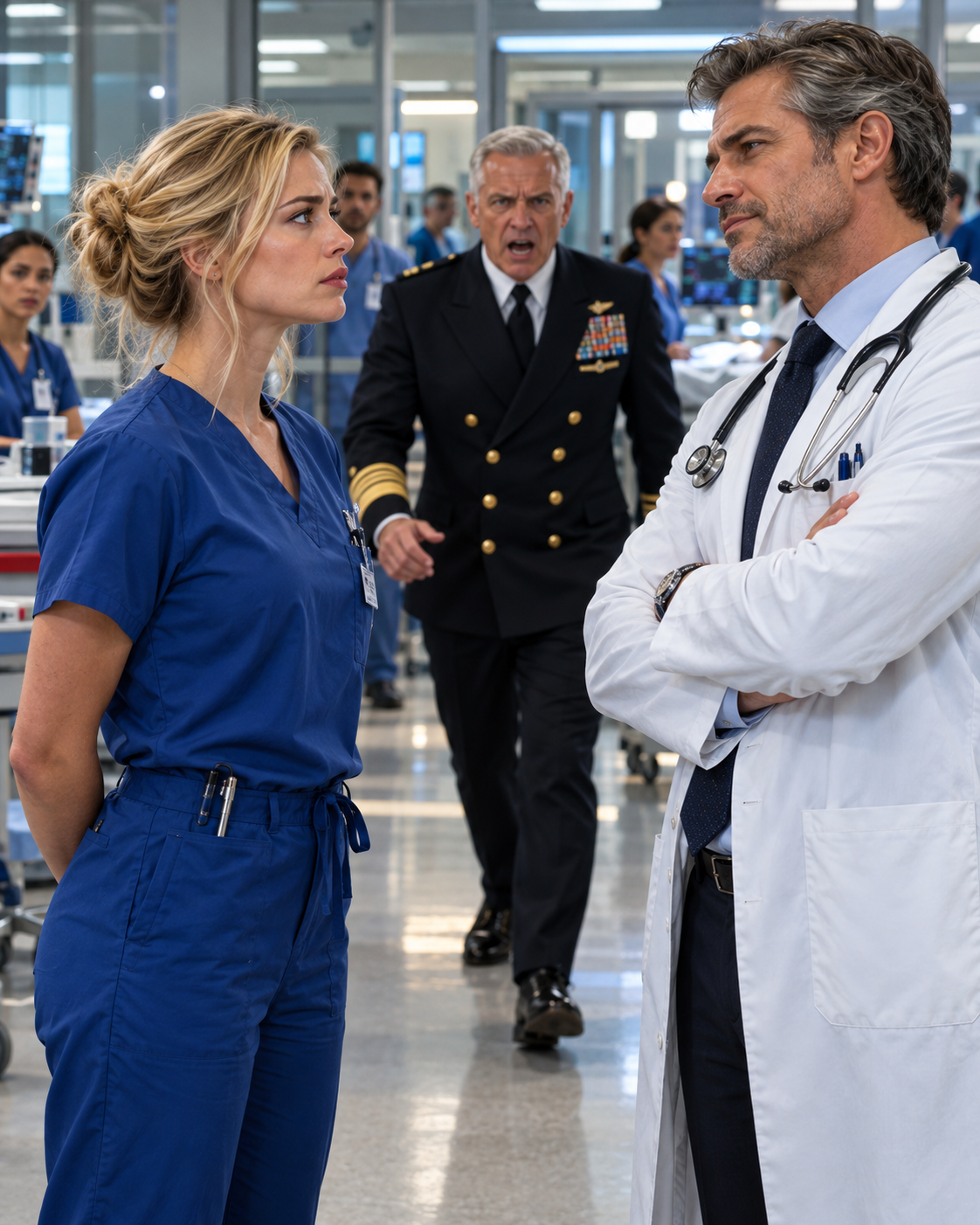
“Proceed,” he said.
His voice sounded different now.
The certainty had disappeared.
I focused on the task in front of me, the patient’s condition, and the movements of the team around the bed.
There was no ocean beneath my feet this time.
There was a young sailor whose life was slipping away while everyone in the room fought to bring him back.
I did not think about the insult in the hallway.
I did not think about the months of humiliation.
I thought about the five men in the North Atlantic who had trusted me to bring them home.
And I thought about the man in front of me who deserved the same chance.
The emergency intervention lasted thirteen seconds from the moment the critical airway maneuver began to the moment the team established a path for oxygen.
Thirteen seconds.
I heard someone count.
I heard the respiratory therapist call out a change in the monitor.
Then Danny’s chest rose.
Once.
Twice.
A third time, more steadily.
The oxygen saturation began to climb.
The blue around his lips slowly gave way to color.
“Air movement confirmed,” the respiratory therapist announced. “We’re getting oxygenation.”
Nobody cheered.
Nobody moved for a heartbeat.
Then the room erupted into coordinated activity as the team secured the airway, administered the appropriate emergency medications, and worked to stabilize Danny for further treatment.
Graves stared at the monitor.
His face had gone pale.
I stepped back to give the team room.
My hands were trembling.
I had not noticed until that moment.
The tremor started in my left fingers and traveled up my arm, a delayed reaction to the fear I had forced aside while Danny was dying.
I closed my hand around the edge of the counter.
Four years earlier, I had watched blood disappear into the dark Atlantic.
Now I watched a young sailor breathe because a room full of people had finally stopped arguing long enough to act.
I turned toward Danny’s bed.
His eyes remained closed, but his chest continued to rise.
I whispered a promise he could not hear.
“Stay with us, Danny.”
The doors at the far end of the department flew open.
A tall man in a Navy uniform strode inside, followed by two officers who appeared to have been moving at a run.
Rear Admiral Thomas Anderson had arrived for a scheduled inspection of the medical center, but the emergency in progress had redirected him toward the trauma area.
He stopped when he saw the cluster of clinicians around Danny.
“What happened?”
The charge nurse began explaining the situation.
Anderson listened, his eyes moving from the monitor to the equipment and finally to me.
Then his gaze dropped to my right arm.
He went completely still.
I recognized the expression before he spoke.
Recognition.
Not of my face alone, but of the specialized tactical prosthetic beneath my rolled-up sleeve, a piece of equipment designed around demands most hospital staff had never encountered.
“That prosthetic,” he said quietly. “Where did you get it?”
I felt my stomach tighten.
“Through the service, sir.”
His eyes narrowed as he examined the distinctive mechanical assembly.
“That configuration was issued to a very small number of rescue personnel. I remember the reports.”
The hallway seemed to fall silent again.
Graves looked from the admiral to me.
“What reports?”
Anderson did not answer him immediately.
He took a step closer, studying my face as if a memory were finally aligning with the person standing before him.
“Claire Carter,” he said.
My name sounded different when it came from him.
I straightened instinctively.
“Yes, sir.”
“North Atlantic rescue. Four years ago.”
I could feel the room listening.
“Five crew members recovered from a sinking vessel,” he continued. “One rescue swimmer seriously injured during the final extraction.”
He paused.
“That was you.”
Nobody spoke.
I wished, suddenly and fiercely, that I were anywhere else.
Not because I was ashamed of what I had done, but because I had spent four years trying to become someone whose identity did not begin and end with the day she lost her arm.
Anderson looked at Danny, then back at me.
“I read the operational summary,” he said. “I remember the casualty report. I remember the recommendation for commendation.”
“I did what I was trained to do, sir.”
“You did considerably more than that.”
I glanced toward the floor.
“I was part of a crew.”
“Yes,” he said. “And the crew brought five men home because you kept going when most people would have been unable to continue.”
Graves’s face had changed.
The man who had mocked my disability less than an hour earlier now looked as though the ground beneath him had shifted.
“Admiral,” he began, “I wasn’t aware of her background.”
Anderson turned toward him.
“Would that have changed what you said?”
Graves opened his mouth.
Nothing came out.
The question hung between them, heavier than any reprimand.
I could have answered for him.
I could have described every insult, every dismissive remark, every shift during which he had made me feel that I had to earn the right to occupy space in a department where I had already proved my competence.
But Danny was still in the bed.
He was alive, yet fragile.
He needed monitoring, further treatment, and a team that could put its pride aside long enough to keep him safe.
So I returned to his side.
“His oxygenation is improving,” I told the attending physician. “He needs continued close observation and definitive follow-up for the airway and allergic reaction.”
The physician nodded and began coordinating the next steps.
Behind me, Anderson watched in silence.
I could feel the admiral’s attention, but I refused to become a story while my patient still needed care.
A few minutes later, Danny was transferred to a higher level of monitoring.
The doors closed behind his bed, and the immediate crisis finally loosened its grip on the room.
My legs felt strangely weak.
I went into the staff washroom, locked the door, and stood with both shoulders against the cool tile.
Then I let myself breathe.
My reflection looked back at me from the mirror.
Tired eyes.
Pale skin.
A loose strand of hair escaping its tie.
And the black prosthetic I had once believed would always be the first thing people noticed.
I lifted my left hand to my face.
For four years, I had treated the loss of my arm as a private fact, something to manage quietly so that I could get on with the rest of my life.
I had not realized how much energy I spent trying to make other people comfortable with it.
A knock came at the door.
“Claire?”
It was Anderson.
I wiped my face and opened the door.
He stood outside without the entourage that had accompanied him into the department.
“May I speak with you?”
“Of course, sir.”
He looked at my prosthetic, then deliberately raised his eyes to meet mine.
“I want to apologize for something.”
I frowned.
“You didn’t say anything, sir.”
“Not today.”
He paused.
“When the rescue report came across my desk, I saw the injury, the commendation, and the recommendations for continued service. I signed the paperwork. I assumed the system would take care of the rest.”
His expression hardened with regret.
“I never asked what happened to you after the report was closed.”
I had no answer for that.
He continued.
“Did anyone help you find your way back into service?”
“Some people did. Some didn’t know how. Others thought I should be grateful just to be alive.”
“And what did you want?”
The question surprised me.
Nobody had asked it that simply in years.
I looked down at the black fingers of my prosthetic.
“I wanted to be useful again without having to prove that I was still the person I had been before.”
Anderson nodded slowly.
“That sounds like a difficult thing to ask of yourself.”
“It was.”
He glanced toward the department.
“What happened today was extraordinary, but I don’t want the lesson to be that you had to reveal a classified past to earn respect.”
The words caught me off guard.
He was right.
If my history had remained unknown, if he had never recognized the prosthetic, I would still have been the same nurse.
I would still have studied, practiced, cared for patients, and worked to make myself better.
The difference would only have been that fewer people knew why.
Anderson seemed to read the thought on my face.
“Your ability should have been assessed on its merits,” he said. “Your disability should never have been treated as evidence against you.”
For the first time that morning, I felt the pressure in my chest ease.
Not disappear.
Just ease.
Then the admiral asked a question that changed the direction of my life.
“Have you ever considered teaching?”
I looked at him.
“I train new nurses when the department needs it.”
“I mean formally. Emergency response. Adaptation. Teamwork under pressure. The kind of preparation that recognizes what injured service members can still contribute instead of deciding what they can no longer do.”
I stared at him for a long moment.
I had spent four years trying to build a life that did not revolve around my injury.
I had never considered that the injury itself might help me build something for others.
Before I could answer, Anderson continued.
“I can’t promise you a program or a budget today. But I can help bring the right people together, and I can make sure your proposal gets a fair hearing.”
I looked back toward the emergency department.
Through the glass, I could see the nurses moving between beds, the physicians conferring, and the quiet machinery of a place that never stopped needing people.
I thought about Danny.
I thought about the five men who had survived the Atlantic.
And I thought about all the people who had returned from service carrying wounds that were visible, invisible, or both.
“Let me put something together,” I said.
Anderson gave a small nod.
“Then let’s see what we can build.”
For the first time in years, my past no longer felt like a door I had to keep closed.
It felt like a bridge I might be able to help someone else cross.
Part 3
By the end of the shift, the story had traveled farther than I wanted it to.
People spoke in hushed voices near the nurses’ station, exchanging fragments of what they had seen and what they thought they understood.
Some called me a hero.
Others wanted to know how I had managed to perform under pressure without showing fear.
A few stared at my prosthetic with a new kind of curiosity, as though the mechanical hand itself had somehow changed overnight.
I did not enjoy any of it.
I had not saved Danny to become the center of a story.
I had helped because he was a patient in danger, and helping him was my responsibility.
When I returned to the department after finishing the necessary documentation, Graves was waiting beside the staff entrance.
His white coat was still immaculate.
His expression was not.
“Carter,” he said.
I stopped.
For a moment, he seemed to struggle with the words.
“I owe you an apology.”
I waited.
He looked down at his hands.
“What I said this morning was inappropriate. What I’ve said over the past several months was inappropriate, too.”
It was the first time I had heard him acknowledge the pattern rather than dismiss each incident as a joke or misunderstanding.
“I’m sorry,” he added.
The apology sounded uncomfortable.
Perhaps it should have.
I could have made him list every insult.
I could have asked him to explain why he had assumed that an amputation meant incompetence, or why he had mistaken my silence for weakness.
Instead, I asked him a question.
“If Admiral Anderson hadn’t been here, would you be apologizing?”
Graves looked up.
His mouth tightened, then relaxed.
“I don’t know.”
It was not a satisfying answer.
But it was an honest one, and honesty was more useful than a polished excuse.
I nodded once.
“Then I hope you think about that.”
I walked past him.
I did not forgive him that day.
Forgiveness was not a debt I owed someone simply because he had finally recognized the damage he had done.
But neither did I want my future to be shaped by the amount of anger I could carry.
I wanted something more useful than revenge.
Three days later, Danny Reyes was awake and able to speak.
The allergic reaction had left him exhausted, frightened, and shaken by how quickly an ordinary morning had turned into a fight for his life.
When I entered his room, he was sitting upright in bed, a blanket pulled over his legs.
He looked at me for several seconds.
“You’re the nurse who held my hand,” he said.
“I was.”
He swallowed.
“I remember trying to talk, but nothing came out. I could hear everybody, but I couldn’t tell them I couldn’t breathe.”
His voice cracked.
“I thought I was going to die.”
I pulled a chair beside his bed.
“You were very sick, Danny. The team acted quickly, and you’re getting the care you need now.”
He studied my face.
“Somebody told me you saved me.”
I shook my head gently.
“A whole team worked to get you through it. You did your part, too.”
He glanced at my right arm.
“Does it hurt?”
The question was so direct that I almost laughed.
“Sometimes.”
“All the time?”
“Not all the time.”
He considered that, then looked toward the window.
“I’m sorry you lost it.”
I felt the familiar pressure behind my ribs, but this time it was not humiliation.
“Thank you.”
He turned back toward me.
“Do you miss who you were before?”
I could have given him the answer I had given so many people.
I could have said I was fine, that life went on, that I had learned to adapt.
Instead, I told him the truth.
“Some days, I miss her terribly. Other days, I realize she’s still here. Just not in the same shape.”
Danny nodded as if he understood more than his years should have required him to understand.
“Then I guess I’m glad you were here.”
I sat beside him until the conversation faded and the room settled into a comfortable quiet.
When I left, I stood in the hallway for a moment and allowed myself to feel the full weight of what had happened.
For years, I had believed that moving forward meant leaving the rescue swimmer behind.
Danny’s question made me wonder whether I had been trying to escape a part of myself that did not need to be escaped at all.
The following week, Admiral Anderson arranged a meeting with hospital leadership, representatives from the Coast Guard, rehabilitation specialists, and military medical educators.
I arrived with a folder containing twelve pages of notes.
I had spent nights working on it after my shifts, sketching ideas at the kitchen table of my small apartment while rain tapped against the windows.
I called the proposal the Adaptive Service and Emergency Readiness Initiative.
The name was plain on purpose.
I did not want a monument to my injury.
I wanted a practical program that would help injured veterans and active-duty personnel develop the skills, confidence, and clinical knowledge needed to continue serving in medical and emergency response roles.
The proposal included accessible simulation labs, prosthetic-adaptation workshops, peer mentorship, rehabilitation-informed training, and partnerships with clinicians experienced in caring for patients with disabilities.
It also included something I considered just as important.
A structured process for evaluating people according to the actual requirements of their roles, with appropriate accommodations and safety standards, rather than assumptions about what their bodies could or could not do.
When my turn came to speak, I stood at the front of the conference room.
My right sleeve was rolled back.
I had decided not to hide the prosthetic that day.
Not because I wanted anyone to admire it, but because I was tired of treating it as an apology.
“An injury changes a person’s life,” I began. “Sometimes it changes what they can do. Sometimes it changes how they have to do it. But it doesn’t automatically erase their judgment, discipline, experience, or ability to learn.”
I looked around the table.
“I am not asking us to ignore limitations. In medicine, limitations matter. Patient safety matters. Training standards matter. What I’m asking is that we stop confusing a limitation with a verdict.”
Nobody interrupted.
I continued.
“Some injured service members will need different duties. Some will need extensive retraining. Some will discover that the career they loved is no longer possible, and they will need help finding another path. We owe them honesty about those realities.”
I paused.
“But we also owe them the chance to find out what remains possible before we decide for them.”
Across the table, one of the rehabilitation specialists nodded.
A senior nurse began taking notes.
Even Graves, who had been invited to contribute as part of the emergency department’s leadership team, remained silent.
I turned toward the admiral.
“Four years ago, I thought losing my arm meant losing the part of me that knew how to serve. It took a long time to understand that service was never located in one particular limb.”
My voice wavered, and I allowed it to.
“It was in the training, the judgment, the willingness to show up when someone else needed help, and the responsibility to keep learning when the world changed.”
I looked down at my prosthetic.
“This program won’t make every injured person fit every role. That’s not its purpose. Its purpose is to make sure we stop closing doors before we’ve even bothered to see who’s standing in front of them.”
When I finished, the room remained quiet for several seconds.
Then Anderson leaned forward.
“Let’s develop the pilot program,” he said. “Bring me a detailed implementation plan, a training framework, and a realistic budget.”
I felt my shoulders loosen.
It was not a promise of instant success.
There would be approvals, reviews, funding questions, and disagreements about how the program should work.
But it was a beginning.
And for the first time in four years, I was building something that connected the person I had been with the person I was becoming.
Over the next several months, the proposal became a working program.
We started small, with a handful of participants and a team willing to challenge its own assumptions.
There was Marcus, a former corpsman who had lost part of his leg and feared that the hospital would never take him seriously again.
There was Elena, a veteran who had sustained nerve damage in one hand and worried that her medical career was over before it had truly begun.
There were others whose injuries were less visible but whose uncertainty was just as heavy.
On the first day, I stood before them in a simulation room filled with training mannequins, medical carts, and equipment arranged for emergency-response exercises.
Some participants looked eager.
Others looked as if they were waiting for someone to tell them they did not belong.
I recognized that expression immediately.
“I won’t promise you this will be easy,” I told them. “I won’t tell you every career can be resumed exactly as it was before. And I won’t ask you to pretend your injuries don’t matter.”
I let the words settle.
“But nobody in this room gets to decide that your future is over just because your life changed.”
Marcus raised his hand.
“What if we try everything and still can’t do what we used to?”
I looked at him.
“Then we figure out what you can do now. We find the work that fits your abilities, train for it properly, and make sure you have the chance to be excellent at it.”
He looked down at his prosthetic leg.
“And if people still look at us differently?”
“Some will,” I said. “You can’t control every assumption someone makes about you. But you can demand fair standards, build real competence, and refuse to let their ignorance become the measure of your worth.”
Elena smiled faintly.
“That sounds like something you had to learn the hard way.”
“It was.”
We began the first exercise.
There were mistakes, frustrations, and awkward moments.
One participant struggled to adapt a familiar procedure to a different range of motion.
Another grew angry when a simulation exposed a weakness he had been trying to conceal.
Nobody was allowed to pretend that effort alone could replace training.
We assessed, adjusted, practiced, and tried again.
Slowly, the room changed.
People began asking for help without apologizing.
They began offering each other practical solutions instead of empty encouragement.
They learned that adaptation was not the same as failure, and that independence did not mean refusing assistance.
I watched Marcus complete a complex emergency-response simulation with a calmness he had not possessed on the first day.
When the exercise ended, he looked at me with disbelief.
“I thought I was finished,” he said.
I smiled.
“You thought you were finished with one version of your life.”
He glanced toward the other participants.
“There’s a difference?”
“There’s a very big difference.”
By the end of the pilot, several participants had qualified for new duties, while others had identified realistic accommodations and training goals that allowed them to continue progressing safely.
Not everyone returned to the exact work they had done before.
That was never the promise.
The promise was that their next chapter would be shaped by evidence, effort, and opportunity rather than by somebody else’s fear of what disability meant.
Graves changed more slowly.
He did not become a different man overnight, and I would not have trusted an overnight transformation anyway.
But he began asking questions before making judgments.
He consulted the rehabilitation specialists about accommodations.
He stopped making jokes about my arm.
During a staff meeting, he even challenged another physician who dismissed a veteran’s request for an adapted workstation without considering the person’s actual duties.
I watched him do it without comment.
I did not need him to become my friend.
I needed him to understand that his position gave him influence over people’s lives, and that influence carried responsibilities beyond issuing orders.
Several months after the program launched, the medical center held a small recognition ceremony for the first group of participants.
Danny Reyes attended as well.
He had recovered sufficiently to return to duty after completing his medical follow-up, and he had volunteered to speak about the importance of rapid emergency response and clear communication.
When he approached me before the ceremony, he looked healthier than the frightened young sailor I remembered.
“I still think about that day,” he said.
“So do I.”
He glanced at my prosthetic.
“Can I ask you something?”
“Of course.”
“When you walked into that room, were you scared?”
I considered giving him a reassuring answer.
Instead, I told him the truth.
“Yes.”
He frowned.
“You didn’t look scared.”
“Being afraid and being unable to act are not the same thing.”
I watched him absorb the distinction.
“I was scared when I went into the ocean, too,” I continued. “I was scared after I lost my arm. I was scared when I started nursing school and wondered whether everyone would see the injury before they saw me.”
I smiled gently.
“Courage isn’t the absence of fear, Danny. Sometimes it’s simply choosing to do the next right thing while the fear is still there.”
He nodded.
Then he offered his hand.
I shook it with my left.
His grip was warm and firm.
For a moment, I thought of the five men I had pulled from the Atlantic, and of all the people whose lives had crossed mine since then.
I thought of the person I had been before the storm, and the person I had struggled to become afterward.
I no longer needed to decide which version of myself deserved to exist.
They were both me.
At the end of the ceremony, Admiral Anderson stood beside the training room’s entrance while participants spoke with their families and instructors.
He approached me as the crowd began to thin.
“You built something important here, Claire.”
“We built it,” I corrected.
He smiled.
“Fair enough.”
Then his expression grew thoughtful.
“Have you considered sharing your story with a wider audience? There are people who need to hear it.”
I looked across the room at Marcus helping a new participant adjust the positioning of his training equipment, at Elena laughing with a colleague, and at Danny speaking with a young corpsman who had stopped to ask about his recovery.
For years, I had kept my story quiet because I wanted people to see the nurse rather than the injury.
Now I understood that telling the truth about my past did not have to trap me inside it.
It could help someone else imagine a future they had not yet allowed themselves to consider.
“Maybe,” I said. “As long as the story isn’t just about me.”
Anderson followed my gaze.
“It won’t be.”
That evening, after the last participant had left, I remained in the empty simulation room.
The overhead lights cast pale reflections across the stainless-steel equipment.
I removed my gloves and flexed the fingers of my prosthetic, checking the familiar mechanisms before lowering my arm to my side.
I could still remember the ocean.
Some nights, I remembered it too clearly: the crushing cold, the metallic scream of the collapsing winch, the unbearable weight of knowing that one wrong movement could cost another person their life.
The memory would probably never disappear completely.
But it no longer owned every room I entered.
I walked to the window and watched the lights of Portsmouth shimmer against the darkness.
For a long time, I had believed survival meant learning how to live with what was missing.
Now I understood that survival also meant recognizing what remained.
My right arm was gone.
The years I had spent in the water were gone.
The woman I had been before the accident could never return exactly as she was.
But my judgment remained.
My compassion remained.
My ability to learn, to teach, to stand beside someone who was frightened and tell them they were not alone remained.
And so did my responsibility to use those things well.
The next morning, I returned to the emergency department.
The hallway looked exactly as it had on the day Graves humiliated me.
The same bright lights.
The same rolling carts.
The same doors opening and closing as people hurried toward the next emergency.
I passed the nurses’ station, where a young nurse was struggling to fasten a supply pouch with one hand while balancing a stack of charts against her hip.
I stopped and helped her rearrange the load.
“Thanks,” she said with a relieved smile.
“No problem.”
Then I continued toward my station.
My right sleeve was rolled up.
Not to make a statement.
Not to invite questions.
Simply because I was tired of treating part of my body as something that needed to be hidden.
A new patient was arriving, and the team was already preparing the room.
I pulled on my gloves, checked the chart, and took my place beside the bed.
Nobody asked how many arms I had.
Nobody asked about the ocean.
They needed a nurse.
I was there.
And as the doors swung shut behind the next patient, I finally understood the lesson I had spent four years trying to learn: losing a part of yourself does not mean losing the right to serve, to belong, or to become someone new.
Sometimes the strongest thing a person can do is stop measuring life by what was taken away and begin measuring it by what they can still give.
My prosthetic arm could never bring back the one I had lost in the Atlantic.
But it reminded me every day that a life could change without becoming worthless, that dignity did not need permission, and that a person’s capacity to help others could never be measured by the shape of their body.
And somewhere beyond those hospital walls, another injured veteran was deciding whether to try again.
I hoped that when they finally walked into a room full of strangers, they would not have to prove they were a hero before anyone treated them like a human being.
I hoped someone would look at them, see the person standing there, and make room for what they could become.
Because the greatest thing I brought back from the ocean was not the memory of the five men I had saved.
It was the understanding that no one should have to earn their humanity by surviving the impossible.
And no one should have to reveal a heroic past before the world is willing to respect the life they are living now.