At the Metropolitan Club, my billionaire fiancé’s father publicly ordered me removed because my charcoal suit made me look “unimportant,”
At 6:17 the following morning, Arthur Sterling discovered that money could move faster than pride.
His company’s internal procurement portal displayed a notice requiring additional authorization for several sensitive transactions.
Two minutes later, the finance department received a request to preserve records associated with the Aegis acquisition.
By seven, outside counsel had been notified that the government was conducting an urgent review of newly documented discrepancies.
By eight, Arthur’s executive assistant had called three different officials and received the same answer each time.
The review was active.
No one would discuss confidential evidence over an unsecured line.
No one would promise that the contract would remain untouched.
Arthur responded the way he always had when confronted with an obstacle.
He made calls.
He demanded names.
He reminded people of his company’s employment numbers, its political relationships, and the importance of maintaining a stable defense supply chain.
He threatened to contact senators.
He told his lawyers that someone had made a mistake and expected them to correct it before the markets opened.
At 9:05, Vance Defense Systems issued a brief statement saying it was cooperating with a routine administrative review.
At 9:22, a financial journalist contacted the company’s communications office asking about allegations of irregular billing.
At 9:40, Arthur’s chief financial officer informed him that several transactions connected to the disputed program had been placed under enhanced scrutiny.
Arthur slammed his hand against his desk.
“This is absurd. The Aegis contract has survived ten years of reviews.”
His lawyer, Malcolm Price, stood near the window with a tablet in his hand.
“Then we need to determine what changed.”
“Someone at the Pentagon is targeting me.”
“Do we know that?”
Arthur’s expression hardened.
“We will.”
Across Washington, I was sitting in a secure office reviewing the same audit trail that had started the process moving.
I had slept for less than four hours.
My uniform was pressed, my notes were organized, and a cup of coffee sat untouched beside a stack of acquisition records.
I had not slept because I was angry.
I had slept because the review required accuracy, and accuracy became harder when exhaustion turned assumptions into facts.
The evidence was troubling.
Invoices described components that did not match the approved specifications.
Shipping records suggested that certain semiconductors had passed through an offshore intermediary that had not received the required authorization.
Several safety reports appeared to rely on test results that could not be reconciled with the underlying engineering records.
None of those discrepancies, taken alone, proved the full scope of a criminal scheme.
Together, they justified an investigation that could no longer be postponed.
My role was to document what the records showed, identify what remained unverified, and make sure the proper authorities had the information needed to act.
I had learned long ago that the most dangerous sentence in acquisition oversight was, “Everyone knows how this works.”
It was usually spoken just before someone explained why an exception should not be documented.
At 10:30, my supervisor entered the office.
“Major Baker, the contractor’s counsel has requested an expedited meeting.”
“With whom?”
“The acquisition review team, legal counsel, and the officials responsible for the award.”
“Have they provided a written agenda?”
“Yes. They believe the issue can be resolved administratively.”
I looked at the request.
Arthur’s lawyers wanted to characterize the discrepancies as documentation errors and supply-chain misunderstandings.
Perhaps some of the issues could eventually be explained.
That was precisely why the review had to be conducted carefully.
“Schedule the meeting through the established process,” I said. “Make sure the audit team has the original records and the contractor receives whatever notice the applicable procedures require.”
My supervisor nodded.
“Understood.”
He turned to leave, then paused.
“There’s another matter. The contractor’s chief executive has asked whether Major Baker will attend.”
I looked up.
“Why?”
“He says he wants to address a personal conflict of interest.”
For the first time that morning, I felt something close to disbelief.
Arthur had finally discovered that I had a name.
“Tell counsel that I will participate in my official capacity if the review requires my involvement. Any personal relationship or potential conflict will be disclosed through the appropriate channel.”
My supervisor studied me for a moment.
“Are you comfortable with that?”
“No,” I said honestly. “But comfort isn’t the standard.”
By early afternoon, the request for a meeting had become a formal conference scheduled at the Pentagon.
Arthur arrived with Christian and a team of expensive lawyers who looked as though they had prepared for a disagreement over paperwork rather than an investigation that could threaten a corporate empire.
Christian wore a navy suit and carried himself with the nervous stiffness of someone who had spent the entire morning being told that everything would be fine.
Arthur walked ahead of him.
He had traded his scotch glass for a leather briefcase, but the expression on his face was unchanged.
He expected to find a mistake.
He expected someone to apologize.
He expected to leave with the Aegis contract intact.
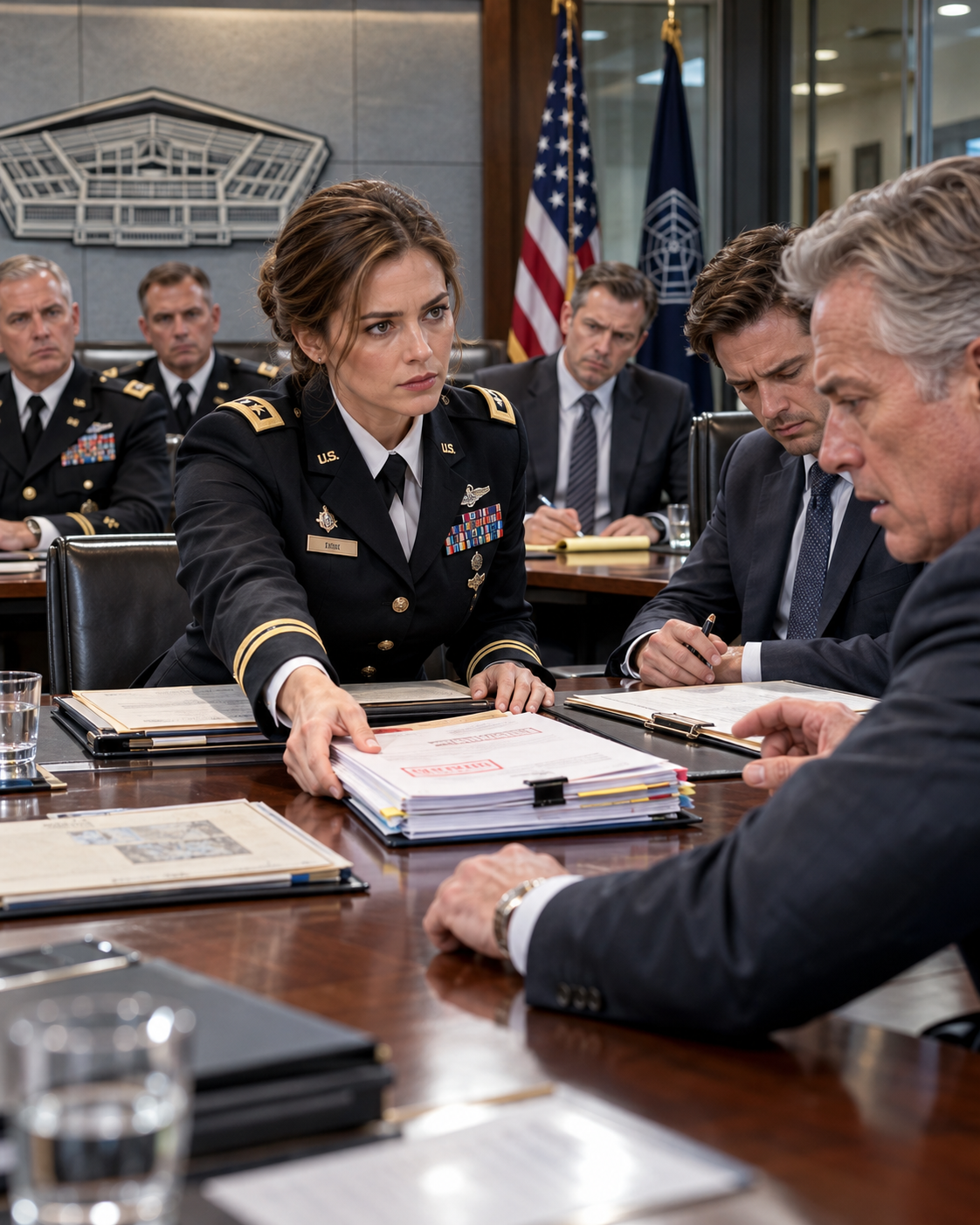
The visitors were escorted through the appropriate security procedures and into a secure conference room on the Pentagon’s third floor.
Armed sentries stood outside.
Inside, several division officers sat beside representatives from the acquisition authority and a military attorney from the Judge Advocate General’s Corps.
A red-stamped audit dossier rested in front of each authorized member of the review team.
At the far end of the table stood a brass nameplate.
MAJOR R. BAKER.
Arthur noticed it before he noticed me.
I was seated behind the nameplate, wearing my uniform, my expression composed.
For several seconds, he seemed unable to connect the woman he had dismissed at the Metropolitan Club with the officer sitting in front of him.
Then his eyes narrowed.
“You.”
I didn’t move.
“Good afternoon, Mr. Sterling.”
He turned toward Malcolm Price.
“She is involved in this?”
The lawyer’s face tightened.
“Mr. Sterling, we need to let the meeting proceed.”
Arthur pulled out his chair.
“This is a personal vendetta. She was at my club last night, and now my company is facing an emergency review.”
The JAG attorney spoke before I could answer.
“Mr. Sterling, any potential conflict has been disclosed and reviewed. Major Baker is participating in accordance with her assigned responsibilities. The evidence and decisions will be evaluated by the authorized officials, not by personal relationships.”
Arthur’s jaw moved as though he were chewing on an insult.
“Convenient.”
I opened the dossier.
“The purpose of this meeting is to review documented discrepancies in the Aegis acquisition, determine what additional evidence is required, and address the contract’s status under the applicable terms and regulations.”
I spoke slowly enough that no one could mistake my meaning.
“This is not a meeting about dinner at the Metropolitan Club.”
Christian looked at me.
For the first time, I saw something in his expression beyond embarrassment.
He looked afraid.
Not of me.
Of the realization that the life he had inherited might not be as secure as he had always believed.
I slid the first set of records across the table.
The documents included invoices, shipping records, component specifications, and safety reports that could not be reconciled with the approved procurement requirements.
The red stamp on the cover read FEDERAL AUDIT REVIEW.
“These records identify discrepancies involving billing, component authorization, and safety-data integrity,” I said. “The audit team has preserved the source documents and documented the chain of custody. We will distinguish between verified facts, unresolved questions, and any findings that require referral to investigative authorities.”
Malcolm Price began taking notes.
Arthur leaned forward.
“Those are accounting issues. They can be corrected.”
“Some accounting discrepancies can be corrected,” I replied. “But inaccurate invoices cannot simply be amended without determining why they were inaccurate, whether payments were improper, and whether the underlying goods met the contract requirements.”
“The components were supplied.”
“That does not establish that they were authorized.”
“They performed.”
“That does not establish that the required safety tests were completed or accurately reported.”
Arthur’s face darkened.
“You don’t understand the realities of manufacturing at this scale.”
“I understand that soldiers depend on equipment that performs according to its approved specifications.”
I turned to the next page.
“The records also raise questions about whether certain test results were represented accurately in the documentation submitted to the government.”
One of the division officers leaned forward.
“Has the engineering team completed its independent assessment?”
“The assessment is ongoing,” I said. “We are not presenting unresolved technical questions as established conclusions. We are presenting the discrepancies that require examination.”
Arthur seized on the distinction.
“Then you admit you have no proof of fraud.”
“I admit that an investigation must establish the facts before conclusions are reached.”
I held his gaze.
“But the absence of a final conclusion does not erase the evidence that triggered the review.”
For the first time, Arthur had no immediate answer.
Then I opened the second file.
It was thinner than the first, but the room seemed to grow quieter when I placed it on the table.
“This document is an archived whistleblower complaint submitted eleven years ago by Thomas Reyes, a former engineer at Vance Defense Systems.”
Arthur went completely still.
The name meant something to him.
I could see it in the way his fingers tightened around the edge of the table.
Thomas Reyes had been a young engineer when he reported concerns about offshore sourcing, component traceability, and discrepancies between the company’s internal testing records and its formal safety submissions.
His complaint had been routed through internal channels.
Shortly afterward, he was fired.
The company’s stated reason had been poor performance and failure to follow supervisory instructions.
The complaint had never received the independent examination its contents warranted.
Over the years, the records had been scattered across archived correspondence, personnel files, and old acquisition documents.
The recent audit had not begun with Thomas’s report.
It had uncovered new discrepancies, which led investigators to search for earlier warnings that might explain how the same problems had developed.
That search had brought the eleven-year-old complaint back into view.
I placed the first page in front of Arthur.
“Mr. Reyes identified concerns involving the same offshore supply-chain pathway now under review.”
Malcolm Price read the page, then looked at his client.
Arthur’s face had lost its color.
“This is an old personnel dispute.”
“The complaint was submitted before the current audit, and its allegations were never fully resolved,” I said. “Its existence does not independently prove the current allegations. It does, however, raise important questions about what the company knew, what it investigated, and whether relevant information was withheld.”
Arthur pushed the document away.
“That man was incompetent.”
“Then the records should support that conclusion.”
He stared at me.
I continued.
“Instead, the archived file contains a written warning about the same category of supply-chain risk now identified in the audit.”
The JAG attorney made a note.
One of the division generals turned to the contractor’s lawyers.
“Did your client preserve the records associated with this complaint?”
Malcolm Price answered carefully.
“We will need to review the file before making a complete statement.”
“That is understood,” the attorney replied. “The review team will issue the appropriate preservation requirements.”
Arthur leaned toward his lawyer and whispered something I couldn’t hear.
The lawyer shook his head slightly.
It was a small gesture, but I understood it.
For years, Arthur had operated as though every difficult question could be answered by controlling the room.
Now, the room belonged to a process he could not control simply by speaking louder.
I closed the second file.
“Today’s purpose is not to pronounce anyone guilty. The purpose is to establish what happened, protect the integrity of the acquisition process, and ensure that any decision concerning the contract follows the evidence and the governing rules.”
Arthur looked at me with an expression I had never seen on his face before.
It wasn’t hatred.
It was uncertainty.
He finally understood that I wasn’t there to humiliate him.
I was there to make sure he could not humiliate the truth into silence.
Part 3
The conference lasted nearly four hours.
Arthur’s lawyers challenged the interpretation of individual invoices, questioned the reliability of old correspondence, and argued that supply-chain problems were common in complex defense manufacturing.
The review team considered each point.
Some records required additional verification.
Several technical questions were referred for independent examination.
The archived whistleblower complaint prompted a separate review of the company’s earlier response and its record-retention practices.
Nobody announced that Arthur was guilty of a crime.
Nobody needed to.
By the end of the meeting, the acquisition officials had enough documented concerns to take formal action under the contract’s applicable provisions.
The Aegis award was suspended pending the required review, and the responsible authorities began the process of determining whether termination, recovery of funds, or further referrals were warranted.
The decision did not come from my personal anger.
It came from the evidence, the contractual requirements, and the officials authorized to act.
That distinction would matter later, when Arthur tried to tell anyone who would listen that a rejected marriage proposal had brought down his company.
In the corridor outside the conference room, he stopped beside me.
Christian stood a few steps behind him, pale and silent.
Arthur’s lawyer had moved away to speak with another member of the review team.
For once, no audience remained to reassure Arthur that he was the most important man in the building.
“You think you’ve won,” he said.
I looked at him.
“This isn’t a contest.”
“You have no idea what you’ve done to hundreds of employees.”
His words struck closer to home than his insult at the club.
I knew there were engineers, technicians, warehouse workers, and administrative staff whose livelihoods depended on the company.
Many of them had never seen an invoice connected to the Aegis contract.
Some might have spent their entire careers doing honest work.
They had not asked to become collateral damage in a fight over executive decisions.
“I am aware that people who had nothing to do with these allegations may be affected,” I said. “That’s one reason the review needs to be accurate and fair.”
“Fair?” Arthur gave a bitter laugh. “You humiliated me in front of my lawyers.”
“No, Mr. Sterling. The records did that.”
His face twisted.
“You could have handled this differently.”
“I did handle it differently. I followed the process instead of turning a personal insult into an official decision.”
He stepped closer.
“Don’t pretend you weren’t angry.”
“I was angry.”
The admission seemed to surprise him.
“I was angry when you decided I wasn’t important enough to sit at your table. I was hurt when your son watched you insult me and said nothing.”
Christian flinched.
“But neither of those things changed the invoices, the shipping records, the safety reports, or the old complaint from Thomas Reyes.”
Arthur opened his mouth.
I continued before he could interrupt.
“If the evidence clears your company, the review should reflect that. If it establishes misconduct, the consequences should follow. I won’t ask the government to punish you for what you said to me, and I won’t ask it to ignore what the records show because you dislike who is presenting them.”
For several seconds, he said nothing.
Then he turned and walked away.
Christian remained where he was.
I wanted him to speak.
Not because I still expected him to rescue me, but because I wanted to know whether the man I had loved could finally stand inside an uncomfortable truth without looking for somewhere to hide.
He took a step toward me.
“Clara.”
I waited.
“I didn’t know it would happen like that.”
“You knew he was insulting me.”
“I thought if I stayed quiet, he’d calm down.”
I felt an old sadness settle over me.
“Did he?”
Christian lowered his head.
“No.”
“Then what did your silence accomplish?”
He had no answer.
I could have told him that I understood his fear.
I had seen what Arthur’s approval meant to him, how deeply his identity was tied to a father who measured affection through obedience.
I could even understand how a person could spend so many years avoiding conflict that he eventually mistook cowardice for peace.
But understanding a wound did not require me to live inside it.
“I loved you,” I said quietly. “I thought we were building a life where we could tell each other the truth, even when it was difficult.”
“We can still do that.”
“Can we?”
He looked at me with desperate hope.
“I’ll talk to him. I’ll make sure he never treats you that way again.”
I shook my head.
“You shouldn’t have needed to promise that after the fact.”
His eyes filled with tears.
I turned toward the security checkpoint.
Behind me, he said my name again, but I kept walking.
The following weeks were difficult for everyone connected to Vance Defense Systems.
The company challenged the suspension and argued that the audit findings had been misunderstood.
Its board commissioned an independent review.
The acquisition officials continued examining the disputed records, while investigators pursued the evidence through the appropriate legal channels.
The initial contract action was followed by further scrutiny of the company’s financial disclosures and its handling of the earlier whistleblower complaint.
As the review expanded, the board began confronting a problem it could no longer solve with public relations.
The questions did not concern one invoice or one supplier.
They concerned whether senior leadership had ignored repeated warnings, whether government payments had been justified, and whether the safety documentation submitted for a critical defense system could be trusted.
Thomas Reyes was eventually contacted through the proper investigative process.
He was no longer the frightened young engineer who had lost his job eleven years earlier.
He had built a different career, started a family, and learned to live with the fact that doing the right thing had once cost him almost everything.
When investigators asked whether he still had copies of his original complaint, he said he had kept them.
“I didn’t keep them because I wanted revenge,” he reportedly told the investigators. “I kept them because I knew someone might eventually ask what happened.”
His records helped investigators reconstruct the chronology of the earlier warnings.
They did not replace the need for corroboration, but they provided a crucial lead that the review team could test against other evidence.
The board’s confidence in Arthur deteriorated.
At an emergency meeting, directors considered the company’s exposure, the potential loss of government business, and the damage to its credibility with other customers.
Arthur argued that he had built Vance Defense Systems from the ground up and deserved the chance to correct whatever problems had occurred.
Some directors acknowledged his achievements.
Others asked why the same categories of concern had appeared in records spanning more than a decade.
By the end of the meeting, the board voted unanimously to remove him as chief executive while the investigation continued.
The decision was not a criminal verdict.
It was a judgment by the company he had led that his continued control had become an unacceptable risk.
Arthur left the boardroom without making a statement.
Within months, the financial strain became impossible to contain.
The suspended Aegis contract was ultimately terminated through the formal process after the responsible authorities determined that the contractual requirements had not been satisfied.
Additional business was lost as customers reviewed their exposure.
Creditors tightened their terms.
Potential buyers withdrew.
Vance Defense Systems attempted to restructure, but its liabilities and loss of confidence proved too severe.
The company eventually entered liquidation.
Several employees found new positions with other contractors.
Others faced months of uncertainty while their claims were processed.
I thought about them more often than I thought about Arthur.
A company could be responsible for serious wrongdoing without every person inside it being guilty.
That was another truth the investigation taught me.
Accountability had to be firm enough to mean something and careful enough not to become another form of injustice.
By the time federal prosecutors announced charges against Arthur for alleged major fraud and related offenses, his empire had already begun to disappear.
He pleaded not guilty and awaited trial.
The legal process would determine his criminal responsibility.
I did not celebrate when I heard the news.
I didn’t feel triumphant when the company closed its doors.
I felt the same quiet exhaustion I had felt after the conference at the Pentagon, along with the knowledge that the truth had finally been given room to breathe.
Christian called several times during those months.
I didn’t answer.
His messages began with explanations and ended with apologies.
He said he had been afraid of his father.
He said he had spent his entire life trying to earn approval that always seemed just beyond reach.
He said he had mistaken silence for loyalty and had finally understood the cost.
I believed that some of what he said was true.
But a person could understand the source of his behavior without undoing the harm it had caused.
I did not hate Christian.
I simply no longer trusted him with the parts of myself I had spent so long learning to protect.
One cold afternoon, several months after the Metropolitan Club dinner, I was leaving the Pentagon when I saw him standing near the outer security area.
He looked thinner.
The expensive confidence he had worn so easily before was gone, replaced by the uncertain expression of someone who had discovered that money could not restore every lost thing.
He held his hands together as I approached.
“Clara, please. Just a minute.”
I stopped at a respectful distance.
He looked at my uniform, then at my face.
“I owe you an apology.”
I said nothing.
“I should have defended you that night. I knew what my father was doing, and I let him do it because I was afraid of what it would mean if I stood up to him.”
His voice broke.
“I kept telling myself I was trying to keep the peace. But I wasn’t keeping the peace. I was making you pay for my fear.”
I felt the words settle between us.
For months, I had imagined what an apology from Christian might sound like.
In those imagined conversations, I had sometimes pictured myself feeling vindicated, finally hearing the words that would repair the humiliation of that dinner.
Standing in front of him, I realized that an apology could be sincere and still arrive too late to change the future.
“I am sorry, Clara,” he whispered. “I know I don’t deserve another chance, but I need you to know that I understand now.”
His eyes filled with tears.
For a moment, I saw the man I had loved, not the billionaire’s son or the frightened fiancé, but the person who had once sat beside me on a park bench and told me that he admired how calmly I handled difficult situations.
I remembered believing him.
Then I remembered the white tablecloth, Arthur’s scotch, and Christian’s lowered eyes.
“I hope you learn to stand up for yourself,” I said.
He nodded, wiping his face.
“And I hope you find someone who deserves you.”
I adjusted the brim of my service cap.
“That isn’t something you need to worry about anymore.”
He took a breath as if he wanted to ask me to stay, but he stopped himself.
For the first time, he allowed my decision to exist without trying to negotiate it away.
I walked toward the parking area.
The sky above the Pentagon was pale and wintry, and the wind carried the distant sound of traffic across the grounds.
My phone vibrated with a message about a logistics briefing scheduled for the next morning.
There would be another problem to solve, another set of records to examine, another decision that would require patience rather than anger.
I placed the phone in my pocket and kept walking.
For most of my life, I had believed that peace would come when the people who underestimated me finally recognized my worth.
I had imagined my father’s pride, Arthur’s respect, and Christian’s courage as doors that would eventually open if I worked hard enough.
But those doors had never belonged to me.
I could not make my father look up from his own expectations.
I could not make Arthur value anyone he considered beneath him.
And I could not make Christian become brave simply because I loved him.
What I could do was decide how I would respond when someone tried to make me smaller.
I could insist that evidence mattered more than status.
I could follow the rules even when breaking them would have felt satisfying.
I could refuse to confuse revenge with justice.
And I could walk away from a relationship that required me to accept humiliation in exchange for belonging.
At the Pentagon, authority was often represented by signatures, approvals, and decisions recorded in files that would outlast the people who made them.
But the most important authority I had ever learned to exercise was quieter.
It was the authority to stop asking for permission to respect myself.
I reached my car and paused before opening the door.
For years, I had carried the old hunger to be noticed, to be chosen, and to be told that I was finally enough.
That evening at the Metropolitan Club, I had believed Arthur Sterling was the man who could humiliate me.
I had believed Christian’s silence could break something inside me.
I had believed that losing their approval meant losing something precious.
I understood differently now.
They had not taken my worth away.
They had only revealed the price they expected me to pay for theirs.
I slipped into the driver’s seat, started the engine, and watched the Pentagon lights shimmer across the windshield.
Tomorrow, I would return to work.
I would review the records, ask difficult questions, and do my best to protect the people who depended on decisions made far from the battlefield.
I would make mistakes sometimes.
I would have to correct them.
And I would continue learning, because integrity was not a title or a uniform or a name engraved on a brass plate.
It was what remained when there was no audience to impress and no reward for doing the right thing.
I drove away without looking back.
For the first time in my life, I wasn’t leaving because someone had told me I didn’t belong.
I was leaving because I finally understood that I never needed their permission to belong to myself.