At the hospital’s glittering charity gala, my mother introduced me to two hundred influential guests as a “low-level Air Force printer technician
The first investigator introduced herself as Special Agent Rebecca Collins, and the second, a quiet man named Daniel Price, stood beside her with a document pouch tucked beneath his arm.
They did not raise their voices or make dramatic accusations.
They simply showed me their credentials and asked whether I was prepared to surrender the materials covered by the federal preservation order.
I nodded and entered the combination.
The locks clicked open.
Inside lay sealed folders, authenticated design records, forensic reports, and a signed statement from a former Ward Meridian contractor who had agreed to cooperate with investigators.
The ballroom had become so quiet that I could hear the faint scrape of a chair across the polished floor.
My mother stared at the open briefcase.
“Nathan,” she whispered, “what is this?”
He did not answer.
Agent Collins removed the first folder and examined its seal before placing it on the table.
“These materials concern an ongoing investigation into intellectual property theft, financial representations made to investors, and the use of potentially fraudulent collateral documents,” she said.
A donor near the stage lowered his phone.
Another quietly stepped away from Nathan.
The award presenter stood frozen beside a glass trophy shaped like a rising sun.
Nathan finally found his voice.
“This is a misunderstanding. My company developed its own technology. Claire has never even worked in healthcare software.”
I looked at him.
“You used my architecture diagrams.”
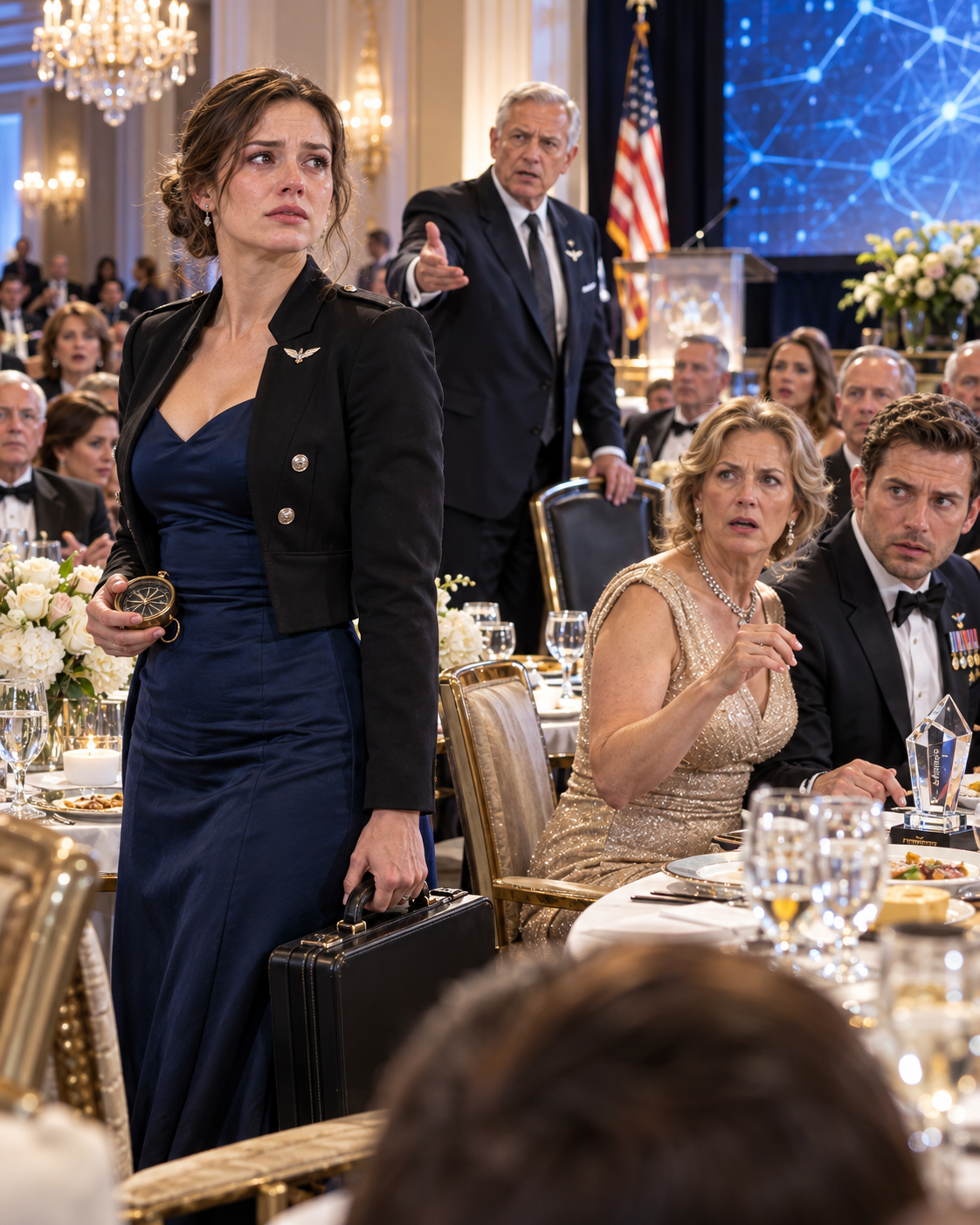
He laughed nervously.
“You made sketches when we were kids. You expect people to believe you invented an entire medical network?”
“No,” I said. “I expect people to examine the records.”
Agent Collins opened a folder containing authenticated version histories and timestamped design files.
The earliest Northstar architecture documents carried my name, my security credentials, and years of revisions created while I served in military cyberdefense.
The diagrams Nathan had submitted to investors contained the same unusual routing logic, the same failover sequence, and even the same annotation I had written during a sleepless night years earlier.
One line read, “When the primary path fails, protect the patient before protecting the system.”
It was a principle Grandpa had taught me long before I knew how to write a line of code.
Nathan had copied the words along with the work.
The investigators also possessed records showing that Ward Meridian had presented the copied architecture as independently developed intellectual property when seeking funding.
Several claims about completed testing and exclusive ownership were now under scrutiny.
Nathan looked around the ballroom, searching for someone who would defend him.
His investors were no longer looking at him.
They were looking at the documents.
My mother reached for my wrist.
“Claire, please. Not here.”
I gently withdrew my hand.
“Where would you prefer? At home, where you can tell everyone I fix printers?”
Her face tightened as though I had slapped her.
“I was trying to protect you from attention.”
“No, Mom. You were protecting the story you liked telling about us.”
She glanced toward the guests, visibly aware that people were listening.
“This is a family matter.”
I looked at the federal investigators standing beside the briefcase.
“Not anymore.”
For a moment, I felt the old familiar guilt rising inside me, the instinct to soften the truth so that my mother would not have to endure embarrassment.
Then I remembered Grandpa’s house.
I remembered the little room where he had taught me to repair radios, the kitchen where he had drawn diagrams on napkins, and the porch where he used to sit with his compass in his hand.
Nathan had not merely stolen my work.
He had put the last place that connected me to Grandpa at risk.
I could not protect the family’s reputation by sacrificing the truth again.
General Reed stepped forward and asked the award committee to suspend the presentation until the investigation could be reviewed.
The committee chair agreed.
The glass trophy remained untouched on the stage.
Nathan stared at it as if someone had taken away the future he had already imagined.
“You’re destroying my life,” he said to me.
I shook my head.
“You built your future on something you didn’t create. I’m just refusing to keep holding it up.”
His eyes flashed with anger.
“You always thought you were better than me.”
The accusation hurt because it revealed how little he understood me.
I had never wanted to be better than Nathan.
I had wanted him to see me as his equal.
When we were children, he had been the one our parents praised for winning school competitions, making speeches, and charming adults.
I had been the girl who dismantled broken electronics and forgot to come downstairs for dinner because I was trying to understand how something worked.
Whenever I showed our parents a new project, my mother would smile distractedly and ask whether I had finished my homework.
Whenever Nathan described an idea, she called it extraordinary.
I learned to hide my excitement before anyone could dismiss it.
Grandpa was the only person who never asked me to make my interests smaller.
He would sit beside me for hours, asking questions even when he already knew the answers.
“Curiosity is a kind of courage,” he told me once. “It means you’re willing to discover that what you believe might be wrong.”
After he died, I kept his compass in a drawer beside my childhood radio.
I carried it when I joined the Air Force.
I held it during the longest nights of my training.
And I placed it beside my keyboard when our team developed Northstar, the system that would eventually protect military medical networks during a coordinated cyberattack.
The system was never the work of one person alone.
I had led a team of engineers, analysts, clinicians, and security specialists who tested every failure path they could imagine.
We had designed redundancies, isolated compromised components, and prioritized continuity of care so that a cyberattack could not easily shut down critical medical operations.
When the attack came, Northstar helped hospitals maintain essential services while damaged systems were isolated and restored.
Our team worked for days with barely any sleep.
I remembered a physician calling to tell us that an emergency department had continued treating patients despite a major network disruption.
I remembered the quiet relief of knowing that people who would never learn our names had been able to receive care.
That was why I had chosen the work.
Not for awards.
Not for applause.
Not to prove my mother wrong.
I had wanted to build something that mattered when everything else failed.
And now my brother had taken that purpose and turned it into a sales pitch.
The investigators continued examining the documents while the gala organizers quietly asked guests to remain available in case statements were needed.
Nathan’s attorney arrived shortly afterward, his expression grim.
He spoke privately with Agent Collins, then pulled Nathan aside.
I could not hear their conversation, but I saw Nathan’s shoulders stiffen when his attorney showed him a page from the financial records.
A few minutes later, Nathan approached me again.
“Can we talk somewhere private?”
I glanced at the investigators.
“Anything you say about the company should go through your attorney.”
“This isn’t about the company.”
“Then what is it about?”
He looked toward our mother.
“Grandpa’s house.”
My stomach tightened.
“What about it?”
He lowered his voice.
“I didn’t think the lender would actually move against it. The documents were old, and I believed I could replace the financing before anyone noticed.”
“You used a property you didn’t own as collateral?”
“I was going to fix it.”
“You put his house at risk to finance a company built on my work.”
“I thought Ward Meridian would succeed. I thought I could make enough money to repay everything.”
I stared at him, trying to recognize the brother I had grown up with.
“Did you ever intend to tell the investors where the technology came from?”
He looked away.
That was answer enough.
The house had been left to our family through Grandpa’s estate, with ownership arrangements that required proper authorization before any transfer or pledge could be made.
Nathan had submitted obsolete paperwork suggesting he possessed rights he did not have.
The legal status of the property was now part of the investigation, and the lender had been instructed to preserve all records while the documents were reviewed.
I could not promise that the house would be untouched by the dispute, but the investigators had found no valid transfer of ownership to Nathan.
For the first time that evening, I felt relief that had nothing to do with my reputation.
At least Grandpa’s house had a chance of surviving what my brother had done.
Nathan rubbed his forehead.
“I was under pressure. Investors wanted results, and I couldn’t afford to look weak.”
“You could have asked me for help.”
“You would have said no.”
I considered that.
“Maybe I would have refused to let you steal my work. But I might have helped you build something honest.”
His eyes lifted toward mine.
I could see the boy he had once been, the brother who had helped me carry boxes into Grandpa’s attic and who had laughed with me when our homemade radio picked up a distant baseball game.
For a moment, I wanted to believe that boy was still there.
Then he said, “You could have shared Northstar with me from the beginning.”
I felt the hope fade.
“Northstar was developed for military medical cyberdefense. It wasn’t mine to hand over, Nathan. There were security obligations, licensing restrictions, and other people whose work you copied.”
He looked frustrated, as if the facts were inconveniences rather than boundaries.
I stepped away.
“I hope you take responsibility for what you’ve done.”
He did not follow me.
By the end of the evening, the award committee had formally suspended Nathan’s nomination pending the investigation.
Several investors announced that they were pausing new funding and reviewing their agreements with Ward Meridian.
The company’s board placed its leadership under review, and Nathan was temporarily removed from decisions involving the disputed technology while the legal process proceeded.
No dramatic arrest took place in the ballroom.
There were no handcuffs or shouting matches.
There were documents to preserve, statements to collect, and legal questions that would take time to resolve.
But as guests began leaving, I watched Nathan stand alone beneath the same chandelier where my mother had introduced him as the family’s great visionary.
For the first time, the applause had stopped, and nobody rushed to fill the silence for him.
My mother approached me near the ballroom doors.
Her silver gown shimmered beneath the lights, but her face looked suddenly tired.
“Claire, I never wanted this to happen.”
I held the compass between my fingers.
“Did you know he had copied my work?”
She shook her head quickly.
“I knew he had been studying some of your old projects. He said he had developed the concept independently.”
“And you believed him?”
“He was so confident.”
I gave a small, bitter laugh.
“I was confident when I was eight years old and fixed a radio. You told me to stop wasting time and focus on something practical.”
She flinched.
“I didn’t understand what you were doing.”
“You never asked.”
For several seconds, she said nothing.
Then she whispered, “I thought Nathan needed my support more than you did.”
The honesty in that sentence hurt more than another denial would have.
I had spent most of my life trying to earn a kind of recognition that Nathan seemed to receive without effort.
I had mistaken my mother’s preference for a verdict on my worth.
“You didn’t have to understand my work,” I told her. “You only had to respect that it mattered to me.”
Her eyes filled with tears.
“I am sorry.”
I wanted the apology to erase the years of small dismissals, the family dinners where my accomplishments were ignored, and the way she had introduced me to strangers that night.
It did not.
But I accepted that she might finally be seeing something she had refused to see before.
“I hear you,” I said. “I don’t know what happens next.”
She nodded, unable to meet my eyes.
Outside, the evening air was cold enough to clear my head.
General Reed stood near the entrance, waiting for his driver.
He approached me when he saw the compass in my hand.
“Henry would have been proud of you.”
My throat tightened.
“You knew my grandfather?”
“We met years ago, when he worked with a civilian engineering group supporting military communications. He spoke about you more than once.”
I stared at him.
“He never told me that.”
“He didn’t want to influence your choices. He believed you needed room to become yourself.”
The general paused.
“He also told me that you were the only person in his family who ever asked why a system failed before asking who was to blame.”
I looked down at the compass.
That sounded exactly like Grandpa.
“He believed the work mattered more than the credit,” General Reed continued. “But he also knew that people who refuse to claim their work sometimes allow dishonest people to claim it for them.”
I thought about the briefcase, the gala, and the countless times I had remained silent to keep the peace.
“I never wanted to be famous,” I said.
“Then don’t chase fame,” he replied. “But don’t mistake obscurity for humility. The people who depend on your work deserve to know who is accountable for it.”
His words followed me home.
The next several months were difficult.
The federal investigation continued, and I provided testimony about my original designs, the development process, and the security restrictions surrounding Northstar.
The records supported my account, and the investigators identified multiple instances in which Ward Meridian had presented copied material as proprietary work.
Questions about the financing and the collateral documents were referred to the appropriate authorities.
Nathan’s award was formally withdrawn.
His company lost several major investors, and its board began restructuring the business while the disputed technology was removed from its product plans.
The legal process moved more slowly than the gala guests had expected.
There were no instant resolutions, and no single document repaired the damage.
But the evidence remained intact, and I no longer had to carry the truth alone.
My mother called regularly.
At first, her conversations were filled with explanations about the pressure Nathan had faced and the fear she had felt when the scandal became public.
I listened, but I refused to reassure her that everything was fine.
Eventually, her questions changed.
She asked about my work.
She asked what Northstar actually did.
She asked how a system could keep hospitals functioning when ordinary networks failed.
For the first time, she stayed on the phone long enough to hear the answers.
It was a small change, but it was real.
Nathan took longer.
His first apology arrived in an email that began by explaining how difficult the investors had been and how much pressure he had faced.
I read it once and set it aside.
A week later, he sent another message.
This time, he wrote that he had stolen my work because he wanted the recognition I had earned without having to face the possibility that he might fail on his own.
He admitted that he had convinced himself my silence meant permission.
It did not.
He apologized without asking me to withdraw my statements or help him regain control of the company.
I met him at a quiet coffee shop near Grandpa’s old neighborhood.
He looked smaller without a room full of people waiting to hear him speak.
“I don’t expect you to forgive me,” he said.
“Good.”
He gave a tired smile.
“I deserved that.”
We sat in silence for a while.
Then he asked, “Do you think I can ever build something worthwhile?”
I considered the question carefully.
“Yes,” I said. “But not if you start by deciding that someone else’s work is yours.”
He nodded.
I did not promise that we would become close again.
Trust could not be restored by a single conversation, and forgiveness could not be demanded as payment for an apology.
But when we left, he did not ask me to make his mistakes easier to live with.
That was something.
A year after the gala, I returned to Grandpa’s house.
The legal review had confirmed that Nathan’s attempted pledge had not transferred ownership, and the property remained protected while the remaining financial disputes were resolved.
I opened the windows, swept dust from the dining table, and found the old radio still sitting on the shelf where Grandpa had left it.
Its wooden casing was scratched, and one of its knobs was missing.
I carried it to the table and began examining the wiring.
For a moment, I was eight years old again, sitting beneath the table while adults discussed a future that seemed to have no place for me.
Then I remembered Grandpa kneeling beside me.
“Signals bring people home.”
I turned the compass over in my palm.
The needle trembled before settling toward north.
I finally understood that he had never meant I should spend my life searching for approval.
He had meant that, no matter how confusing the world became, I should remember what guided me.
In the months that followed, I accepted an opportunity to help establish a mentorship program for young engineers and medical technology specialists.
We brought together students who had been told their interests were impractical, junior technicians whose ideas had been dismissed, and researchers who needed a place to develop their work without being forced to surrender credit for it.
I taught them about secure design, responsible innovation, teamwork, and the importance of documenting contributions.
But I also told them something I wished I had understood earlier.
“You don’t have to become the loudest person in the room,” I said during our first workshop. “You do have to learn how to stand behind the truth of what you’ve built.”
One young woman stayed after the others had left.
She held a notebook against her chest and looked embarrassed.
“My parents say engineering is a waste of time,” she admitted. “They want me to study something they can explain to their friends.”
I recognized the careful way she held her shoulders, as though she had already learned to apologize for taking up space.
I pulled out a chair.
“Tell me what you’re building.”
Her face changed.
For the next twenty minutes, she explained a prototype designed to help rural clinics manage emergency equipment shortages.
Her idea was rough, and she had plenty to learn, but the problem she wanted to solve was real.
When she finished, she looked at me anxiously.
“Do you think it’s worth pursuing?”
I thought of my grandfather’s radio, Northstar, the gala, and the black briefcase that had finally forced my family to confront the truth.
“I think it’s worth testing,” I told her. “Let’s find out what works.”
She smiled as though someone had opened a window in a room she had believed was locked.
After she left, I sat alone in the workshop and took Grandpa’s compass from my pocket.
For years, I had thought the needle pointed toward a place.
Now I understood that direction mattered more than destination.
I could not change the family I had been born into, and I could not recover every year I had spent shrinking my ambitions to make other people comfortable.
But I could choose what I did with the years ahead.
I could build systems that protected people.
I could teach young innovators to value honesty as much as ingenuity.
And I could love my family without allowing their expectations to decide how much of myself I was permitted to become.
My mother eventually visited the mentorship center.
She stood at the entrance for several minutes, watching the students gather around a prototype while I helped them troubleshoot a circuit.
When I noticed her, she looked almost uncertain about whether she belonged there.
I walked over and offered her a chair.
She sat beside me and watched the students work.
“I never realized how much you were doing,” she said quietly.
I looked at the young woman who had returned that morning with a revised design, her notebook open and her eyes bright with possibility.
“I’m glad you’re asking now.”
My mother nodded.
It wasn’t a perfect reconciliation.
Some wounds would take years to soften, and some conversations would never happen the way I wished they had.
But I no longer needed her to declare me extraordinary before I could believe that my work mattered.
That evening, after everyone had gone, I returned to Grandpa’s house and repaired the old radio.
When the speaker finally crackled to life, a distant voice emerged through the static.
I smiled and adjusted the dial.
The compass lay beside my hand, its brass surface worn smooth by years of being carried.
I had spent much of my life believing that being overlooked was the price of keeping the peace.
Now I knew better.
There is a difference between being humble and allowing others to erase you.
There is a difference between loving your family and surrendering your future to their expectations.
And there is a difference between seeking applause and refusing to let a lie stand in the place of the truth.
I switched off the radio and placed the compass in my pocket.
For the first time, I felt no need to prove anything to the people who had once dismissed me.
I had work to do, people to help, and young minds waiting to discover what they could build.
As I locked the front door, my phone buzzed with a message from General Reed.
The subject line read: A New Northstar Initiative.
Beneath it was a brief note explaining that a coalition of civilian hospitals wanted to explore a new emergency resilience program based on lessons from the original system.
At the bottom, he had added one sentence.
They specifically asked for you to lead it.
I looked toward the darkened windows of Grandpa’s house and felt the old compass press gently against my palm.
For years, I had tried to live quietly enough that nobody would notice me.
Now the world was asking me to step forward, not because my family had finally approved of me, but because the work mattered.
I opened the message and began to type my reply.
This time, I did not hesitate.