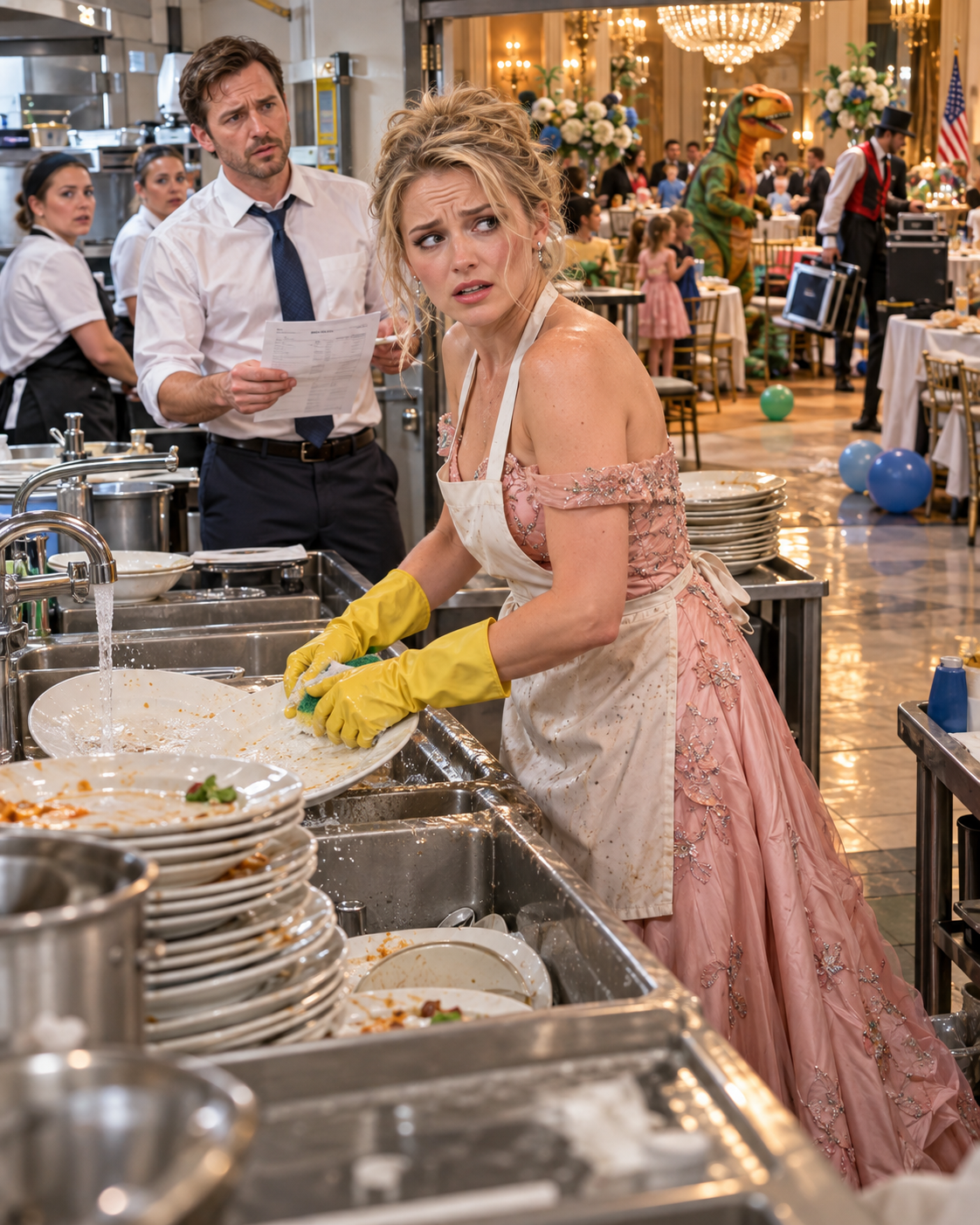
At the Grand Crest Manor, I watched my mother’s credit card get declined while my sister stared at me like I was cruel for refusing
Trevor tugged my sleeve so gently that at first I barely noticed.
The barbecue was loud around us, with paper plates bending under ribs and corn, children chasing each other through the yard, and Darren arguing with my uncle about whether the Broncos had any chance that season.
I leaned closer.
“What is it?”
Trevor glanced toward Chloe.
Then toward Lucas.
Then back at me.
“Mom, why did Aunt Chloe ask Grandma to give her money again?”
My smile disappeared.
“She asked Grandma for money?”
Trevor nodded.
“She said it was for something important.”
Across the patio, Chloe was laughing at something Aunt Clara had said, but when she looked up and saw my face, her smile changed.
Just slightly.
Enough for me to notice.
I waited until Trevor ran back outside before I approached her.
“What did you ask Mom for?”
Chloe looked down at her plate.
“Nothing.”
“Trevor heard you.”
She sighed.
“It wasn’t like that.”
“Then tell me what it was like.”
For a few seconds, the old Chloe appeared again, the one who could turn any question into an accusation.
“You really can’t let anything go, can you?”
I almost walked away.
Then she exhaled.
“I asked Mom if she could help with one bill.”
“What bill?”
“The manor.”
My chest tightened.
“You’re still paying for that?”
“We’re paying it.”
“How?”
“Darren set up installments.”
I stared at her.
“And you wanted Mom to cover them.”
“Just temporarily.”
There it was again.
That word.
Temporary.
It had been Chloe’s favorite word for years.
Temporary loans.
Temporary help.
Temporary emergencies.
Temporary mistakes that somehow became everyone else’s permanent responsibility.
I lowered my voice.
“Why didn’t you tell me?”
“Because I knew what you’d say.”
“And what would I say?”
She looked at me.
“No.”
For once, I didn’t feel guilty saying it.
“Then you already knew the answer.”
Chloe looked toward the yard.
Lucas was playing basketball with Trevor, both boys laughing over a terrible attempt at a layup.
“They’re different now,” she said.
“Who?”
“Our kids.”
I watched them.
“Yes.”
“Lucas keeps asking why we don’t do huge birthdays anymore.”
I swallowed.
“That’s probably hard.”
“It is.”
Chloe rubbed her hands together.
“I used to think if my son had more, he would feel more loved.”
That sentence stopped me.
Because beneath all her excuses and spending, there was finally something honest.
Fear.
Not entitlement.
Not arrogance.
Fear.
I sat beside her.
“Why?”
She stared at the grass.
“Because I grew up thinking people only noticed you when you were impressive.”
I knew exactly what she meant.
Our mother had never intended to create that lesson.
But Chloe had absorbed it anyway.
If she got better grades, people noticed.
If she bought better clothes, people noticed.
If Lucas had a bigger party, people noticed.
And when people noticed, she felt safe.
The problem was that safety had become expensive.
Very expensive.
“I thought you were jealous of me,” she whispered.
“I was jealous of the way Mom rescued you.”
Chloe nodded.
“I know.”
I looked at her.
“I wasn’t jealous of you.”
She gave a small laugh.
“You should have told me.”
“You should have asked.”
Neither of us spoke for a while.
Then she said, “I really am sorry about the card.”
I nodded.
“I know.”
“No, I mean it.”
“I know.”
“I was desperate.”
“I know.”
She looked at me.
“But you still said no.”
“Yes.”
“Did you hate me for it?”
I thought about that.
“No.”
“What did you feel?”
I looked toward Trevor.
“Afraid.”
Her eyebrows lifted.
“Of what?”
“Of becoming the person who saves you every time you fall, until you never learn how to stand.”
Her eyes filled with tears.
For once, she didn’t defend herself.
She simply nodded.
The conversation ended there.
But the consequences didn’t.
A few weeks later, Darren called me.
He sounded exhausted.
“She got another job.”
I laughed softly.
“Seriously?”
“Seriously.”
“How is she handling it?”
“Badly.”
That made me laugh.
Then Darren said something that surprised me.
“She’s also doing better.”
I sat down.
“What do you mean?”
“She started keeping track of every dollar.”
“Chloe?”
“Yes.”
“On paper?”
“Color-coded paper.”
I laughed so hard that Darren started laughing too.
Then he became serious.
“She also stopped using the credit card.”
That mattered.
Because Chloe’s problem had never been simply spending.
It was what spending represented.
Every purchase had been a declaration.
I am okay.
I am successful.
I am not behind.
I am not failing.
I am not less than anyone else.
And every time reality contradicted that declaration, she spent more.
Now reality was sitting in front of her without anywhere to hide.
A month later, Mom called me.
“I owe you an apology.”
I sat quietly.
“For what?”
“For making you feel like saying no was cruel.”
My throat tightened.
She continued.
“I thought I was helping Chloe.”
“You were.”
“No.”
She corrected herself.
“I was helping her avoid consequences.”
That sentence stayed with me.
Because sometimes love and enabling look almost identical from the outside.
They both involve giving.
They both involve sacrifice.
They both involve wanting someone you love to stop hurting.
But real love sometimes requires you to let someone hurt enough to change.
Mom cried.
“I should have protected both of you.”
I looked out my window.
“Trevor doesn’t need everyone to protect him.”
“What does he need?”
I smiled.
“People who show up.”
That was the part our family had forgotten.
Trevor never needed an extravagant birthday.
He needed people who wanted to be there.
He needed friends who ran beside him.
He needed his mother beside the basketball court.
He needed a cake shaped like a dinosaur because dinosaurs made him happy.
He needed someone to look him in the eyes and say, “You matter even when nobody is impressed.”
And maybe I needed that lesson too.
Because for years, I had measured fairness by comparing what Chloe received with what I received.
I had kept score.
Her rent.
Her tuition.
Her vacations.
Her emergencies.
Her excuses.
My work.
My bills.
My sacrifices.
My anger.
But Trevor taught me something better.
A child should not have to inherit the scoreboard adults built.
So I stopped keeping it.
Not because Chloe suddenly became perfect.
She didn’t.
She still overspent sometimes.
She still occasionally called Darren from a store asking if something was “financially reasonable,” which apparently meant, “Please stop me from buying this.”
But she had changed.
Slowly.
Uncomfortably.
Honestly.
And the biggest change came one Saturday when she showed up at my house carrying a cardboard box.
“What’s that?”
She placed it on the kitchen table.
Inside were the yellow rubber gloves.
The original pair.
The ones she had worn at the manor.
I stared at them.
“You kept these?”
She nodded.
“I thought they were humiliating.”
“They were.”
She laughed.
“Thanks.”
I picked them up.
“So why keep them?”
She shrugged.
“Because that was the first day I had to finish my own mess.”
I looked at her.
“And?”
She smiled.
“I survived.”
That was the moment I finally understood that standing my ground had never been about punishing Chloe.
It had been about refusing to participate in a pattern that was hurting everyone.
Her.
Me.
Our mother.
Our children.
Even Darren.
The boundary had not destroyed our family.
It had forced our family to become honest.
That Christmas, I gave Chloe the new pair of yellow gloves.
She opened the box and stared at me.
“You really bought me these?”
“Of course.”
She held them up.
“They’re terrible.”
“They’re practical.”
“You’ve become very annoying.”
“I learned from you.”
She laughed.
Then she hugged me.
Not a dramatic hug.
Not the kind people give when they want forgiveness.
Just a normal sisterly hug.
The kind that doesn’t ask for money afterward.
From the living room, Lucas shouted, “Mom!”
“What?”
“Can we have a magician next birthday?”
Chloe froze.
Darren started laughing.
I covered my mouth.
Trevor shouted from the hallway, “Only if you pay him first!”
The entire house erupted.
Even Chloe laughed until tears ran down her cheeks.
Then she looked at me.
“Deal.”
The following spring, Trevor and Lucas had another shared birthday.
There was no manor.
No eighty-five children.
No performers.
No giant pink gown.
Just a park, two basketballs, folding tables, pizza, and two cakes.
Chloe arrived early.
She carried the drinks.
Darren brought chairs.
Mom brought extra plates.
Aunt Clara brought a homemade dinosaur cake that looked slightly crooked.
Trevor loved it.
Lucas loved it too.
At one point, I watched Chloe crouch beside the boys while they argued over whose turn it was.
She didn’t buy them anything.
She didn’t distract them.
She didn’t fix the argument.
She simply waited while they worked it out.
That tiny moment meant more to me than the Grand Crest Manor ever could.
Because growth rarely announces itself.
Sometimes it looks like a woman in ordinary clothes sitting on a playground bench, realizing she doesn’t have to prove her worth through what she can afford.
Sometimes it looks like a mother finally saying no without hating herself for it.
Sometimes it looks like a grandmother admitting that rescuing someone isn’t the same as loving them.
And sometimes it looks like a little boy making a three-point shot while everyone he loves cheers, not because the party is expensive, but because he is there.
That evening, after everyone left, Trevor helped me clean the backyard.
He found the old yellow gloves sitting on the counter.
He picked them up and smiled.
“Are these Aunt Chloe’s?”
“Yes.”
“Why does she still have them?”
I smiled.
“Because some lessons are worth keeping.”
He thought about that.
Then he said, “Do you think Aunt Chloe learned hers?”
I looked toward the driveway.
Chloe was standing beside her car, waving before she left.
“I think she’s still learning.”
Trevor nodded seriously.
“Me too.”
Then he ran inside.
I stood alone for a moment, listening to the quiet.
I thought about the casino.
About cards.
About luck.
About how often people believed one lucky hand could fix everything.
It couldn’t.
Not in gambling.
Not in families.
Not in life.
Sometimes the bravest thing you can do is fold.
Not because you’ve lost.
Because you finally understand what the next hand will cost.
I had spent years believing that saying no would make me the villain in my family.
Instead, it became the boundary that gave all of us a chance to become better.
And somewhere inside the kitchen, Trevor yelled that he had found something under the table.
I walked inside.
“What is it?”
He held up a small envelope.
My name was written across the front.
I opened it.
There was only one sentence inside, written in Chloe’s handwriting.
“Next year, I want to tell you what really happened before the manor party.”
I stared at the words until the room seemed to go completely silent.
Because suddenly, I understood something I had never considered.
Maybe the Grand Crest Manor disaster hadn’t started with Chloe’s spending.
Maybe there had been something else underneath it all.
Something she had been too ashamed to tell me.
And for the first time since that terrible birthday, I wondered whether the yellow gloves had been the ending of one story…
or the beginning of another.
The next morning, Chloe called before I could ask her about the note.
Her voice was unusually quiet.
“I think it’s time I told you everything.”
And that was when I realized the hardest part of our family’s story might not have happened at the manor at all.
… The Story continues in the Comments! 👇