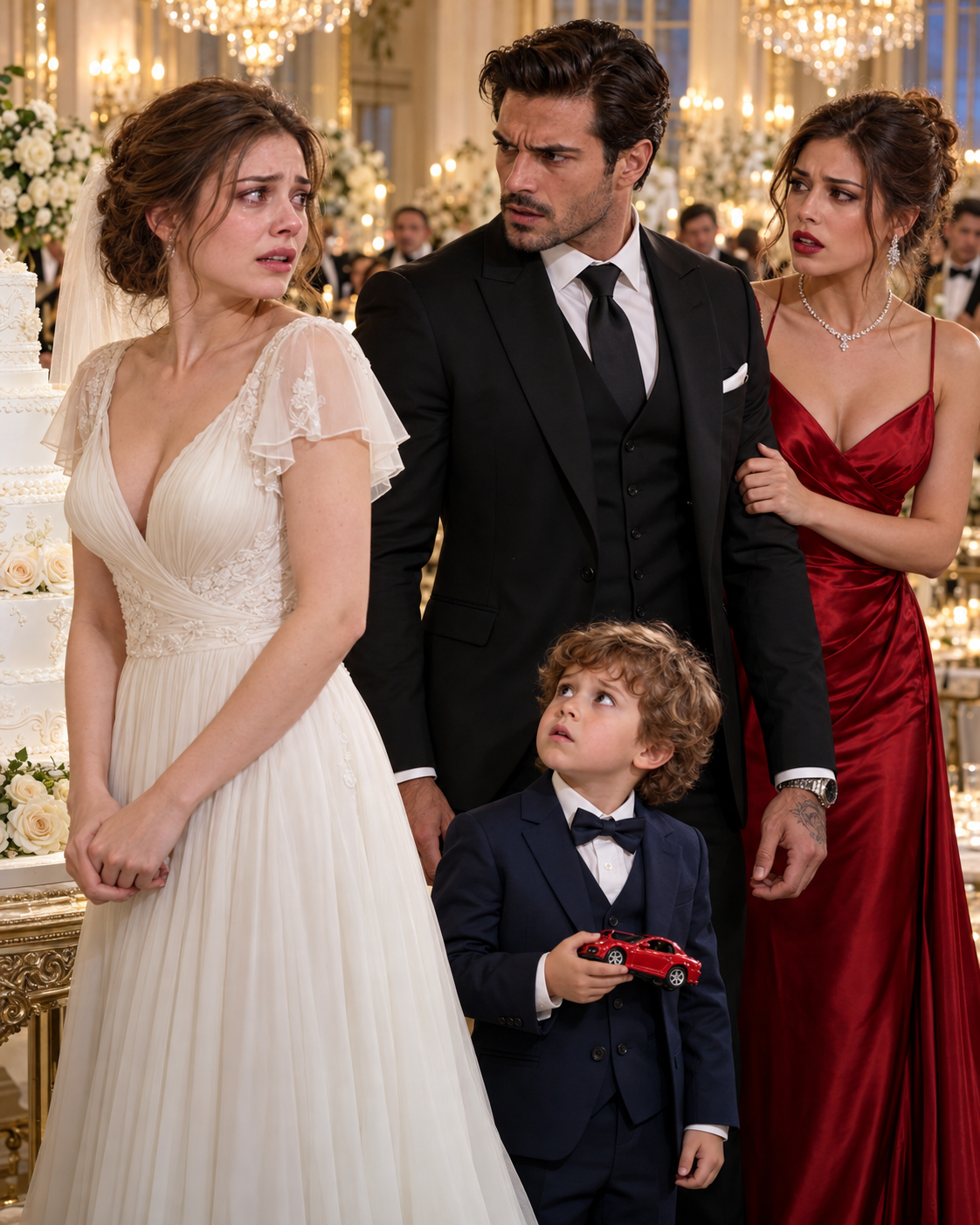
At the glittering Waldorf Astoria ballroom in Manhattan, my guests watched in stunned silence as I ordered a security guard
TASK 2
The message arrived on Valerie’s phone at 9:17 the following morning, just as she was opening the bakery.
I knew because she called me three minutes later, and I had never heard her voice sound so frightened.
“Alexander, can you come here?”
I was already reaching for my keys.
“What happened?”
“Please don’t ask me anything over the phone. Just come.”
When I arrived, she had locked the front door and turned the sign to CLOSED, even though a line of customers was waiting outside.
Toby sat at the kitchen table, coloring a picture of three stick figures beneath a yellow sun.
Valerie stood beside the counter with her phone in one hand and the photograph from the unknown number displayed on the screen.
The image showed her outside the bakery, Toby holding her hand, and a dark sedan parked across the street.
The message beneath it read, “Ask Valerie what she never told you.”
I looked at her.
“Valerie, what is this?”
She pressed her lips together, fighting to keep them from trembling.
“I thought it was over.”
“What was over?”
She glanced toward Toby, then quietly asked him to take his crayons into the back room.
He obeyed reluctantly, pausing at the doorway to look at us.
When his footsteps faded, Valerie placed both hands on the counter.
“Before I met you, before our marriage, I had a brother named Michael.”
I waited.
“He was twenty-three when he died in a car accident. He had been working for a financial firm that handled investments for several wealthy families, including yours.”
I remembered the name vaguely.
Michael Hart had been a junior analyst at one of our subsidiaries, a promising young man who had supposedly resigned shortly before his death.
“What does your brother have to do with this?”
“Michael discovered irregular transfers between companies connected to your father and several outside investors. He believed someone was using your family’s accounts to hide money.”
My stomach tightened.
“Did he tell you?”
“He told me enough to frighten me, but not enough to explain everything. He said he had made copies of certain records and that he was going to report what he found.”
She swallowed.
“Two days later, his car went off a wet road outside Boston.”
I stared at her.
“Are you saying his death wasn’t an accident?”
“I’m saying I never received an answer that made sense.”
She went to a cupboard behind the counter and removed a small metal tin, its edges worn from years of handling.
Inside lay a folded letter, a faded photograph of a young man standing beside Valerie, and a small brass key.
“I kept these because I couldn’t bear to throw them away,” she said. “After you divorced me, I found the letter in an old box at my mother’s house. I was going to show you, but by then I believed you would think I was trying to manipulate you again.”
I unfolded the letter carefully.
The handwriting was uneven, hurried, and unmistakably written by someone who feared he was running out of time.
Michael mentioned a hidden ledger, suspicious transfers, and a person inside the Whitmore organization who had threatened him.
At the bottom, he had written one sentence that made my blood run cold.
“If anything happens to me, don’t trust the person who claims to be protecting Alexander.”
I read it twice.
“Why didn’t you tell the police?”
“I did. They said there wasn’t enough evidence to reopen the case. I was young, Alexander, and I had no money or influence. When Sabrina began accusing me of stealing your company’s secrets, I wondered whether Michael’s death and the financial records were connected.”
“Did you ever find the ledger?”
Valerie shook her head.
“No, but Michael once told me he had hidden a key somewhere he believed nobody would look.”
I looked down at the brass key in the tin.
A small number had been engraved into its head: 314.
My first instinct was to call Daniel.
My second was to protect Valerie from another investigation that might reopen wounds she had spent years trying to close.
But the photograph of the dark sedan remained on her phone, and whoever had sent it knew where Toby lived.
“We’re not handling this alone,” I told her. “I’ll call Daniel, and we’ll take the messages to the police.”
Valerie nodded, but her eyes remained distant.
“Alexander, if Michael was right, this may involve people who are still powerful.”
“Then we’ll find out what happened without hiding anything.”
She gave a bitter little smile.
“You finally learned that lesson.”
The remark hurt because it was true.
Daniel arrived that afternoon, examined the letter, and immediately recognized the reference to the old Whitmore headquarters.
“Room 314,” he said. “The building had a private records archive before your father moved everything to the new offices.”
“My father died twelve years ago,” I replied.
“That doesn’t mean the records disappeared.”
We drove to the old headquarters, a limestone building in Lower Manhattan that now housed several smaller companies.
The security manager remembered the archive, but most of its contents had supposedly been destroyed during a renovation.
Daniel presented the key and explained that we were investigating suspected financial misconduct connected to a former employee.
After checking an old inventory, the manager led us down a service corridor to a storage room behind the basement offices.
A row of rusted cabinets stood beneath flickering fluorescent lights.
The third cabinet had a narrow lock marked 314.
The key turned.
Inside lay a leather-bound ledger wrapped in yellowing paper, along with a sealed envelope bearing Michael Hart’s name.
I felt as though I had stepped into a room where the past had been waiting patiently for someone brave enough to enter.
Daniel photographed every page before touching anything else.
The ledger contained account numbers, transfer dates, and coded references to shell companies that had received money from our family business over a period of several years.
Some entries predated my marriage.
Others continued long after my father’s death.
And several payments had been authorized through an account controlled by Sabrina.
“She wasn’t working alone,” Daniel murmured.
I turned another page and found a signature that stopped me cold.
It belonged to my uncle, Richard Whitmore, my father’s younger brother and the man who had helped guide me through the first years of running the company.
Richard had been my mentor after my father died.
He had stood beside me at my wedding.
He had comforted me after Valerie left, telling me that some women could never be trusted.
I stared at his signature until the room seemed to tilt.
Daniel placed a hand on the ledger.
“Don’t jump to conclusions. A signature can be forged, and we need to establish what these entries actually mean.”
He was right.
For the first time, I was grateful someone was stopping me from turning suspicion into certainty.
We copied the documents, secured the original through the proper legal process, and took everything to the investigators handling Sabrina’s case.
The following week revealed the first clear connection.
Several payments in Michael’s ledger had passed through a consulting firm owned by a longtime associate of Richard’s.
That firm had also paid the communications contractor Sabrina used to intercept Valerie’s messages.
The trail was no longer a collection of isolated crimes.
It was a system.
But the evidence still did not prove Richard had known about the forged accusations against Valerie, much less that he had played any role in Michael’s death.
I wanted to confront him immediately.
Daniel advised patience.
“If he’s involved, he’ll know something is wrong the moment you accuse him,” he warned. “Let the investigators establish the facts.”
I hated waiting.
For years, I had mistaken speed for decisiveness and intimidation for leadership.
Now I had to learn that justice demanded something more difficult than anger.
It demanded restraint.
Meanwhile, Valerie and Toby stayed with her mother for several nights while the police assessed the threats.
I offered to arrange private security, but Valerie insisted that any arrangements be discussed openly rather than imposed on her.
We agreed on a security company recommended by Daniel, and I made sure Valerie could contact the officers directly without going through my staff.
Toby was too young to understand the danger, but he noticed the tension.
One evening, while I helped him build a wooden train track at Valerie’s mother’s house, he asked why everyone kept whispering.
“Sometimes grown-ups have problems they need to solve,” I told him.
“Did you make a problem?”
The question caught me off guard.
“Yes,” I admitted. “A long time ago, I made a very big mistake.”
“Did you say sorry?”
“I did.”
“Then you have to do better next time,” he said, pushing a little train across the track.
I looked at him, stunned by the simplicity of his judgment.
Children did not need polished speeches about redemption.
They needed adults whose actions matched their promises.
A few days later, the investigators requested an interview with Richard.
He arrived at the company’s offices wearing his usual navy suit and silver tie, carrying himself with the calm authority I had admired since childhood.
When I entered the conference room, he looked at me and sighed.
“I wondered how long it would take you to come to me.”
I remained standing.
“Did you know Sabrina was framing Valerie?”
His expression hardened.
“Be careful, Alexander.”
“Did you know Michael Hart was investigating suspicious transfers before he died?”
Richard slowly removed his glasses.
“Your father built this company during a time when business was brutal. There were arrangements, partnerships, and decisions that would look ugly if examined decades later.”
“That isn’t an answer.”
“No,” he said. “It isn’t.”
He looked older than I remembered.
“I knew Michael had discovered irregularities. I also knew he was frightened. I told him to bring his concerns to me, and I promised I would handle them.”
“What happened to him?”
“I don’t know.”
“Did you authorize the payments in the ledger?”
Richard looked down at his hands.
“Some of them, yes.”
The room seemed to grow smaller.
He explained that years earlier, my father had approved secret financial arrangements with several investors to keep the company solvent during a crisis.
When the investments became illegal or too risky, Richard helped move money through intermediary firms rather than expose the family to scrutiny.
He insisted he had never ordered anyone to harm Michael.
He also admitted that he had learned Sabrina was manipulating the company’s internal reports and had chosen not to investigate because he feared the scandal would destroy the business.
“And Valerie?” I asked.
Richard’s silence answered before he did.
“Sabrina told me your marriage was becoming a liability,” he said. “She said Valerie had access to sensitive information and might expose the old accounts.”
“So you let her destroy my wife.”
“I believed I was protecting the company.”
“No,” I said, my voice shaking. “You were protecting yourself.”
Richard looked up sharply.
For a moment, I saw the uncle who had taught me to ride a bicycle, the man who had sat beside my hospital bed when I was twelve, and the relative whose approval I had spent half my life trying to earn.
Then I saw the man who had watched my marriage collapse and chosen silence.
“I cannot undo what happened,” he said.
“Neither can I.”
The investigators entered the room and formally informed Richard that he would be questioned further regarding the financial arrangements and his knowledge of the communications tampering.
He left with them without resistance.
I did not feel victorious.
I felt the terrible weight of learning that a family could be betrayed not only by the person who committed the crime, but by everyone who saw the truth and decided that silence was more convenient.
The investigation continued for months.
Forensic accountants traced the money, digital specialists recovered deleted communications, and former employees finally came forward with accounts of intimidation.
The evidence established Sabrina’s role in the fraudulent transfers and her deliberate efforts to isolate Valerie from me.
Richard faced separate scrutiny over the financial misconduct and his concealment of warning signs.
The circumstances surrounding Michael’s death remained uncertain, and investigators refused to make promises about what they could prove.
That uncertainty became its own burden.
Valerie had waited years for answers about her brother.
I could not offer her certainty where none existed.
I could only promise that I would never again confuse a powerful person’s assurance with the truth.
One cold afternoon, Daniel brought us a new development.
The original investigator Sabrina had hired to intimidate Valerie had agreed to cooperate with prosecutors.
He had retained copies of his reports, including a message in which Sabrina instructed him to make Valerie believe that contacting me would result in criminal charges and the loss of custody of her unborn child.
Valerie read the message in silence.
Then she folded the paper carefully and placed it on the table.
“She knew I was pregnant,” she whispered.
“Yes,” Daniel said gently. “The evidence indicates that she knew.”
Valerie closed her eyes.
For years, she had wondered whether Sabrina had acted out of jealousy or whether she had simply wanted to eliminate a rival.
Now she knew the cruelty had been deliberate.
It was not a misunderstanding.
It was not a series of unfortunate mistakes.
Someone had looked at a frightened pregnant woman and calculated exactly how to make her feel powerless.
I reached for Valerie’s hand but stopped before touching it.
She noticed.
After a moment, she placed her fingers in mine.
“I spent years thinking you didn’t care enough to look for me,” she said.
“I know.”
“I was wrong about one thing.”
I looked at her.
“You didn’t know the whole truth,” she continued. “But you had enough reason to ask questions, and you chose not to.”
The distinction hurt more than an accusation because it was fair.
“I did,” I said. “And I will carry that for the rest of my life.”
She nodded slowly.
“Then don’t turn that guilt into another way of making everything about you. Help the people she hurt, tell the truth about what happened, and be Toby’s father.”
I understood.
Remorse could become another form of selfishness if I used it to demand sympathy from the person I had harmed.
So I stopped asking Valerie whether she had forgiven me.
I focused instead on the promises I could keep.
I established an independent fund to help former employees who had been threatened into silence, with oversight from outside counsel rather than my company’s executives.
I released the internal findings that could legally be disclosed and accepted responsibility for the failures in our oversight system.
I also made sure Valerie had no obligation to participate in public statements, interviews, or any part of my company’s response.
She had already lost too much of her life to other people’s decisions.
Through it all, Toby continued to measure my love in the smallest possible units.
Would I come to his school play?
Would I remember the dinosaur he wanted for his birthday?
Would I be there when he woke from a nightmare?
I learned that a child could forgive a great deal without understanding the full cost of what had happened.
That made my responsibility greater, not smaller.
On the evening of Toby’s fifth birthday, Valerie invited me to dinner at her apartment.
The table was covered with homemade pizza, paper crowns, and a collection of drawings Toby had made at preschool.
One picture showed Valerie holding his hand.
Another showed me standing on the other side.
Between us, Toby had drawn a red car.
“What does the car mean?” I asked.
He looked at me as though the answer were obvious.
“It’s how you came to find me.”
I swallowed hard.
After dinner, Valerie and I washed the dishes while Toby played in the living room.
For a long time, neither of us spoke.
Then she said, “I used to imagine what I would do if you ever came back.”
“What did you imagine?”
“Sometimes I imagined screaming at you. Sometimes I imagined slamming the door. Sometimes I imagined you would arrive with a perfect explanation and make all the pain disappear.”
“And now?”
“Now I know explanations don’t erase anything.”
I dried a plate and set it down.
“No,” I said. “They don’t.”
She looked toward the living room, where Toby was making his toy car race across the floor.
“But people can change,” she continued. “Not because they say they will, and not because they finally understand what they lost. They change when they keep choosing differently, even when nobody is watching.”
I turned toward her.
“Do you think I have?”
“I think you’re learning.”
It was not a declaration of love.
It was not a promise that we would ever be married again.
It was an honest answer, and I had learned to treasure those more than comforting lies.
A week later, the district attorney’s office informed us that Sabrina had agreed to cooperate in exchange for consideration in the prosecution of the financial crimes.
Her statement confirmed several details about the fraud but did not resolve every question surrounding Michael’s death.
The investigation into the old financial arrangements continued.
Richard sent me a letter from his attorney, expressing regret and asking to speak privately.
I read it twice before placing it in a drawer.
I was not ready to decide what forgiveness would look like between us.
Perhaps one day I would be.
Perhaps I would not.
I had finally learned that forgiveness could not be demanded as payment for remorse.
The following spring, Valerie opened a second bakery in a neighboring town.
She did it without my money, using savings and a small business loan she had secured herself.
I offered to help review the lease, but she made it clear that she wanted advice only when she asked for it.
I respected that boundary.
On opening day, I arrived early to assemble shelves and carry flour bags into the kitchen.
Toby wore a tiny apron and proudly announced himself as the official quality inspector.
When the first customers entered, Valerie stood behind the counter, nervous but smiling.
For a moment, I saw the woman I had married before fear and betrayal had taught her to guard every hope.
I did not mistake that glimpse for a promise.
It was simply a moment, and moments were what I had learned to protect.
Later, after the last customer left, Toby placed his red toy car on the counter.
The paint had chipped, and one wheel was a different shade because I had replaced the original with a spare part.
“Can you fix it again?” he asked.
I examined the car.
“It looks like it’s working pretty well.”
“But what if it breaks?”
I crouched beside him.
“Then we’ll see what we can do together.”
He considered that answer, then smiled and ran outside to join Valerie.
I remained in the doorway, watching them beneath the soft gold of the setting sun.
For most of my life, I had believed that a man’s worth could be measured by the empire he controlled and the number of people who feared crossing him.
I had built an entire identity around never appearing weak.
Yet the most important people in my life had never needed me to be invincible.
They needed me to be honest, patient, and present.
I could not return the years I had stolen from Valerie.
I could not give Toby the birthdays, bedtime stories, or ordinary mornings we should have shared.
I could not promise that love would erase the memories that still hurt.
But I could choose what happened next.
I could answer when my son called.
I could listen when Valerie spoke.
I could tell the truth even when it cost me something.
And I could remember that strength was not the power to make others obey, but the courage to become someone they could trust.
As I stepped outside, Toby ran toward me with the red car in his hand.
“Daddy, race you to Mommy!”
I laughed and followed him down the sidewalk.
For once, I did not need to be first.
I only needed to be there when he reached the finish line.
And when Valerie looked back at me and smiled, I understood that our story did not need to return to the way it had begun.
It needed to become something better.
Something honest.
Something chosen freely, one day at a time.
Because the greatest punishment for a man who had once believed he could control everything was learning that love could never be commanded.
It could only be earned, protected, and offered without guarantees.
And as Toby slipped his small hand into mine, I finally understood that the life I had spent years trying to dominate was asking me for something far simpler.
To stay.