At the front door of my garage on Route 41, Victoria Vance looked at my empty shop, then at my eight-year-old daughter
Part 2
The first company to call us was small.
Then another called.
Then a third.
Word traveled through engineering circles faster than I expected.
People wanted to know how a mechanic from a dead factory had developed a torque-distribution system that could make electric vehicles more efficient without adding enormous complexity.
I never told them the whole story.
Not yet.
I told them about the engineering.
I told them about the mathematics.
I told them about the prototypes.
But I kept Sarah’s notebook in the bottom drawer of my desk.
Some things weren’t ready to be explained.
Then a major EV manufacturer asked for a live integration trial.
Julian read the email twice.
“Are you seeing this?”
“Yeah.”
“They want to put our system into one of their test vehicles.”
“I know.”
He leaned back.
“That’s not a little deal.”
“No.”
“What are you going to do?”
I looked through the factory window at Chloe.
She was sixteen months older than the girl who had watched our garage disappear, but sometimes I could still see that same child in her eyes.
“We’re going to test it.”
The trial took three months.
There were simulations.
Stress tests.
Heat tests.
Wet-road tests.
Emergency braking tests.
And one final run on a closed proving track outside Columbus.
I stood behind the safety barrier with my hands clenched.
The prototype accelerated down the track.
The data streamed across the monitor.
Energy consumption dropped.
Then dropped again.
When the vehicle completed the final loop, the lead engineer stared at the numbers.
“Run it again.”
We did.
Same result.
Nineteen percent better energy efficiency than the competing system they had been evaluating.
The engineer looked at me.
“How did you do this?”
I glanced at Julian.
Then at the notebook in my pocket.
“Years of work.”
He smiled.
“That’s all?”
“That’s all.”
Two weeks later, Holt Precision Works signed its first major development agreement.
The factory changed almost overnight.
New equipment arrived.
Engineers started walking through the doors.
We hired people.
We bought better computers.
We painted the walls.
But I refused to change one thing.
Near the entrance, I kept the old rusted metal sign from my original garage.
HOLT AUTO REPAIR.
The letters were scratched and faded.
Julian wanted to throw it away.
I wouldn’t let him.
“Why keep that thing?” he asked.
“Because that’s where this started.”
One evening, Chloe found me standing beneath it.
“You miss the old place.”
“Sometimes.”
“Do you miss Mom there?”
I nodded.
“Everywhere.”
She leaned against my shoulder.
“Do you think she would be proud?”
I looked at the sign.
“I think she’d ask why we stopped at nineteen percent.”
Chloe laughed.
“That’s definitely something Mom would say.”
Then the past came back.
Not as a memory.
As a threat.
Victoria Vance requested a meeting.
Her message was short.
She wanted to discuss “strategic intellectual property alignment.”
Julian read it and snorted.
“That’s corporate for ‘we want what you have.'”
I nodded.
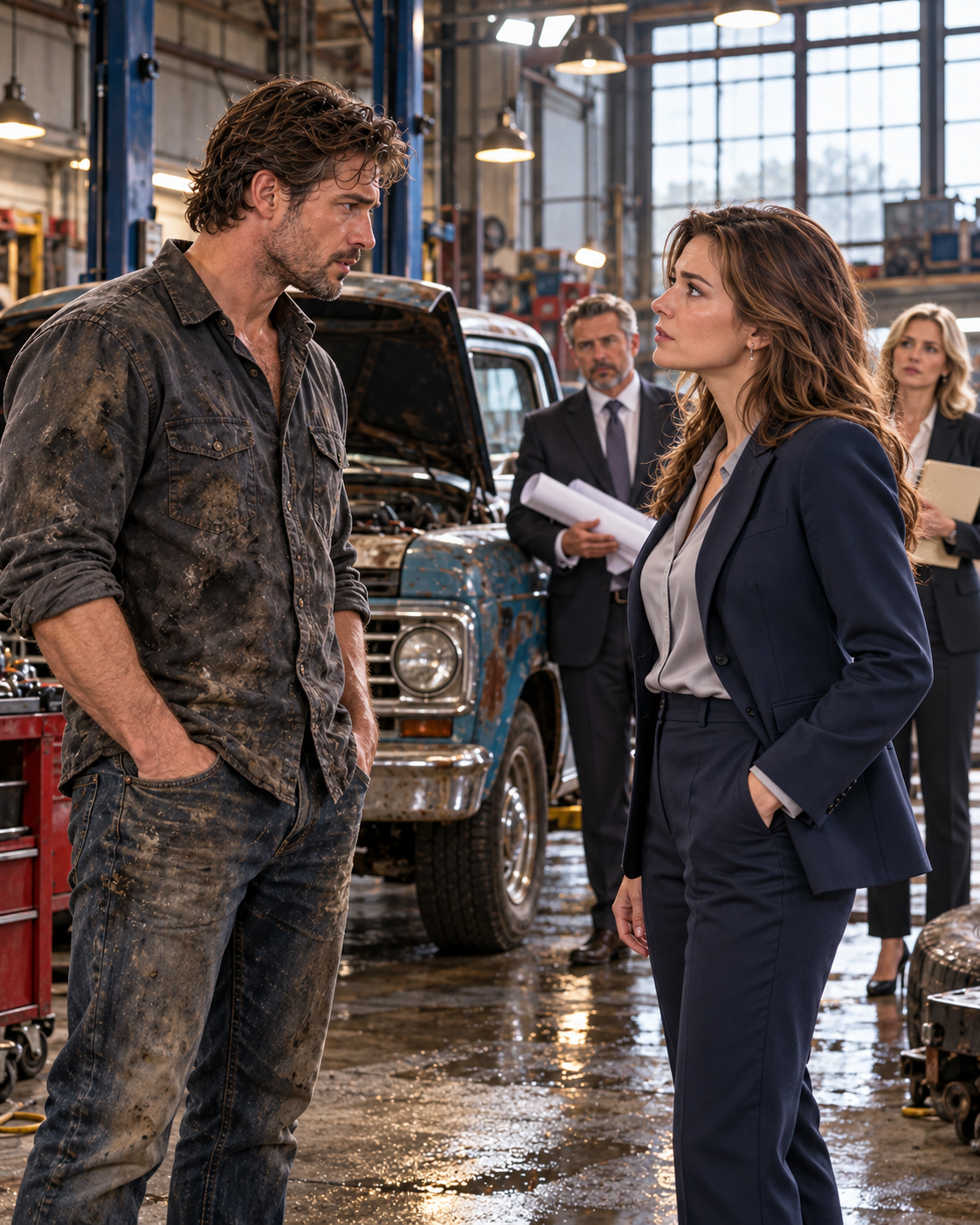
The meeting took place in our factory.
Victoria arrived with Marcus and two attorneys.
For a moment, nobody spoke.
Then Victoria looked around.
“I underestimated you.”
I leaned against the conference table.
“That makes two of us.”
She almost smiled.
“You’ve developed something significant.”
“We have.”
“We’re prepared to make a substantial offer for the patents.”
“No.”
One attorney shifted in his chair.
Victoria remained calm.
“You haven’t heard the number.”
“I don’t need to.”
“We could make Holt Precision Works very wealthy.”
“We’re already building a company.”
“You could retire.”
I looked at her.
“That’s what you thought I wanted the first time.”
Her expression changed slightly.
“Marcus told me you were sentimental.”
“He was wrong.”
“Then what are you?”
I looked through the glass wall at the engineers working late.
“A builder.”
Silence filled the room.
Victoria folded her hands.
“There is another option.”
“Lawsuit?”
She didn’t answer.
She didn’t have to.
I had expected it.
The patents were strong.
Our documentation was stronger.
And we had preserved every design revision, test result, email, and laboratory record.
I had learned something during the months when my garage was being taken from me.
Power doesn’t always come from having more money.
Sometimes it comes from being prepared.
I slid a folder across the table.
“Our counsel reviewed your preliminary claims.”
Victoria opened it.
Her eyes moved across the pages.
“We aren’t interested in a monopoly,” I said.
“We’re interested in building the technology into the industry.”
She looked up.
“Explain.”
“Non-exclusive licensing.”
Marcus leaned forward.
“At market rates?”
“Exactly.”
Victoria stared at me.
“You’d license this to competitors?”
“If they meet the standards.”
“That could make us vulnerable.”
“It could also make the technology better.”
She closed the folder.
For several seconds, she said nothing.
Then she asked something I didn’t expect.
“Why?”
I looked at her.
“Because Sarah believed good ideas shouldn’t belong to one person.”
Victoria’s face softened.
“Sarah?”
“My wife.”
I told her about the notebook.
About the equations.
About the garage.
About the prototype we never finished.
I didn’t tell the story for sympathy.
I told it because she had asked.
When I finished, the room was quiet.
Victoria looked down at her hands.
“My father started Vance Automotive in a two-bay shop,” she said.
I didn’t know that.
“He used to tell me that a business dies when the owner stops remembering why it existed.”
She gave a small, tired laugh.
“I suppose I forgot.”
Marcus shifted uncomfortably.
Victoria turned toward him.
“Did you photograph Holt’s workbench?”
The room went completely still.
Marcus didn’t answer.
She looked at him again.
“Marcus.”
He cleared his throat.
“I was documenting the property.”
“That wasn’t my question.”
He finally said, “Yes.”
I felt something cold move through my chest.
Victoria looked back at me.
“I didn’t know.”
“I believe you.”
Marcus started to speak.
She stopped him.
“No.”
He went silent.
Victoria stood.
“Mr. Holt, I can’t undo what happened.”
“No.”
“But I can stop pretending it was acceptable.”
She picked up her coat.
“There’s an Industry Technology Summit in Columbus next month.”
I frowned.
“Why are you telling me?”
“Because you should be there.”
“I don’t need your permission.”
“I know.”
She paused at the door.
“That’s why I’m inviting you.”
She left.
Julian waited until the door closed.
Then he said, “I officially dislike her slightly less.”
I laughed.
“That’s progress.”
The Industry Technology Summit arrived on a gray morning in Columbus.
Holt Precision Works had one booth.
No giant screens.
No celebrity engineers.
No expensive lighting.
Just a simple display, our prototype, several technical diagrams, and the old metal sign from my garage.
Julian looked around the enormous exhibition hall.
“We look like someone’s garage sale.”
I smiled.
“Feels familiar.”
Within an hour, people started stopping.
Then more came.
Engineers asked questions.
Manufacturers asked about licensing.
Students wanted to know how the system worked.
One professor spent twenty minutes studying our torque maps.
“You built this in a three-thousand-eight-hundred-square-foot abandoned factory?”
I nodded.
He smiled.
“Good.”
“Good?”
“That’s how innovation usually looks before everyone knows what it is.”
By noon, our little booth had become one of the busiest spaces in the hall.
Then I saw Victoria walking toward us.
She wasn’t surrounded by executives.
She wasn’t carrying a legal folder.
She wore a simple black suit and had a notebook in her hand.
She stopped beside the prototype.
“Show me the torque transition at low traction.”
I smiled.
“That’s your opening line?”
“It’s a technical summit.”
“Fair enough.”
I pulled up the data.
We stood there for nearly twenty minutes.
She asked real questions.
I gave real answers.
At one point, she disagreed with one of my assumptions.
I disagreed with hers.
Neither of us backed down.
And somehow, that felt like victory.
Not because I had defeated her.
Because she was finally looking at what I had built instead of what she could take from it.
When the conversation ended, Victoria looked at the old HOLT AUTO REPAIR sign.
“You kept it.”
“I told you.”
“I remember.”
She looked at the crowded booth.
“Your wife would have been proud.”
I looked down.
“Thank you.”
Victoria nodded.
Then she walked away.
I thought that was the end of our story.
It wasn’t.
Part 3
That evening, after the summit closed, I returned to the booth alone.
The hall was almost empty.
The lights above us had dimmed.
The voices had faded into the distance.
I ran my hand across the old metal sign.
For a moment, I was back in the original garage.
I could hear the hydraulic lift.
I could smell the oil.
I could see Sarah sitting at the workbench with her blue notebook open.
And I could hear Chloe asking her three questions.
I closed my eyes.
For years, I had believed losing the garage was the worst thing that ever happened to me.
I was wrong.
The worst thing would have been believing that losing a building meant losing everything.
Buildings can be taken.
Businesses can collapse.
Contracts can disappear.
People can underestimate you.
They can even try to turn your own work against you.
But there are things they cannot buy.
The knowledge in your hands.
The lessons left by someone you loved.
The courage to start again when starting again feels impossible.
And the decision to keep building when nobody is watching.
Chloe found me at the booth that night.
She was carrying Barnaby.
The same bear.
Older now.
A little more worn.
She stood beside me and looked at the empty hall.
“Is it over?”
I smiled.
“For tonight.”
She looked at the prototype.
“Did we win?”
I thought about it.
Then I shook my head.
“I don’t think that’s the right question.”
“What is?”
I put my arm around her.
“Did we become who we were supposed to become?”
She was quiet.
Then she nodded.
“Mom would say that’s a better question.”
I laughed softly.
“She would.”
Chloe opened her notebook.
I raised an eyebrow.
“Three questions?”
She smiled.
“Always.”
I waited.
She looked toward the empty exhibition hall.
“First, if someone takes your first dream, does that mean you failed?”
“No.”
“Why?”
“Because the first dream isn’t always the final one.”
She nodded and wrote it down.
“Second, can something good come from something terrible?”
I looked at the old sign.
“Sometimes.”
“Sometimes?”
“Only if you refuse to let the terrible thing be the end.”
She wrote that too.
Then she hesitated.
“What was the third?”
She looked at me.
“Why did Mom leave that sentence in the notebook?”
I knew exactly which sentence she meant.
Don’t ever stop thinking.
I reached into my jacket and pulled out the blue notebook.
Its edges were worn.
The cover was scratched.
There were grease marks on several pages.
But Sarah’s handwriting was still there.
I opened to the first page.
Chloe leaned against me.
“I used to think Mom wrote that because she wanted you to invent something.”
“Maybe.”
“But now?”
I looked at the words.
“Now I think she wrote it because she knew life would hurt us.”
Chloe’s eyes filled with tears.
“She wanted us to keep thinking after the hurt.”
I nodded.
“She wanted us to keep asking what comes next.”
Chloe touched the page.
“Do you think she knew we’d get here?”
I smiled.
“I don’t think anyone can know that.”
Then I closed the notebook.
“But I think she hoped.”
We stood there together for a long time.
No applause.
No cameras.
No executives.
Just a father and daughter beside a battered sign from a garage that no longer existed.
Months later, Holt Precision Works began licensing the technology to several manufacturers.
We kept the agreements fair.
We kept improving the system.
And every time someone asked where it began, I told them the truth.
It began in a little garage on Route 41.
It began with a woman named Sarah who refused to stop thinking.
It began with a little girl who asked three questions every morning.
And it began again when a man who had lost almost everything decided that losing everything was not the same as being finished.
Victoria and I never became friends.
We didn’t need to.
But every few months, she would call.
Sometimes we talked business.
Sometimes engineering.
Once, she asked how Chloe was doing.
“She’s studying mechanical engineering,” I told her.
Victoria laughed.
“Of course she is.”
“She says she wants to improve the system.”
“Good.”
“She says nineteen percent isn’t enough.”
There was silence on the phone.
Then Victoria laughed.
“That sounds familiar.”
One year after the summit, I returned to the old garage site.
The Vance Automotive service hub was nearly finished.
Steel beams rose where my little shop had once stood.
For a moment, I felt something unexpected.
Not anger.
Not regret.
Peace.
I stood there with Chloe beside me.
She was taller now.
Barnaby was tucked beneath her arm.
She looked at the construction site.
“Do you ever wish we had kept it?”
I looked at the place where our old garage had been.
“Sometimes.”
She nodded.
“Me too.”
Then she smiled.
“But I like what we built.”
I looked at her.
“Me too.”
She took my hand.
We walked back toward the truck.
Before we left, I looked over my shoulder one last time.
The old building was gone.
The dream wasn’t.
And that was when I finally understood what Sarah had been trying to teach me all those years ago.
You cannot always control what people take from you.
You cannot always stop powerful people from underestimating you.
You cannot always save the place where your memories were made.
But you can decide what those memories become.
For me, they became a blueprint.
For Chloe, they became a question.
For Sarah, they became a legacy.
And for Holt Precision Works, they became the beginning of something far larger than any garage could ever contain.
That night, Chloe placed the blue notebook on my desk.
“There’s one more page,” she said.
I opened it.
She had written something beneath her mother’s sentence.
Don’t ever stop thinking.
And beneath it, in Chloe’s handwriting, were five simple words.
Don’t ever stop building, either.
I stared at the page until my eyes blurred.
Then I smiled.
Because after all those years, I finally understood that Sarah’s last gift had never been the notebook.
It had been the belief that even after life breaks your heart, there is still something worth building with the pieces.
And sometimes, the people who think they’ve taken everything from you are only clearing the ground for the life you were brave enough to build next.